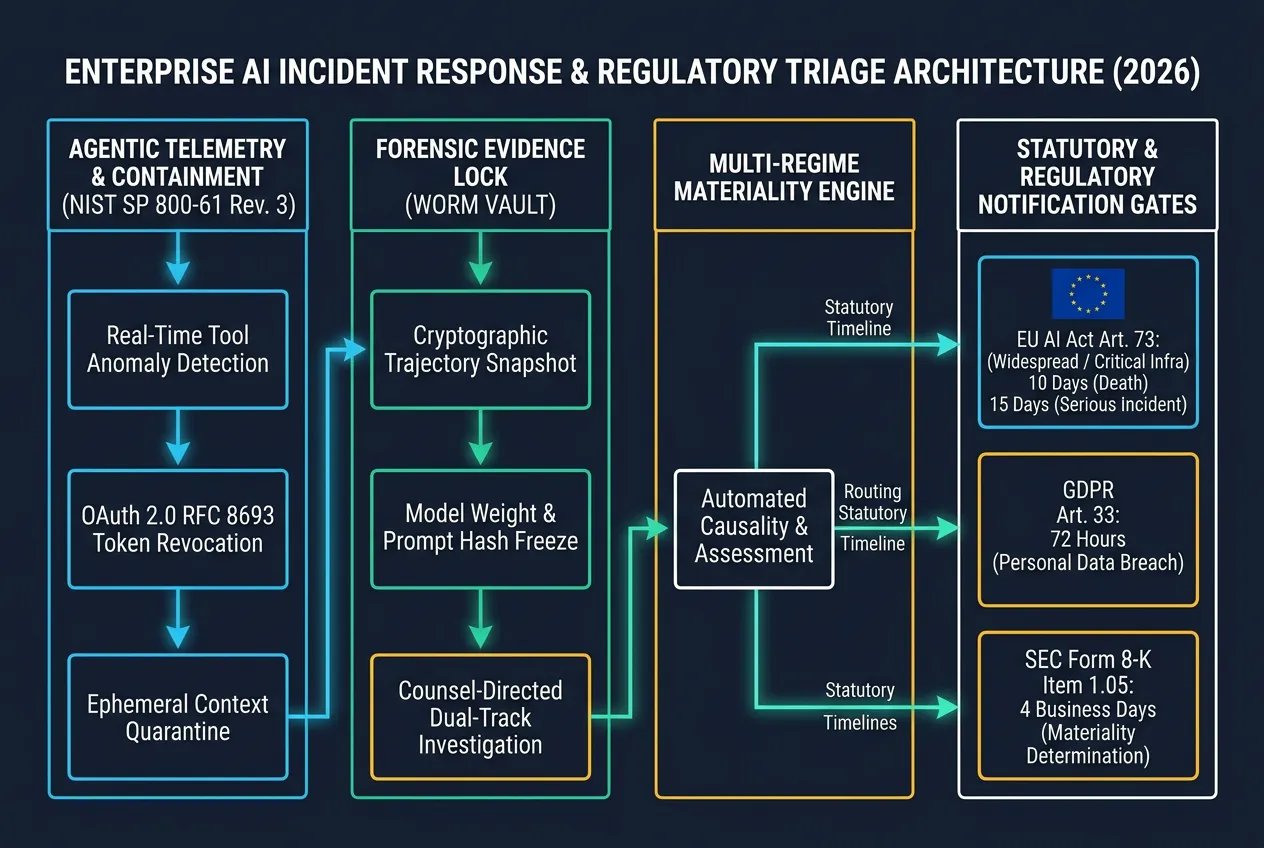
Enterprise AI incident response requires unifying technical agent containment, non-deterministic forensic preservation, and overlapping regulatory notification clocks into a single automated playbook. Under 2026 mandates, organizations must coordinate NIST SP 800-61 Rev. 3 lifecycle controls with EU AI Act Article 73 serious incident deadlines—2 days for widespread or critical infrastructure disruptions, 10 days for fatalities, and 15 days for general serious incidents—alongside GDPR's 72-hour breach window and SEC Form 8-K Item 1.05's four-business-day materiality disclosure rule.
Why Do Traditional Cybersecurity Runbooks Fail Autonomous AI Incidents?
Traditional cybersecurity incident response playbooks—modeled on legacy network perimeter breaches, deterministic software bugs, or static database exfiltration—collapse when applied to production generative AI and autonomous multi-agent systems. When an enterprise deploys agentic workflows capable of reading untrusted external data, reasoning across dynamic context windows, and invoking downstream APIs, the nature of an operational incident shifts from unauthorized network access to authorized identity subversion and stochastic behavioral failure.
In a conventional software environment, an engineer investigating an incident can replay a deterministic stack trace against a fixed binary to reproduce the exact failure state. In an autonomous AI architecture, three structural dynamics invalidate traditional runbooks:
- Ephemeral and Stochastic Execution States: Because language model outputs depend on temperature sampling, dynamic Retrieval-Augmented Generation (RAG) payloads, and evolving in-memory context windows, a harmful or unauthorized agent action cannot be reproduced simply by re-running the prompt later. If the exact context window, retrieved vector chunks, and tool schemas are not cryptographically frozen at the millisecond of anomaly detection, the forensic root cause vanishes.
- Indirect Prompt Injection and Confused Deputy Execution: Under the OWASP Top 10 for Agentic Applications (2026), attackers do not need to compromise infrastructure credentials to trigger an incident. By embedding adversarial instructions inside external emails, legal documents, or web pages ingested by an agent, an attacker hijacks the agent's control flow, causing it to execute unauthorized tool calls using its legitimate delegated OAuth scopes.
- Divergent Regulatory Definitions of an "Incident": Security Operations Centers (SOCs) historically escalate incidents only when confidentiality, integrity, or availability (CIA) is compromised. Under 2026 AI governance frameworks, a system with zero network intrusion and uninterrupted compute uptime can still trigger a mandatory regulatory notification if model drift or an agentic hallucination causes a fundamental rights infringement, critical infrastructure disruption, or material business impact.
How Does NIST SP 800-61 Rev. 3 Reshape Enterprise AI Incident Response?
On April 3, 2025, the National Institute of Standards and Technology released NIST SP 800-61 Rev. 3 (Incident Response Recommendations and Considerations for Cybersecurity Risk Management), superseding the long-standing Rev. 2 framework from 2012. Rather than treating incident response as an isolated four-step checklist handled solely by a technical responder team, NIST SP 800-61 Rev. 3 restructures incident management as a CSF 2.0 Community Profile integrated across all six functions of the NIST Cybersecurity Framework (CSF) 2.0.
For Chief Information Security Officers (CISOs), Chief AI Officers (CAIOs), and General Counsel, aligning enterprise AI incident response with NIST SP 800-61 Rev. 3 requires dividing operations into two continuous macro-phases:
| NIST SP 800-61 Rev. 3 Phase | CSF 2.0 Functions | Enterprise AI & Agentic Implementation Controls |
|---|---|---|
| Phase 1: Prepare | Govern, Identify, Protect | Establish cross-functional AI Governance Charters; maintain a live AI Bill of Materials (AI-BOM) mapping models, vector indices, and downstream tools; enforce OAuth 2.0 RFC 8693 token exchange and context-free grammar (CFG) tool constraints. |
| Phase 2: Incident Response | Detect, Respond, Recover | Ingest real-time OpenTelemetry GenAI distributed traces; trigger automated agent circuit breakers and scoped token revocation; freeze WORM forensic snapshots; execute clean-room weight and RAG rollbacks; feed root-cause telemetry into continuous red-teaming suites. |
Automated Containment: Kill-Switches, Token Revocation, and Context Quarantine
When an anomaly detector or inline safety classifier flags a rogue agent trajectory during the Detect and Respond phases, human-in-the-loop review is too slow to prevent cascading downstream writes. Production AI architectures must implement three automated containment primitives:
- Scoped Non-Human Identity Revocation: Rather than shutting down an entire enterprise application, the incident orchestrator revokes the specific delegated
acttoken issued to the compromised agent session via RFC 8693 token exchange, immediately halting all external API writes while preserving read-only diagnostic state. - Ephemeral Context and Memory Quarantine: If an incident stems from indirect prompt injection or memory poisoning, the contaminated vector namespace or session memory shard is isolated into a quarantine partition. This prevents sibling agents in a multi-agent choreography from ingesting the poisoned context while preserving the shard for forensic inspection.
- Deterministic Fallback Routing: In accordance with enterprise AI service level agreements, critical business workflows automatically fail over from the quarantined autonomous agent to a deterministic rule-based workflow or a human approval queue during the Recover phase.
How Do EU AI Act Article 73, GDPR Article 33, and SEC Item 1.05 Clocks Interact?
The most acute operational risk in enterprise AI incident response is multi-regime clock collision. A single production AI failure—such as an autonomous customer-service or financial-underwriting agent suffering a context-poisoning attack that exposes personal data and executes unauthorized transactions—simultaneously activates statutory reporting timers across European AI market surveillance, data protection, and U.S. securities law.
Because each statute defines its triggering event and countdown clock differently, legal and compliance teams must run a unified regulatory triage matrix:
| Regulatory Regime | Statutory Authority | Triggering Threshold | Mandatory Reporting Deadline | Primary Recipient |
|---|---|---|---|---|
| EU AI Act (Critical / Widespread) | Regulation (EU) 2024/1689, Art. 73(3) | Widespread infringement or serious incident involving death, serious health damage, or critical infrastructure disruption under Art. 3(49)(b) | Immediately, and no later than 2 days after awareness of the incident | EU Member State Market Surveillance Authorities |
| EU AI Act (Fatal Incident) | Regulation (EU) 2024/1689, Art. 73(4) | Serious incident resulting in the death of a person | Immediately after causal link established/suspected, and no later than 10 days after awareness | EU Member State Market Surveillance Authorities |
| EU AI Act (General Serious Incident) | Regulation (EU) 2024/1689, Art. 73(2) | Any other serious incident under Art. 3(49) involving a high-risk AI system (including fundamental rights breaches) | Immediately after causal link established/reasonably likely, and no later than 15 days after awareness | EU Member State Market Surveillance Authorities |
| EU GDPR | Regulation (EU) 2016/679, Art. 33(1) | Personal data breach (unauthorized disclosure, alteration, or loss of personal data in prompts, RAG, or outputs) | Without undue delay, and where feasible not later than 72 hours after becoming aware | Competent Data Protection Supervisory Authority |
| U.S. SEC Cybersecurity Rule | SEC Form 8-K, Item 1.05 (Release No. 33-11216) | Determination that a cybersecurity incident is material to reasonable investors (assessed without unreasonable delay) | Within 4 business days after determining that the incident is material | U.S. Securities and Exchange Commission (Public EDGAR Filing) |
Navigating the Causality vs. Materiality Trap
General Counsel must distinguish between the causal link standard of the EU AI Act and the materiality determination standard of the SEC:
- EU AI Act Article 73 Causality First: Under Article 73(2), the 15-day clock (and the 10-day clock for fatalities under Article 73(4)) requires reporting immediately after the provider establishes a causal link—or the reasonable likelihood of a causal link—between the AI system and the serious incident, but capped strictly at 15 days (or 10 days) from initial awareness of the incident. If forensic investigation is still ongoing at the deadline, Article 73(5) permits submitting an initial incomplete report followed by a complete report once the investigation concludes. Crucially, under Article 73(6), providers and deployers must preserve all relevant evidence—avoiding any remediation or model modification that destroys forensic logs prior to authority inspection.
- SEC Form 8-K Item 1.05 Materiality Determination: For public companies subject to Exchange Act reporting, the four-business-day clock under Item 1.05 does not start on the date the AI anomaly is detected; it starts on the date the company determines that the cybersecurity incident is material. However, Item 1.05 Instruction 1 mandates that registrants make this materiality determination "without unreasonable delay" after discovery. When an autonomous agent incident involves third-party foundation model APIs or hosted vector databases, registrants cannot invoke vendor opacity to stall their materiality evaluation.
How Should Enterprises Architect Forensic Preservation and Privilege Protocols?
When an AI incident causes financial loss, regulatory scrutiny, or potential tort liability, the technical evidence generated during containment immediately becomes the center of future litigation and regulatory enforcement. Without disciplined forensic architecture, routine engineering debugging can inadvertently destroy exculpatory telemetry or waive legal privilege across the entire post-incident root-cause analysis.
To satisfy both enterprise AI audit readiness standards and federal evidentiary rules, organizations should implement a Dual-Track Forensic & Privilege Protocol:
1. Immutable WORM Forensic Snapshots (The Fact Track)
At the moment an incident threshold is crossed, the telemetry pipeline must automatically write an immutable snapshot to a hardware-enforced Write-Once-Read-Many (WORM) evidence vault. This non-privileged factual record satisfies regulatory preservation mandates (such as EU AI Act Article 73(6)) and provides the foundational metadata needed for Federal Rule of Evidence 902(13) self-authentication:
- Exact model identifier, weight hash, quantization parameters, and temperature/top-p settings.
- Complete system prompt, user input, and intermediate chain-of-thought or agentic reasoning tokens.
- Exact retrieved RAG chunk IDs, vector similarity scores, and source document hashes at execution time.
- Full tool-call JSON payloads, RFC 8693 identity claims, and downstream API response codes.
2. Counsel-Directed Root-Cause Investigation (The Privileged Track)
As analyzed in our coverage of AI legal privilege and work product rulings in 2026, courts strictly scrutinize whether post-incident forensic reports were created for ordinary business continuity or in anticipation of litigation. To protect strategic legal evaluation:
- Separate Engineering Remediation from Legal Causality Analysis: Routine operational metrics required by regulators or auditors remain on the factual track. Strategic root-cause hypotheses, liability assessments, and simulated adversarial reconstructions should be commissioned explicitly in writing by inside or outside legal counsel.
- No Consumer AI Tools for Incident Triage: Engineers and incident responders must never paste incident logs, compromised prompts, or customer payloads into unapproved or consumer-grade AI assistants to summarize the outage—an action that triggers immediate privilege waiver and secondary data breach exposure.
- Coordinate Vendor Contract Notification: Because enterprise deployments rely on upstream foundation models, incident playbooks must integrate enterprise AI SLA notice covenants and AI liability insurance notification requirements, ensuring upstream providers deliver cryptographic log attestations within 24 hours of a severity-1 escalation.
To operationalize these controls across your security, engineering, and legal teams, explore how Prest0's enterprise governance platform unifies real-time agentic telemetry, zero-retention audit trails, and role-based execution guardrails.
Explore Prest0 Enterprise Governance
What triggers mandatory reporting under EU AI Act Article 73?
Under Article 73 of the EU AI Act (Regulation (EU) 2024/1689), mandatory reporting is triggered whenever a high-risk AI system suffers a "serious incident" as defined in Article 3(49)—meaning an incident or malfunctioning that directly or indirectly leads to the death or serious damage to a person's health, a serious and irreversible disruption of the management or operation of critical infrastructure, the infringement of obligations under Union law intended to protect fundamental rights, or serious damage to property or the environment.
What are the exact reporting deadlines under EU AI Act Article 73?
Article 73 establishes a three-tier statutory timeline measured from awareness of the serious incident: (1) no later than 2 days for widespread infringements or serious incidents involving critical infrastructure disruption, death, or serious health damage under Article 3(49)(b); (2) no later than 10 days if the incident results in the death of a person; and (3) no later than 15 days for all other general serious incidents, reported immediately once a causal link (or reasonable likelihood of a causal link) is established.
Does SEC Form 8-K Item 1.05 apply to AI-related incidents?
Yes. Although the SEC has not created a separate AI-specific disclosure form, any unauthorized occurrence, prompt injection attack, model poisoning, or data exfiltration conducted in or through an enterprise's AI information systems that jeopardizes the confidentiality, integrity, or availability of the system or the data residing therein qualifies as a cybersecurity incident. If the registrant determines that the incident is material to reasonable investors, it must file a Form 8-K under Item 1.05 within four business days of that materiality determination.
Why can't enterprises immediately retrain or patch an AI model after a serious incident in the EU?
Under Article 73(6) of the EU AI Act, following the notification of a serious incident, the provider must immediately perform the necessary investigations in relation to the incident and the AI system involved, and must not perform any investigation which involves altering the AI system in a way that may affect any subsequent evaluation of the causes of the incident, prior to informing the competent market surveillance authorities of such action. Freezing an immutable WORM snapshot of the exact model state and execution logs before rolling back or patching production weights is essential to maintain statutory compliance.
How does NIST SP 800-61 Rev. 3 improve AI incident response over Rev. 2?
Published in final form in April 2025, NIST SP 800-61 Rev. 3 replaces the legacy sequential four-phase model with a continuous lifecycle mapped directly to all six functions of NIST CSF 2.0 (Govern, Identify, Protect, Detect, Respond, Recover). For AI deployments, this requires embedding governance decision rights, supply-chain inventory (Identify), and runtime guardrails (Protect) directly into incident readiness before an anomaly ever reaches the detection and containment stages.
This article is provided for general informational and educational purposes only and does not constitute formal legal advice, regulatory compliance certification, or an attorney-client relationship. Organizations should consult qualified legal counsel and certified security professionals regarding specific incident notification obligations across applicable jurisdictions.