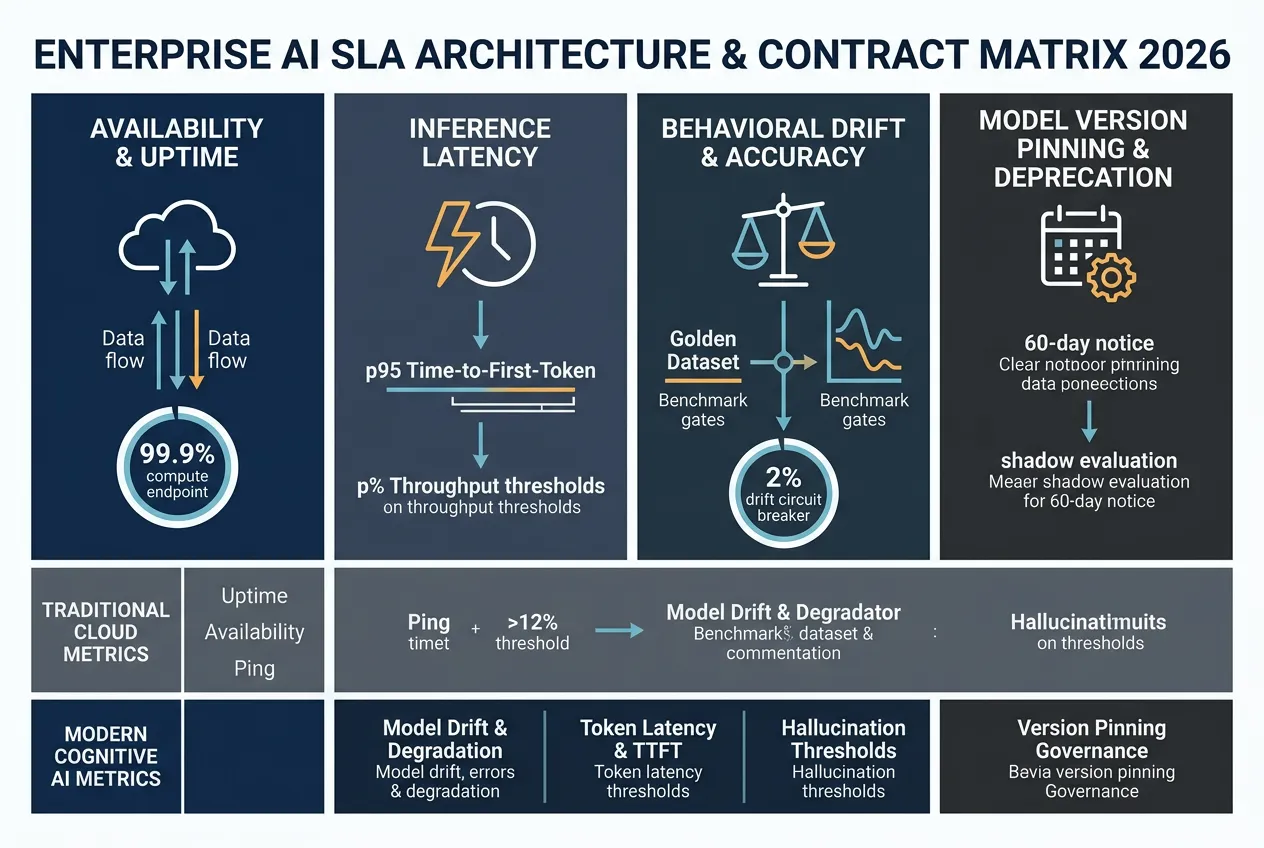
An enterprise AI Service Level Agreement (SLA) in 2026 cannot rely exclusively on traditional cloud availability metrics like 99.9% HTTP server uptime. Modern enterprise AI contracts govern four interdependent operational pillars: endpoint availability, inference token latency (Time-to-First-Token and sustained tokens-per-second thresholds), task-specific evaluation accuracy using immutable golden benchmarks, and strict model version pinning with mandatory deprecation notice windows.
Why Do Traditional Cloud SLAs Fail for Generative AI and Autonomous Agents?
For over two decades, enterprise software-as-a-service (SaaS) procurement centered on standard compute infrastructure commitments:
- Ping Availability: 99.9% or 99.95% uptime guarantees measuring whether HTTP endpoints return a 200 OK status code.
- Hardware Redundancy: N+1 data center failovers, disk I/O thresholds, and database read-replica synchronizations.
- General Support Windows: Standard Severity-1 ticket response times within one to four hours.
In production AI systems, this legacy framework produces a critical blind spot: an API gateway can return a 200 OK response with zero network packet loss, while the underlying model generates severe hallucinations, enters infinite reasoning loops, suffers semantic drift, or experiences catastrophic inference latency degradation under peak GPU cluster congestion.
+---------------------------------------------------------------------------------------------------+
|                           ENTERPRISE AI SERVICE LEVEL AGREEMENT ARCHITECTURE                      |
+------------------------------------+----------------------------------+---------------------------+
| 1. COMPUTE INFRASTRUCTURE          | 2. INFERENCE LATENCY             | 3. COGNITIVE ACCURACY     |
| • 99.9% Endpoint Uptime            | • p95 Time-to-First-Token (TTFT) | • Task-Specific Benchmark |
| • GPU Cluster Provisioning         | • Min Tokens/Sec Throughput      | • 2% Drift Trigger Gate   |
| • Sub-Second Fault Recovery        | • Dynamic Queue Shedding         | • Golden Test Sets        |
+------------------------------------+----------------------------------+---------------------------+
                                     |
                                     v
+---------------------------------------------------------------------------------------------------+
| 4. MODEL VERSIONING & DEPRECATION GOVERNANCE                                                      |
| • Mandatory 60-Day Advance Notice for Model Updates                                               |
| • Fixed Major/Minor Endpoint Pinning (e.g., /v1/models/gpt-4o-2026-05)                            |
| • Shadow Verification Testing & Unilateral Rollback Remedies                                     |
+---------------------------------------------------------------------------------------------------+
Enterprise legal teams and procurement leaders now recognize that availability without cognitive integrity is an unmitigated operational risk.
What Are the Four Pillars of Modern Enterprise AI SLAs?
Leading enterprise AI contracts in 2026 deconstruct service commitments into four operational guarantees:
1. Compute Endpoint Availability & Uptime
Enterprise AI providers provide dedicated or provisioned throughput with contractual uptime tiers (e.g., 99.9% monthly availability). Key drafting considerations include:
- Exclusion Hygiene: Narrowing standard force majeure and scheduled maintenance windows so providers cannot mask GPU capacity shortages as unpenalized maintenance.
- Failover Redundancy: Multi-region inference fallbacks ensuring cross-zone traffic routing when specific data center accelerators experience hardware failures.
2. Inference Latency and Token Throughput Commitments
Unlike microservices returning static JSON payloads, large language models generate streaming token sequences with variable processing loads. Contractual latency metrics must measure:
- Time-to-First-Token (TTFT): Defining the p95 and p99 latency threshold from request receipt to initial token delivery (e.g., TTFT < 800ms).
- Sustained Token Velocity: Establishing minimum tokens-per-second (TPS) throughput metrics (e.g., maintaining at least 60–80 tokens/sec on provisioned tiers).
- Concurrency Buffers: Guaranteeing non-degrading performance under negotiated peak concurrent request volumes.
3. Cognitive Output Quality & Task-Specific Benchmark Gating
Major model providers universally disclaim open-ended output accuracy warranties in their standard commercial terms. To bridge this gap, enterprise contracts establish task-specific evaluation frameworks:
- The Golden Dataset Exhibit: The parties agree to an immutable evaluation dataset representing the customer's specific enterprise workflow (e.g., contract classification, legal extraction, customer support triage).
- Statistical Drift Triggers: Setting objective drift thresholds—such as an automated task performance decline exceeding 2 percentage points on the agreed evaluation benchmark.
- Regular Audit Schedules: Establishing quarterly benchmark evaluations or automated continuous evaluation runs triggered by upstream weights adjustments.
4. Model Version Pinning and Change Management Governance
Silent model updates—where a foundation model provider adjusts weights, quantization levels, safety filters, or system prompt prefixes without warning—routinely disrupt downstream business workflows. Modern AI agreements require:
- Version-Pinned Endpoints: Explicit access to immutable, snapshot-dated model versions for at least 12 to 24 months.
- Advance Deprecation Notice: A strict contractual requirement providing 30 to 90 days of advance written notice before deprecating any model checkpoint or system endpoint.
- Parallel Testing Sandboxes: Access to dual-run shadow environments allowing the enterprise to validate new model releases against baseline test suites prior to production migration.
How Are Meaningful Remedies Structured for AI Performance Failures?
In traditional cloud agreements, service level failures yield nominal cloud credits—often capping out at 10% to 25% of monthly hosting fees. For enterprise AI deployments powering core business functions, standard credit schedules provide zero economic protection.
Modern AI procurement negotiations demand tiered, escalating remedies:
| Severity Level | Performance Violation | Contractual Remedy |
|---|---|---|
| Tier 1: Latency Breach | p95 TTFT or token throughput degrades below threshold for > 15 consecutive minutes | Immediate service credit for affected inference volume; automated traffic rerouting. |
| Tier 2: Semantic Drift | Model evaluation score drops > 2 percentage points on agreed golden benchmark suite | Provider must submit formal remediation plan within 5 business days; rollback to prior snapshot at provider cost. |
| Tier 3: Unannounced Change | Provider pushes unannounced weight changes or deprecates pinned endpoint without 60-day notice | Full monthly service credit; immediate freeze of prior checkpoint; unpenalized termination right. |
| Tier 4: Chronic Degradation | Multiple SLA breaches across 3 consecutive billing periods | Immediate termination for cause, full refund of unearned prepaid fees, and paid data migration assistance. |
+---------------------------------------------------------------------------------------------------+
|                                 SLA REMEDIATION LIFECYCLE WORKFLOW                                |
+------------------------+--------------------------+-----------------------+-----------------------+
| 1. DETECTION           | 2. NOTICE & ISOLATION    | 3. REMEDIATION        | 4. EXIT RIGHTS        |
| Continuous synthetic   | Automated customer       | 5-day mandatory       | Chronic breach        |
| canary monitoring      | alert within 24 hours    | rollback or hotfix    | triggers termination  |
| flags drift > 2%       | of benchmark failure     | at vendor expense     | without penalty       |
+------------------------+--------------------------+-----------------------+-----------------------+
What Strategic Steps Should Corporate Counsel Take During AI Procurement?
Enterprise counsel and procurement leaders should execute the following checklist when negotiating AI vendor terms:
- Reject Blanket Availability Equivalence: Explicitly state in the Master Services Agreement that uptime metrics do not satisfy quality or operational efficacy warranties.
- Draft a Dedicated AI Service Exhibit: Append an exhibit defining model identifiers, pinned version tags, maximum TTFT latency, minimum token throughput, and benchmark evaluation protocols.
- Establish Model Change Rights: Secure unilateral rights to remain on older model checkpoints or terminate agreements if upgraded models fail enterprise compliance gates.
- Align Multi-Cloud Fallback Architecture: Ensure technical teams deploy abstracted AI gateways that automatically reroute traffic across secondary providers if an SLA violation triggers a circuit breaker.
Frequently Asked Questions (FAQ)
Do commercial AI providers guarantee 100% factual accuracy in enterprise contracts?
No. Major foundation model providers explicitly disclaim output accuracy warranties in standard agreements. Sophisticated enterprise buyers negotiate objective evaluation metrics around agreed golden test sets rather than general warranties.
What is the difference between Time-to-First-Token (TTFT) and End-to-End Latency?
Time-to-First-Token (TTFT) measures the elapsed time between sending an API prompt and receiving the very first token of the output stream. End-to-end latency measures the total time required to generate the entire completion. In streaming and agentic applications, TTFT is the critical metric for interactive user experience.
What constitutes actionable model drift in an enterprise contract?
Actionable model drift occurs when an updated or modified model exhibits a statistically significant decline in performance—typically defined as a drop greater than 2 to 3 percentage points—on an agreed-upon reference evaluation benchmark.
How long should model version pinning remain active under an SLA?
Enterprise organizations should require version pinning for a minimum of 12 months, accompanied by at least 60 to 90 days of advance notice before a pinned model version is retired.