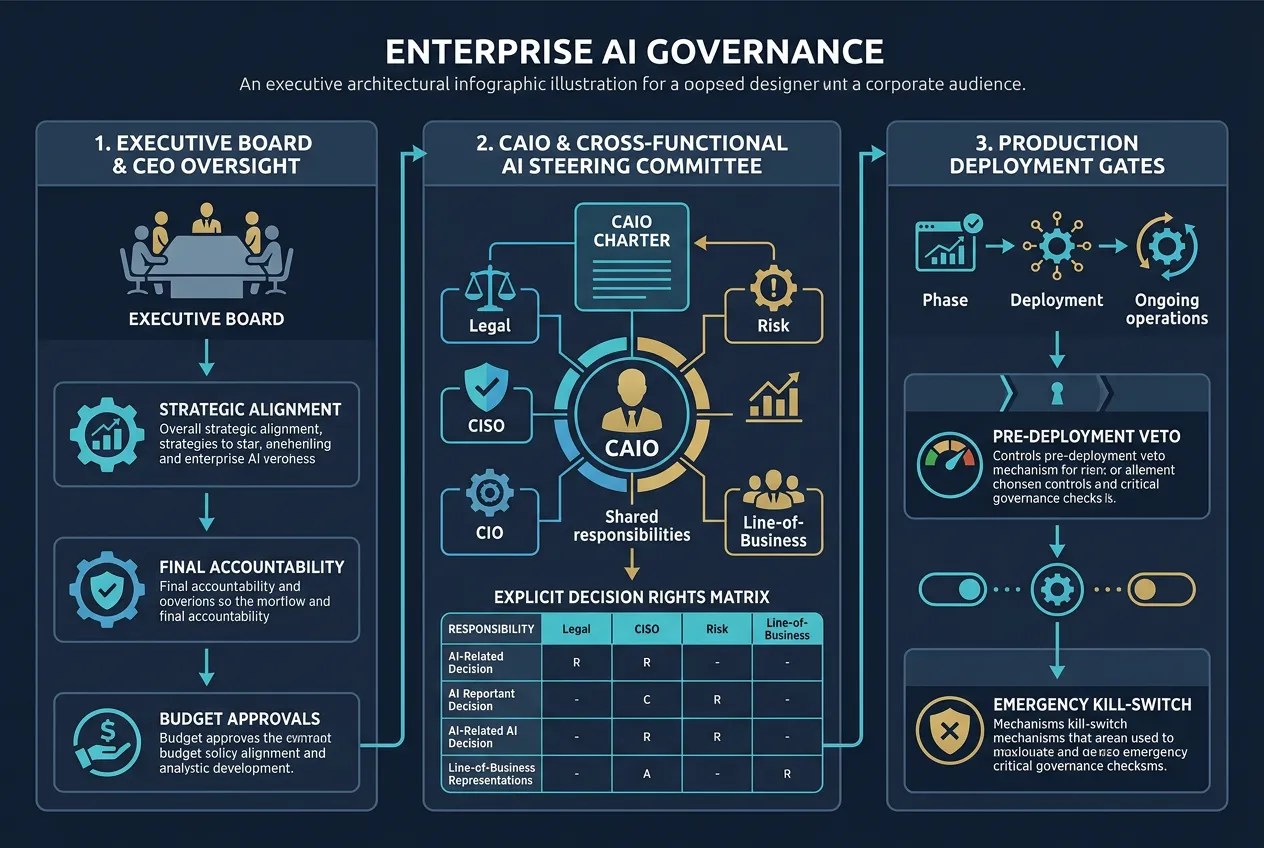
An enterprise AI governance charter establishes binding decision rights, deployment gating, and operational accountability across an organization's artificial intelligence portfolio. Rather than functioning as an advisory think tank or academic ethics panel, a modern enterprise AI governance charter provides the Chief AI Officer (CAIO) and cross-functional steering committee with explicit pre-deployment veto authority, continuous risk-tier thresholds, and an emergency operational kill-switch to protect enterprise assets, client confidentiality, and regulatory standing.
Why Does Enterprise AI Require an Explicit Governance Charter?
Enterprise organizations that adopt generative and agentic artificial intelligence without an explicit, board-approved governance charter routinely encounter three structural operational failures:
- Unbounded shadow experimentation: Individual business units deploy disparate model APIs, embedding client records or proprietary trade secrets into consumer-grade interfaces without legal vetting, contractual zero data retention (ZDR) guarantees, or enterprise logging.
- Diffusion of accountability: When an autonomous system hallucinates regulatory filings, leaks confidential pricing, or takes unauthorized system actions, traditional IT, information security, and line-of-business executives engage in jurisdictional finger-pointing because no single officer holds defined authority over agentic outcomes.
- Paralysis at the deployment gate: Conversely, organizations with informal governance subject high-ROI automated workflows to endless, unstructured committee reviews where risk aversion stalls production adoption indefinitely.
A formal AI governance charter solves this impasse by replacing subjective opinion with codified decision rights, standardized risk classification, and transparent escalation pathways.
What Is the Reporting Structure of a Modern Chief AI Officer?
In mature enterprise operating models, the Chief AI Officer serves as an independent C-suite executive reporting directly to the Chief Executive Officer (CEO), maintaining regular quarterly reporting access to the Board of Directors' Audit and Risk Committee.
Subordinating the CAIO entirely beneath the Chief Information Officer (CIO) or Chief Technology Officer (CTO) creates an inherent conflict of interest: technical infrastructure leaders are incentivized by delivery velocity, uptime, and operational throughput, which can directly conflict with rigorous risk gating, bias auditing, and legal compliance.
                               ┌─────────────────────────────────┐
                               │       Board of Directors        │
                               │      (Audit & Risk Comm.)       │
                               └────────────────┬────────────────┘
                                                │ Quarterly Governance
                                                ▼ & Risk Reporting
                               ┌─────────────────────────────────┐
                               │     Chief Executive Officer     │
                               └────────────────┬────────────────┘
                                                │ Direct Executive
                                                ▼ Line
┌───────────────────────┐      ┌─────────────────────────────────┐      ┌───────────────────────┐
│ Chief Info Officer    │◄────►│     Chief AI Officer (CAIO)     │◄────►│  General Counsel /    │
│ & Chief Tech Officer  │      └────────────────┬────────────────┘      │  Chief Compliance Off.│
└───────────────────────┘                       │                       └───────────────────────┘
                                                │ Chairs
                                                ▼
                               ┌─────────────────────────────────┐
                               │  Cross-Functional AI Steering   │
                               │           Committee             │
                               │ (Legal, InfoSec, Risk, Finance) │
                               └────────────────┬────────────────┘
                                                │ Binding Deployment
                                                ▼ Gate Authority
                               ┌─────────────────────────────────┐
                               │   Enterprise AI Portfolio       │
                               │  (Tier 1–4 Production Systems)  │
                               └─────────────────────────────────┘
The CAIO leads an operational AI Governance Office that maintains the corporate inventory of all models, agent harnesses, prompts, and autonomous tools, operationalizing standards defined under NIST AI RMF 1.0 and ISO/IEC 42001.
What Binding Decision Rights Must the AI Steering Committee Hold?
The Enterprise AI Steering Committee must never operate as a purely advisory body. Its governing charter must explicitly delineate five binding decision rights:
| Decision Domain | Autonomous Line Authority | Steering Committee Gate | CAIO Unilateral Authority |
|---|---|---|---|
| Tier 1 (Low Risk) Internal developer productivity tools, non-sensitive search, code completion. | Line-of-business lead may deploy within pre-approved vendor list. | Periodic retrospective review; no blocking gate. | May audit or revoke approval if usage policies are breached. |
| Tier 2 (Internal Operations) Back-office summarization, contract extraction, internal HR routing. | Proposes architecture, testing data, and business case. | Formal gating review: requires InfoSec ZDR audit and Legal clearance. | Casts deciding vote upon cross-functional deadlock. |
| Tier 3 (Client-Facing / Regulated) Automated client advisory, underwriting scoring, public communication. | Must prepare algorithmic impact assessment and evaluation harness. | Unanimous approval required across Legal, CISO, and Business Unit. | Pre-Deployment Veto: CAIO may unilaterally halt launch for unverified risk. |
| Emergency System Anomaly Active data exfiltration, hallucinated regulatory claims, runaway execution. | Operations staff must execute immediate incident quarantine. | Emergency convening within 4 hours of quarantine activation. | Kill Switch: CAIO holds unilateral power to revoke API credentials and disable system. |
| Residual Risk Override Disputed high-impact business initiative where risks exceed standard tolerance. | Cannot override committee determinations. | Cannot override committee determinations. | Executive appeal only to CEO + Board Audit Chair with signed risk acceptance. |
Pre-Deployment Veto vs. Emergency Kill-Switch
A robust charter distinguishes between ex-ante gating and in-flight containment:
- Pre-Deployment Veto: The formal right of the CAIO and the Legal/CISO committee chairs to refuse production deployment certification for any model or autonomous workflow that fails standardized evaluation benchmarks, lacks verified deterministic output checks, or exposes privileged client data.
- Emergency Kill Switch: The technical and legal authority to sever API keys, isolate microVM harnesses, or revert model endpoints immediately upon detection of anomalous drift, prompt injection exploitation, or unauthorized transactional activity—without awaiting multi-day committee deliberation.
How Do Enterprise Charters Operationalize NIST AI RMF and ISO/IEC 42001?
Modern corporate AI governance translates global compliance standards into day-to-day corporate workflows by mapping committee responsibilities directly to the four core functions of the NIST AI Risk Management Framework (NIST AI RMF 1.0) and ISO/IEC 42001 AI Management Systems:
- Govern (Organizational Culture & Policies): The charter defines corporate acceptable-use policies, acceptable data classifications for training versus inference, and annual mandatory workforce AI literacy certification.
- Map (Context & Inventory): Every deployed generative model, API connector, and third-party SaaS tool must be cataloged in a live enterprise AI registry that tracks model version, vendor change controls, data lineage, and integration boundaries.
- Measure (Evaluation & Metrics): Before any autonomous workflow touches production data, the engineering sponsor must produce verifiable benchmarks measuring task accuracy, hallucination rates under adversarial prompt injection, and outcome reliability.
- Manage (Continuous Monitoring & Incident Response): The governance charter establishes strict telemetry logging requirements. Every prompt, response token, and agentic tool invocation must be archived with cryptographic immutability to preserve regulatory audit trails and privilege protections.
What Are the Essential Charter Provisions for Law Firms and Institutions?
For legal organizations, financial institutions, and healthcare enterprises, the AI governance charter must incorporate specialized institutional safeguards:
- Strict Privilege and Confidentiality Walls: Unfiltered consumer LLM access is strictly barred. The charter mandates that all enterprise AI access occur through enterprise tenants backed by verified Zero Data Retention agreements, precluding third-party model retraining on institutional work product.
- Human-in-the-Loop Attribution: In legal practice, Model Rules 1.1, 5.1, and 5.3 mandate that licensed attorneys maintain supervisory responsibility over all technological assistance. The charter codifies that no pleading, discovery response, or client advisory may be transmitted externally without explicit licensed human review and verification.
- Continuous Vendor Change Control: Third-party AI vendors frequently update model weights, temperature defaults, and terms of service without advance notice. The charter mandates that any silent backend change by an AI vendor triggers immediate re-evaluation and sandbox testing before production traffic resumes.
Related Insights & Strategic Frameworks
Explore related enterprise AI governance and agentic infrastructure analyses from the Prest0n engineering and legal practice series:
- Enterprise AI Vendor Change Control: Approval Is a Baseline, Not a Lifetime Pass
- Enterprise AI Permission Readiness: Discovery Is Not Access
- Enterprise AI Pricing Models in 2026: Beyond Seat Licenses to Outcome Economics
- Statewide AI Court Rules: Verification and Signature Doctrines in 2026
- Agentic Harness Engineering: Controlled Evolution, Not Blind Optimization
What is the difference between an AI steering committee and an AI ethics board?
An AI ethics board is typically an advisory, non-operational body that discusses philosophical principles and long-term societal impacts without binding authority. An AI steering committee is an executive corporate governance body possessing formal decision rights, budgetary oversight, pre-deployment veto power, and direct accountability for enterprise risk, regulatory compliance, and operational execution.
Can a business unit leader override the CAIO's deployment veto?
No. Under a mature enterprise AI governance charter, line-of-business executives cannot unilaterally override a CAIO veto. Overriding a deployment refusal requires a formal residual-risk acceptance petition co-signed by the Chief Executive Officer and presented directly to the Board of Directors' Audit and Risk Committee, accompanied by explicit indemnification and mandatory remediation timelines.
How often should the AI steering committee convene?
Leading enterprises structure steering committee cadences into two tiers: a bi-weekly operational review to assess Tier 2 and Tier 3 deployment pipelines, model evaluations, and vendor changes; and a monthly strategic session to review portfolio ROI, regulatory updates, incident logs, and enterprise-wide risk metrics. An emergency quorum can be convened within four hours in the event of an active kill-switch trigger or security compromise.