Federal Rule of Evidence 902(13) establishes self-authentication for certified machine-generated electronic records, but federal courts and the Advisory Committee on Evidence Rules in 2026 draw a strict line: certifying an accurate technical extraction does not satisfy substantive reliability standards for machine learning models or generative AI inferences. While Rule 902(13) eliminates live custodian testimony for electronic systems that produce accurate results, substantive admissibility requires independent scrutiny under Federal Rule of Evidence 702.
Why Is Federal Rule of Evidence 902(13) Emerging in AI Litigation?
Federal Rule of Evidence 902 governs self-authenticating evidence—categories of documents and records requiring no extrinsic evidence of authenticity to be admitted into court. In 2017, the Judicial Conference added subdivisions (13) and (14) to streamline modern commercial litigation:
- Rule 902(13): Authenticates a record generated by an electronic process or system that produces an accurate result, established by written certification from a qualified person under Rule 902(11).
- Rule 902(14): Authenticates data copied from an electronic device, storage medium, or file, authenticated by hash value comparison and forensic byte verification.
In early electronic discovery and forensic litigation, Rule 902(13) served primarily to authenticate automated server logs, GPS geolocation pings, ATM transaction journals, and standard database query outputs. Counsel avoided flying database administrators across the country simply to establish that an automated cron job reliably wrote log rows to an immutable disk.
However, the rapid enterprise deployment of generative AI, autonomous agentic workflows, and machine learning analytics has sparked an aggressive evidentiary shortcut. Litigants frequently attempt to introduce complex AI models, algorithmic scoring summaries, and automated synthetic extractions into federal litigation solely through a Rule 902(13) affidavit executed by an internal software engineer.
Federal courts are rejecting this tactic. As demonstrated in United States v. Gogic (E.D.N.Y. 2025), a Rule 902(13) certificate confirms merely that an extraction script faithfully retrieved electronic records from a designated endpoint; it does not establish the substantive truth, methodological validity, or factual accuracy of algorithmic interpretations or synthesized data.
What Is the Critical Firewall Between Authenticity and Reliability?
The fundamental mistake counsel make when dealing with automated and AI-generated outputs is confusing evidentiary authenticity under Article IX with substantive reliability under Article VII.
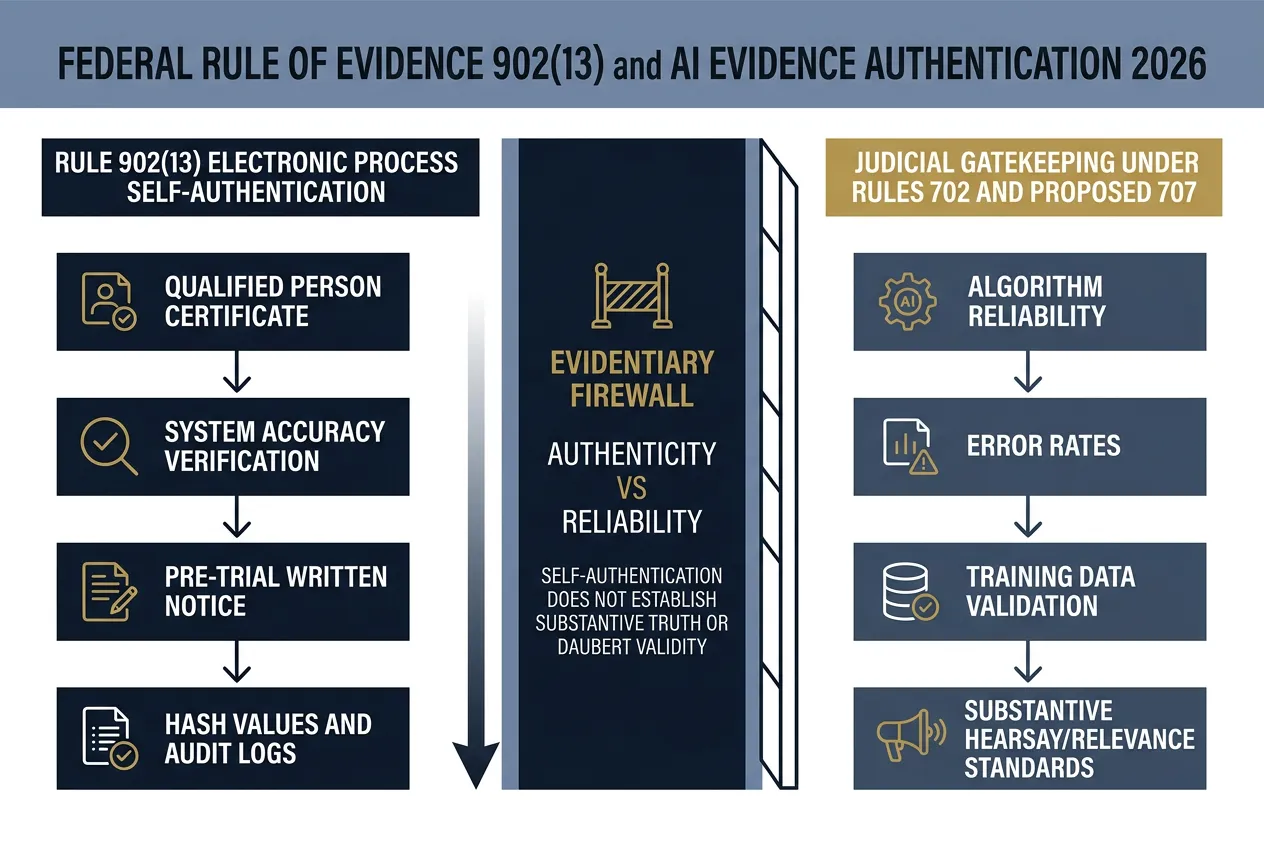
Under Federal Rule of Evidence 901(a), authentication requires only a threshold showing that the item is what the proponent claims it to be. Rule 902(13) merely provides an evidentiary shortcut to that threshold by allowing an affidavit under penalty of perjury to substitute for live foundational witness testimony.
+------------------------------------------------------------------------+
|                          ARTICLE IX: AUTHENTICITY                      |
|                                                                        |
|  Rule 902(13) Self-Authentication Certificate:                         |
|  • Establishes electronic provenance, system origin, and hash integrity|
|  • Satisfies: "This output was genuinely created by Algorithm X."      |
+------------------------------------------------------------------------+
                                    |
                                    v [Evidentiary Firewall]
+------------------------------------------------------------------------+
|                          ARTICLE VII: RELIABILITY                      |
|                                                                        |
|  Rule 702 / Daubert Substantive Gatekeeping:                           |
|  • Scrutinizes algorithm methodology, validation datasets, error rates |
|  • Satisfies: "The algorithmic output is scientifically reliable."     |
+------------------------------------------------------------------------+
When a software process acts as a deterministic ledger—such as recording network packet timestamps or cryptographic SHA-256 hashes—authenticity and functional accuracy converge. The system "produces an accurate result" because the process is mathematical and reproducible.
Conversely, when an AI system utilizes non-deterministic machine learning architectures, statistical natural language generation, or autonomous decision reasoning, the concept of "producing an accurate result" shifts fundamentally. A certificate stating that a model generated text does not certify that the model’s reasoning was factual, unhallucinated, or grounded in valid methodology.
What Are the Required Elements of a Rule 902(13) Certification?
To invoke Federal Rule of Evidence 902(13) effectively for admissible machine-generated evidence, proponents must satisfy four strict procedural prerequisites:
1. Written Certification by a Qualified Person
The certification must be executed by an individual with personal technical knowledge of the electronic process or system. The declarant must detail their technical competence, their familiarity with the hardware and software architecture, and the basis for their knowledge regarding system operations.
2. Affirmative Proof of an "Accurate Result"
The declarant cannot simply assert that the system is accurate in a conclusory sentence. For algorithmic systems, the Advisory Committee on Evidence Rules highlights that establishing an accurate result requires detailing:
- System operational parameters and maintenance protocols.
- Automated error logging, monitoring, and validation checks.
- Verification that software versions remained uncorrupted during the operative logging period.
3. Pre-Trial Reasonable Written Notice
Rule 902(13) explicitly incorporates the procedural notice framework of Rule 902(11). Proponents must give adverse parties reasonable written notice of their intent to offer the certified electronic record prior to trial, making the record and the certification available for inspection. This advance notice provides opposing counsel a fair opportunity to challenge both the certification's adequacy and the system's accuracy.
4. Preservation of Opposing Party Cross-Examination
While Rule 902(13) avoids live testimony at trial, adverse counsel retains the right to depose the certifying expert during discovery, cross-examine the declarant regarding system vulnerabilities, or file a motion in limine asserting that the underlying output represents inadmissible hearsay or unvetted expert testimony.
How Does Advisory Committee Activity in 2026 Reshape Machine Evidence?
The Advisory Committee on Evidence Rules has engaged in extensive study regarding artificial intelligence, deepfakes, and automated machine outputs across its 2025 and 2026 sessions:
| Rule Mechanism | Procedural Scope | 2026 Status & Evidentiary Standard |
|---|---|---|
| FRE 902(13) | Electronic Process Self-Authentication | Enacted. Authenticates provenance; strictly separated from substantive algorithmic validity. |
| Proposed FRE 707 | Machine-Generated / AI Evidence Reliability | Deferred for Study. Explores extending Rule 702 Daubert gatekeeping to standalone automated models. |
| Proposed FRE 901(c) | Generative AI & Deepfake Authentication | Under Active Review. Proposes burden-shifting mechanisms upon threshold showings of synthetic manipulation. |
| FRE 104 Gatekeeping | Admissibility vs. Conditional Relevance | Governing Doctrine. Rule 104(a) judicial preponderance applies to technical foundational reliability. |
In its May and October 2026 meetings, the Advisory Committee reaffirmed that courts should continue leveraging existing evidentiary frameworks—specifically Federal Rule of Evidence 104 and Federal Rule of Evidence 702—to screen algorithmic reliability rather than prematurely enacting rigid statutory mandates.
When algorithmic evidence involves synthetic generation or probabilistic classification, the proponent must establish reliability through expert witness testimony under Rule 702. Attempting to circumvent Daubert review by cloaking an AI model in a Rule 902(13) affidavit is routinely met with judicial exclusion.
Practical Litigation Checklist: Challenging and Defending AI Self-Authentication
Litigators handling cases involving automated data extraction, machine learning models, or generative AI logs should implement four tactical steps:
- Scrutinize the Declarant’s Qualifications: Audit whether the certifying individual possesses direct engineering knowledge of the model runtime or merely administrative custody of exported spreadsheets.
- Demand Underlying Model Telemetry: Request pipeline validation logs, training dataset distributions, and system drift monitoring records to contest whether the system consistently produced an accurate result.
- Assert the Article VII Expert Barrier: If the machine output synthesizes opinions, predictive risk scores, or diagnostic interpretations, file an immediate objection demanding compliance with Rule 702.
- Enforce Notice and Inspection Deadlines: Enforce Rule 902(11) pre-trial disclosure timelines to ensure sufficient discovery windows to perform cryptographic hash checks and algorithmic audits.
For comprehensive strategies regarding evidence authentication and AI court orders, review our detailed guide on Federal Court AI Standing Orders and Statewide AI Court Rules.
Does Rule 902(13) allow AI-generated expert summaries to be admitted without a testifying witness?
No. Federal Rule of Evidence 902(13) governs authenticity, not substantive admissibility or expert witness requirements. While a certification can establish that an electronic log was accurately generated by a specific server script, any output providing expert analysis, probabilistic opinion, or scientific evaluation must still satisfy Federal Rule of Evidence 702.
What is the difference between Rule 902(13) and Rule 902(14)?
Rule 902(13) authenticates the dynamic process or system that generated an electronic record (verifying that the process produces an accurate result). Rule 902(14) authenticates exact digital copies of existing files or storage media, typically verified through identical cryptographic hash values such as SHA-256.
Can an opposing party cross-examine the person who signs a Rule 902(13) certificate?
Yes. Rule 902(13) incorporates the notice provisions of Rule 902(11), requiring timely pre-trial notice and inspection. Adverse parties can depose the certifier, challenge the technical accuracy of the underlying process, or call the certifier for cross-examination at trial or evidentiary hearings.
How did the court rule on AI evidence and Rule 902(13) in United States v. Gogic?
In United States v. Gogic (E.D.N.Y. 2025), the court held that while Rule 902(13) authenticated that digital spreadsheets were extracted from an electronic system, it did not establish the reliability or authenticity of the underlying substantive communications. The court excluded AI-organized exhibits lacking supporting witness testimony.