How do production engineering teams stop an autonomous agent from entering infinite retry loops, exhausting upstream API rate limits, or taking down downstream services when a third-party dependency degrades? In production multi-agent systems, unconstrained autonomy without bounded failure domains inevitably triggers systemic outages. Implementing ai agent circuit breakers provides deterministic blast-radius containment, transforming cascading crashes into graceful, isolated degradations across tool APIs, model gateways, and inter-agent communication channels.
Why Do Autonomous AI Agents Cause Cascading Failures?
In traditional microservices architectures, cascading failures typically stem from predictable spikes in network latency, thread-pool exhaustion, or database connection saturation. When a downstream service slows down, callers queue requests until buffers overflow, tripping service-level crashes upstream.
Autonomous AI agents introduce an entirely different failure profile. Because an agent dynamically plans its trajectory at runtime, a degraded tool or malformed model response does not merely trigger an HTTP 500 error; it alters the agent's reasoning loop:
- Semantic Retry Loops: When a tool returns an unexpected response, an unconstrained LLM often attempts to solve the problem by re-invoking the same tool with minor syntactic variations, re-prompting upstream models, or querying alternative tools in rapid succession.
- Exponential Fan-Out: In hierarchical multi-agent architectures, an execution failure in a single subagent often causes parent orchestrators to spawn parallel recovery branches, multiplying query volumes and compounding load on already-struggling dependencies.
- Budget and Token Exhaustion: As retry loops compound, context windows swell with repetitive error logs, inflating token consumption, accelerating rate-limit exhaustion, and driving unexpected operational expenses.
- Cross-Tenant Contamination: Shared model gateways and tool execution workers without rigorous tenant partitioning allow a single malfunctioning agent trajectory to starve healthy workloads of system capacity.
Under the OWASP Top 10 for Agentic Applications, this vulnerability is formalized as ASI08: Cascading Failures—the unmitigated propagation of faults across agentic tools, models, and workflows. Without dedicated containment mechanisms, a transient glitch in a single external database query can collapse an entire enterprise agent mesh.
What Is the Three-State Circuit Breaker Pattern for AI Agents?
Originating in classical distributed systems engineering and formalized by Michael Nygard, the circuit breaker pattern prevents an application from repeatedly attempting an operation that is almost certain to fail. In agentic engineering, this pattern is adapted to wrap model invocations, external tool integrations, and inter-agent message buses.
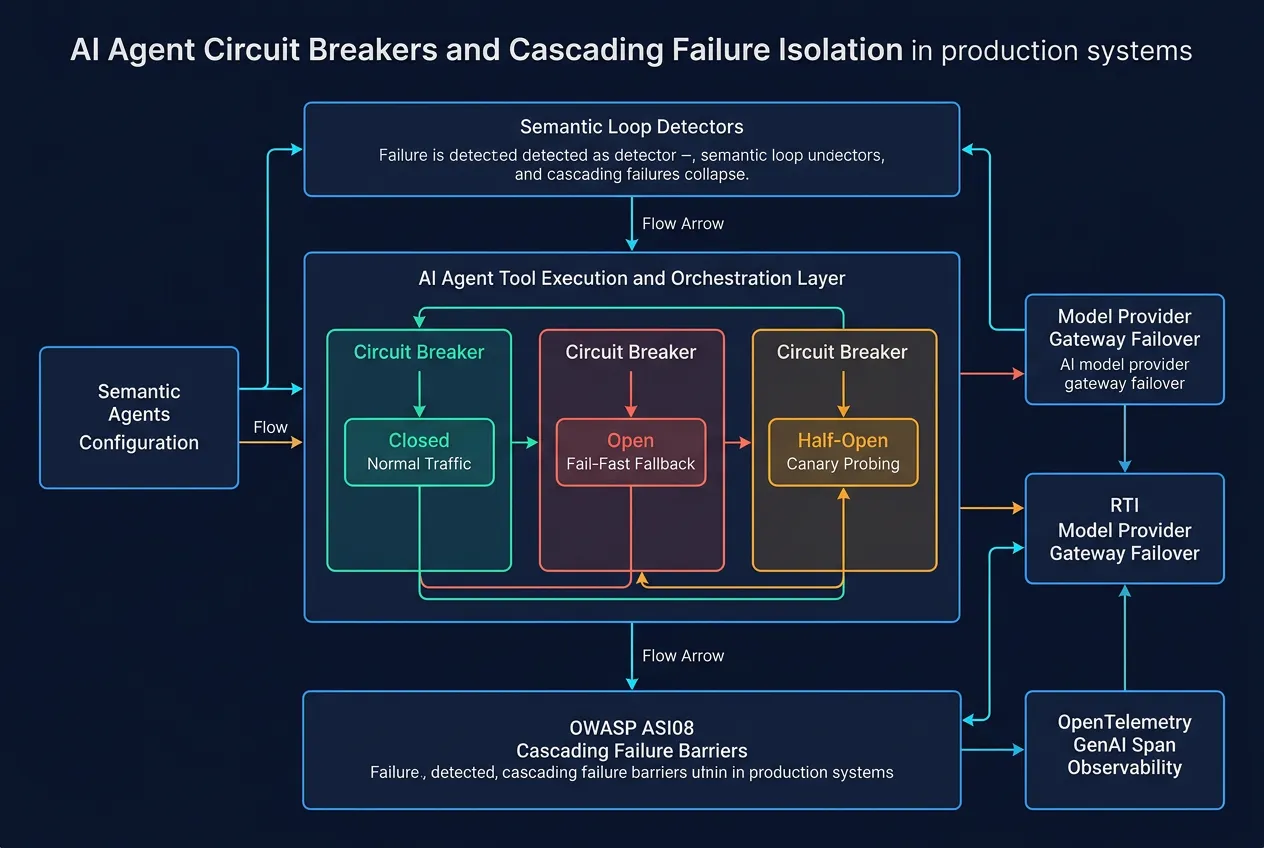
An agentic circuit breaker operates as a state machine with three core operational modes:
1. Closed State (Normal Operations)
- In the Closed state, the circuit breaker permits all agent tool executions and model queries to pass through unimpeded.
- The breaker maintains a rolling time-window counter (e.g., a 60-second sliding window) tracking total requests, network timeouts, HTTP error codes, and malformed outputs.
- If the consecutive error count or failure rate crosses a configured threshold (such as three consecutive network failures or an elevated failure rate across twenty calls), the breaker trips into the Open state.
2. Open State (Fail-Fast Containment)
- Once Open, all subsequent tool or agent invocations fail immediately without attempting network transport to the underlying dependency.
- Instead of throwing an unhandled exception, the orchestration layer returns a structured synthetic fallback message directly to the agent’s context:
json { "tool_status": "circuit_open", "dependency": "financial_records_api", "retry_after_seconds": 45, "fallback_action": "proceed_with_cached_summary_or_escalate" } - This prevents downstream resource exhaustion and immediately instructs the agent’s reasoning engine to adopt an alternative plan rather than hammering the failing service.
- A reset timer initiates (e.g., 30 to 60 seconds), keeping the breaker open until the cooldown period expires.
3. Half-Open State (Canary Probing)
- When the reset timer elapses, the circuit transitions into the Half-Open state.
- The breaker allows a tightly bounded number of canary probe requests (typically one or two isolated calls) to pass through to the target service.
- If the canary probe succeeds with a valid, schema-compliant response, the circuit breaker resets to Closed, resuming normal traffic flow.
- If the canary probe times out or fails, the breaker immediately re-trips to Open, doubling the cooldown period via exponential backoff to allow downstream services sufficient time to recover.
How Do Semantic Circuit Breakers Differ from Network Circuit Breakers?
Standard infrastructure circuit breakers evaluate binary network health: HTTP 502/503/504 status codes, TCP connection drops, and socket read timeouts. However, production agent telemetry reveals that the majority of agentic failure cascades occur while transport networks report HTTP 200 OK.
A model provider can return HTTP 200 while producing nonsensical JSON, empty tool calls, infinite repetitive phrases, or policy refusal strings. To contain these failures, engineering teams implement Semantic Circuit Breakers operating directly inside the orchestration engine.
| Dimension | Classical Network Circuit Breaker | Agentic Semantic Circuit Breaker |
|---|---|---|
| Layer | Transport / Gateway (Envoy, NGINX) | Orchestration / Execution Runtime |
| Failure Signals | HTTP 5xx, TCP drops, socket timeouts | JSON schema mismatch, semantic drift, loop repetition |
| Trip Triggers | Network error rates, latency p99 spikes | Step budgets, token caps, cosine similarity repeats |
| Fallback Output | HTTP 503 Service Unavailable | Synthetic context injection, cached answers, human handoff |
| Blast Radius | Server-level network connection pools | Agent reasoning trajectory, tool state, subagent mesh |
Key Semantic Tripping Mechanisms
- Jaccard / Cosine Trajectory Loop Detection: The orchestrator computes rolling similarity hashes over the agent's last tool invocation arguments. If an agent calls a database search tool three times in a row with near-identical semantic similarity in its query arguments, the semantic breaker trips, halting the loop.
- Schema and Hallucination Violations: If a model returns invalid tool call arguments that fail Pydantic or JSON schema validation after two consecutive attempts, the breaker trips to prevent infinite self-correction cycles.
- Cumulative Step and Token Budgets: Every agent trajectory is allocated strict upper bounds (e.g., maximum eight tool steps and thirty-two thousand total tokens). Exceeding these limits instantly opens the circuit, terminating runaway execution before cost or latency thresholds are breached.
What Are the Core Architecture Patterns for Cascading Failure Isolation?
Containing cascading failures requires pairing circuit breakers with broader defensive distributed systems patterns:
User / Upstream Service
          │
          ▼
┌─────────────────────────────────────────────────────────┐
│        AI Agent Orchestration & Gateway Layer           │
│                                                         │
│   ┌──────────────────┐         ┌────────────────────┐   │
│   │ Bulkhead Workers │         │ Admission Control  │   │
│   │ (Tenant Pools)   │         │ (Backpressure)     │   │
│   └────────┬─────────┘         └─────────┬──────────┘   │
└────────────┼─────────────────────────────┼──────────────┘
             │                             │
             ▼                             ▼
┌───────────────────────────┐ ┌───────────────────────────┐
│  Tool Circuit Breaker     │ │  Model Gateway Breaker    │
│  [ Closed / Open / Half ] │ │  [ Primary -> Fallback ]  │
│  - Timeouts & Quotas      │ │  - Latency & 429 Quotas   │
│  - Semantic Loop Check    │ │  - Schema Validation      │
└────────────┬──────────────┘ └────────────┬──────────────┘
             │                             │
             ▼                             ▼
   External Tool / API           LLM Inference Providers
1. Bulkheading (Tenant and Capability Partitioning)
Borrowed from nautical engineering, bulkheads partition system resources into isolated compartments so that a breach in one hull section does not sink the ship:
- Dedicated Worker Pools: High-risk, open-ended research agents run in isolated execution pools separate from latency-sensitive transactional customer agents.
- Per-Tenant Resource Quotas: Hard concurrency caps and token-per-minute ceilings prevent a single tenant's rogue batch script from exhausting platform-wide capacity.
2. Multi-Model Gateway Failover
Relying on a single model endpoint introduces a critical single point of failure. Modern agent gateways wrap primary inference providers in circuit breakers:
- If the primary frontier model experiences elevated p99 latency (>15s) or HTTP 429 rate limits across a 30-second window, the gateway trips open and automatically routes queries to a warm secondary provider.
- Failover routes must utilize standardized prompt templates and strict output schema parsers to maintain output consistency across different model families.
3. Idempotency Keys and Write Fences
When network disconnects occur during tool execution, an agent may re-issue an action without knowing whether the previous call completed. Requiring unique client-generated idempotency keys (Idempotency-Key: req_<uuid>) on all state-mutating tool APIs guarantees that retried actions do not produce duplicate charges, records, or side effects.
How Should Teams Implement OpenTelemetry Observability for Agent Breakers?
Engineering teams cannot manage what they cannot measure. Standardizing agent circuit breaker telemetry on OpenTelemetry GenAI Semantic Conventions provides full observability across the execution lifecycle.
Every tool invocation should emit structured span attributes:
gen_ai.agent.id: Unique identifier for the calling agent.gen_ai.tool.name: Name of the executed tool.gen_ai.circuit_breaker.state: Current state (closed,open,half_open).gen_ai.circuit_breaker.failure_count: Rolling failure count in the active window.gen_ai.execution.step: Ordinal index of the tool call within the agent's trajectory.gen_ai.trajectory.token_usage: Cumulative prompt and completion tokens used.
By tracking these metrics in central dashboards, Site Reliability Engineering (SRE) teams can monitor breaker trips in real time, distinguish transient upstream provider latency from semantic prompt loops, and continuously tune timeout thresholds.
Frequently Asked Questions
What is the primary difference between a retry budget and a circuit breaker?
A retry budget limits the total number of retries an agent or service can attempt over a specific time window, preventing retries from overwhelming an already degraded system. A circuit breaker monitors failure rates and proactively cuts off all traffic to a failing dependency once a threshold is crossed, failing fast until the service demonstrates recovery.
Why isn't exponential backoff alone sufficient for AI agent tools?
Exponential backoff delays retries but does not prevent the agent from attempting redundant calls, exhausting context window tokens, or running up inference bills. If a third-party API is experiencing a prolonged outage, repeated backoff loops simply stall the agent while consuming worker memory and execution threads.
How does OWASP ASI08 relate to agentic circuit breakers?
OWASP ASI08 (Cascading Failures) in the Top 10 for Agentic Applications addresses risks where an unhandled failure in one agent, tool, or integration propagates across interconnected systems. Circuit breakers, bulkheads, and step limits serve as the primary engineering controls required to mitigate ASI08 vulnerabilities.
Can an LLM decide when to open a circuit breaker?
No. Circuit breaker state transitions must be strictly deterministic and managed by the deterministic orchestration runtime, not the stochastic language model. The LLM receives notification that a circuit has opened, but the measurement of failure rates, timers, and state switches must execute in reliable application code.