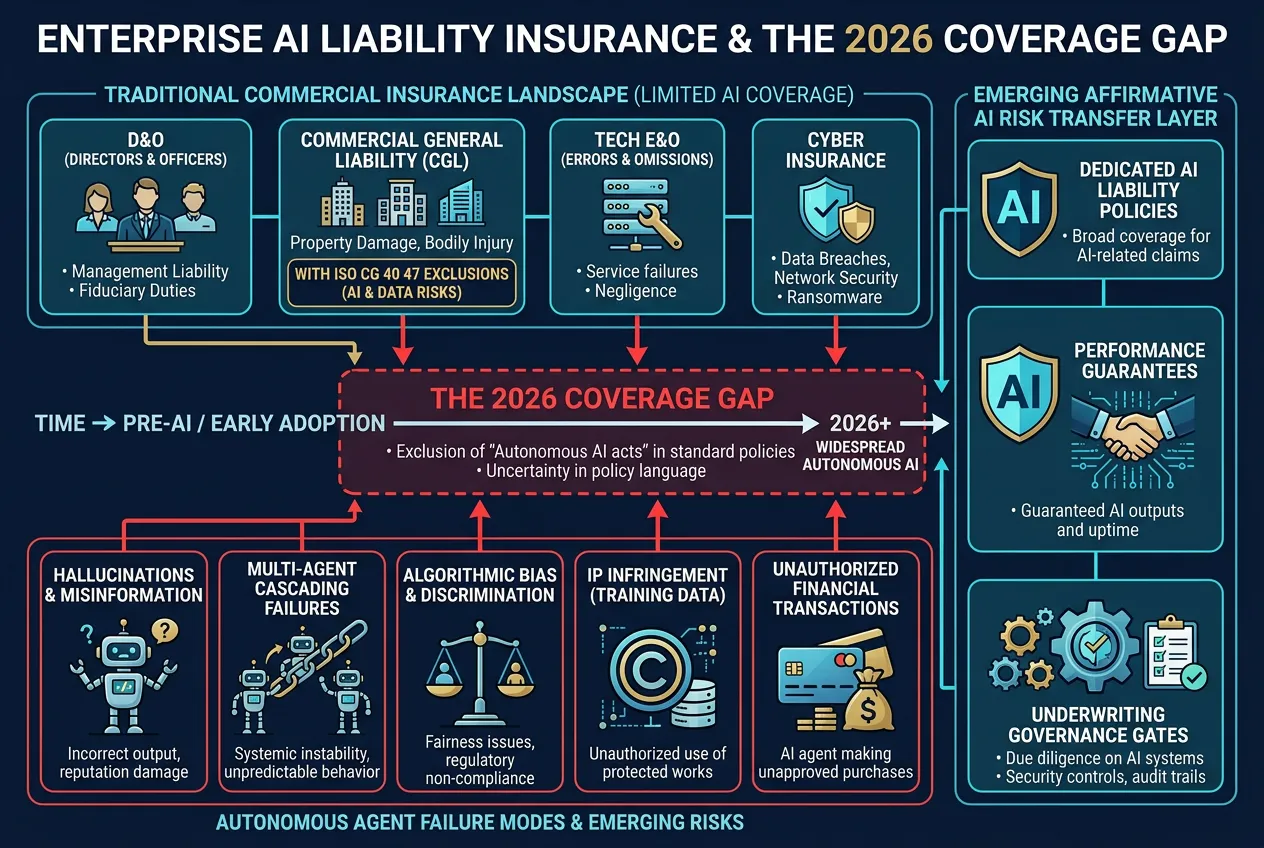
Enterprise AI liability insurance has emerged as one of the most critical and complex risk management frontiers in 2026. As corporate adoption shifts from exploratory generative chat interfaces to fully autonomous multi-agent production systems, enterprise risk officers are discovering an alarming reality: standard commercial insurance policies—including Cyber Insurance, Technology Errors and Omissions (Tech E&O), and Commercial General Liability (CGL)—routinely fail to cover autonomous AI failures. With standard exclusions actively carving out algorithmic decision-making and performance drift, organizations are turning to affirmative standalone policies, dedicated performance guarantees, and rigorous algorithmic underwriting standards to close the enterprise AI liability insurance coverage gap.
Why Do Traditional Commercial Policies Exclude Autonomous AI Risks?
For decades, corporate enterprises relied on a familiar trifecta of insurance lines to manage technology and operational exposures: Commercial General Liability (CGL) for bodily injury and property damage, Technology Errors and Omissions (Tech E&O) for software defects and professional service failures, and Cyber Insurance for data breaches, ransomware, and network business interruption. However, autonomous AI agents operate across a fundamentally distinct risk profile that breaks the traditional assumptions underlying these legacy policies.
In traditional software development, deterministic code produces predictable outputs based on explicit logic trees. If a software defect causes economic harm, Tech E&O policies respond to the software engineer's professional error or negligent omission. In contrast, generative AI models and multi-agent workflows are probabilistic and non-deterministic. A model can hallucinate false financial data, execute unauthorized financial transactions via agentic tool calling, or generate defamatory text without any identifiable code failure, malicious cyber breach, or human negligence.
Recognizing this exposure, the commercial insurance market has systematically moved to eliminate "silent AI" risk—the unintended exposure of traditional policies to algorithmic losses. This transition mirrors the insurance industry's historic elimination of "silent cyber" during the late 2010s, creating clear demarcations where traditional policies decline to defend or indemnify organizations against AI-generated liabilities.
What Are the ISO CG 40 47 and CG 40 48 Generative AI Exclusions?
The most sweeping structural contraction in AI liability coverage occurred with the introduction of standard endorsement forms by the Insurance Services Office (ISO) and Verisk, notably endorsements CG 40 47 and CG 40 48:
- CG 40 47 (Exclusion — Generative Artificial Intelligence): Attaches to ISO Commercial General Liability coverage forms (both occurrence and claims-made). It broadly excludes coverage under Coverage A (Bodily Injury and Property Damage Liability) and Coverage B (Personal and Advertising Injury Liability) for any loss, damage, or legal liability "arising out of" generative artificial intelligence. Because courts interpret the phrase "arising out of" expansively as requiring only a minimal causal nexus, any operational failure where an AI model played a contributory role risks total coverage denial.
- CG 40 48 (Exclusion — Generative Artificial Intelligence — With Limited Exception): Provides a narrower carve-out, allowing insureds to purchase limited, scheduled exceptions for specific designated generative AI operations, while maintaining a baseline exclusion across all unlisted algorithmic activities.
Beyond CGL, insurers are aggressively inserting bespoke generative AI endorsements into Cyber and Tech E&O renewals. In cyber policies, carriers routinely limit coverage to external unauthorized network intrusions, explicitly denying claims where an autonomous agent acted within its provisioned OAuth permissions, even if its autonomous reasoning resulted in massive data leakage, cascading API failures, or unauthorized asset liquidation.
| Insurance Line | Traditional Core Coverage | The 2026 AI Coverage Gap | Governing Exclusion / Market Response |
|---|---|---|---|
| Commercial General Liability (CGL) | Third-party bodily injury, property damage, advertising injury | AI system hallucinating dangerous guidance, physical equipment damage from agentic IoT control | ISO Endorsements CG 40 47 and CG 40 48 ("arising out of generative AI") |
| Technology Errors & Omissions (Tech E&O) | Professional negligence, deterministic software code defects, breach of contract | Non-deterministic algorithmic drift, model hallucinations, unexpected probabilistic responses | Explicit generative AI carve-outs, sub-limits, or mandatory manual-oversight warranties |
| Cyber Insurance | Unauthorized third-party hacking, ransomware, data breach forensics | Autonomous agent privilege abuse within valid OAuth credentials, data poisoning during ingestion | Exclusion of non-malicious algorithmic actions; failure to qualify as an "unauthorized access event" |
| Directors & Officers (D&O) | Corporate governance failure, breach of fiduciary duty, securities litigation | Board oversight failure regarding AI risk governance, misleading corporate AI capability disclosures | Scrutiny under AI compliance mandates (e.g., EU AI Act, SEC guidance), restricted entity coverage |
What Are the Core Pillars of Standalone Enterprise AI Liability Insurance?
To bridge this multi-million-dollar protection deficit, a specialized market of affirmative AI liability coverage has emerged. Pioneered by specialized algorithmic risk underwriters such as Armilla Assurance (offering limits up to $25 million) and Munich Re through its aiSure program (providing structured performance guarantees up to $15 million), standalone enterprise AI liability insurance provides purpose-built risk transfer.
A robust enterprise AI risk transfer architecture rests on four affirmative pillars:
- Algorithmic Errors & Omissions (Model Hallucination Coverage): Indemnifies the insured against third-party economic losses resulting from inaccurate, fabricated, or biased outputs produced by deployed models, including automated customer service advice, algorithmic pricing determinations, and medical/legal synthesis.
- Autonomous Agent Execution & Tool-Calling Liability: Covers financial losses and contractual breach claims stemming from multi-agent trajectory errors, unintended external API calls, unauthorized electronic fund transfers, or automated database modifications executed by autonomous agents.
- Intellectual Property & Training Data Infringement: Shields enterprises against copyright, trademark, and trade secret infringement claims arising from foundational model training data, retrieval-augmented generation (RAG) context ingestion, or model completion similarity.
- Model Performance & Efficacy Guarantees: Protects both AI vendors and enterprise buyers against warranty breaches when an AI solution fails to meet contractually defined performance thresholds, such as precision, recall, or operational efficiency metrics.
How Do Insurers Underwrite Enterprise AI Systems in 2026?
Unlike traditional software underwriting, which relies primarily on static questionnaires and cybersecurity hygiene audits, AI risk underwriting demands continuous, evidence-based technical evaluation. Insurers will not underwrite black-box autonomy without verifiable governance telemetry.
Underwriting standards in 2026 require enterprise insureds to demonstrate adherence to recognized AI governance frameworks, such as NIST AI RMF 1.0, ISO/IEC 42001, and the OWASP Top 10 for Agentic Applications. Underwriters scrutinize five specific technical gates:
- Audited Golden Benchmark Testing: Insureds must maintain version-controlled evaluation test sets (
pass^k, trajectory consistency) to detect performance drift and regressions prior to production deployments. - Runtime Guardrails and Circuit Breakers: Telemetry verifying the presence of deterministic inline firewalls, prompt injection filters, and automated circuit breakers capable of halting runaway agent loops before cascading financial damage occurs.
- Least-Privilege Non-Human IAM: Enforcement of scoped identity controls, ephemeral OAuth delegation tokens (RFC 8693), and mandatory human-in-the-loop (HITL) step-up authorization gates for high-stakes actions.
- Zero Data Retention (ZDR) and Privacy Controls: Verification that fine-tuning and inference pipelines operate in isolated VPCs with contractual and technical prohibitions against third-party model training or data scavenging.
- Comprehensive Lineage and Audit Logging: Distributed OpenTelemetry tracing capturing full agentic execution traces, tool invocations, and prompt-response hashes to facilitate post-incident claims forensics.
To explore how enterprise contracts interact with operational AI governance, examine our detailed analyses on Enterprise AI Service Level Agreements: Structuring SLAs, Drift, and Latency Commitments in 2026, Enterprise AI Vendor Indemnification: IP Risk in 2026, and Enterprise AI Agent IAM: Governing Non-Human Identities and OAuth Delegation in 2026.
Frequently Asked Questions
Does a standard enterprise cyber insurance policy cover losses caused by an AI agent hallucination?
In almost all cases, no. Standard cyber insurance policies are designed to respond to unauthorized malicious third-party attacks, extortion, and data breaches. If an internal AI agent hallucinates erroneous data or executes an incorrect workflow without an external malicious cyber intrusion, the insurer will typically deny coverage on the grounds that no covered network security event occurred.
What is the impact of ISO Endorsement CG 40 47 on corporate general liability?
ISO Endorsement CG 40 47 excludes all bodily injury, property damage, and personal and advertising injury claims arising out of generative artificial intelligence from Commercial General Liability policies. If an enterprise deploys an AI agent that provides physical operational instructions or generates marketing material that infringes third-party rights, CG 40 47 allows the insurer to deny both defense and indemnity.
What is the difference between AI liability insurance and an AI performance warranty?
AI liability insurance is a third-party casualty coverage that indemnifies the insured against lawsuits, legal defense costs, and statutory damages resulting from AI failures affecting outside parties. An AI performance warranty or guarantee (such as Munich Re aiSure) is a financial guarantee that reimburses an enterprise buyer or vendor for direct economic and contractual losses if the model fails to perform at its agreed technical service level or accuracy threshold.
How can enterprise risk officers prepare for upcoming insurance renewals?
Risk officers should immediately audit existing commercial policies for emerging generative AI exclusion endorsements, inventory all internal and client-facing AI deployments, and map their technical guardrails against NIST AI RMF 1.0 and ISO/IEC 42001. Demonstrating robust runtime circuit breakers, least-privilege API scoping, and continuous golden dataset benchmarking is essential to securing favorable affirmative AI liability terms and capacity.