Enterprise AI audit readiness in 2026 requires continuous, cryptographically verifiable telemetry rather than retroactive log assembly. As regulatory frameworks including ISO/IEC 42001 Clause 9.2 and EU AI Act Article 72 mandate systematic post-market monitoring and independent verification, organizations must maintain dedicated evidence vaults that capture immutable model prompts, deterministic tool invocations, dataset lineage, and drift benchmarks.
When external regulators or internal oversight committees scrutinize production generative systems, retroactively searching unstructured application databases inevitably fails. Regulators demand mathematical proof of operational compliance, non-repudiation of agentic tool actions, and verifiable guardrails.
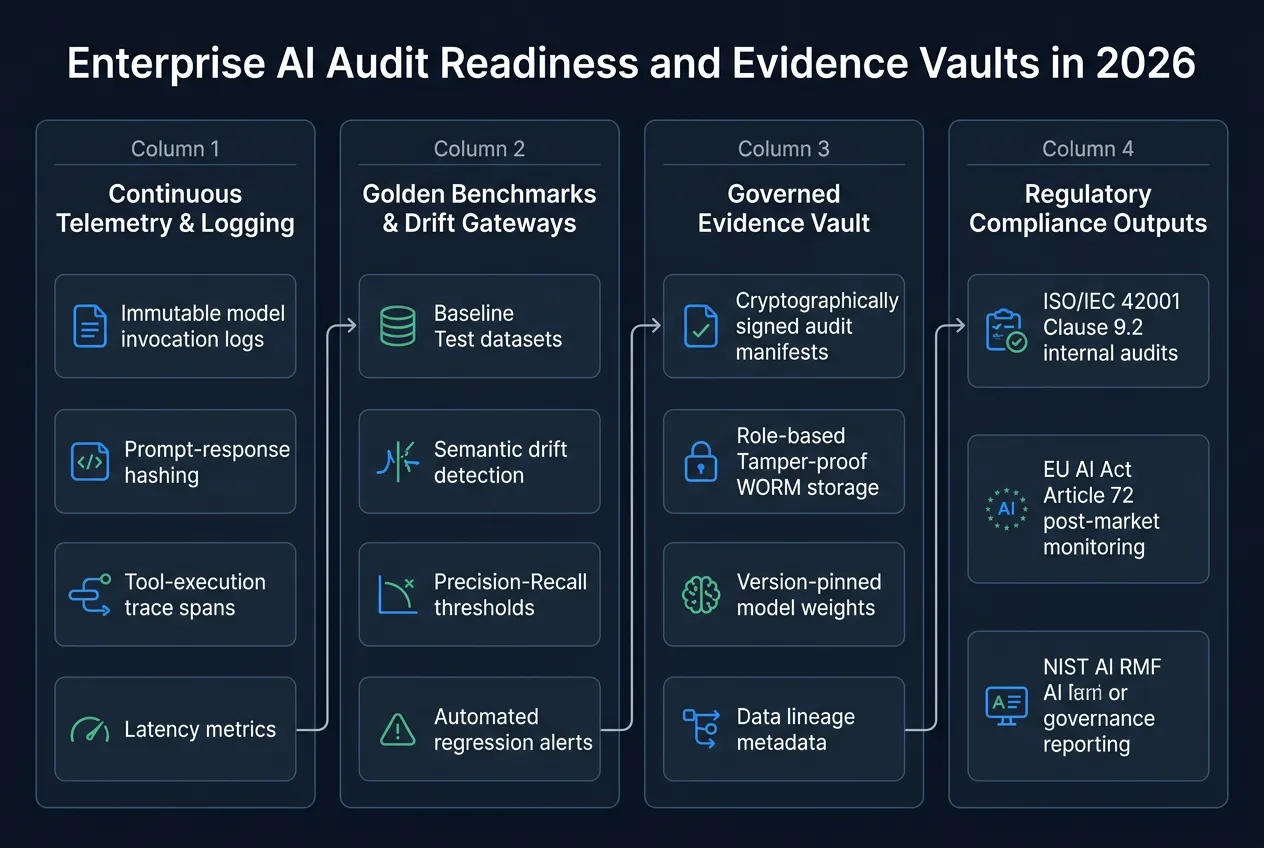
What Is Enterprise AI Audit Readiness in 2026?
Enterprise AI audit readiness is the operational and architectural capability of an organization to provide immediate, verifiable, and tamper-proof evidence regarding the performance, safety, decision-making, and regulatory compliance of its deployed artificial intelligence systems.
Historically, software compliance relied on static code repositories, change control tickets, and annual penetration testing. Production AI systems, however, are non-deterministic, interact dynamically with external systems via APIs, and evolve as underlying frontier model weights update.
Consequently, compliance under standards like ISO/IEC 42001 Clause 9.2 (Internal Audit) and the EU AI Act Article 72 (Post-Market Monitoring) demands a shift from periodic sampling to continuous automated evidence generation.
As explored in our analysis of Enterprise AI Acceptance Testing and Enterprise AI Liability Insurance, contractual enforceability and regulatory defensibility both collapse when an organization cannot demonstrate exact model execution provenance.
Why Do Traditional Software Logging Pipelines Fail AI Audits?
Traditional application logging pipelines—such as standard syslog, ELK stacks, or cloud service log aggregators—fail AI audits due to four fundamental architectural deficiencies:
- Lack of Cryptographic Immutability: Standard log collectors permit administrative truncation, retention purges, or downstream mutation. In legal disputes or regulatory enforcement actions, mutable logs fail judicial authentication standards such as Federal Rule of Evidence 902(13).
- Context Fragmentation Across Agentic Steps: Multi-turn autonomous agent trajectories span disparate microservices, third-party LLM endpoints, and MCP server tools. When logs are stored as disconnected event lines without distributed context propagation, auditors cannot reconstruct the causal decision graph.
- Absence of Model Version and System Prompt Pinning: Commercial foundation model APIs frequently update system defaults or quantization kernels. A log recording an input string and output string without the exact pinned model snapshot, temperature, seed, and active system prompt hash cannot be deterministically evaluated for drift.
- Data Privacy and Redaction Conflicts: Logging raw prompts and responses risks capturing protected health information (PHI), personally identifiable information (PII), or confidential corporate trade secrets, creating acute compliance violations under GDPR and CCPA.
| Audit Vector | Traditional Software Logging | Governed Enterprise AI Evidence Vault |
|---|---|---|
| Storage Architecture | Mutable object stores / ephemeral syslog | Cryptographically hashed Write-Once-Read-Many (WORM) storage |
| Execution Provenance | Timestamp + HTTP status code | Pinned model weights hash, system prompt digest, and token seeds |
| Multi-Turn Context | Fragmented trace IDs | W3C distributed trace context linking full subagent trajectories |
| Telemetry Integrity | Best-effort log delivery | Merkle-tree chained audit blocks with digital signatures |
| Regulatory Alignment | SOC 2 Type II baseline | ISO/IEC 42001 Clause 9.2, EU AI Act Art. 72, NIST AI RMF 1.0 |
How Does an Enterprise AI Evidence Vault Work?
An Enterprise AI Evidence Vault is an isolated, write-once-read-many (WORM) compliance data repository designed specifically for non-deterministic model architectures. The evidence vault operates as an out-of-band telemetry consumer, receiving cryptographically signed trace packages from production runtime environments.
[Production AI Agent Runtime]
          │
          ├──> (1) Ingress Filter: Zero-Retention PII Redaction & Hashing
          ├──> (2) Invocation Context: Model Version, Weights Digest, Seeds, Prompts
          ├──> (3) Tool Execution Spans: MCP Tool Calls, Return Payloads, Latencies
          │
          ▼
[Cryptographic Ingestion Gateway]
          │
          ├──> Generates Merkle Leaf Hash (SHA-256 Digest)
          ├──> Appends Hardware Security Module (HSM) Digital Signature
          │
          ▼
[Governed AI Evidence Vault (WORM Storage)]
          │
          ├──> Immutable Execution Logs (Partitioned by Tenant & Matter)
          ├──> Version-Pinned Golden Evaluation Benchmarks
          ├──> Continuous Drift Telemetry (Wasserstein Distance & Semantic Metrics)
          │
          ▼
[Auditor & Regulator Gateway]
          └──> Non-Repudiation Proofs, ISO 42001 Reports, & Court Filings
The evidence vault records five non-negotiable metadata components for every high-stakes inference event:
1. Ingress & Egress Content Digest
Rather than retaining raw PII, the ingestion gateway computes a cryptographic SHA-256 hash of the sanitized prompt and generated completion, pairing the digest with zero-knowledge validation proofs where sensitive customer data must remain sealed.
2. Runtime Parameter Fingerprints
The vault stores the exact model identifier, model provider release timestamp, temperature, top-p, seed parameter, and the cryptographic hash of the active system prompt and tool definitions.
3. Tool Invocation & Subagent Execution Spans
Utilizing OpenTelemetry GenAI semantic conventions, the system captures every tool call initiated by the model, including exact parameters passed, execution duration, network status, and raw tool output. This architecture builds directly on principles established in our guide to Event-Driven Agent Architectures.
4. Continuous Evaluation & Golden Benchmark Results
To comply with ongoing monitoring mandates, the evidence vault ingests continuous benchmark outputs run against static golden test suites. If semantic drift exceeds predefined variance thresholds, the vault triggers an automated governance incident.
5. Hardware-Backed Digital Signatures
Audit packages are sealed using Hardware Security Modules (HSM) or cloud KMS asymmetric keys, preventing retroactive modification even by system administrators possessing root infrastructure access.
What Are the Mandatory Regulatory Audit Requirements in 2026?
Enterprise AI deployments in 2026 are governed by three primary audit and monitoring standards across North America and Europe:
ISO/IEC 42001:2023 Clause 9.2 (Internal Audit)
Clause 9.2 mandates that organizations conduct internal audits of their Artificial Intelligence Management System (AIMS) at planned intervals. The audit program must determine whether the AIMS conforms to organizational requirements, complies with ISO/IEC 42001 criteria, and is effectively implemented and maintained. Crucially, Clause 9.2.2 requires documented proof of audit execution, auditor impartiality, and explicit tracking of corrective actions resulting from detected deficiencies.
EU AI Act Article 72 (Post-Market Monitoring for High-Risk AI)
Under Article 72 of the EU Artificial Intelligence Act, providers and deployers of high-risk AI systems must establish a documented post-market monitoring system. This system must actively and systematically collect, document, and analyze operational performance data across the system's entire lifecycle. The objective is to evaluate continuous compliance with Chapter III Section 2 technical requirements, detect unforeseen algorithmic bias, and identify systemic risks before they produce widespread harm.
NIST AI Risk Management Framework (AI RMF 1.0) & OMB M-24-10
In the United States, federal guidance under OMB Memorandum M-24-10 and NIST AI RMF 1.0 requires enterprises and government contractors to maintain continuous risk monitoring, algorithmic impact assessments, and independent verification logs. Systems impacting critical rights or safety must maintain automated audit trails demonstrating human-in-the-loop oversight and fail-safe termination gates.
How Can Organizations Implement an AI Audit Program?
Deploying a defensible AI audit program requires a structured four-stage implementation methodology:
Phase 1: Architecture & Telemetry Standardization
  ├── Instrument OpenTelemetry GenAI Semantic Conventions across all LLM pipelines
  ├── Establish SHA-256 hashing for system prompts, tools, and model configs
  └── Deploy automated PII/PHI tokenization proxies at ingress boundaries

Phase 2: Immutable Evidence Vault Provisioning
  ├── Configure Write-Once-Read-Many (WORM) storage buckets with object lock
  ├── Implement KMS/HSM digital signing for hourly audit telemetry batches
  └── Establish tenant-isolated evidence partitioning for customer privacy

Phase 3: Continuous Drift & Benchmark Automation
  ├── Deploy automated nightly evaluation runs against locked golden test suites
  ├── Configure statistical drift alerts (Kolmogorov-Smirnov & cosine distance)
  └── Establish automated circuit breakers when evaluation accuracy degrades

Phase 4: Regulatory Mapping & External Auditor Gateways
  ├── Map vault telemetry schemas directly to ISO/IEC 42001 Clause 9.2 controls
  ├── Automate generation of EU AI Act Article 72 post-market monitoring digests
  └── Provide read-only, cryptographically authenticated portals for compliance teams
By institutionalizing continuous audit readiness, enterprises eliminate the panic of surprise regulatory inspections, ensure evidentiary admissibility in litigation, and maintain rigorous operational integrity across autonomous systems.
What is the difference between an AI audit and a traditional IT audit?
A traditional IT audit inspects static code, infrastructure configurations, and human access permissions against deterministic control objectives. An AI audit must evaluate non-deterministic model behaviors, dynamic prompt contexts, training and retrieval data lineage, autonomous tool invocation trajectories, and continuous statistical drift over time.
Does ISO/IEC 42001 Clause 9.2 specify how often an AI internal audit must occur?
No. ISO/IEC 42001 Clause 9.2 does not prescribe a rigid calendar frequency. Instead, the standard requires organizations to conduct internal audits at planned intervals justified by organizational context, process importance, inherent system risks, and the findings of previous audits. High-risk or rapidly evolving AI agents generally require quarterly or continuous automated audit cycles.
Why is Write-Once-Read-Many (WORM) storage necessary for AI evidence?
WORM storage enforces hardware-level immutability, ensuring that log records, prompt hashes, and inference metadata cannot be altered, overwritten, or deleted during the mandated retention period. In court proceedings or regulatory enforcement inquiries, WORM storage provides the non-repudiation required to satisfy evidence authentication rules.
Can an organization log AI prompts without violating GDPR or data privacy laws?
Yes, by utilizing client-side or gateway-level data tokenization and cryptographic hashing. Instead of storing cleartext personal data in compliance logs, organizations record reversible pseudonymized tokens or one-way cryptographic SHA-256 hashes alongside mathematical verification proofs, preserving auditability while ensuring data minimization.