Enterprise AI agent IAM in 2026 requires treating autonomous agents as distinct non-human principals rather than running them under shared service accounts or raw user OAuth tokens. By implementing OAuth 2.0 Token Exchange (RFC 8693), organizations bind both the human sponsor (sub) and the acting agent (act) into short-lived, scope-attenuated credentials that enforce ethical walls, prevent privilege escalation, and preserve dual-principal auditability across enterprise systems.
Why Does Traditional Enterprise IAM Fail When Autonomous AI Agents Act on Behalf of Users?
Traditional enterprise identity and access management (IAM) was architected around a binary distinction: interactive human users authenticating via Single Sign-On (SSO) and static backend workloads authenticating via service accounts or API keys. Autonomous AI agents break both models simultaneously because they reason dynamically over unstructured context, invoke multi-step tool chains, and act on behalf of specific human professionals across multiple downstream systems.
According to the CyberArk 2025 Identity Security Landscape survey of 2,600 security decision-makers across 20 countries, enterprise machine identities now outnumber human identities by a ratio of 82 to 1. Simultaneously, research cited by the Cloud Security Alliance (CSA) indicates that while non-human identities average 45 per human across traditional enterprises—and reach 144 to 1 in cloud-native environments—formal IAM governance teams actively manage less than half of their organization's machine identities, leaving the majority tracked only within fragmented departmental or application-owner silos.
When enterprises deploy AI agents into this governance gap, engineering teams frequently default to one of two anti-patterns:
- Over-Privileged System Service Accounts: An orchestrator agent is provisioned with a static, tenant-wide API key or master service account to query document management systems (DMS), customer relationship management (CRM) platforms, or billing ledgers. While application-layer code attempts to filter results by the requesting user, the underlying credential possesses unrestricted read/write authority across the entire tenant.
- User Token Impersonation (Pass-Through OAuth): The agent caches and replays the human user's full OAuth 2.0 access or refresh token. To every downstream resource server, the AI agent's autonomous API calls are cryptographically indistinguishable from the human user clicking buttons in a browser.
Both patterns directly trigger ASI03: Identity and Privilege Abuse in the OWASP Top 10 for Agentic Applications (2026). Under service-account pooling, a single indirect prompt injection inside an untrusted document or email can trick the agent into exfiltrating records belonging to other clients—a "confused deputy" failure that bypasses ethical walls. Under user token impersonation, the agent inherits the human's maximum standing privileges (such as partner-level trust accounting access or global repository deletion rights) rather than the minimal permissions required for a single bounded task.
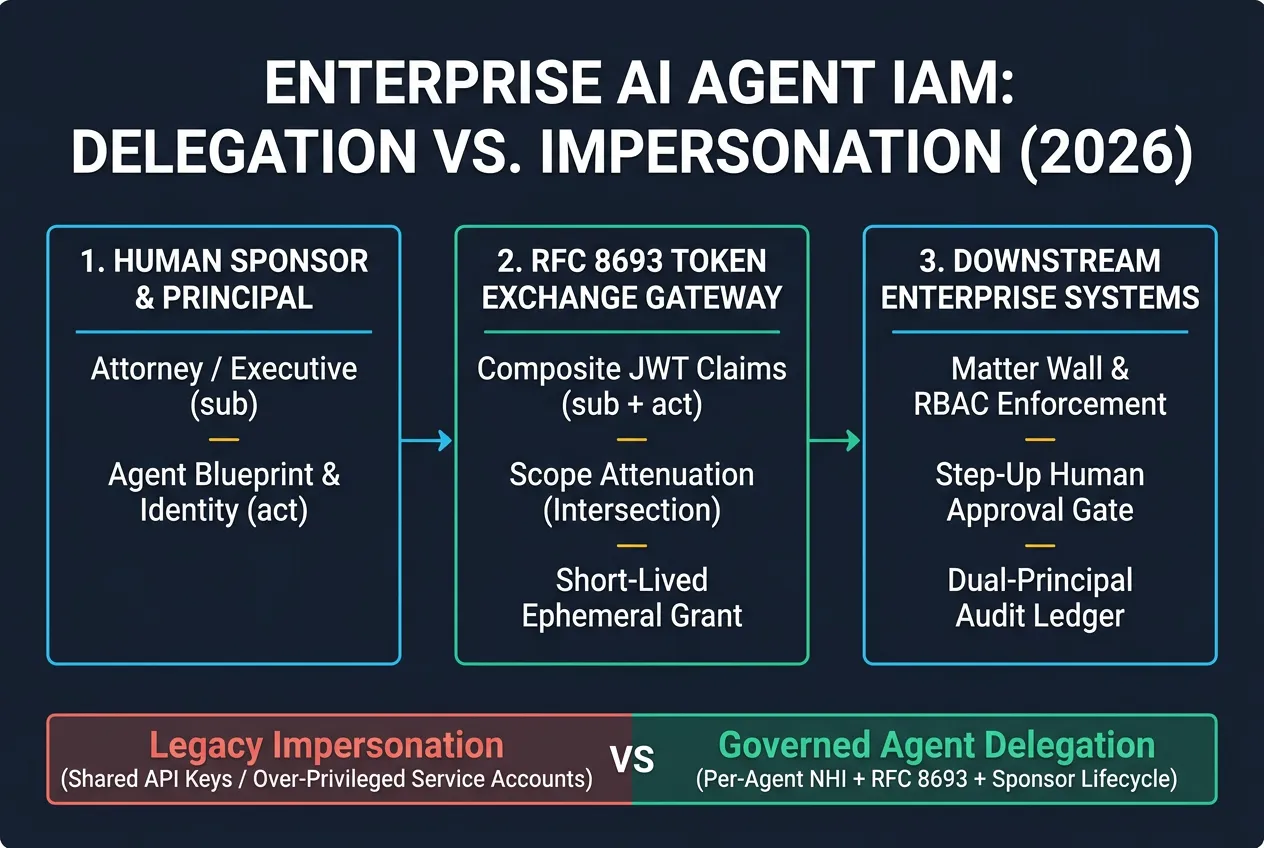
How Does OAuth 2.0 Token Exchange (RFC 8693) Separate Delegation from Impersonation?
To govern autonomous workflows without surrendering identity boundaries, enterprise architects must replace credential impersonation with cryptographic delegation. The foundational standard for this architecture is OAuth 2.0 Token Exchange (RFC 8693), published by the Internet Engineering Task Force (IETF).
Section 1.1 of RFC 8693 draws a formal security distinction between impersonation and delegation:
- Impersonation semantics: Principal A uses Principal B's credentials such that Principal A is indistinguishable from Principal B at the resource server.
- Delegation semantics: Principal A (the AI agent) retains its own distinct identity while exercising a constrained subset of authority granted by Principal B (the human sponsor or originating user).
In a production agentic architecture, when a human professional instructs an AI agent to perform a multi-step workflow—such as summarizing a litigation docket and staging a client update—the agent does not pass the user's primary session token to downstream APIs. Instead, the agent runtime executes an RFC 8693 token exchange against the enterprise Authorization Server:
- Subject and Actor Presentation: The agent presents the user's current context token as the
subject_token(representing the human on whose behalf the work is initiated) alongside the agent's own workload credential (such as an mTLS certificate or workload identity token) as theactor_token. - Policy Evaluation and Scope Attenuation: The Authorization Server validates that the specific agent blueprint is explicitly authorized to act for that user via a
may_actpolicy claim, and computes the strict intersection of permissions required for the immediate tool invocation. - Composite Token Issuance: The Authorization Server issues a short-lived, audience-restricted JSON Web Token (JWT) containing both the
sub(Subject) claim and a structuredact(Actor) claim.
{
  "iss": "https://auth.enterprise-example.internal",
  "aud": "https://dms.enterprise-example.internal/api/v2",
  "sub": "partner-4920@lawfirm-example.internal",
  "act": {
    "sub": "spiffe://enterprise-example.internal/ns/prod/sa/docket-briefing-agent-v4",
    "act": {
      "sub": "spiffe://enterprise-example.internal/ns/prod/sa/intake-router-agent-v2"
    }
  },
  "scope": "matters:read:matter_88412 documents:draft:matter_88412",
  "exp": 1793572200
}
As shown in the nested act structure defined by RFC 8693 Section 4.1, when an orchestrator agent delegates a subtask to a specialized subagent, each hop appends the prior actor into a verifiable chain. Downstream systems and distributed OpenTelemetry tracing pipelines can inspect the exact provenance of every read and write operation: who authorized the workflow, which top-level agent planned it, and which leaf agent executed the API call.
| Architectural Dimension | Shared Service Account | User OAuth Impersonation | Governed Agent Delegation (RFC 8693) |
|---|---|---|---|
| Cryptographic Principal | Single static machine account | Human user (sub only) | Dual attribution (sub + nested act chain) |
| Effective Permission Set | Union of all tenant users (Superuser) | Full standing privileges of the human user | Strict intersection (User ∩ Agent ∩ Task Scope) |
| Blast Radius on Prompt Injection | Cross-tenant / cross-matter data exposure | Unauthorized actions across all user-accessible apps | Bounded to single resource, read/draft action, and TTL |
| Audit Trail Fidelity | Blind (all actions appear as one bot) | Ambiguous (agent actions look like human clicks) | High-assurance (human sponsor + exact agent instance) |
| Revocation Granularity | Rotating key breaks all concurrent users | Revoking session logs out the human user | Per-agent, per-grant instant revocation |
How Should Law Firms and Regulated Enterprises Architect Non-Human Identity (NHI) Lifecycles?
Deploying RFC 8693 token exchange solves runtime transport security, but enterprise governance also requires full lifecycle management for the agents themselves. Frameworks such as Microsoft Entra Agent ID and the Cloud Security Alliance's agentic identity guidance establish that every AI agent must be governed through four structural lifecycle controls:
1. Explicit Human Sponsorship and Blueprint Registration
No AI agent should exist in production as an "unowned" automation. Every agent blueprint and runtime instance must be cryptographically bound to a named human Sponsor (a partner, practice-group leader, or business-unit owner) and a technical owner. If the human sponsor changes roles, leaves the firm, or has their clearance modified on a sensitive matter, the IAM control plane must automatically re-evaluate or suspend the sponsored agent's active grants.
2. Intersection-Based Least Privilege (User ∩ Agent ∩ Task)
In legal, financial, and healthcare environments, access is governed by strict ethical walls and matter-level access control lists (ACLs). As detailed in our analysis of enterprise AI permission readiness and discovery boundaries, an agent must never possess broader authority than the human invoking it, nor should it inherit human privileges irrelevant to its specialized function.
The effective permission set $P_{\text{effective}}$ issued at token exchange must be calculated as:
$P_{\text{effective}} = P_{\text{human}} \cap P_{\text{agent_blueprint}} \cap P_{\text{task_intent}}$
If a litigation partner has access to 40 active matters ($P_{\text{human}}$), and invokes a deposition-summary agent ($P_{\text{agent_blueprint}}$ allows read-only transcript access and draft memo creation), for a specific case (Matter #88412), the issued token grants read access solely to Matter #88412 transcripts for a 5-minute window—nothing else.
3. Step-Up Human-in-the-Loop Authorization for Outward Side Effects
Even when a human user possesses standing authority to execute high-consequence actions—such as disbursing funds, filing court pleadings, or sending external client correspondence—an autonomous agent acting under delegated authority must be blocked from executing irreversible outward side effects autonomously.
In a governed IAM architecture, high-consequence API scopes (e.g., email:send_external, billing:release, record:delete) are stripped from standard agent token exchanges. Instead, as explored in our guide to agent idempotency and transactional side-effect gates, the agent is granted only a stage or prepare scope. Completing the outward commit requires an interactive, out-of-band step-up authorization (such as an authenticated approval card signed by the human principal's session).
4. Ephemeral Credentials and Automated Orphan Reaping
Static API keys and long-lived refresh tokens stored in agent environment variables are prime targets for credential harvesting. Governed agent architectures eliminate static secrets in favor of workload identity federation (such as SPIFFE/SPIRE or cloud-native OIDC workload identities) paired with RFC 8693 token exchange. When a subagent finishes a branch of work, its ephemeral token expires within minutes, and automated identity-governance sweeps immediately deprovision dormant agent instances. This pairs directly with enterprise AI continuous red teaming to verify that no lateral privilege paths remain open in production.
Frequently Asked Questions (FAQ)
What is the difference between an AI agent service account and a non-human identity (NHI) with OAuth delegation?
A traditional service account is a static, shared machine credential with fixed, often broad permissions across a system, providing no cryptographic link to the specific human user who triggered a workflow. A governed agent NHI using OAuth 2.0 Token Exchange (RFC 8693) authenticates as a distinct agent actor (act) while carrying the specific originating human's identity (sub), receiving a short-lived token narrowed to the exact intersection of the user's and agent's permissions for a single task.
Why is passing a user's OAuth access token directly to an AI agent considered a security risk?
Passing a user's primary OAuth token directly to an AI agent creates an impersonation vulnerability classified under OWASP Agentic Top 10 ASI03 (Identity and Privilege Abuse). The agent inherits every permission the human user holds across the application, meaning a prompt injection or reasoning error can cause the agent to read unrelated confidential files or execute privileged actions, while audit logs falsely record the activity as direct human actions.
How does RFC 8693 handle multi-agent orchestration where one agent calls another subagent?
RFC 8693 supports nested act (Actor) claims inside the issued JSON Web Token. When an orchestrator agent exchanges a token to invoke a specialized subagent, the authorization server embeds the subagent as the outer act claim and preserves the orchestrator agent inside an inner act claim alongside the human sub claim, maintaining an unbroken, auditable chain of custody across every hop while further narrowing the allowed scopes.
How do law firms enforce ethical walls and matter confidentiality when deploying AI agents?
Law firms enforce ethical walls by evaluating token exchanges against the strict intersection of the human attorney's matter access list, the agent blueprint's functional role, and the active matter context. Even if an agent framework runs as a centralized service, it can only obtain downstream DMS or practice-management tokens scoped to the specific matter ID verified for that attorney's active session.
Ready to Govern Autonomous AI with Enterprise-Grade Identity Controls?
At Prest0, every workflow is built around strict workspace isolation, role-based permission boundaries, and explicit human authorization cards for outward actions—ensuring autonomous work never outruns your governance controls.
Explore Prest0 Security & Architecture
This information is for general informational purposes only and does not constitute legal advice.