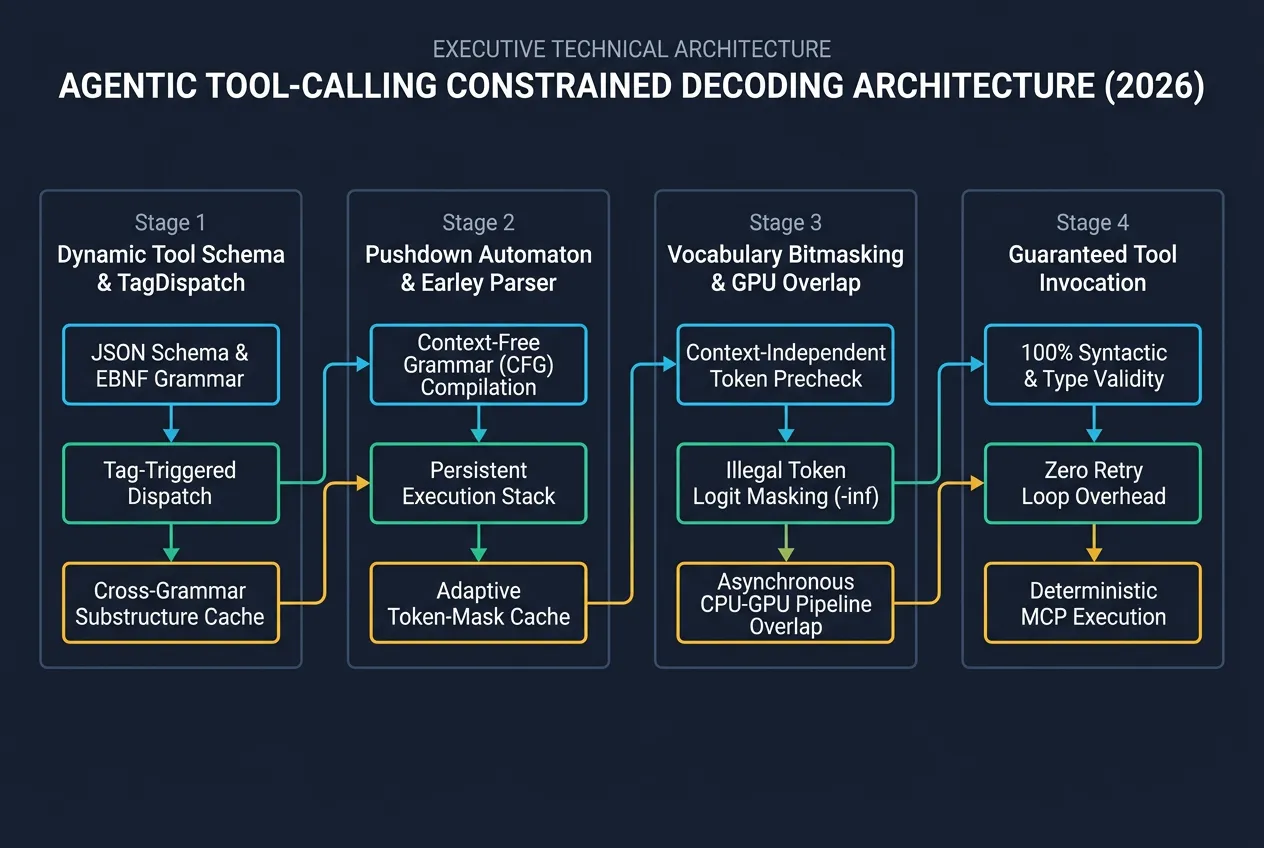
Agentic tool-calling constrained decoding guarantees that autonomous AI agents emit syntactically valid, schema-compliant tool invocations by masking invalid vocabulary logits during inference rather than relying on post-generation validation retries. By compiling JSON Schemas and domain-specific languages into pushdown automata or context-free grammars (CFGs) and overlapping CPU bitmask evaluation with GPU forward passes, production serving engines eliminate malformed tool calls with near-zero latency overhead.
Why Do Prompt-Based Tool Schemas Fail in Multi-Turn Agent Loops?
When engineering teams move autonomous AI agents from single-turn prototypes into multi-step production pipelines, unconstrained token sampling becomes an immediate reliability bottleneck. In a standard autoregressive forward pass, a language model computes a probability distribution over its entire vocabulary for each subsequent token. Even when a model is heavily fine-tuned on function-calling datasets, every generated character—every quotation mark, nested bracket, escaped newline, or enum string—remains a probabilistic sample.
In a single-turn invocation, a high-capability model might achieve strong structural compliance through system prompting alone. However, in multi-turn agentic workflows that chain dozens of Model Context Protocol (MCP) tool calls, minor per-step formatting failures compound rapidly. Common unconstrained decoding failure modes include:
- Unterminated strings and unescaped control characters: When an agent generates multi-paragraph code snippets, SQL queries, or legal clauses inside a JSON string argument, unescaped double quotes or raw newlines corrupt the outer JSON payload.
- Hallucinated parameter keys and enum drift: Under long-context attention degradation, models frequently invent plausible-sounding field names (
user_idinstead ofaccountId) or emit enum values outside the target API's schema. - Type coercion and nesting violations: Emitting a stringified array instead of a native JSON array, or dropping required nested object fields when approaching output token limits.
- Mixed reasoning and invocation boundaries: Bleeding free-form chain-of-thought reasoning directly into the structured tool-call block, causing downstream parsers to fail immediately.
Historically, engineering teams attempted to mask these failures using post-generation validation loops: parsing the output with Pydantic or a JSON validator, catching the exception, and appending the traceback to the conversation history for a model retry. As we analyzed in AI Agent Circuit Breakers: Cascading Failure Isolation in 2026 and AI Agent Backpressure: Admission Control in Production, validation retry loops multiply token consumption, blow through end-to-end latency budgets, and pollute the agent's context window with error noise.
How Does Agentic Tool-Calling Constrained Decoding Work Under the Hood?
Constrained decoding—also referred to as guided generation or structured decoding—transforms schema compliance from an after-the-fact validation check into an inline invariant of the token generation loop. At every decoding step, just before the inference server samples the next token from the model's output logits, a grammar engine evaluates which tokens in the vocabulary represent valid continuations of the target schema. Every token that would violate the grammar has its logit set to negative infinity ($-\infty$), reducing its sampling probability to zero.
Early guided-generation frameworks, formalized by Brandon T. Willard and Rémi Louf in Efficient Guided Generation for Large Language Models (arXiv:2307.09702, implemented in the open-source Outlines library), demonstrated that regular expressions and JSON schemas could be compiled into deterministic finite-state machines (FSMs). By precomputing an index mapping each FSM state to valid vocabulary tokens, the runtime could look up valid token masks in $O(1)$ time without scanning the entire vocabulary at every decoding step.
However, production agentic tool calling quickly exposed the expressiveness limits of pure regular expressions and static finite-state machines:
- Recursive and deeply nested structures: Complex agentic actions—such as constructing abstract syntax trees (ASTs), nested Boolean filter queries, SQL subqueries, or recursive workflow graphs—require Context-Free Grammars (CFGs) backed by a Pushdown Automaton (PDA) with an execution stack.
- Vocabulary tokenization misalignment: LLM tokenizers (such as Byte-Pair Encoding) do not align neatly with grammar boundaries. A single token like
": [spans a string closing quote, a key-value separator, whitespace, and an array opening bracket, requiring byte-level state transitions across multi-byte tokens. - Dynamic per-request tool registries: In multi-tenant enterprise platforms, each agent turn may expose a dynamically filtered subset of tools based on user role permissions, MCP server connections, and active workflow state—making multi-second ahead-of-time FSM compilation impractical.
| Architectural Dimension | Unconstrained Sampling + Retry Loops | Static Regex / FSM Guided Decoding | Dynamic CFG & Pushdown Automaton (XGrammar / XGrammar-2) |
|---|---|---|---|
| Structural Expressiveness | Arbitrary text (prone to syntax drift) | Regular languages & flat JSON Schemas | Full Context-Free Grammars (CFGs), recursive JSON, & DSLs |
| Syntax Validity Guarantee | Probabilistic (fails under long context) | Guaranteed for non-recursive schemas | Guaranteed across arbitrary nesting & recursive rules |
| Dynamic Schema Compilation | None (prompt text only) | High ahead-of-time compilation latency | JIT compilation with Cross-Grammar Cache (>6× faster) |
| Per-Token Decoding Overhead | Zero inline; massive retry tail latency | Low after warm-up; memory-intensive | Near-zero end-to-end via CPU-GPU overlap & prechecked masks |
| Hybrid Reasoning + Tool Switch | Fragile string parsing | Requires separate generation calls | Native TagDispatch mid-stream switching |
How Do Pushdown Automata and Context-Independent Prechecks Eliminate Decoding Latency?
A naive implementation of context-free grammar constrained decoding checks every token in a 128,000-token vocabulary against a pushdown automaton at every single generation step, introducing severe CPU bottlenecks that stall GPU tensor cores. Modern structured generation engines eliminate this bottleneck through a split compilation and execution architecture, pioneered in XGrammar: Flexible and Efficient Structured Generation Engine for Large Language Models (arXiv:2411.15100, MLSys 2025).
The core insight behind XGrammar is separating the vocabulary into two distinct classes for any given pushdown automaton state:
- Context-Independent Tokens: For the vast majority of states in a grammar (for example, inside a JSON string literal or matching a fixed object key), whether a token is valid depends only on the current top state of the automaton, not on the historical parent states stored deeper in the stack. These token bitmasks are precomputed ahead of time and stored in a compact adaptive token-mask cache.
- Context-Dependent Tokens: Only a tiny fraction of tokens—specifically those that close a nested rule and pop the pushdown automaton stack (such as
},], or)")—depend on the parent stack context to determine what may follow. Only these boundary tokens are evaluated dynamically at runtime using a persistent tree-structured stack.
By precomputing context-independent token masks and restricting runtime stack evaluation to boundary transitions, XGrammar achieves up to 100× speedups in grammar mask generation over prior constrained-decoding engines. Furthermore, because token mask computation runs on the host CPU while the language model's transformer layers execute on the GPU, the serving engine overlaps CPU bitmask generation for step $t+1$ with the GPU forward pass for step $t$, achieving near-zero end-to-end latency overhead during batch inference.
How Does Dynamic Grammar Compilation Scale to Multi-Tenant Agentic Tool Registries?
In early deployments, constrained decoding worked well when every request shared a single static output schema. In production agent architectures, however, tool schemas change dynamically on every turn. An enterprise agent orchestrating across MCP Distributed Tracing: Context Propagation in 2026 and Event-Driven Agent Architectures: Asynchronous Choreography in 2026 must interleave free-form user reasoning with dynamic tool dispatches selected from dozens of tenant-specific schemas.
To solve the dynamic schema bottleneck, XGrammar-2: Efficient Dynamic Structured Generation Engine for Agentic LLMs (arXiv:2601.04426, 2026) introduced three foundational runtime mechanisms specifically engineered for agentic workloads:
1. TagDispatch for Seamless Reasoning-to-Tool Switching
Autonomous agents rarely emit raw JSON from the first token of a turn. Instead, they generate natural-language chain-of-thought reasoning or user-facing explanations before invoking one or more tools. TagDispatch monitors the token stream in free-form mode using an Aho-Corasick automaton watching for specific dispatch tags (such as <tool_call> or native model function-call tokens). The exact moment a dispatch tag is emitted, the decoder switches mid-stream into the compiled CFG for that specific tool's JSON Schema, and switches back to unconstrained generation once the closing tag is completed.
2. Cross-Grammar Substructure Caching
Even when two agent turns expose different combinations of tools, their underlying JSON Schemas share massive structural overlap—standard string formatting rules, ISO-8601 timestamp patterns, pagination objects, and base JSON primitives. Rather than recompiling the entire grammar from scratch on every turn, a Cross-Grammar Cache hashes and reuses compiled pushdown automaton substructures across requests, combined with Just-In-Time (JIT) mask compilation that computes token masks lazily only for states the agent actually visits. Together with Earley-based adaptive token-mask caching and repetition-state compression, XGrammar-2 delivers more than 6× faster grammar compilation than prior structured-generation engines while preserving near-zero serving overhead.
3. Bounded Repetition and Schema Sanitization
Malicious or poorly written third-party MCP tool schemas can trigger state-space explosion if they include unbounded regular expression quantifiers (e.g., minItems: 1000 or deeply nested anyOf combinators). Production agent gateways enforce strict schema admission budgets—capping recursion depth, normalizing union types into discriminated unions, and compressing repetition states—before passing the grammar to the inference engine.
Why Syntactic Validity Is Necessary—But Not Sufficient—for Agentic Safety
Engineering leaders must maintain a clear boundary between syntactic validity and semantic or authorization safety. Constrained decoding guarantees that when an agent invokes transfer_funds(amount, destination_account), the JSON payload will never fail to parse, amount will always be a valid number, and destination_account will match the required account string pattern.
However, a syntactically valid tool call can still be a catastrophic security failure or an uncalibrated trajectory error:
- Prompt Injection & Confused Deputy Attacks: If an untrusted document retrieved via RAG contains an indirect prompt injection, constrained decoding will dutifully help the hijacked model emit a 100% schema-valid tool call to exfiltrate data. Mitigating this requires strict privilege separation and capability-scoped tokens, as detailed in Enterprise AI Agent IAM: Governing Non-Human Identities and OAuth Delegation in 2026.
- Semantic Hallucination Within Valid Types: A grammar can force an argument to be a valid ISO date string (
"2026-11-10"), but it cannot verify whether that date accurately reflects the statutory deadline in the underlying legal document. - Forced-Choice Hallucination: If a schema forces an agent to select one of four enum values when the agent lacks sufficient context to know the answer, constrained decoding compels the model to guess a valid enum rather than abstaining—unless the schema explicitly includes an abstention or clarification branch.
To build defense-in-depth on the Prest0 platform, constrained decoding must be paired with explicit schema abstention paths, deterministic policy-as-code parameter validation outside the LLM, and cryptographic execution logging.
What is the difference between JSON mode and grammar-constrained decoding?
Basic "JSON mode" only guarantees that the model's output parses as valid, arbitrary JSON (balanced braces and valid strings), without enforcing which keys, data types, or enum values appear inside it. Grammar-constrained decoding compiles a specific JSON Schema or Context-Free Grammar (CFG) into a state machine, guaranteeing that every required field, nested object type, and enum constraint is satisfied token by token.
Does constrained decoding slow down LLM token generation in production?
In modern inference servers using engines like XGrammar and XGrammar-2, end-to-end token generation overhead is near zero. By precomputing context-independent token masks, using JIT compilation with cross-grammar caching, and executing CPU bitmask lookups asynchronously in parallel with GPU transformer forward passes, the logit mask is ready before the GPU finishes computing the next token's probabilities.
Can constrained decoding prevent an AI agent from calling the wrong tool or hallucinating facts?
No. Constrained decoding enforces structural and syntactic compliance—eliminating malformed JSON, invalid parameter names, and type mismatches. Preventing semantic hallucinations or unauthorized tool execution requires domain-calibrated trajectory evaluations, explicit abstention schemas, and out-of-band Identity and Access Management (IAM) policy enforcement.