Federal Rule of Evidence 803(6) governs whether autonomous AI agent logs, automated business workflows, and machine-generated enterprise communications qualify for the business records hearsay exception in federal courts in 2026. While purely machine-generated automated records are technically non-hearsay under Rule 801 because an algorithm lacks natural-person declarant status, courts increasingly scrutinize hybrid AI records—where human prompts, model inferences, and external tool outputs converge—under Rule 803(6) and Rule 803(6)(E)'s affirmative untrustworthiness standard. To admit autonomous AI records, enterprises must provide qualified custodian testimony demonstrating regular business activity, contemporaneous generation, and verifiable algorithmic reliability.
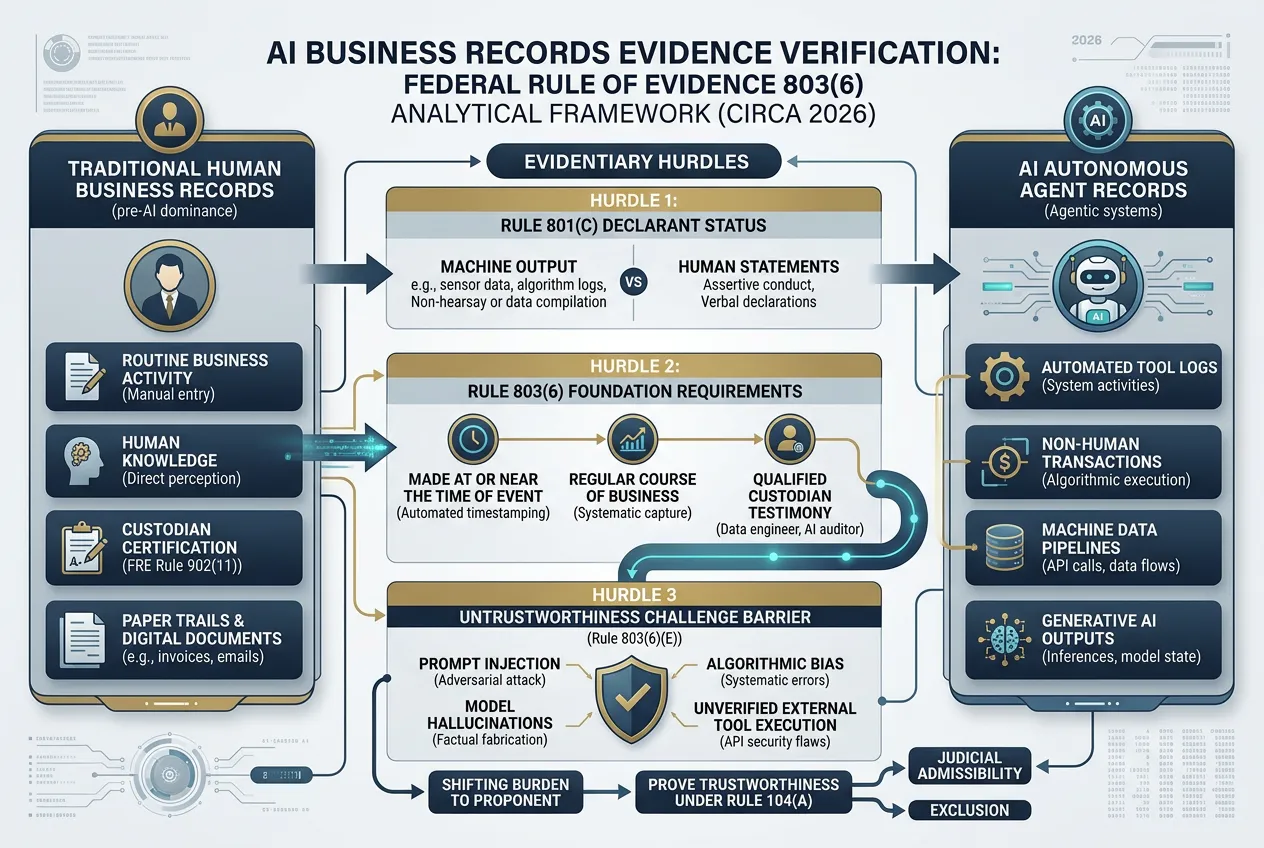
What Is the Legal Boundary Between AI Machine Output and Rule 803(6) Hearsay?
The foundational threshold in introducing artificial intelligence records in federal court begins with the definition of hearsay under Federal Rule of Evidence 801. Under Rule 801(b), a "declarant" is strictly defined as a natural person. As established in landmark federal precedents such as United States v. Lizarraga-Tirado (9th Cir. 2015) and United States v. Washington (4th Cir. 2007), purely automated data logging, GPS coordinates, and raw machine telemetry do not constitute statements by a person, and therefore sit entirely outside the hearsay prohibition.
However, modern enterprise autonomous AI agents do not operate as simple deterministic calculators. Production AI systems ingest human-authored natural language prompts, retrieve proprietary internal documents via semantic search, process inputs across non-deterministic large language models, and invoke external software tools via protocol layers like the Model Context Protocol (MCP). This multi-stage execution pipeline creates a complex evidentiary hybrid:
- Human Prompt Ingestion (Rule 801 / 802): Prompts submitted by employees or customers contain assertive natural-language assertions. If offered for the truth of the matter asserted within the prompt, they remain classic hearsay unless an independent exception applies.
- Machine-Generated Intermediate Processing (Rule 901(b)(9)): The model's algorithmic reasoning, token probability calculations, and deterministic tool calls represent machine processes that require authentication under Rule 901(b)(9) demonstrating system accuracy.
- Synthesized Final Business Deliverables (Rule 803(6)): When the AI agent compiles customer communications, credit underwriting decisions, automated medical triage notes, or transactional transaction ledgers and files them into corporate databases, trial counsel routinely offers the resulting output as a business record under Rule 803(6).
When corporate litigants seek to introduce an AI-synthesized report to prove the substantive truth of the factual conclusions stated in that report, federal judges refuse to bypass hearsay scrutiny simply because software generated the final document. If an autonomous agent compiles factual summaries derived from human input, the proponent must establish the traditional five-part foundation under Rule 803(6).
What Are the Five Mandatory Foundational Elements for AI Records Under Rule 803(6)?
To qualify an AI-generated or AI-assisted enterprise record under Federal Rule of Evidence 803(6), the proponent must establish five distinct statutory requirements through the testimony of a records custodian or another qualified witness, or by a formal certification under Rule 902(11) or 902(13):
| Rule 803(6) Requirement | Traditional Human Business Record | Autonomous AI Agent Record (2026 Standards) |
|---|---|---|
| 803(6)(A): Contemporaneous Creation | Document prepared by staff at or near the time of the event. | Automated transaction timestamping recorded instantaneously via immutable distributed trace spans at the millisecond of API execution. |
| 803(6)(B): Knowledge of Event | Record made by someone with personal knowledge or transmitted by someone with knowledge. | Verified ingest pipeline demonstrating that the underlying data ingested by the model originated from reliable primary sensors, verified databases, or authorized human inputs. |
| 803(6)(C): Regular Course of Business | Record kept in the regular course of an organization's ongoing business. | Agent workflows deployed as standard production operational architecture, rather than specialized ad-hoc prompt scripts generated in anticipation of litigation. |
| 803(6)(D): Regular Business Practice | Routine practice of the business to create such records. | Systematic corporate policy requiring autonomous agents to record, validate, and store structured audit logs for every transaction. |
| 803(6)(E): Trustworthiness Safeguards | Opponent fails to demonstrate untrustworthiness in source or preparation. | Verified defense against prompt injections, model hallucination audits, version-pinned weights, and deterministic schema validation. |
A common failure in federal litigation occurs when proponents treat any database printout as an automatic business record. In corporate litigation, courts require affirmative proof that the automated process was integral to the company's daily operational conduct. Documents prepared by an AI tool specifically to summarize past events for trial preparation are categorically barred under the longstanding doctrine of Palmer v. Hoffman (1943).
How Does Rule 803(6)(E) Function as an Untrustworthiness Shield Against Unreliable AI?
Under the 2014 amendments to Federal Rule of Evidence 803(6), the burden of proof regarding trustworthiness is structured with precision: once the proponent satisfies subsections (A) through (D), the record is presumptively admissible unless the opponent demonstrates that "the source of information or the method or circumstances of preparation indicate a lack of trustworthiness."
In the context of generative artificial intelligence and autonomous agent swarms, Rule 803(6)(E) has emerged as the primary evidentiary battleground in federal trials:
1. Indirect Prompt Injection and Context Contamination
Opposing counsel can challenge the trustworthiness of an AI business record by introducing evidence that the agent's input stream was vulnerable to indirect prompt injection. If an autonomous agent scraped external websites, read inbound third-party customer emails, or processed unvalidated document uploads, malicious prompt tokens could have hijacked the model's instructions, causing it to fabricate fraudulent transaction records or erroneous audit entries. Proof of context poisoning destroys the circumstantial guarantee of reliability upon which Rule 803(6) is built.
2. Algorithmic Hallucination and Model Non-Determinism
Because generative AI models rely on probabilistic sampling rather than deterministic retrieval, two identical inputs can yield divergent substantive answers unless temperature parameters are pinned strictly to 0.0. If an opponent demonstrates that the model exhibited variable error rates or fabricated factual assertions during the relevant time window, the court may sustain an 803(6)(E) objection unless the proponent shows active verification safeguards.
3. Procedural Burden-Shifting Under Rule 104(a)
When an opponent makes a colorable showing of algorithmic unreliability under Rule 803(6)(E), the court resolves the preliminary question of admissibility under Rule 104(a) by a preponderance of the evidence standard. The burden effectively shifts back to the proponent to establish that its automated AI pipelines maintained adequate technical firewalls, validation checks, and output guardrails to ensure trustworthiness.
Who Qualifies as a "Custodian or Other Qualified Witness" for AI Records?
Rule 803(6)(D) requires foundational testimony from a "custodian or another qualified witness." In traditional corporate litigation, a human resources manager or office administrator routinely serves as the records custodian. However, when autonomous AI agents generate the record, the legal standard for a "qualified witness" shifts significantly.
Federal courts do not require that the witness be a computer programmer or the machine learning research scientist who wrote the foundation model's weights (United States v. Chiaradio, 1st Cir. 2012). However, the witness must possess sufficient personal knowledge of the system's operational architecture to explain:
- How data is ingested, processed, and stored by the automated AI system;
- What internal security controls prevent unauthorized alteration or third-party context injection;
- How the enterprise monitors and evaluates model accuracy, drift, and output validity;
- That the AI system was functioning properly and reliably during the relevant timeframe.
A non-technical executive who merely prints an AI-generated PDF without understanding whether the output originated from human records, deterministic rules, or generative model synthesis will fail the qualification test. Enterprises preparing for federal litigation must train specialized technical custodians or rely on comprehensive self-authenticating affidavits under Rule 902(11) paired with technical certifications under Rule 902(13).
What Evidentiary Protocols Must Enterprises Implement to Secure AI Admissibility?
To withstand Rule 803(6)(E) untrustworthiness challenges and secure business record admissibility, enterprise legal and technical teams must establish five evidentiary protocols:
- Hardware-Backed Write-Once-Read-Many (WORM) Storage: Store all agent execution logs, prompt parameters, model outputs, and tool receipts in tamper-evident, append-only object storage.
- Cryptographic Hashes and Session Signatures: Generate deterministic SHA-256 or BLAKE3 hashes for every agent input-output trajectory immediately upon generation, enabling seamless self-authentication under Rule 902(14) Hash Verification.
- Constrained Decoding and Schema Enforcement: Enforce Context-Free Grammar (CFG) decoding on all agent tool calls to eliminate malformed syntax and guarantee deterministic data formatting as analyzed in our review of Agentic Constrained Decoding.
- Comprehensive OpenTelemetry Audit Spans: Maintain granular distributed tracing capturing the exact model snapshot ID, temperature, prompt template, and external tool responses under standardized OpenTelemetry GenAI Semantic Conventions.
- Periodic Golden Holdout Benchmarking: Regularly evaluate production agent pipelines against static, human-verified evaluation suites to create an objective audit trail proving system accuracy for Rule 104 Preliminary Admissibility.
Can an AI model itself qualify as a "declarant" under Federal Rule of Evidence 801?
No. Under Federal Rule of Evidence 801(b), a declarant is strictly defined as a natural person. Pure machine calculations, automated sensor readings, and raw algorithmic telemetry do not constitute hearsay statements under Rule 801(c). However, when AI outputs incorporate human assertions or are offered to prove the substantive truth of facts derived from human sources, hearsay exclusions and exceptions—including Rule 803(6)—remain fully applicable.
What is the difference between authenticating an AI record under Rule 901(b)(9) and qualifying it under Rule 803(6)?
Rule 901(b)(9) addresses authentication—proving that an automated process or system produces an accurate result. Rule 803(6) addresses hearsay—providing an exception for reliable records created in the regular course of business. An AI-generated report must satisfy both: it must be authenticated as an accurate product of the software under Rule 901, and it must satisfy the business records criteria under Rule 803(6) to overcome hearsay objections.
Does an opponent have to prove that an AI agent was hacked to exclude its records under Rule 803(6)(E)?
No. Rule 803(6)(E) requires only that the opponent present evidence showing that the source of information or the method or circumstances of preparation indicate a lack of trustworthiness. Demonstrating unmonitored model drift, variable hallucination rates, susceptibility to prompt injection, or the absence of quality assurance auditing is sufficient to shift the burden to the proponent under Rule 104(a).
For foundational guidelines on AI courtroom evidence, consult our analyses on Federal Court AI Standing Orders, Federal Rule of Evidence 604 AI Translations, and Federal Rule of Evidence 1006 Voluminous Summaries.