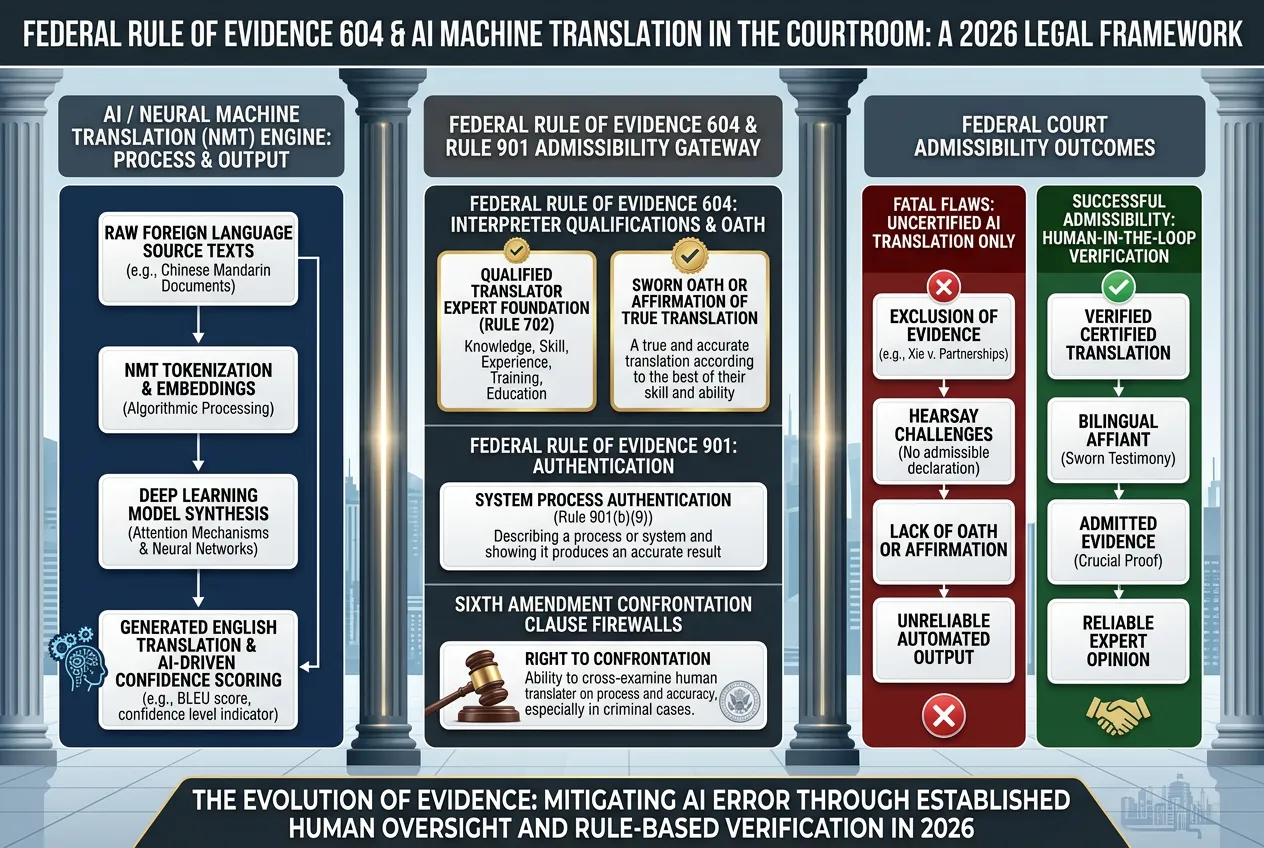
Federal Rule of Evidence 604 requires an interpreter or translator to be qualified and to give an oath or affirmation to make a true translation, creating a fatal evidentiary barrier for standalone artificial intelligence and machine-generated translations in 2026 federal litigation. As established in Xie v. The Partnerships and Unincorporated Associations (N.D. Ill. 2026), courts routinely strike uncertified machine translations because an automated model cannot take a sworn oath, establish qualified expert competency under Rule 702, or satisfy authentication prerequisites under Rule 901(b)(9). Litigants offering foreign-language documents must pair algorithmic translation pipelines with certified human-in-the-loop review and bilingual sworn declarations to ensure courtroom admissibility.
Why does Federal Rule of Evidence 604 bar standalone AI translation evidence?
Federal Rule of Evidence 604 establishes that an interpreter—a designation federal courts apply to translators of foreign-language written evidence as well as live spoken testimony—must be qualified as an expert under Federal Rule of Evidence 702 and must give an oath or affirmation to make a true translation. When litigation teams use large language models or commercial neural machine translation engines to render foreign-language contracts, communications, or exhibits into English, the resulting document lacks both statutory foundations.
In Xie v. The Partnerships and Unincorporated Associations (N.D. Ill. 2026), the federal court firmly excluded foreign-language exhibits accompanied solely by automated machine translations. The court held that submitting a machine-generated translation without identifying a qualified human translator who executed or verified the translation under oath or affirmation renders the evidence legally inadmissible. Because an algorithm cannot execute an affidavit under penalty of perjury or undergo cross-examination regarding its subjective semantic choices, offering standalone AI translation violates Rule 604 on its face.
Furthermore, Federal Rule of Evidence 901(b)(9) requires evidence describing a process or system to show that the process produces an accurate result. While automated translation systems exhibit high fluency, they remain prone to hallucinated idioms, dropped negative clauses, and subtle tone distortions that can invert legal obligations. Without a human witness attesting to accuracy under oath, an algorithmic translation remains an unverified secondary exhibit.
How do federal courts distinguish between oral interpreters and written documentary translations?
The Advisory Committee on Evidence Rules, during its October 15, 2026 meeting proceedings and historical reviews of Rule 604, has evaluated the procedural friction between live oral interpretation and written documentary translation. While the core text of Rule 604 was drafted primarily with courtroom oral interpreters in mind, federal courts across the circuits routinely cross-apply its qualification and oath requirements to written declarations, translated affidavits, and foreign documentary records.
       UNVERIFIED AI TRANSLATION                     GOVERNED ADMISSIBILITY PIPELINE
   [Foreign-Language Document]                    [Foreign-Language Document]
               │                                              │
               ▼                                              ▼
   [Autonomous LLM Translation]                   [Neural Machine Translation Engine]
               │                                              │
               ▼                                              ▼
   [Uncertified English Draft]                    [Qualified Bilingual Human Expert]
               │                                              │
   ┌───────────┴───────────┐                      ┌───────────┴───────────┐
   ▼                       ▼                      ▼                       ▼
No Sworn Oath        No Rule 702            Rule 604 Sworn Oath      Rule 901(b)(9)
Under Penalty of     Expert Witness         or Affirmation of        Process & Accuracy
Perjury (FRE 604)    Foundation             True Translation         Attestation
   │                       │                      │                       │
   └───────────┬───────────┘                      └───────────┬───────────┘
               ▼                                              ▼
       FATAL EXCLUSION                                ADMITTED AS EVIDENCE
   (Xie v. Partnerships 2026)                     (FRCP Rule 26 / FRE Rule 104)
In commercial and civil litigation, offering a foreign document in federal court requires compliance with Federal Rule of Civil Procedure 26, Federal Rule of Evidence 1002 (the Best Evidence Rule), and Rule 1008. If a translation is contested, the original foreign-language document constitutes the primary evidence; the English translation is merely secondary interpretive testimony. Consequently, if the translator is an unverified software program, the opposing party is deprived of the ability to test translation fidelity through depositions or evidentiary objections, mandating preclusion under Rule 403 and Rule 604.
What procedural standards apply to AI translation under state evidence codes?
State jurisdictions have moved to formalize documentary translation standards to prevent unvetted AI filings from flooding court dockets. Effective July 2, 2026, amendments to the Texas Rules of Evidence codified strict procedural mandates for foreign-language documents offered into evidence.
Under the Texas evidentiary framework, any foreign-language document must be served on all opposing parties well in advance of trial alongside:
- An accurate English translation;
- An affidavit or unsworn declaration under penalty of perjury executed by a qualified translator;
- Specific attestations demonstrating the translator's bilingual qualifications and affirming that the translation is true, accurate, and complete.
Failure to meet these advance filing deadlines or reliance on automated software translations without an accompanying human declaration results in automatic exclusion upon timely objection. Other state supreme courts, including New York and California, have issued administrative guidelines cautioning attorneys that submitting court documents translated by consumer AI tools without licensed human verification breaches counsel's pre-filing diligence duties.
How does the Sixth Amendment Confrontation Clause impact AI translations in criminal proceedings?
In federal criminal prosecutions, the constitutional stakes of machine translation are acute. Under the Sixth Amendment Confrontation Clause and the Supreme Court's Crawford v. Washington doctrine, a criminal defendant has the fundamental right to be confronted with the witnesses against them. When the government introduces testimonial hearsay translated from a foreign language—such as recorded wiretaps, foreign law enforcement witness statements, or overseas encrypted messages—the translation itself is testimonial.
If the government were to rely on an autonomous AI model to translate incriminating foreign statements, the defendant cannot cross-examine the machine regarding algorithmic bias, training set hallucinations, or syntactic misinterpretations. Federal courts require the human linguist who vouched for the translation to take the stand under Rule 604, subjecting their semantic choices, dialect competency, and contextual accuracy to rigorous cross-examination. An AI translation offered without an examining human witness creates structural constitutional error under the Sixth Amendment.
What protocol ensures admissibility for AI-assisted legal translations?
To capture the efficiency and velocity of enterprise neural translation models while guaranteeing evidentiary admissibility in federal court, litigation departments must enforce a three-stage procedural protocol:
- Enterprise Neural Translation with Data Firewalls: Execute the preliminary translation using dedicated enterprise translation infrastructure governed by contractual Zero Data Retention (ZDR) to prevent client confidentiality breaches under Model Rule 1.6 and avoid third-party privilege waiver.
- Independent Bilingual Human Verification: Retain a qualified professional linguist or accredited court translator to conduct a line-by-line review of the algorithmic output against the source document, reconciling idiomatic anomalies, specialized legal terminology, and syntax.
- Execution of Formal Rule 604 Certification: Have the qualified human translator execute a formal sworn affidavit or declaration under 28 U.S.C. § 1746 affirming their professional qualifications, detailing their verification methodology under Rule 901(b)(9), and providing the solemn oath required by Rule 604 that the English rendition is a true and accurate translation of the foreign original.
Can an attorney certify an AI translation using their own Rule 11 signature?
No. An attorney's signature under Federal Rule of Civil Procedure 11 certifies that reasonable inquiry has been made into the factual and legal basis of a pleading, but it does not satisfy Rule 604's requirement for a qualified expert interpreter giving an oath of translation accuracy. Unless the attorney qualifies as a fluent bilingual expert and executes a separate factual declaration subject to cross-examination, an attorney cannot serve as the certifying translator for their own client's exhibits.
Does Federal Rule of Evidence 901(b)(9) allow admission of machine translation as a 'system or process'?
Rule 901(b)(9) permits authentication of evidence produced by a system or process showing that it produces an accurate result, but it serves as a supplement to, rather than an exemption from, Rule 604. Even if a party introduces technical testimony proving that a neural machine translation architecture achieves high benchmark scores, Rule 604 independently mandates that an interpreter or translator be qualified and take an oath affirming that the specific translation offered into court is true and accurate.
Litigation teams seeking to establish robust digital discovery workflows can explore our framework on Federal Rule of Evidence 902(14) Hash Verification, review federal judicial gatekeeping standards under Federal Rule of Evidence 104 Preliminary Questions, and examine the judicial allocation of digital proof under Federal Rule of Evidence 1008 Best Evidence.