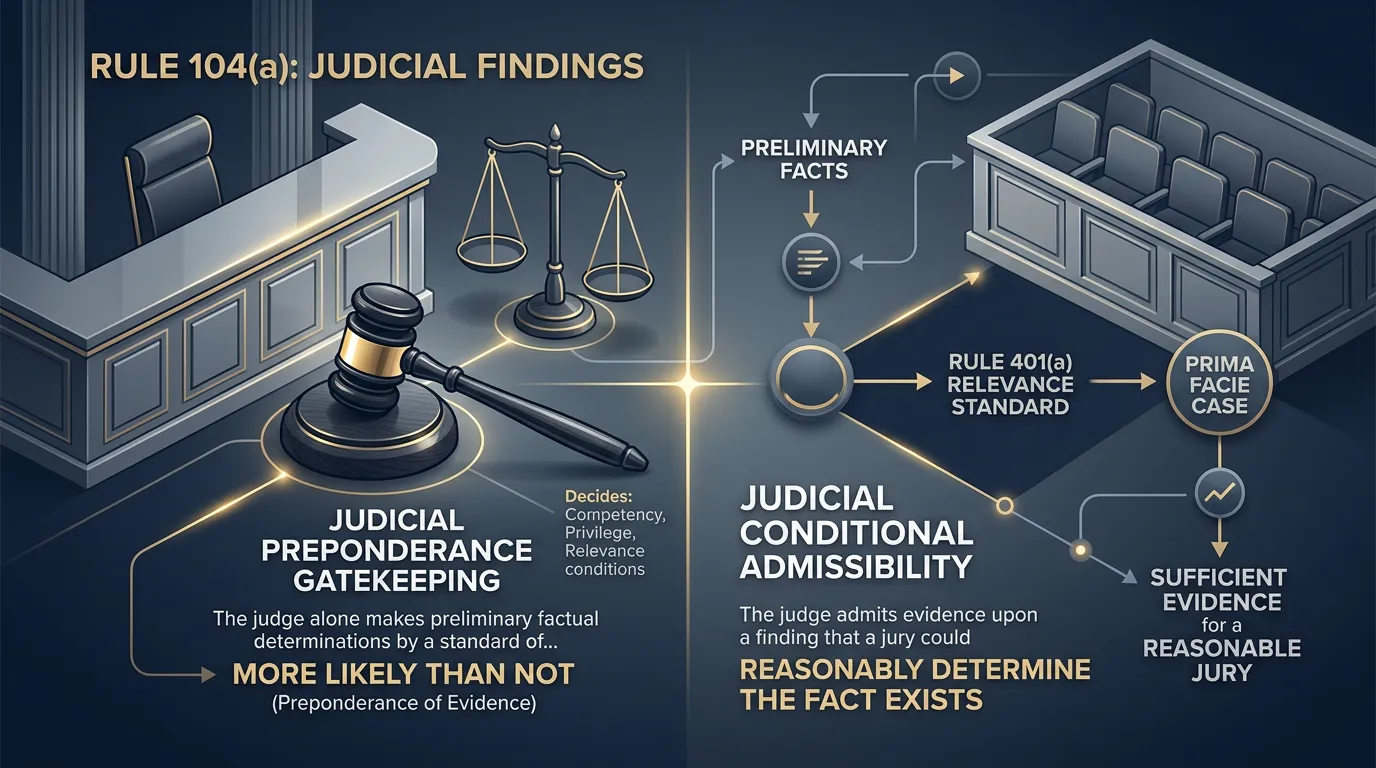
Federal Rule of Evidence 104 governs how trial judges determine preliminary questions of admissibility, privilege, and relevance before evidence reaches a jury. In 2026, the Judicial Conference Advisory Committee on Evidence Rules approved landmark amendments to Rule 104, explicitly codifying the preponderance standard for judicial determinations under Rule 104(a) while eliminating the doctrine of conditional relevance under Rule 104(b).
Why Is the Advisory Committee Amending Federal Rule of Evidence 104?
Federal Rule of Evidence 104 divides responsibility between the trial judge and the jury when evaluating evidence. Despite its foundational importance across federal litigation, Rule 104 has historically suffered from two major structural ambiguities:
- Textual Absence of the Standard of Proof in Rule 104(a): Although the Supreme Court settled in Bourjaily v. United States (1987) that preliminary questions of admissibility are determined under a preponderance of the evidence standard (more likely than not), Rule 104(a) itself omitted any reference to a standard of proof. In complex litigation—particularly surrounding expert testimony under Rule 702 and emerging machine-generated data—practitioners and trial courts frequently conflated admissibility screening with jury-weight questions.
- The Fallacy of "Conditional Relevance" in Rule 104(b): For decades, evidence scholars and practitioners criticized Rule 104(b)’s framing of "conditional relevance." Because virtually all evidence depends upon intermediate premises to connect it to an issue in dispute, segregating a special category of "conditional" relevance created persistent confusion and erroneous trial court rulings.
The Advisory Committee on Evidence Rules approved amendments to both subdivisions, released for public comment running from August 15, 2026 through February 15, 2027, to harmonize these standards across federal practice.
How Does Rule 104(a) Codify the Preponderance Standard?
Under existing Rule 104(a), the trial court must resolve preliminary questions regarding whether a witness is qualified, a privilege exists, or evidence is admissible. In making these determinations, the judge is not bound by evidence rules, with the exception of privilege.
The 2026 proposed amendment adds an operative sentence to the text of Rule 104(a):
"Unless these rules provide otherwise, the proponent must establish the existence of a preliminary fact by a preponderance of the evidence."
This revision firmly embeds the Bourjaily standard into the rulebook. In practical litigation, this standard applies to:
- Hearsay Exceptions: Factual predicates such as whether a declarant was under the stress of excitement for an excited utterance under Rule 803(2), or whether a conspiracy existed under Rule 801(d)(2)(E).
- Privilege Inquiries: Attorney-client communication elements and work product protections.
- Expert and Machine Reliability: The gatekeeping foundation under Rule 702 and proposed Rule 707, requiring affirmative proof that methods and applications are reliable.
By codifying preponderance directly in Rule 104(a), the rule ensures courts cannot bypass their gatekeeping role by deferring foundational admissibility disputes to the jury.
Why Did the Advisory Committee Eliminate "Conditional Relevance" in Rule 104(b)?
Under the former Rule 104(b), when the relevance of evidence depended on whether a fact existed, the proponent was required to introduce proof "sufficient to support a finding" that the fact existed. Under Huddleston v. United States (1988), this prima facie standard simply asks whether a reasonable jury could find the conditional fact by a preponderance of the evidence.
However, as Professor Ronald Allen and the Advisory Committee noted, all logical relevance relies on connecting premises. Creating a distinct category of "conditional relevance" suggested that ordinary relevance was somehow different.
The revised Rule 104(b) eliminates the term "conditional relevance" and refocuses on general relevance under Rule 401(a):
Rule 104(b) Relevance: "To establish that evidence is relevant, the proponent must demonstrate to the court that the trier of fact could reasonably find that the requirements of Rule 401(a) have been met. In making its relevance determination under Rule 401(a), the court may consider the evidence itself, other evidence, and common knowledge and experience. The court may admit the proposed evidence on the condition that further proof be introduced later."
Key Operational Takeaways:
- Jury Probativeness vs. Judicial Materiality: The amended rule focuses Rule 104(b) squarely on Rule 401(a) (the tendency to make a fact more or less probable). In contrast, Rule 401(b) (whether a fact is of consequence to the action) is a matter of substantive law reserved exclusively for judicial resolution under Rule 104(a).
- Common Knowledge and Experience: Judges evaluating relevance may rely not only on formal record evidence, but also on common sense and the expected background knowledge of reasonable jurors in that venue.
- Connecting Up: The amendment explicitly retains the court's discretion to admit evidence provisionally, subject to the proponent introducing connecting proof later in the proceeding.
How Does Rule 104 Interact with Rule 702 and AI Evidence?
The clarification of Rule 104 has direct consequences for digital evidence, complex technical data, and AI-generated outputs:
| Evidence Rule | Admissibility Threshold | Decision Maker | Application to Complex & AI Evidence |
|---|---|---|---|
| Rule 104(a) | Preponderance of the Evidence (More likely than not) | Trial Judge | Gatekeeping reliability for expert testimony (Rule 702), proposed AI reliability standards (Rule 707), and privilege assertions. |
| Rule 104(b) | Prima Facie / Evidence Sufficient to Support a Finding | Jury (Screened by Judge) | Logical probativeness under Rule 401(a), chain of custody baseline links, and witness personal knowledge (Rule 602). |
| Rule 901(a) | Prima Facie Authenticity | Jury (Screened by Judge) | Showing that a file, digital record, or physical exhibit is what the proponent claims it is. |
Litigants can no longer argue that foundational flaws in algorithmic outputs, forensic software, or automated models are mere questions of "weight for the jury" under Rule 104(b). If an objection challenges the underlying reliability or admissibility of a process, Rule 104(a) mandates a judicial finding by a preponderance of the evidence.
What Strategic Steps Should Litigants Take Under the 2026 Standards?
Trial counsel preparing federal civil and criminal cases must calibrate their evidentiary motions to align with these clarified standards:
- Frame Admissibility Challenges Under Rule 104(a): Do not permit opponents to treat technical, forensic, or hearsay foundation gaps as conditional relevance. Explicitly invoke the Rule 104(a) preponderance requirement.
- Distinguish Rule 401(a) Probativity from 401(b) Materiality: When challenging whether an issue belongs in the trial, direct the court to Rule 401(b) as a matter of substantive law governed by Rule 104(a).
- Formalize "Connecting Up" Objections: Where opposing counsel seeks conditional admission of complex evidence under Rule 104(b), demand specific proffer benchmarks on the record and establish definite trial timelines for striking unfulfilled evidence.
For broader analysis of federal procedural developments, explore our reviews of Federal Court AI Standing Orders, Federal Rule of Evidence 901(c) Deepfakes Authentication, and Federal Rule of Evidence 707 AI Evidence Without Experts.
Did the Advisory Committee eliminate Rule 104(b) entirely?
No. The Advisory Committee eliminated the outdated terminology and conceptual framework of "conditional relevance," replacing it with a clear, uniform standard for evaluating general logical relevance under Rule 401(a).
What standard applies to determining witness qualifications and privileges?
Under Rule 104(a), all preliminary determinations regarding witness competence, qualification, privilege, and general admissibility are decided by the judge under a preponderance of the evidence standard.
How does Rule 104 affect machine-generated or automated evidence?
If evidence is offered as expert opinion or automated technical findings that substitute for human expertise, Rule 104(a) requires the judge to find by a preponderance of the evidence that the underlying principles, methods, and applications are reliable.