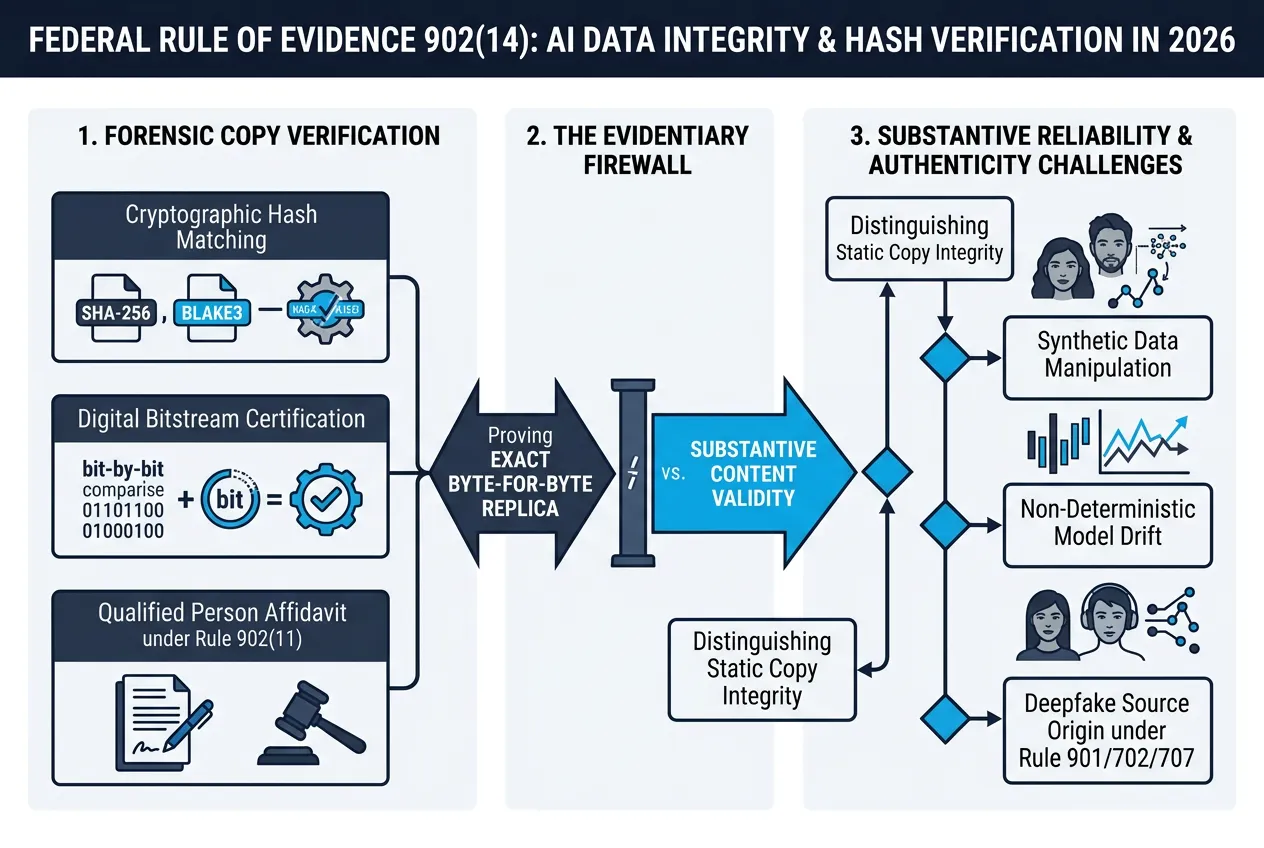
Federal Rule of Evidence 902(14) self-authenticates certified digital copies of electronic records through cryptographic hash matching, but in 2026 federal litigation, courts maintain a strict boundary: certifying an exact byte-for-byte replica confirms only that the file was duplicated without alteration, not that the underlying AI output is truthful, unmanipulated, or methodologically reliable under Federal Rule of Evidence 702. While Rule 902(14) eliminates live custodial testimony for forensic bitstream images, substantive admissibility requires independent scrutiny of model provenance and prompt fidelity.
What Is Federal Rule of Evidence 902(14) in Modern AI Discovery?
Federal Rule of Evidence 902 governs self-authenticating evidence—categories of documents and records requiring no extrinsic evidence of authenticity to be admitted into court. Enacted in 2017 alongside Rule 902(13), Rule 902(14) provides an expedited evidentiary pathway for digital data:
Rule 902(14). Certified Data Copied from an Electronic Device, Storage Medium, or File. Data copied from an electronic device, storage medium, or file, if authenticated by a process of digital identification, as shown by a certification of a qualified person that complies with the certification requirements of Rule 902(11) or (12). The proponent also must meet the notice requirements of Rule 902(11).
In conventional computer forensics and electronic discovery (eDiscovery), Rule 902(14) eliminated the routine necessity of calling forensic examiners to trial merely to testify that an extracted hard drive image, server partition, or email PST archive matched the original device. By generating an identical cryptographic hash value—such as SHA-256 or BLAKE3—and executing a sworn written certificate under penalty of perjury, litigants establish that the proffered electronic copy is an authentic duplicate of the target file.
In 2026 enterprise AI litigation, however, Rule 902(14) has become a primary procedural battleground. Litigants routinely seek to introduce training corpora, fine-tuning checkpoints, model configuration files, autonomous agent scratchpads, and synthetic inference logs via Rule 902(14) forensic certificates, asserting that cryptographic hash matching shields the contents from further evidentiary challenge.
Federal judges are consistently rejecting this overbroad interpretation. While Rule 902(14) forensically authenticates that an electronic file has not been altered since acquisition, it establishes zero presumption regarding how the AI system generated the data or whether the original file represents synthetic fiction.
What Is the Procedural Distinction Between Rule 902(13) and Rule 902(14)?
Although codified together, subdivisions (13) and (14) of Rule 902 address distinct evidentiary questions that litigators must not conflate:
+---------------------------------------------------------------------------------+
|                     FEDERAL RULE OF EVIDENCE 902 COMPARISON                     |
+---------------------------------------------------------------------------------+
|                                                                                 |
|  RULE 902(13): SYSTEM PROCESS ACCURACY                                          |
|  • Scope: Records generated by an electronic process or system.                 |
|  • Standard: Proponent must prove the process "produces an accurate result."   |
|  • Focus: Dynamic logging, database triggers, telemetry pipelines, agent loops.|
|                                                                                 |
|  RULE 902(14): STATIC DATA COPY REPLICATION                                     |
|  • Scope: Data copied from an electronic device, storage medium, or file.      |
|  • Standard: Proponent must prove identical copy through "digital identification"|
|  • Focus: Static file extraction, bitstream disk images, export archives.       |
|                                                                                 |
+---------------------------------------------------------------------------------+
As analyzed in our review of Federal Rule of Evidence 902(13), subdivision (13) scrutinizes whether the generative software process itself operated reliably. Subdivision (14), by contrast, is agnostic to the process that created the original data; it evaluates solely whether the duplicate offered into evidence is a pristine, bit-for-bit twin of the source file.
What Does Cryptographic Hash Matching Actually Prove in Court?
To evaluate the evidentiary weight of a Rule 902(14) certificate in AI disputes, courts and litigators must distinguish between transmission integrity and substantive veracity:
| Evidentiary Dimension | Verified by Rule 902(14) Hash? | Controlling Evidentiary Rule |
|---|---|---|
| Bitstream Copy Integrity | Yes. Confirms zero byte drift between target and copy. | FRE 902(14) |
| Chain of Custody Provenance | Yes. Verifies file acquisition timestamp and custodian. | FRE 902(14) / 902(11) |
| Source Reality vs. Synthetic Deepfake | No. An authentic copy of a deepfake is still a deepfake. | FRE 901(a) / Proposed 901(c) |
| Algorithmic Reasoning Reliability | No. Mathematical hashing does not vet model logic. | FRE 702 / Daubert |
| Hearsay Exemption / Declarant Truth | No. Hashing does not satisfy Rule 801/803 requirements. | FRE 801 / 802 |
The Advisory Committee on Evidence Rules noted in its original advisory notes to Rule 902(14) that "a hash value is a unique algorithmically generated string of characters that represents the digital data in a file." In mathematical forensics:
- A single altered token, space, or timestamp in an AI output file changes its SHA-256 hash completely (the avalanche effect).
- A matching hash conclusively proves that the forensic copy is identical to the file harvested from the enterprise server or cloud bucket.
However, as federal courts emphasize, proving that an attorney possesses an exact byte-for-byte duplicate of an AI agent's inference log does not prove that:
- The AI agent had access to authentic enterprise ground truth.
- The prompt provided to the model was unpoisoned.
- The model's statistical inference was accurate rather than an ungrounded hallucination.
- The synthesized digital audio or video clip was not an AI-generated deepfake.
A proponent who certifies an AI dataset under Rule 902(14) satisfies the procedural burden of showing that their trial exhibit is what was extracted from the server. The opponent remains fully empowered to challenge the exhibit’s admissibility under Federal Rule of Evidence 104, Federal Rule of Evidence 801, and Federal Rule of Evidence 1006.
What Are the Mandatory Statutory Prerequisites for a Rule 902(14) Certificate?
Litigators seeking to admit certified AI logs, model snapshots, or training weights without live custodian testimony must satisfy four statutory prerequisites:
1. Written Certificate Executed by a "Qualified Person"
The certification must be executed under penalty of perjury by a digital forensics examiner, systems administrator, or qualified engineer with direct personal knowledge of the acquisition methodology. The certificate must document the declarant's forensic training, professional certifications (e.g., EnCE, CCE, GIAC), and the exact hardware/software utilized during extraction.
2. Specification of the Digital Identification Process
The declarant must detail the cryptographic methodology employed. Generic assertions that "the files were safely copied" are legally insufficient. The certificate must affirmatively state:
- The exact cryptographic hashing algorithm used (e.g., SHA-256, SHA-3, BLAKE3).
- The baseline hash calculated on the source storage medium immediately upon acquisition.
- The verification hash calculated on the working duplicate offered into court, demonstrating an identical string.
3. Compliance with Rule 902(11) / 902(12) Formalities
Rule 902(14) explicitly requires the certificate to meet the procedural standards of Rule 902(11) (for domestic records) or Rule 902(12) (for foreign records). The declaration must state that the data was captured at or near the time of the event, kept in the course of a regularly conducted activity, and that making the record was a regular business practice.
4. Reasonable Pre-Trial Written Notice and Inspection Opportunity
Proponents must provide adverse parties reasonable advance written notice of their intent to introduce the certified record, making both the record and the forensic declaration available for inspection. In complex AI litigation, this disclosure window allows opposing counsel to perform independent hash verification, review forensic disk images, and examine associated metadata headers.
How Does Advisory Committee Activity in 2026 Frame Rule 902(14)?
In the Advisory Committee on Evidence Rules October 2026 meeting agenda materials and ongoing digital evidence studies, the Committee addressed the intersection of Article IX self-authentication and emergent artificial intelligence technologies:
- Rejection of Premature Rule Rewrites: The Evidence Rules Committee determined that Article IX’s existing framework—including Rules 901, 902(13), and 902(14)—remains procedurally sound and capable of addressing electronic evidence without requiring emergency statutory modifications to Rule 902.
- Preservation of the Substantive Gatekeeping Boundary: The Committee highlighted that self-authentication under Rule 902(14) was intentionally designed as a narrow, mechanical substitute for custodian testimony. It was never intended to serve as a substantive screening mechanism for machine reliability or expert validity.
- Complementary Role with Proposed Rule 901(c): While Rule 902(14) handles bitstream copy preservation, evidentiary gatekeeping regarding whether an AI-generated exhibit is an authentic representation or a synthetic fabrication is addressed under Rule 901(a) and the ongoing study of Proposed Rule 901(c).
Practical Litigation Checklist: Managing AI Hash Certificates
For trial attorneys and corporate counsel handling complex disputes involving AI data, implementing a rigorous evidentiary protocol is vital:
- Demand Forensic Dual-Hashing: In discovery protocols and ESI agreements, mandate that all exported AI model checkpoints, training datasets, and interaction logs be hashed with both SHA-256 and BLAKE3 to prevent collision vulnerabilities.
- Audit Environmental Metadata: Verify that the Rule 902(14) certificate documents full environmental metadata—including container images, environment variables, GPU driver versions, and system timestamps—rather than isolated text files.
- Separate Copy Authenticity from Model Authenticity: When confronted with an opponent's Rule 902(14) certificate, immediately concede copy integrity if the hash matches, but preserve and brief all substantive objections under Rule 403 (unfair prejudice), Rule 702 (scientific reliability), and Rule 802 (hearsay).
- Inspect Extraction Write-Blockers: In high-stakes intellectual property or regulatory enforcement actions, ensure the certifying examiner utilized hardware or software write-blockers during acquisition to guarantee that the source AI memory store was not modified during collection.
For additional frameworks on digital evidence compliance and judicial expectations, review our guides on Federal Rule of Evidence 1008 and Best Evidence and Federal Court AI Standing Orders.
Does a Rule 902(14) certificate prove that an AI-generated document is true?
No. Federal Rule of Evidence 902(14) establishes only that the electronic file offered into court is an exact digital duplicate of the source file, verified by matching cryptographic hash values. It does not establish the factual accuracy, truthfulness, or legal reliability of the information contained within the file.
What is the primary difference between Rule 902(13) and Rule 902(14)?
Rule 902(13) certifies that an automated electronic system or software process operates reliably to produce an accurate result (e.g., an automated telemetry log). Rule 902(14) certifies that a static copy of electronic data is identical to the original source file, verified through digital identification like a cryptographic hash.
Can an opposing party challenge a Rule 902(14) certification if the hash matches?
Yes. While a matching hash value defeats claims that the copy was tampered with after extraction, the opposing party may depose the certifying technician, challenge whether the source file was corrupted before extraction, or assert substantive objections under Rules 403, 702, and 802.
Which cryptographic algorithms are acceptable for Rule 902(14) digital identification?
Federal courts and digital forensics standards widely accept SHA-256, SHA-3, and modern secure hashing standards like BLAKE3. Older algorithms with documented collision vulnerabilities, such as MD5 and SHA-1, are frequently contested and should not be relied upon as sole identifiers in contested litigation.
"""