Federal court AI standing orders in 2026 form a fragmented jurisdictional patchwork across federal district courts rather than a unified national standard. While the Federal Judicial Center provides educational guidance without imposing mandatory filing certifications, individual district judges and local rules have enacted divergent protocols ranging from front-page generative AI disclosures and mandatory verification affidavits to zero data retention requirements. To avoid Rule 11 sanctions and evidentiary exclusions, litigation teams must implement proactive pre-filing verification pipelines.
Why Is There No Single Federal Rule Governing AI Disclosures in Court Filings?
Litigators frequently ask whether practice before the federal judiciary has converged around a national standard governing generative artificial intelligence. The answer is unequivocally no. As of late 2026, the Judicial Conference of the United States and the Advisory Committee on Civil Rules have not promulgated an amendment to Federal Rule of Civil Procedure 11 or a standalone national rule mandating generative AI disclosure.
Instead, federal judicial regulation of artificial intelligence has developed primarily through individual judicial standing orders and targeted local civil rules. This distributed regulatory structure reflects the judiciary's deliberate institutional choice: allow trial judges flexibility to manage their individual dockets while national rule-making committees observe empirical data on AI-assisted litigation.
Consequently, litigation counsel face a multi-tiered regulatory framework:
- National Foundations: Federal Rule of Civil Procedure 11(b), requiring reasonable inquiry into factual assertions and existing law under signed filings.
- Local District Rules: Formal district-wide rules, such as Northern District of Texas Local Civil Rule 7.2(f), creating mandatory disclosure obligations for all cases within the division.
- Individual Judge Standing Orders: Chambers-specific procedural rules governing filing verification, disclosure certificates, and software identification.
- Institutional Education: Guidance from the Federal Judicial Center (FJC), such as An Introduction to Artificial Intelligence for Federal Judges (updated July 2026), focusing on judicial accountability without imposing litigant filing burdens.
What Are the Four Primary Categories of Federal Court AI Standing Orders in 2026?
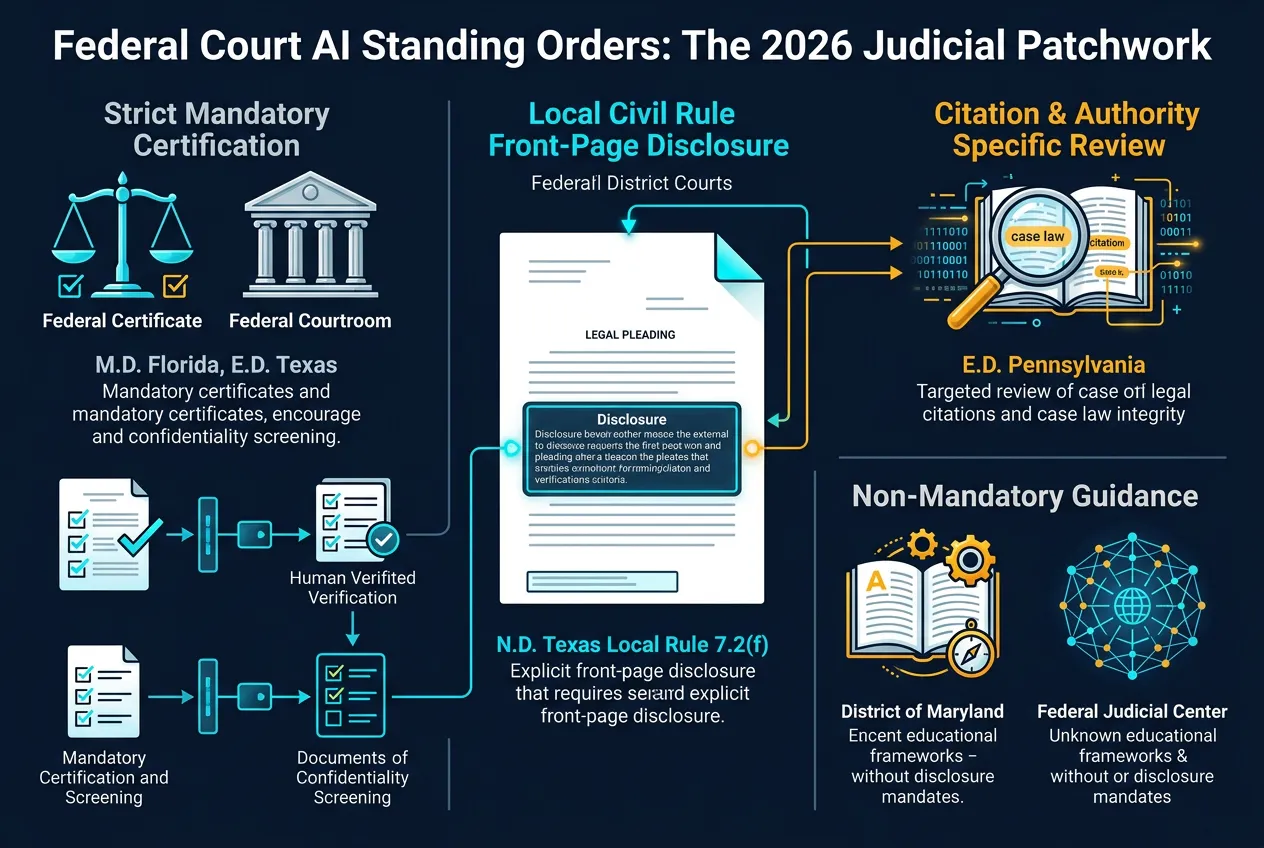
Federal district courts across the United States currently fall into four distinct procedural archetypes. Understanding which archetype governs a specific chambers is essential for every federal litigator.
| Judicial Archetype | Governing Districts / Chambers | Primary Filing Requirement | Sanctions Exposure |
|---|---|---|---|
| 1. Strict Mandatory Certification | M.D. Fla. (Judge Dalton), E.D. Tex. (multiple judges), N.D. Tex. (Judge Brantley Starr) | Affirmative certification attached to all filings; human cross-check of every cite against reporter volumes; disclosure of whether confidential client data entered prompts. | Striking of non-compliant pleadings; monetary fines; mandatory show-cause hearings under Rule 11. |
| 2. Front-Page Local Rule Disclosure | N.D. Tex. Local Civil Rule 7.2(f) | Briefs drafted with AI assistance must expressly state AI usage on the face of the first page; silence certifies zero AI involvement. | Procedural rejection of brief; waiver of arguments; costs of motion practice. |
| 3. Targeted Citation Verification | E.D. Pa. (Judge Baylson, Judge Savage), D. Mass. | Narrow focus on legal citations, parentheticals, and direct quotations; mandatory human verification against official reporters. | Evidentiary exclusion; disciplinary referral for fabricated citations. |
| 4. Educational / Non-Mandatory Guidance | District of Maryland, Federal Judicial Center (FJC) | Emphasizes existing ethical obligations under Model Rules 1.1, 1.6, and 3.3 without requiring procedural AI disclosure forms. | Governed by traditional Rule 11 standards and professional conduct rules. |
Archetype 1: Strict Mandatory Certification
Chambers operating under strict certification standing orders require counsel to file a standalone declaration or certificate with every motion, brief, or pleading. For example, Judge Brantley Starr’s widely cited order in the Northern District of Texas requires attorneys to certify either that no generative AI tool was used in drafting the filing, or that any AI-generated text was reviewed for accuracy by a human being using traditional legal databases.
More recently, chambers in the Middle District of Florida and Eastern District of Texas have expanded these certificates to demand disclosures regarding data privacy and client confidentiality. Filers must certify that client confidences were not disclosed to consumer-grade AI models lacking enterprise Zero Data Retention (ZDR) guarantees.
Archetype 2: Local Civil Rule Front-Page Disclosure
The Northern District of Texas formalized AI disclosure at the district level through Local Civil Rule 7.2(f). Under this rule, counsel need not draft complex independent declarations; rather, any brief prepared with generative AI assistance must state that fact prominently on the first page. Crucially, the rule operates with an automatic negative inference: omitting the disclosure constitutes an affirmative legal certification that artificial intelligence was not utilized in preparing the document.
Archetype 3: Targeted Citation & Quotation Verification
Recognizing that the primary operational hazard of generative AI is citation hallucination rather than stylistic drafting assistance, judges in the Eastern District of Pennsylvania have adopted orders narrowly focused on citation integrity. These orders require counsel to verify that every cited authority, docket entry, and direct quotation exists in an official Westlaw, Lexis, or published reporter volume. Where courts discover nonexistent precedent, judges invoke sua sponte show-cause orders under Rule 11(c)(3).
Archetype 4: Non-Mandatory Guidance and Reliance on Rule 11
Conversely, courts like the District of Maryland and guidance published by the Federal Judicial Center have consciously declined to impose special AI disclosure certificates. These jurisdictions reason that Rule 11, Model Rule 1.1 (Competence), and Model Rule 3.3 (Candor toward the Tribunal) already hold lawyers strictly accountable for every syllable in their court filings. In these courtrooms, adding administrative paperwork is deemed redundant, provided counsel verifies accuracy before filing.
How Does Model Rule 1.6 Intersect with Federal AI Standing Orders?
A growing number of federal judges are incorporating client confidentiality standards into their standing orders. When litigators paste sensitive deposition transcripts, unredacted client financial records, or proprietary trade secrets into cloud-hosted generative AI prompts, they risk waiving attorney-client privilege or violating ABA Model Rule 1.6(c).
In several federal districts, standing orders now require counsel to confirm that:
- Prompts were submitted strictly to enterprise platforms with contractual Zero Data Retention (ZDR) and zero-training guarantees.
- Protected health information (PHI) and personally identifiable information (PII) were scrubbed prior to model inference.
- No information subject to a protective order under Federal Rule of Civil Procedure 26(c) was processed across public APIs.
Firms that rely on consumer-grade models or open-web AI interfaces cannot execute these certifications without exposing the firm to malpractice liability and severe evidentiary sanctions.
What Pre-Filing Verification Protocol Protects Litigation Teams in 2026?
To safely navigate this federal patchwork, corporate legal departments and litigation boutiques must establish a standardized, defensible Pre-Filing AI Verification Protocol:
[Drafting Phase]
  │  LLM / Legal Agent Draft Generation
  ▼
[Automated Citation Extraction]
  │  Parse all case citations, statutes, record citations, and parentheticals
  ▼
[Deterministic Legal Corpus Check]
  │  Automated query against primary reporters (Westlaw / Lexis / Fastcase)
  ▼
[Human Attorney Cite-Checking]
  │  Paralegal/Associate reviews pinpoint quotes against official reporter text
  ▼
[Local Rule & Standing Order Audit]
  │  Docket check: Does the presiding judge require Form AI-1 or Rule 7.2(f) disclosure?
  ▼
[Rule 11 Certification & Signature]
└── Attorney of Record signs filing with verified compliance record- Chambers-Specific Standing Order Check: Before drafting commences, review the presiding judge's docket on the court’s website. Never rely on general district rules alone; individual magistrate and district judges often have conflicting requirements within the same courthouse.
- Two-Pass Citation Verification: Every legal assertion and pinpoint quote must be manually cross-checked against primary law. Never cite a case unless counsel has retrieved and read the underlying judicial opinion.
- Enterprise Zero-Retention Infrastructure: Require all litigation personnel to utilize enterprise-grade legal platforms (such as Prest0) that operate under strict zero-retention architecture, preventing client data from entering public training pools.
- Standardized Disclosure Boilerplate: Where local rules or standing orders mandate disclosure, utilize precise, objective language: > "Counsel certifies that generative artificial intelligence was utilized in the research and structural drafting of this brief. In compliance with the Court’s Standing Order, counsel of record personally verified the accuracy, validity, and legal relevance of all cited authorities, factual citations, and quotations using primary legal sources."
Frequently Asked Questions (FAQ)
Does the Federal Judicial Center require litigators to disclose generative AI use?
No. The Federal Judicial Center (FJC) publishes educational materials for federal judges—including its comprehensive bench guide An Introduction to Artificial Intelligence for Federal Judges—but it does not issue standing orders or mandate disclosure requirements for practicing litigants.
What happens if an attorney fails to disclose AI use in a court that requires it?
Failure to disclose violates local court rules and judicial standing orders, triggering orders to show cause under Federal Rule of Civil Procedure 11. Consequences range from striking the offending brief and imposing opposing counsel's attorney fees to disciplinary referrals and public sanctions.
Does checking a brief for accuracy excuse an attorney from filing a required AI disclosure?
No. In jurisdictions operating under affirmative disclosure rules (such as N.D. Tex. Local Rule 7.2(f) or Judge Starr’s standing order), human accuracy verification is an additional requirement, not an alternative to disclosure. Both obligations must be satisfied.
Are there federal judges who explicitly prohibit generative AI entirely?
While early in the emergence of generative AI a small handful of judges experimented with outright prohibitions, the overwhelming judicial consensus in 2026 permits generative AI as an administrative and drafting tool, provided counsel undertakes strict, verifiable human-in-the-loop validation of all legal arguments and citations.
Related reading: