Can litigators introduce generative artificial intelligence summaries of voluminous corporate records as substantive evidence under Federal Rule of Evidence 1006? Under Federal Rule of Evidence 1006, federal courts permit artificial intelligence and machine-generated summaries of voluminous admissible writings, recordings, or electronically stored information to be admitted as substantive evidence, provided that three mandatory prerequisites are established: the underlying source records are independently admissible, the raw documents are made available to opposing counsel for inspection and testing, and the proponent affirmatively proves the mathematical and semantic accuracy of the algorithmic extraction.
Where an algorithmic summary interprets, models, or synthesizes underlying data rather than performing direct arithmetic aggregation, federal trial judges enforce dual gatekeeping firewalls under Rule 1002 and Rule 403, requiring testifying witness sponsorship to prevent prejudicial automation bias.
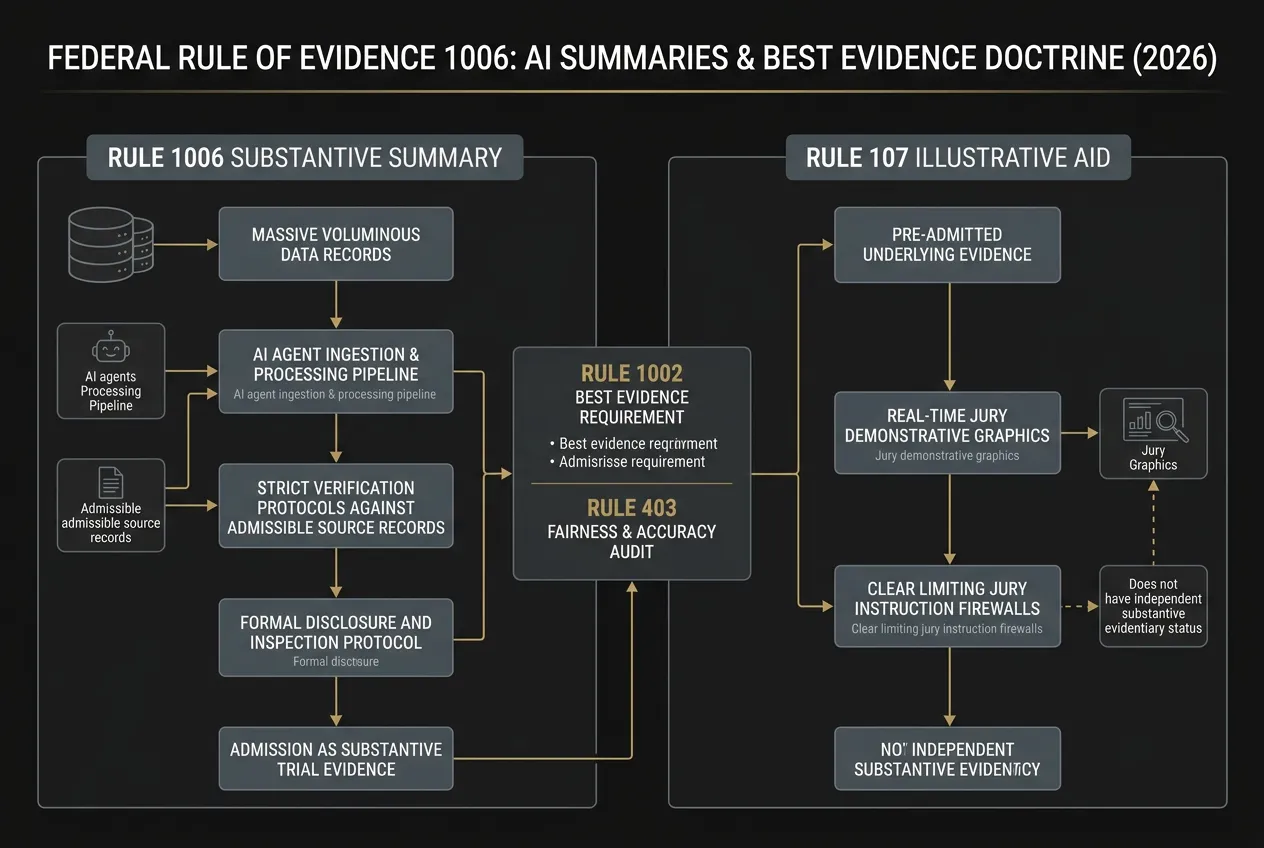
What Is the Governing Legal Standard for Rule 1006 Substantive Summaries?
Federal Rule of Evidence 1006 creates a statutory exception to Rule 1002 (the Best Evidence Rule), authorizing trial courts to admit a summary, chart, or calculation to prove the content of voluminous writings, recordings, or photographs that cannot be conveniently examined in court. Unlike pedagogical trial aids that merely illustrate counsel's argument, an exhibit admitted under Rule 1006 constitutes independent substantive evidence that goes into the jury room during deliberations.
To qualify for admission under Rule 1006, federal procedural doctrine requires the proponent to prove four foundational elements:
- Voluminous Inconvenience: The underlying materials must be so voluminous that in-court examination by the jury or fact-finder would be practically impossible or highly inconvenient.
- Independent Admissibility: The underlying source documents must themselves be admissible in evidence (such as properly authenticated business records under Rule 803(6) or opposing party statements under Rule 801(d)(2)). A proponent cannot use an AI summary to launder inadmissible hearsay into the trial record.
- Availability for Inspection: The proponent must make the underlying originals or duplicates available for examination or copying by opposing parties at a reasonable time and place prior to trial, ensuring adverse counsel can verify the summary's fidelity against the source corpus.
- Demonstrated Accuracy: The summary must accurately and non-misleadingly reflect the underlying data without editorial slant, selective omissions, or hallucinations.
When modern enterprise litigation involves millions of emails, Slack messages, financial ledgers, or telemetry logs, legal teams increasingly deploy automated agentic ingestion and summarization workflows. However, as federal courts emphasize, algorithmic speed does not alter evidentiary burdens: an AI-generated summary must strictly mirror the underlying facts.
How Does Rule 1006 Substantive Evidence Differ from Rule 107 Illustrative Aids?
A critical tactical and procedural threshold in federal trial practice is distinguishing between substantive Rule 1006 summaries and illustrative demonstrative aids governed by Federal Rule of Evidence 107 (effective December 1, 2024). Confusing these two frameworks risks exclusion or severe jury confusion:
| Procedural Dimension | Federal Rule of Evidence 1006 Summary | Federal Rule of Evidence 107 Illustrative Aid |
|---|---|---|
| Evidentiary Nature | Independent substantive evidence | Visual/pedagogical trial aid (not evidence) |
| Jury Room Access | Accompanies jury into deliberations as an exhibit | Excluded from jury deliberations absent stipulation |
| Prerequisite Record | Underlying voluminous documents need not be admitted | Underlying evidence must be already admitted on the record |
| Jury Instruction | Fact-finders evaluate summary as factual proof | Mandatory limiting instruction: aid is not evidence |
| AI Ingestion Scope | Direct aggregation, deduplication, and extraction | Argumentative visual framing, timelines, or charts |
Federal Rule of Evidence 107 codifies the standard for illustrative aids used to help the fact-finder understand admitted evidence or witness testimony. If an AI agent generates an interactive timeline or explanatory chart synthesizing testimony already entered into the record, counsel must offer it as a Rule 107 aid. Conversely, if counsel uses an agentic pipeline to distill 500,000 corporate purchase orders into a multi-tab reconciliation schedule without entering all 500,000 records into trial evidence, the exhibit must satisfy Rule 1006.
What Are the Mandatory Evidentiary Prerequisites for AI-Generated Summaries?
Federal judges evaluating AI-generated Rule 1006 exhibits scrutinize the technical pipeline through three foundational filters:
1. The Admissibility and Cleanliness of the Underlying Corpus
Under settled federal precedent, a summary cannot cure defective underlying evidence. If an AI model processes a document collection that contains unauthenticated third-party communications, unexcused hearsay, or privileged materials, the resulting summary is contaminated and inadmissible. Litigators must establish the admissibility of the source corpus—typically through Rule 902(11) self-authenticating business record certifications or Rule 902(13) automated electronic process certifications—before offering the summary.
2. Full Disclosure of Prompts, Temperature, and Methodology
Rule 1006's inspection mandate requires providing opposing counsel with the opportunity to inspect not merely the source documents, but the mathematical and algorithmic methodology used to compile the summary. In federal practice, adverse parties are entitled to examine:
- The system prompts, context windows, and user instructions given to the LLM or agent;
- The model version, deterministic temperature setting (which must be 0.0 for factual extractions), and context retrieval parameters;
- The cross-validation logs, deduplication rules, and token confidence scoring; and
- Any prompt iterations or filtering scripts that excluded specific document subsets.
Withholding prompt engineering or processing scripts violates Rule 1006's advance disclosure requirement, creating substantial grounds for pre-trial exclusion.
3. Human Qualified Witness Sponsorship and Verification Audits
An AI agent cannot take the oath or undergo cross-examination. Therefore, an AI-generated Rule 1006 summary requires a competent human witness—such as a forensic eDiscovery technologist, data scientist, or qualified litigation paralegal—who conducted independent validation audits.
Best practices dictate that the sponsoring witness execute random statistical spot-checks (e.g., verifying a statistically significant 95% confidence interval of sample points against source documents) and certify that zero hallucinated claims, non-existent dates, or distorted figures exist in the deliverable.
What Role Do Rule 1002 and Rule 403 Play as Gatekeeping Firewalls?
Federal trial courts balance Rule 1006 against two countervailing evidentiary safeguards:
Rule 1002 (The Best Evidence Rule)
Rule 1002 mandates that an original writing or recording is required to prove its content, except as otherwise provided in the rules. When an AI tool moves beyond mechanical mathematical tabulations (e.g., summing invoice totals) into subjective semantic synthesis (e.g., summarizing an executive's state of mind across 10,000 emails), courts hold that the summary no longer qualifies as a mere distillation under Rule 1006. Instead, it constitutes interpretive advocacy or expert opinion that violates the Best Evidence Rule unless the original writings themselves are introduced.
Rule 403 (Prejudicial Automation Bias)
Under Rule 403, trial courts exclude relevant evidence if its probative value is substantially outweighed by the danger of unfair prejudice, confusing the issues, or misleading the jury. AI-generated summaries present acute automation bias risks: fact-finders often assign an unwarranted aura of objective, scientific infallibility to computer-generated charts and tables. If an algorithmic summary contains subtle semantic skew, asymmetric document filtering, or opaque probability scoring, judges will exclude the summary under Rule 403 or relegate it to an illustrative aid with strict limiting instructions.
Step-by-Step Pre-Trial Protocol for Admitting AI Summaries
To ensure an AI-generated Rule 1006 summary withstands pre-trial motions in limine and evidentiary objections, litigation teams should follow a five-stage operational protocol:
- Isolate and Hash the Admissible Ingestion Corpus: Maintain strict chain-of-custody documentation and cryptographic SHA-256 hashes of all source documents to establish that only admissible, authenticated records entered the pipeline.
- Enforce Deterministic Extraction Settings: Lock LLM inference to zero temperature, disable speculative sampling, and document all deterministic regex and SQL queries utilized during data transformation.
- Execute Dual-Track Verification Audits: Pair programmatic reconciliation (asserting row counts, checksums, and totals against baseline database dumps) with blind human review of random source samples.
- Serve Early Rule 1006 Disclosures: Provide opposing counsel with formal pre-trial notice, attaching the complete underlying document repository, the algorithmic workflow specification, and prompt logs at least 30 days before the final pretrial conference.
- Prepare the Sponsoring eDiscovery Custodian: Ensure your sponsoring witness is fully prepared to explain the technical architecture, data lineage, error rates, and human verification checks during voir dire.
By treating algorithmic summarization as a rigorous evidentiary discipline rather than a shortcut, litigators can harness agentic efficiency while building an unassailable trial record.
Related Insights
- Federal Rule of Evidence 104: Preliminary Questions and Relevance Standards in 2026
- Proposed Federal Rule of Evidence 707: AI and Machine-Generated Evidence in 2026
- Federal Rule of Evidence 902(13): AI Evidence Self-Authentication in 2026
- Federal Rule of Evidence 801: AI Evidence and the Declarant Doctrine in 2026
Can an AI-generated summary be admitted under Rule 1006 if some underlying documents are hearsay?
No. Rule 1006 requires that the underlying voluminous records must be independently admissible in evidence. If the underlying corpus contains inadmissible hearsay that does not qualify for an exception (such as Rule 803(6) business records), the resulting summary is legally tainted and inadmissible.
Does opposing counsel have a right to inspect the prompts and software used to generate a Rule 1006 AI summary?
Yes. Rule 1006 requires that the proponent make the underlying records available for examination. In the context of algorithmic summaries, federal courts interpret this mandate to include the technical methodology, model configuration, deterministic prompt instructions, and validation logs necessary to test the summary's accuracy.
What happens if an AI summary contains a single material hallucination or error?
A material factual error or hallucination undermines the required threshold showing of accuracy under Rule 1006 and elevates the risk of unfair prejudice under Rule 403. Depending on the severity, trial judges will either strike the exhibit entirely or exclude it as substantive evidence, requiring counsel to re-examine witnesses through primary source documents.