Enterprise artificial intelligence contracts in 2026 must treat model deprecation and upstream weight modifications as operational business continuity risks rather than standard software updates. When foundation model providers retire endpoints, alter system prompt parsing, or silently adjust tokenizer configurations, autonomous multi-step agent workflows suffer catastrophic trajectory breakdown. Negotiating robust enterprise AI model deprecation covenants requires binding providers to immutable dated snapshot availability, minimum 180 to 365-day advance deprecation notices, 90-day mandatory parallel-run testing windows, and explicit contractual remedies including fee-free termination and data migration escrows.
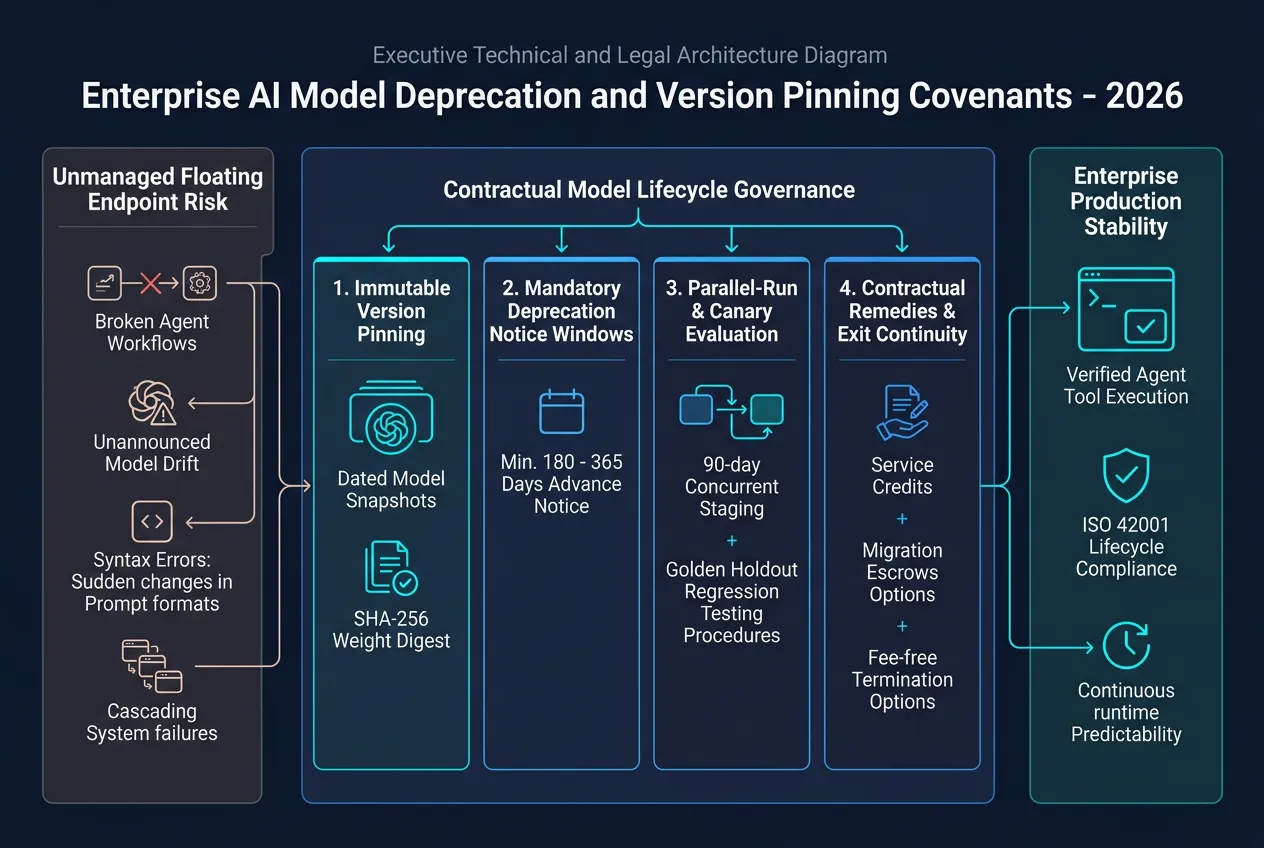
How do enterprise AI model deprecation covenants protect production workflows?
Enterprise artificial intelligence model deprecation covenants establish legally binding obligations on foundation model providers and cloud aggregators, preventing unilateral endpoint retirement or unannounced model updates from disrupting production systems. Without explicit contractual lifecycle covenants, enterprise software that delegates operational workflows to commercial LLMs remains vulnerable to sudden upstream deprecation timelines as brief as 30 to 60 days.
By enforcing dated snapshot version pinning, formal change-notification windows, and structured parallel-run staging, these covenants transform non-deterministic third-party dependencies into governed enterprise infrastructure subject to standard IT change-management controls.
What are the operational risks of floating model aliases in autonomous workflows?
In consumer software, routing traffic to dynamic endpoints such as gpt-4o-latest or claude-3-5-sonnet-latest ensures users access incremental intelligence improvements. However, across regulated enterprises, legal departments, and production agent swarms, floating model aliases introduce fatal operational vulnerabilities:
- Semantic Trajectory Drift: Subordinate agent workflows rely on finely tuned system prompts, Context-Free Grammar (CFG) constrained decoding, and few-shot tool demonstration schemas. An unannounced underlying weights update can alter adherence to negative constraints, leading to schema validation failures and cascading agent tool-call deadlocks.
- Evidentiary and Audit Invalidation: Under regulatory frameworks such as SOC 2 Type II Section 9561 and Federal Rule of Evidence 902(14), automated enterprise decisions must maintain reproducible provenance. If an upstream foundation model's weights shift silently between execution and external audit, the deterministic reproduction of the reasoning path becomes legally and technically impossible.
- Token Output Latency and Cost Volatility: Updates to model reasoning token allocations or hidden chain-of-thought processing alter Time-To-First-Token (TTFT) metrics, blowing past strict enterprise AI Service Level Agreements and triggering unexpected token overage charges.
What core contractual covenants must enterprise legal teams demand?
To insulate enterprise operations from abrupt upstream vendor decisions, corporate counsel and Chief Artificial Intelligence Officers (CAIOs) must negotiate four indispensable model lifecycle covenants into their Master Services Agreements (MSAs) and AI Service Schedules:
| Governance Pillar | Standard Commercial Terms (Vendor Default) | Required Enterprise Covenant (2026 Standard) |
|---|---|---|
| Model Version Pinning | Vendor reserves right to route traffic to updated model versions; point releases deprecated ad hoc. | Obligation to support immutable, dated model snapshots (e.g., gpt-4o-2024-08-06) for at least 12–24 months post-release. |
| Deprecation Notice Window | 30 to 60 days standard notice via developer documentation or email notification. | Minimum 180 days advance written notice for Generally Available (GA) models; 365 days for enterprise tier commitments. |
| Parallel-Run Staging | Deprecated model terminated immediately upon replacement availability. | Guaranteed 90-day concurrent operational window where both old and new versions run concurrently at identical pricing. |
| Contractual Remedies | Sole remedy limited to service termination; pro-rata refunds typically excluded. | Tiered service credits, pro-rata refund of prepaid annual capacity commitments, and immediate termination rights without penalty. |
How should organizations structure parallel-run regression and acceptance gates?
Receiving advance notice of model deprecation is insufficient unless enterprise engineering teams can execute automated migration testing before upstream endpoints shut down. Modern contracts must incorporate structured acceptance testing protocols:
- Golden Holdout Canary Evaluation: During the mandatory 90-day parallel-run window, the enterprise shadows production traffic across both the pinned model snapshot and the successor model candidate. Trajectory accuracy must match or exceed predefined contractual procurement benchmarks on proprietary private evaluation sets.
- Schema and Tool Protocol Compatibility: The migration suite must validate that the successor model honors existing Model Context Protocol (MCP) tool schemas, JSON validation boundaries, and structured extraction without requiring extensive prompt re-engineering.
- Dedicated Vendor Technical Support: For tier-one mission-critical workloads, the contract should stipulate vendor engineering assistance to optimize fine-tuned LoRA adapters or system prompts for the replacement architecture at zero additional licensing cost.
How do model deprecation covenants align with ISO 42001 and EU AI Act mandates?
Contractual version pinning is not merely a technical convenience—it is an emerging regulatory mandate. Under ISO/IEC 42001 Clause 8 (Operational Planning and Control), deployers of artificial intelligence management systems must demonstrate change management rigor across external dependencies. An unannounced vendor deprecation that forces an unvetted model into production violates documented AI risk treatment plans.
Similarly, under Article 72 and Article 73 of the European Union AI Act, providers and deployers of high-risk AI systems must establish continuous post-market monitoring and incident reporting. Deploying an unverified successor model without thorough regression auditing exposes the organization to severe regulatory non-compliance penalties. Establishing contractual version pinning guarantees that changes to algorithmic dependencies follow formal internal change-control workflows.
What is the difference between model version pinning and model escrow?
Model version pinning contractually binds an API vendor to keep a specific snapshot of model weights and runtime endpoints accessible over cloud infrastructure. In contrast, model escrow deposits model weights, LoRA adapters, tokenizer configurations, and containerized runtimes with an independent neutral agent for clean-room recovery if the vendor suffers insolvency or catastrophic breach.
Why is a 30-day deprecation notice inadequate for enterprise AI agents?
A 30-day deprecation notice is insufficient because autonomous agents execute complex multi-step workflows. Migrating an agent architecture requires rewriting prompt templates, re-validating Context-Free Grammars, executing thousands of automated canary test runs, and verifying compliance across legal and security baselines. An enterprise migration cycle routinely requires 60 to 90 days of engineering and validation work.
Can cloud hyperscalers guarantee model snapshot availability longer than frontier labs?
Yes. Enterprise cloud hosting platforms (such as Microsoft Azure OpenAI Service, AWS Bedrock, and Google Cloud Vertex AI) frequently offer extended lifecycle support agreements, maintaining dated model snapshots for 12 to 24 months, whereas direct frontier lab API endpoints may enforce shorter public lifecycle policies. Enterprise procurement should specify underlying infrastructure commitments regardless of whether sourcing directly or through hyperscaler aggregators.
For enterprise leaders designing durable AI procurement strategies, review our related analyses on Enterprise AI Model Escrow and Business Continuity Standards, Enterprise AI Vendor Indemnification and IP Risk, and Enterprise AI Service Level Agreements and Drift Commitments.