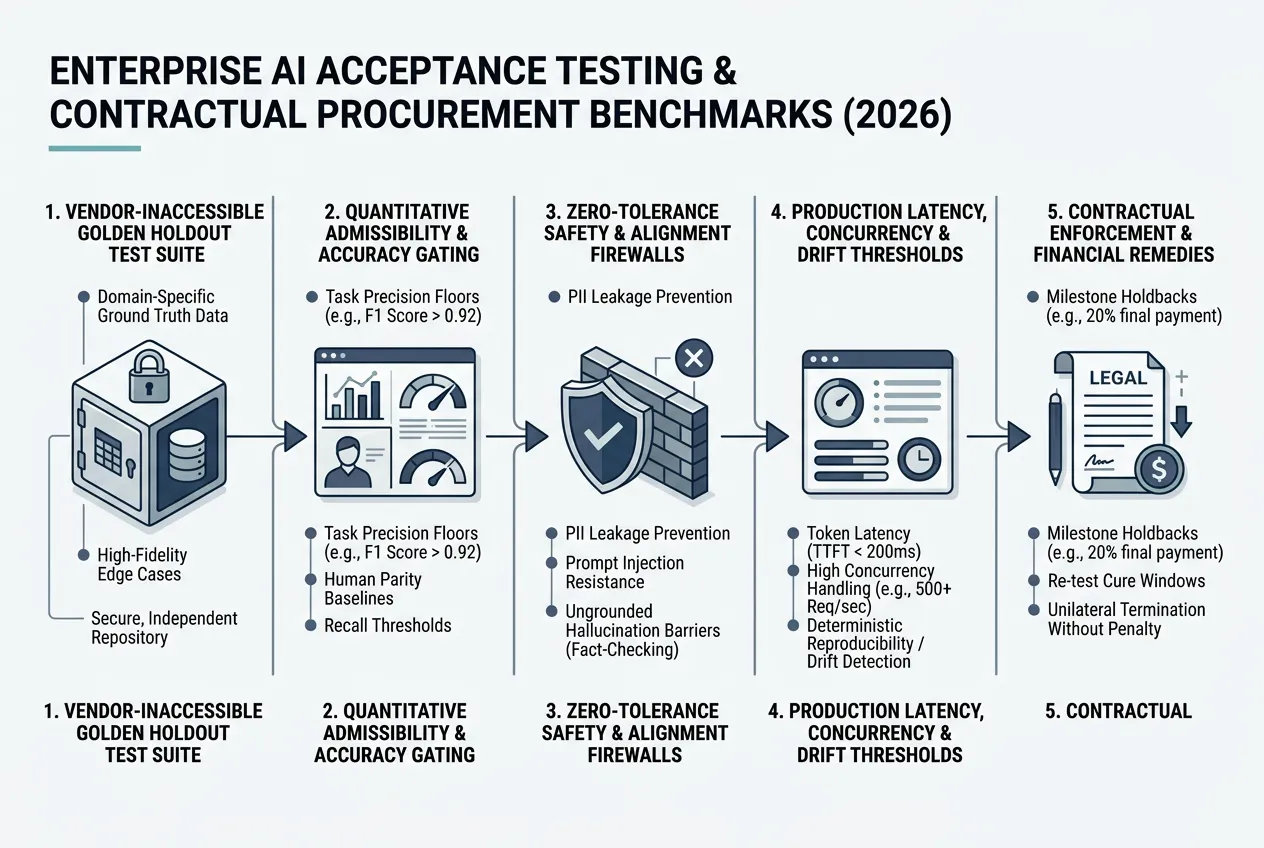
Enterprise AI acceptance testing in 2026 requires engineering teams and corporate counsel to replace subjective vendor demonstrations with contractual, mathematically verifiable performance benchmarks before releasing production funds or greenlighting deployment. Under modern enterprise master service agreements (MSAs) and Statements of Work (SOWs), enterprise buyers protect mission-critical workflows by instituting vendor-inaccessible golden holdout datasets, category-specific precision floors, zero-tolerance safety firewalls, and hard milestone holdbacks that legally supersede standard "deemed acceptance" clauses.
For decades, enterprise software procurement relied on deterministic User Acceptance Testing (UAT). If a database returned records matching structured SQL queries, or an ERP processed payroll ledger entries without syntax faults, the system was accepted. Generative and agentic AI systems shatter this paradigm. Foundation models, multi-agent frameworks, and retrieval-augmented generation (RAG) pipelines operate non-deterministically. A model that achieves high overall completion across vendor-curated demo queries can fail catastrophically on corporate contract abstraction, complex multi-turn statutory interpretation, or private API tool execution.
To bridge this operational vulnerability, enterprises in 2026 are mandating rigorous contractual acceptance frameworks aligned with federal procurement standards—such as OMB Memorandum M-25-22, GAO AI evaluation methodologies (GAO-26-107859), and the NIST AI Risk Management Framework (NIST AI RMF 1.0).
What Is Enterprise AI Acceptance Testing?
Enterprise AI acceptance testing is the formalized contractual process through which an enterprise evaluates, scores, and validates a vendor’s generative model or autonomous agent system against pre-agreed quantitative criteria prior to go-live, financial release, or production rollout.
Unlike standard functional testing conducted by software developers, contractual acceptance testing serves as an enforceable legal checkpoint. If the vendor’s system fails to satisfy strict empirical thresholds within a defined evaluation window, the enterprise retains specific contractual remedies: milestone payment holdbacks, mandatory vendor cure periods, rights to force model rollbacks, and unilateral contract termination without penalty.
The structural challenge in 2026 lies in separating synthetic vendor benchmarks from real-world enterprise capability. Off-the-shelf public benchmarks like MMLU, GSM8K, or HumanEval measure generalized reasoning on public internet data, but provide zero assurance regarding an enterprise’s private schemas, internal workflow policies, or regulatory constraints.
Why Must Enterprises Mandate Vendor-Inaccessible Golden Holdout Suites?
The most critical architectural requirement in modern AI procurement is the establishment of a vendor-inaccessible golden holdout test suite. When vendors are permitted to evaluate models using shared benchmark data, prompt engineering and fine-tuning inevitably overfit to the test distribution.
A robust enterprise holdout suite incorporates three distinct data partitions:
- Curated Historical Ground Truth: Real enterprise interactions, complex documents, domain filings, and workflow logs where expected outcomes have been validated by human domain experts.
- Edge Cases and Adversarial Boundary Tests: Unusual syntactic structures, malformed multi-party transactions, out-of-distribution inputs, and boundary conditions that stress model reasoning.
- Synthetic Negative Controls and Injection Probes: Inputs designed to trigger model hallucinations, prompt injection vulnerabilities (OWASP ASI01), privilege escalation attempts (ASI03), and ungrounded factual fabrication.
To preserve contractual integrity, the enterprise keeps roughly half of this benchmark suite strictly private. The vendor receives schema definitions, task descriptions, and public training samples, but never sees the actual golden evaluation evaluation vectors. The contract specifies that acceptance scoring occurs exclusively within the enterprise’s isolated sandbox environment or via automated API evaluation pipelines governed by the buyer.
What Key Quantitative Acceptance Dimensions Belong in the SOW?
A legally enforceable AI Statement of Work avoids vague standards such as "commercial reasonableness" or "industry-standard accuracy." Instead, the agreement must establish quantitative metric floors across five core operational dimensions:
- Task Quality & Precision Floor: Domain-specific ground truth match (F1 Score or exact field match) must meet pre-agreed quantitative baselines per task category (preventing high-volume basic queries from masking failures in complex sub-tasks).
- Factual Grounding & Retrieval Verification: Mandatory context attribution requiring the model to cite retrieved enterprise corpus records or explicitly abstain from answering, maintaining near-zero ungrounded hallucination rates.
- Deterministic Consistency: Multi-turn output variance evaluated via semantic cosine stability across repeated test runs at low temperature settings.
- Safety & Security Firewalls: Absolute zero-tolerance block rate on prompt injection, PII leakage, and tool misuse vulnerabilities.
- Inference Latency & Throughput: Time-to-First-Token (TTFT) and sustained generation throughput under concurrent enterprise load, protecting production responsiveness.
How Do Modern Contracts Structure the Acceptance Process?
In legacy IT procurement, vendors frequently insert clauses stating that software is "deemed accepted" if the client fails to deliver written objections within 10 to 14 business days. In generative AI deployments, "acceptance by silence" represents unacceptable legal risk.
Comprehensive enterprise AI contracts establish a four-phase acceptance workflow:
Phase 1: Sandbox Baseline Validation
Upon delivery of the configured model or agent, the enterprise initiates an automated run of the golden holdout suite within a dedicated staging tenant. The vendor is granted zero access to prompt logs during this evaluation.
Phase 2: Category-Level Scoring & Audit
The enterprise scores model outputs using calibrated LLM-as-a-judge evaluators paired with human domain expert verification on flagged anomalies. In accordance with GAO evaluation methodologies, results must demonstrate independent reproducibility. The system must meet the minimum threshold across every individual category floor; high accuracy in basic search cannot offset a failure in contract abstraction or calculations.
Phase 3: Formal Written Certificate of Acceptance
Acceptance occurs exclusively upon delivery of an affirmative, countersigned Certificate of Acceptance executed by the enterprise’s designated technical lead. The agreement explicitly disclaims all forms of constructive, implied, or deemed acceptance.
Phase 4: Cure Period and Contractual Remedies
If the model fails to satisfy the quantitative criteria:
- Cure Window: The vendor receives a 15-to-30-day cure period to adjust system prompts, retrieval parameters, or fine-tuning weights at vendor expense.
- Milestone Holdback: The enterprise withholds milestone implementation payments until re-testing succeeds.
- Rollback or Termination: If the vendor fails to achieve passing scores after two evaluation cycles, the enterprise holds the absolute right to roll back to prior stable systems, demand a full refund of unearned fees, and terminate the agreement without penalty.
How Does Continuous Acceptance Govern Model Updates and Drift?
A critical distinction between traditional software and generative AI is that an accepted model does not remain static. Foundation model providers frequently push silent model weight updates, system prompt revisions, or backend parameter adjustments that introduce severe behavioral drift.
To guard against downstream degradation, enterprise contracts must extend acceptance testing into a continuous acceptance framework:
- Version Pinning & Advance Deprecation Notice: Vendors must contractually guarantee that production endpoints remain pinned to exact model versions. Upstream providers must provide at least 90 days’ advance written notice before deprecating an accepted model version.
- Automated Canary Re-Testing: Prior to deploying any vendor-side update, patch, or weight modification, the new model must execute against the enterprise’s golden holdout suite. The updated version must meet or exceed the original baseline acceptance scores.
- Drift-Triggered Remedies: If production monitoring detects persistent drift in task accuracy or factual grounding over any rolling audit window, the vendor must immediately restore the prior model checkpoint or face service credits and financial penalties under governing Enterprise AI Service Level Agreements.
What Legal and Regulatory Standards Underpin AI Acceptance?
Enterprise AI procurement does not exist in a regulatory vacuum. Regulated entities—including financial institutions, healthcare networks, and government contractors—must align acceptance testing with emerging governance mandates:
- OMB Memorandum M-25-22 & M-24-18: Federal directives requiring agencies acquiring generative AI to implement rigorous pre-award testing, continuous performance verification, and transparent vendor accountability.
- GAO Artificial Intelligence Evaluation Framework (GAO-26-107859): Federal auditing standards establishing four foundational principles for validating AI systems: Governance, Data Quality, Performance Monitoring, and Systemic Transparency.
- NIST AI Risk Management Framework (NIST AI RMF 1.0) & ISO/IEC 42001: Recognized standards for identifying operational risks, measuring model reliability, and maintaining auditable evaluation logs.
- EU AI Act Conformity Assessments: For high-risk AI deployments, Article 43 mandates post-market monitoring and rigorous pre-deployment testing to verify that models meet health, safety, and fundamental rights benchmarks.
By embedding these standards directly into contractual acceptance exhibits, enterprise leaders transform abstract regulatory guidance into enforceable procurement safeguards.
What is the difference between standard software UAT and enterprise AI acceptance testing?
Standard software UAT evaluates deterministic logic with predictable pass/fail outcomes against functional specifications. Enterprise AI acceptance testing evaluates non-deterministic statistical models across multi-turn reasoning, factual grounding, prompt injection resistance, and hallucination rates using private golden holdout datasets and quantitative precision floors.
Why is "deemed acceptance" dangerous in enterprise AI procurement contracts?
Deemed acceptance clauses trigger automatic legal acceptance if the buyer does not submit formal objections within a short calendar window (e.g., 10 days). In complex AI deployments, subtle model drift, latent hallucinations, and edge-case security vulnerabilities rarely surface immediately, exposing the enterprise to full contractual liability and payment obligations before the system is verified safe.
Can vendors evaluate models using their own benchmarks instead of buyer holdouts?
No. Vendor-curated benchmarks inevitably introduce selection bias and risk data leakage, where the model has already trained on the test evaluation set. Enforceable contracts require the buyer to evaluate the model using a proprietary, vendor-inaccessible golden holdout suite representing real enterprise data and adversarial edge cases.
What happens if an AI vendor fails the contractual acceptance criteria?
The contract should grant the vendor a single bounded cure period (typically 15 to 30 days) to remediate performance at their own expense. If the system fails the secondary acceptance audit, the enterprise should hold unilateral rights to withhold payment, roll back to prior stable software, receive a full refund of upfront fees, and terminate the contract without liability.
Strategic Takeaway for Enterprise Leaders
Enterprise AI adoption cannot succeed on trust alone. Corporate procurement teams, Chief Information Officers, and General Counsel must align on one non-negotiable principle: if performance cannot be measured against private ground truth, the contract cannot be signed.
By replacing ambiguous marketing claims with vendor-inaccessible golden holdout suites, category-specific precision floors, and strict milestone payment holdbacks, enterprises establish the structural leverage necessary to deploy generative AI safely, predictably, and profitably in 2026.
Related insights: