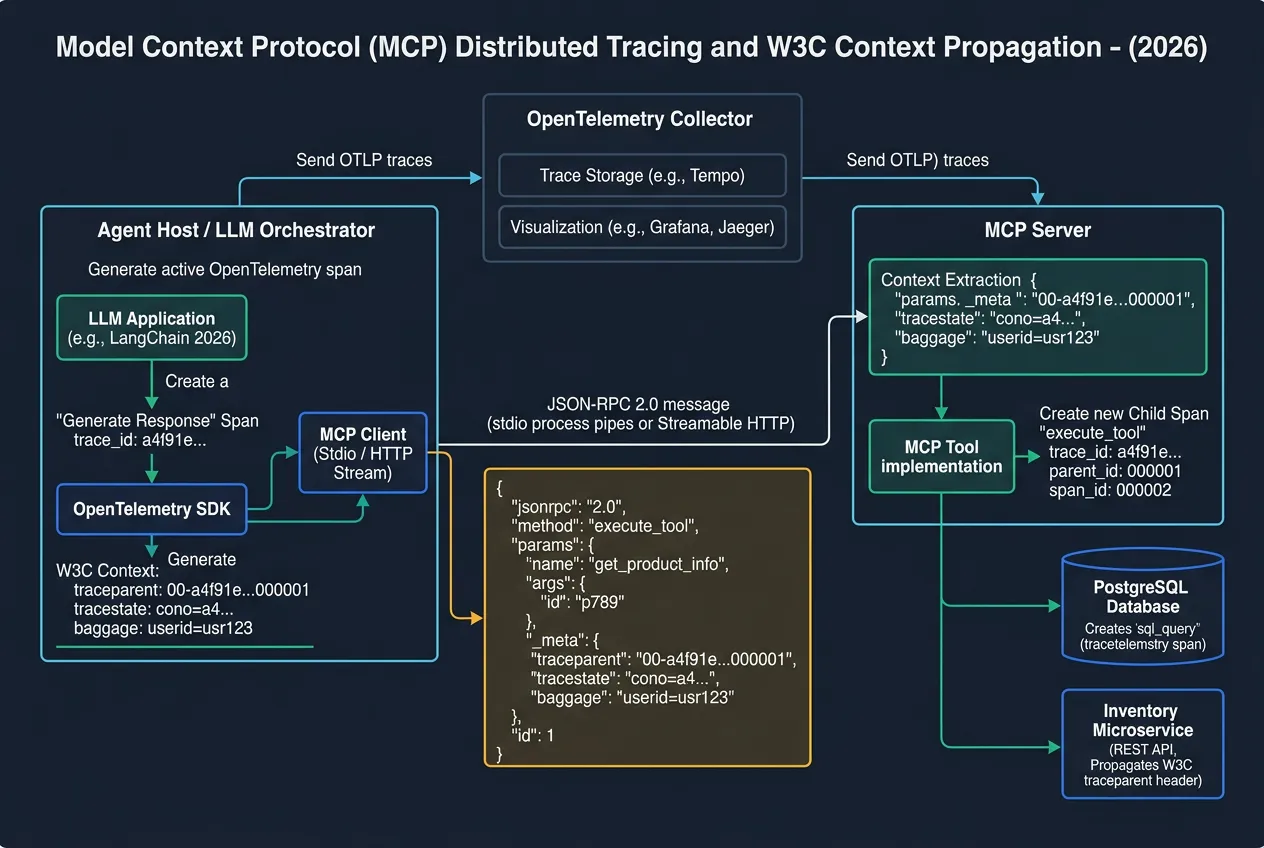
Production AI engineering teams in 2026 rely on MCP distributed tracing and context propagation to prevent telemetry blackouts when autonomous agents invoke tools across subshell pipes and remote services. By standardizing on the Model Context Protocol 2026-07-28 specification and SEP-414 request metadata extensions, orchestrators serialize W3C traceparent, tracestate, and baggage within the JSON-RPC request’s params._meta payload, preserving end-to-end trace parentage across stdio pipes and Streamable HTTP transports.
Why does distributed tracing fail across legacy MCP implementations?
In traditional microservice architectures, distributed context propagates through network protocol headers such as HTTP traceparent and tracestate. However, the Model Context Protocol was intentionally architected to support local process execution over standard input/output (stdio) pipes alongside remote transports. Because child subshell processes spawned via stdio have no HTTP protocol headers, standard OpenTelemetry auto-instrumentation hooks fail to capture cross-process boundaries.
When an agent orchestrator initiates an internal execution span and issues a tool call across a stdio pipe, the child MCP server starts in a telemetry vacuum. Without explicit context propagation:
- Tool executions are logged as isolated, unparented root traces or dropped entirely from the active trace DAG.
- Latency spikes and network timeouts occurring within MCP database lookups or filesystem mutations cannot be correlated with the triggering agent prompt.
- Cross-agent tool handoffs lose their causal lineage, making forensic root-cause analysis of agent loops and hallucinations impossible.
In production multi-agent environments, unlinked sub-traces represent a primary source of lost observability data during complex agent workflows. Resolving this gap required standardizing context propagation at the application message layer rather than relying on transport-level network headers.
How does SEP-414 standardize context propagation in JSON-RPC?
To achieve transport-independent observability across both local subshells and distributed HTTP networks, the MCP Working Group finalized SEP-414 (Request Metadata), which was incorporated into the core MCP 2026-07-28 Specification.
SEP-414 establishes a reserved metadata field, _meta, located directly within the JSON-RPC 2.0 params object of every request and notification. This field reserves standardized keys for W3C Trace Context and Baggage:
{
  "jsonrpc": "2.0",
  "id": "req-agent-turn-9842",
  "method": "tools/call",
  "params": {
    "name": "query_case_law_database",
    "arguments": {
      "jurisdiction": "2d Cir.",
      "query": "preliminary injunction generative AI trade secrets"
    },
    "_meta": {
      "traceparent": "00-4bf92f3577b34da6a3ce929d0e0e4736-00f067aa0ba902b7-01",
      "tracestate": "congo=t61rcWkgMzE,rojo=00f067a",
      "baggage": "tenant.id=enterprise-firm-9921,agent.role=researcher"
    }
  }
}
By encoding W3C headers directly inside params._meta:
- Transport Agnosticism: Telemetry context travels natively through
stdiopipes, Streamable HTTP SSE streams, WebSocket tunnels, and message brokers with zero modification to underlying process transports. - Bi-directional Causality: When an MCP server spawns nested downstream HTTP calls to external vector indexes or ERP databases, the server extracts
params._meta.traceparentinto its local execution context, injecting it as the parent span for all outbound network I/O. - Zero-Loss Correlation: Distributed APM collectors such as OpenTelemetry Collector, Jaeger, and Datadog reconstruct the complete end-to-end execution tree from the top-level user prompt down to database queries.
What OpenTelemetry GenAI semantic conventions govern MCP spans?
Establishing causality is only half of the engineering solution; attributing telemetry to standardized attributes is essential for querying multi-agent systems. The OpenTelemetry project addresses this in its dedicated semantic-conventions-genai repository, introduced following the core semantic conventions v1.42.0 update.
In an end-to-end traced agent workflow, span topologies must map strictly to OpenTelemetry GenAI standards:
| Span Role | Span Name | Span Kind | Key Required Attributes |
|---|---|---|---|
| Agent Turn | invoke_agent {gen_ai.agent.name} | CLIENT / INTERNAL | gen_ai.operation.name: "invoke_agent", gen_ai.agent.id, gen_ai.agent.name |
| Tool Execution | execute_tool {gen_ai.tool.name} | INTERNAL / SERVER | gen_ai.operation.name: "execute_tool", gen_ai.tool.name, gen_ai.tool.call_id |
| Model Generation | chat {gen_ai.request.model} | CLIENT | gen_ai.system, gen_ai.request.model, gen_ai.usage.input_tokens |
| MCP Protocol RPC | mcp.call_tool | CLIENT / SERVER | rpc.system: "jsonrpc", rpc.method: "tools/call", mcp.server.name |
Span Lifecycle and Parenting Rules
- The Orchestrator Boundary: The primary agent loop maintains an active
invoke_agentspan. When the reasoning engine resolves a tool-call plan, it generates an OpenTelemetry span representing the client-side tool dispatch. - Context Injection: The MCP client SDK’s trace propagator serializes the current span context into W3C string format and injects
traceparentandbaggageintoparams._meta. - The Server Execution: The MCP server’s middleware intercepts the inbound JSON-RPC message, extracts
params._meta, and initializes a child span of kindSERVERnamedexecute_tool query_case_law_database. - Asynchronous Spans & Links: When tools execute long-running asynchronous batch tasks or invoke multiple decoupled agent sub-workers, the engine binds related traces using OpenTelemetry Span Links rather than rigid parent-child hierarchies to avoid misleading latency measurements.
How do engineering teams implement context propagation across Python and TypeScript SDKs?
Both the official MCP TypeScript SDK (v2+) and Python SDK provide programmatic hooks to automate W3C trace propagation through custom middleware and interceptors.
TypeScript Client-Side Propagation Pattern
import { Client } from "@modelcontextprotocol/sdk/client/index.js";
import { trace, context, propagation } from "@opentelemetry/api";

export async function callMcpToolWithTracing(
  client: Client,
  toolName: string,
  args: Record<string, unknown>
) {
  const tracer = trace.getTracer("agent-orchestrator", "2.1.0");

  return tracer.startActiveSpan(`execute_tool ${toolName}`, async (span) => {
    try {
      // 1. Create carrier object for OpenTelemetry propagation
      const carrier: Record<string, string> = {};
      propagation.inject(context.active(), carrier);

      // 2. Transmit tool invocation with SEP-414 _meta baggage
      const result = await client.callTool({
        name: toolName,
        arguments: args,
        _meta: {
          traceparent: carrier["traceparent"],
          tracestate: carrier["tracestate"],
          baggage: carrier["baggage"],
        },
      });

      span.setStatus({ code: 1 }); // OK
      return result;
    } catch (error) {
      span.recordException(error as Error);
      span.setStatus({ code: 2, message: (error as Error).message }); // Error
      throw error;
    } finally {
      span.end();
    }
  });
}
Python Server-Side Context Extraction Pattern
from opentelemetry import trace, propagate
from opentelemetry.trace import Status, StatusCode
from mcp.server.fastmcp import FastMCP

mcp = FastMCP("case-law-engine")
tracer = trace.get_tracer("mcp-case-law-server", "1.0.0")

@mcp.tool()
async def query_case_law_database(jurisdiction: str, query: str, _meta: dict = None) -> str:
    # 1. Extract inbound W3C carrier from params._meta
    carrier = _meta or {}
    parent_context = propagate.extract(carrier)

    # 2. Attach parent context and execute child span
    with tracer.start_as_current_span(
        "execute_tool query_case_law_database",
        context=parent_context,
        kind=trace.SpanKind.SERVER
    ) as span:
        span.set_attribute("gen_ai.operation.name", "execute_tool")
        span.set_attribute("gen_ai.tool.name", "query_case_law_database")
        span.set_attribute("case_law.jurisdiction", jurisdiction)

        # Downstream database query automatically inherits parent_context
        results = await run_vector_search(jurisdiction, query)
        return results
What privacy, security, and PII guardrails apply to MCP telemetry?
While distributed tracing provides indispensable diagnostic clarity, unvetted telemetry pipelines create substantial regulatory and data leakage liabilities:
- W3C Baggage Hygiene: Enterprise systems must never place credentials, OAuth access tokens, session cookies, or client PII in W3C
baggagefields. Because baggage headers propagate transparently across third-party services and subprocesses, any data stored in baggage is frequently recorded in external access logs. - Payload Masking at Collector Gateways: In accordance with Zero Data Retention (ZDR) and enterprise security standards, OpenTelemetry Collectors deployed in front of observability backends should run processor pipelines that redact prompt arguments, sensitive client names, and unmasked vector embeddings before telemetry leaves the network perimeter.
- Trace Sampling Strategies: Because production agents generate dozens of nested LLM and tool spans per conversation turn, high-volume deployments must employ tail-based sampling. Tail samplers preserve all failed, errored, or high-latency traces while downsampling routine nominal operations to manage storage economics.
For architectural patterns on securing runtime state and telemetry across enterprise agents, explore our deep dive on Enterprise AI Agent IAM and OAuth Delegation, our guide to Agentic Checkpointing and State Persistence, and our analysis of Distributed Agent Tracing with OpenTelemetry.
Does the Model Context Protocol require HTTP headers for distributed tracing?
No. Under the MCP 2026-07-28 specification and SEP-414, distributed trace context is transmitted inside the JSON-RPC message body via params._meta. This allows context propagation across standard input/output (stdio) process pipes without HTTP headers.
What is the difference between traceparent and baggage in an MCP request?
traceparent transmits the immutable distributed trace identifier, parent span identifier, and trace flags necessary to reconstruct the span call tree. baggage transmits contextual key-value pairs (such as tenant.id or agent.role) across process boundaries for correlation and filtering.
Can an MCP server propagate context to external microservices?
Yes. Once the MCP server extracts traceparent from params._meta, it sets it as the active parent context for its execution thread. Any outbound HTTP, gRPC, or database client instrumented with OpenTelemetry automatically injects this context into outbound requests.
Are OpenTelemetry GenAI semantic conventions finalized?
As of November 2026, OpenTelemetry GenAI semantic conventions are in the Development phase within the dedicated semantic-conventions-genai repository. While widely adopted for production agent observability, attributes should be pinned to stable version releases in production deployments.