Enterprise AI vendor indemnification clauses promise corporate buyers defense and liability coverage against third-party intellectual property infringement claims arising from model outputs. However, in 2026, standard contractual carve-outs—including customer prompt inputs, third-party software combinations, and disabled safety guardrails—can nullify coverage unless enterprise procurement and legal operations teams enforce strict technical compliance gates and negotiate uncapped indemnification terms.
Corporate adoption of foundation models and agentic runtimes has elevated copyright and intellectual property indemnification from a boilerplate contractual provision into a central enterprise risk control. While leading frontier AI providers offer customer copyright commitments and IP defense promises, enterprise counsel frequently discover that commercial protections diverge significantly from marketing commitments when an actual infringement claim or demand letter arrives.
What Does Enterprise AI Vendor Indemnification Actually Cover?
Enterprise AI vendor indemnification typically obligates the provider to defend the corporate customer against third-party intellectual property infringement claims alleging that the vendor's service or generated output violates copyright, patent, trade secret, or other proprietary rights, and to pay resulting adverse court judgments or approved settlements.
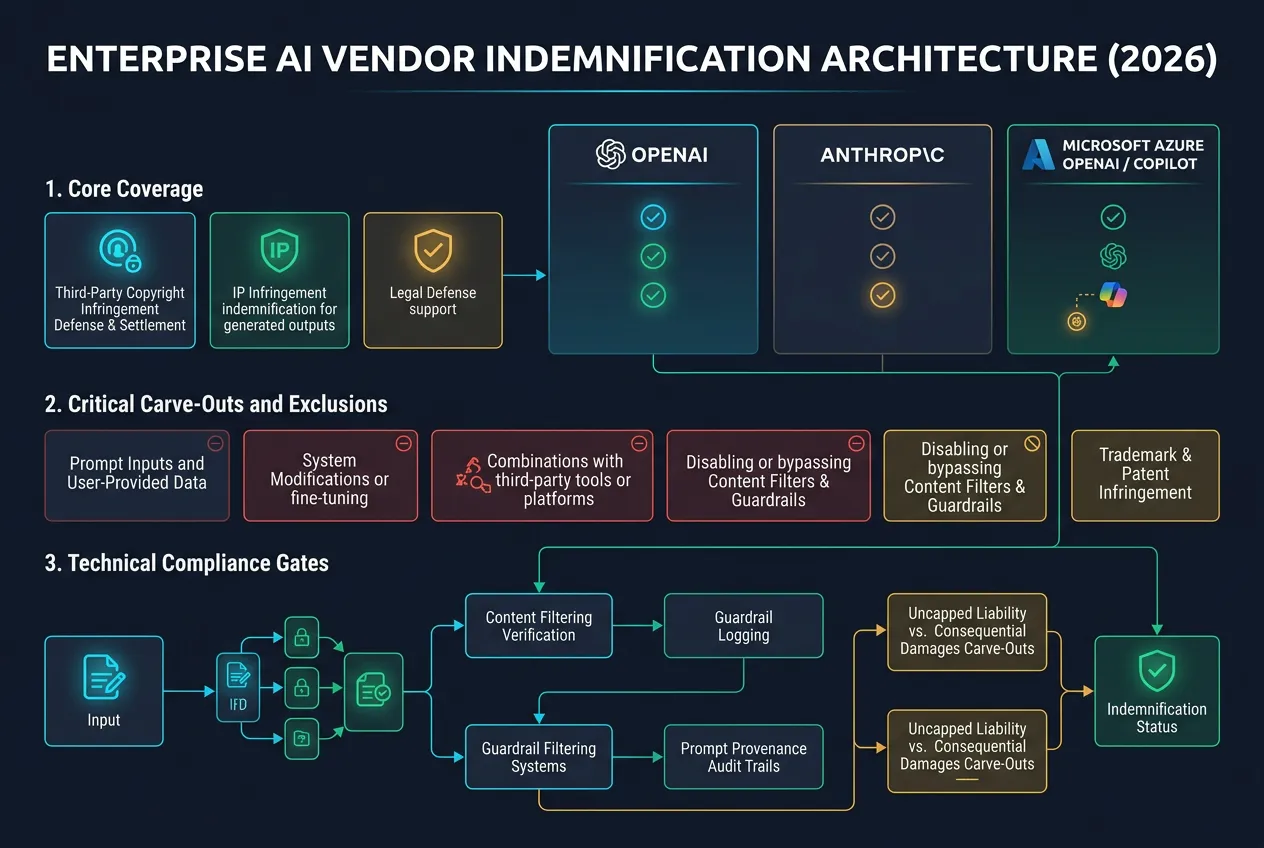
Across primary commercial agreements in 2026, foundation model providers structure their customer protections under distinct frameworks:
| Provider & Service Framework | Scope of Intellectual Property Defense | Key Limitation or Condition Precedent |
|---|---|---|
| OpenAI Business & Enterprise Terms | Defends and indemnifies enterprise and API customers against claims that customer use or distribution of Output infringes a third-party IP right. | Excludes customer prompt content, combinations with third-party software, customer modifications, and failure to apply available filters or safety features. |
| Anthropic Commercial Terms | Defends commercial customers and pays covered judgments or approved settlements for claims that authorized use of Services or Outputs violates third-party IP rights. | Excludes customer modifications, third-party combinations, customer input data, trademarks, and patents embodied in Outputs. |
| Microsoft Customer Copyright Commitment (CCC) | Defends commercial customers and pays adverse final judgments or settlements for covered third-party IP claims regarding Output Content in Azure OpenAI and Copilot. | Conditioned upon mandatory implementation of Azure OpenAI content filters, guardrails, metaprompts, and proof of input rights. Excludes trademark claims. |
While marketing materials often describe these commitments as blanket intellectual property shields, enterprise legal teams must examine the operational dependencies and exclusions that govern whether a claim will actually be defended.
What Are the Critical Carve-Outs and Exclusions in AI Indemnity?
The practical value of an AI indemnification clause depends entirely on its exclusions. In 2026 commercial agreements, four standard carve-outs routinely extinguish vendor indemnification obligations during production enterprise deployments:
- The Customer Input & Prompt Carve-Out: Every major vendor excludes claims arising from customer-provided inputs, training datasets, or prompt embeddings. If a plaintiff alleges that an enterprise prompt intentionally reproduced copyrighted code or copyrighted training passages, the vendor's indemnity falls away, shifting sole liability back to the corporate licensee.
- The Third-Party Combination Carve-Out: Standard technology indemnities exclude liability where infringement arises from combining the model with third-party software, data, or infrastructure. In agentic AI systems that orchestrate multiple APIs, retrieval-augmented generation (RAG) vector stores, and external tools, vendors frequently invoke this carve-out by asserting the infringement stems from the multi-tool pipeline rather than the base model.
- The Modification and Fine-Tuning Carve-Out: Modifying a model's weights, fine-tuning on proprietary corpora, or applying custom post-processing pipelines can void coverage. Unless counsel explicitly negotiates that fine-tuned checkpoints and RAG-grounded outputs remain covered, post-generation transformations break the causal chain required for vendor defense.
- The Guardrail and Content Filter Prerequisite: Under programs such as Microsoft's Customer Copyright Commitment, indemnity is expressly conditioned upon the enterprise maintaining active content filters and system metaprompts. Disabling safety filters—even for legitimate internal research or specialized domain tasks—automatically voids the vendor's defense obligation.
How Should Enterprise Procurement Negotiate AI Indemnification Terms?
Corporate procurement and general counsel must align contractual protections with technical system architecture. High-leverage negotiation priorities include:
1. Carving Indemnification Out of Aggregate Liability Caps
In enterprise SaaS agreements, vendor liability is conventionally capped at fees paid over the preceding 12 months. However, copyright statutory damages under 17 U.S.C. § 504(c) reach up to $150,000 per infringed work for willful violations. An aggregate 12-month fee cap renders indemnification virtually meaningless against class-action or multi-work infringement claims. Enterprise agreements must categorize third-party IP indemnification as an uncapped super-cap or carve it out entirely from the limitation of liability.
2. Explicit Coverage for RAG and Orchestration Pipelines
Procurement teams must negotiate clear language confirming that retrieval-augmented generation (RAG), vector database context injection, and agentic tool invocations do not constitute disqualifying "third-party combinations" or "unauthorized modifications," provided the customer possesses lawful rights to the retrieved underlying data.
3. Mutual Settlement Consent and Defense Control
Agreements should grant the corporate customer consultation and consent rights regarding any proposed settlement that imposes financial liability, injunctive constraints, or operational restrictions on the enterprise's ongoing AI systems or public reputation.
What Technical Compliance Gates Must IT and Legal Operations Enforce?
To preserve contractual indemnification claims, enterprise engineering and legal operations teams must maintain contemporaneous, verifiable audit trails:
- Immutable Prompt and Generation Logging: Maintain cryptographically verifiable logs connecting user prompts, system instructions, retrieved RAG context, and generated outputs. If an infringement claim arises, the enterprise must prove the prompt did not intentionally coax infringing output.
- Continuous Content Filter Telemetry: Capture telemetry confirming that vendor-mandated content filters, safety guardrails, and metaprompts were continuously operational at runtime.
- Enterprise IAM and Token Governance: Implement governed OAuth delegation and non-human identity controls, ensuring automated agents operate under bounded permissions and cannot bypass safety filters.
Enterprise buyers should cross-reference our related architectural guidance on Enterprise AI Outside Counsel Billing, Enterprise AI Agent IAM & OAuth Delegation, and Enterprise Shadow AI Governance to establish end-to-end organizational assurance.
Does enterprise AI vendor indemnification protect against patent infringement claims?
It depends heavily on the vendor's specific contract terms. While some vendors provide broad third-party intellectual property indemnity covering patents and copyrights, other providers explicitly exclude patents embodied in model outputs or limit their commitments strictly to copyright infringement claims.
Why do vendors exclude trademark claims from AI copyright commitments?
Major AI providers exclude trademark and trade dress infringement claims because model outputs cannot verify commercial trademark use, distinctiveness, or likelihood of consumer confusion across specific market classes. Trademark liability remains an enterprise brand compliance responsibility.
Can an enterprise rely on AI indemnification if internal users jailbreak content filters?
No. Vendor indemnities universally require adherence to acceptable use policies and documentation. Intentionally bypassing safety guardrails, disabling content filters, or prompting models to evade copyright controls constitutes a material breach that instantly terminates the vendor's defense obligations.