Enterprise AI SOC 2 compliance in 2026 requires organizations deploying generative models and autonomous agents to map non-deterministic systems directly into the AICPA Trust Services Criteria under the governing guidance of AICPA Technical Questions and Answers (TQA) Section 9561. Rather than establishing a separate certification, TQA Section 9561 mandates that service auditors examine how machine learning models, autonomous tool-calling agents, and foundation model APIs alter an enterprise's system boundaries, risk assessments, change control protocols, processing integrity guardrails, and third-party subservice commitments.
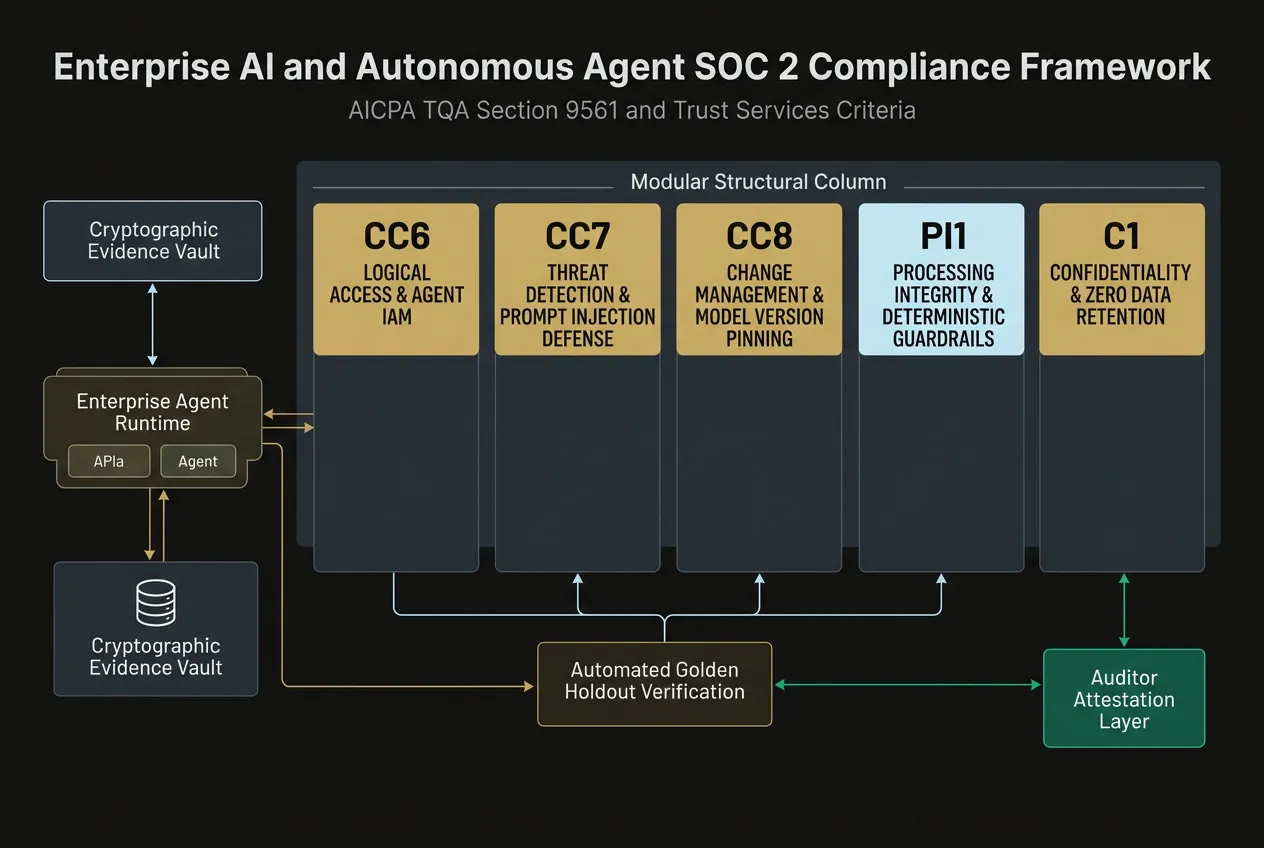
How Does AICPA TQA Section 9561 Reshape SOC 2 Audit Scope?
On September 11, 2026, the American Institute of Certified Public Accountants (AICPA) formally released TQA Section 9561 (SOC Examinations: Effect of the Service Organization's Use of Artificial Intelligence on SOC 1 and SOC 2 Examinations). Issued under AT-C Section 205 (Assertion-Based Examination Engagements), TQA 9561 provides long-awaited technical clarity for auditors evaluating enterprise SaaS platforms and autonomous agent runtimes.
Crucially, the AICPA rejected calls to publish an isolated "AI SOC 2" standard or create novel Trust Services Criteria. Instead, TQA 9561 instructs certified public accountants (CPAs) to enforce existing technology-neutral criteria—spanning Common Criteria (Security), Availability, Processing Integrity, Confidentiality, and Privacy—while subjecting non-deterministic algorithmic workflows to rigorous operational scrutiny.
Under TQA Section 9561, service organizations must formally document four structural dimensions:
- System Boundary Inclusion: Whether foundation models, embedding stores, vector databases, or agent execution harnesses form part of the service delivered to user entities or support automated internal controls.
- System Description Disclosures: Explicit disclosure within Section III of the SOC 2 Type II report detailing how AI models process customer data, the division of automated versus human decision rights, and reliance on commercial API providers.
- Subservice Organization Carve-Outs vs. Inclusive Methods: How third-party model providers (such as cloud foundation model vendors) are categorized under CSOC Section 200, establishing whether vendor commitments are evaluated via complementary subservice organization controls (CSOCs).
- Complementary User Entity Controls (CUECs): The exact operational duties customer organizations must maintain—such as configuring user-level OAuth permissions, establishing client-side prompt sanitation, and reviewing autonomous agent outputs.
Which Trust Services Criteria Govern Enterprise AI and Autonomous Agents?
Auditing autonomous agents and generative workflows requires engineering teams and compliance officers to operationalize internal controls across five key Trust Services Criteria areas.
| Trust Services Criterion | Enterprise AI & Agent Control Requirement | Common Audit Evidence Artifact |
|---|---|---|
| CC6.1 / CC6.2 (Logical Access & IAM) | Least-privilege agent credentials, RFC 8693 token exchange, ephemeral scoped tool tokens | OAuth token exchange logs, scoped service identity manifests |
| CC7.1 / CC7.2 (Threat Detection & Defense) | Automated detection of prompt injections, jailbreaks, and context poisoning attacks | WAF/firewall telemetry, red-teaming probe incident tickets |
| CC8.1 (Change Management) | Deterministic version pinning, golden benchmark evaluation gates prior to model promotion | CI/CD evaluation test receipts, git-tagged model digest manifests |
| PI1.1 / PI1.2 (Processing Integrity) | Input validation, constrained decoding (CFG), schema enforcement, and output sanitization | Schema validation error rates, synthetic canary execution logs |
| C1.1 / C1.2 (Confidentiality & Privacy) | Contractual Zero Data Retention (ZDR), customer tenant isolation, PII masking pipelines | Provider BAA/DPA terms, OpenTelemetry PII scrubber logs |
1. Logical Access & Non-Human Identity Governance (CC6.1, CC6.2, CC6.3)
Traditional SOC 2 audits evaluate human user access reviews, multi-factor authentication (MFA), and role-based access control (RBAC). In autonomous agent environments, auditors must evaluate machine identities. When an AI agent executes tools across enterprise databases, code repositories, or payment gateways, it cannot operate under blanket service account credentials.
Compliant organizations deploy OAuth 2.0 Token Exchange (RFC 8693) to attenuate scopes dynamically based on the intersection of the initiating user, the delegated agent, and the specific task (User ∩ Agent ∩ Task). Access control matrices must prove that agent identities are provisioned with short-lived, ephemeral secrets and that administrative actions (such as data deletion or financial transfers) require out-of-band step-up human authorization.
2. Threat Detection and Vulnerability Management (CC7.1, CC7.2, CC7.3)
Auditors applying TQA 9561 evaluate how organizations defend against AI-specific vulnerabilities, specifically those codified in the OWASP Top 10 for Agentic Applications and OWASP LLM Top 10. Controls must actively monitor for:
- Indirect Prompt Injections: Adversarial instructions embedded within external data sources, untrusted emails, or retrieved documents designed to hijack agent execution.
- Context Poisoning: Unauthorized modification of shared agent memory tiers or retrieval-augmented generation (RAG) knowledge stores.
- Cascading Failures: Uncontrolled recursive loops or runaway tool invocations triggered by non-deterministic model responses.
Evidence for CC7 controls includes automated continuous red-teaming probe logs, Web Application Firewall (WAF) rule sets inspecting inference payloads, and incident response playbooks specifically tested against algorithmic compromise.
3. Change Management and Model Version Pinning (CC8.1)
CC8.1 demands that all software and infrastructure changes be authorized, tested, and approved prior to production release. In traditional SaaS, this governs code merges and container deployments. In enterprise AI, foundation model updates introduced by upstream vendors represent substantial system modifications that can degrade operational accuracy or invalidate compliance assertions.
To satisfy CC8.1, organizations must prohibit dynamic "latest" model aliases in production environments. System configurations must explicitly pin immutable model digests (e.g., specific snapshot dates or cryptographic SHA-256 weights). Furthermore, CI/CD deployment pipelines must enforce automated regression gates against version-controlled "golden holdout datasets." If a model update fails accuracy, hallucination, or safety benchmarks, the deployment must fail closed.
4. Processing Integrity: Constrained Decoding and Guardrails (PI1.1, PI1.2)
Processing Integrity requires that system processing is complete, valid, accurate, timely, and authorized. For generative models that are inherently probabilistic, proving processing integrity presents a fundamental architectural challenge.
Enterprise systems achieve compliance through deterministic runtime guardrails:
- Context-Free Grammar (CFG) Constrained Decoding: Forcing model tool calls through schema-valid JSON schemas, eliminating malformed outputs and unbounded recursion at the token generation layer.
- Input and Output Guardrails: Inline regex and semantic classifiers that block sensitive data exfiltration or out-of-bounds parameter execution.
- Fallback and Circuit Breaking: Automated failover to human operators or deterministic fallback handlers when confidence scores drop below defined operational thresholds.
5. Confidentiality, Tenant Isolation, and Zero Data Retention (C1.1, C1.2)
For service organizations selecting the Confidentiality Trust Services Category, TQA 9561 demands airtight proof that proprietary customer data is never leaked or incorporated into public model weights.
Auditors require verified legal and technical artifacts:
- Enterprise Zero Data Retention (ZDR) Agreements: Contractual proof that third-party model providers do not log customer prompts or use customer data for model training or refinement.
- Tenant Isolation Telemetry: Cryptographic verification that vector database namespaces and episodic agent memory stores enforce hard multi-tenant boundaries.
- Data Sanitization and Masking: Automated pre-inference PII and PHI scrubbers that redact sensitive entity identifiers before payloads cross external API gateways.
What Documentation and Evidence Do Auditors Demand Under TQA 9561?
Achieving a clean SOC 2 Type II attestation for an AI-native service requires engineering and compliance teams to prepare specific evidentiary binders that traditional IT checklists omit.
┌────────────────────────────────────────────────────────────────────────┐
│              Enterprise AI SOC 2 Evidentiary Architecture              │
└────────────────────────────────────────────────────────────────────────┘
                                    │
       ┌────────────────────────────┼────────────────────────────┐
       ▼                            ▼                            ▼
┌───────────────┐          ┌─────────────────┐          ┌─────────────────┐
│ Section III   │          │ Verification &  │          │ Cryptographic   │
│ Architecture  │          │ Evaluation      │          │ Evidence Vault  │
├───────────────┤          ├─────────────────┤          ├─────────────────┤
│ • AI Boundary │          │ • Golden Bench- │          │ • Immutable     │
│ • Model Pin   │          │   mark Gates    │          │   Trace Logs    │
│ • CSOC & CUEC │          │ • Red-Teaming   │          │ • RFC 8693 IAM  │
│   Matrices    │          │   Reports       │          │ • OpenTelemetry │
└───────────────┘ └─────────────────┘ └─────────────────┘- System Inventory & Registry: A comprehensive inventory listing all commercial LLM endpoints, internal fine-tuned weights, embedding models, vector databases, and external tool plugins used within the system.
- Third-Party Vendor Risk Assessments: SOC 2 Type II reports and ISO/IEC 42001 certifications collected from all upstream AI infrastructure providers, accompanied by documented reviews of their complementary subservice organization controls (CSOCs).
- Automated Evaluation Runbooks: Recorded execution logs showing that model upgrades, system prompt modifications, and tool definition adjustments passed automated regression benchmarks prior to production staging.
- Immutable Audit Trails: Centralized, write-once-read-many (WORM) audit logs capturing end-to-end agent decision trajectories—including user intent, model system prompts, exact tool input parameters, external tool outputs, and downstream actions.
How Does SOC 2 Align with ISO/IEC 42001 and the EU AI Act?
Enterprises scaling AI globally rarely pursue SOC 2 in isolation. Leading service organizations establish a unified control framework that bridges AICPA Trust Services Criteria with international governance mandates.
- ISO/IEC 42001 (Artificial Intelligence Management System): While SOC 2 evaluates operational effectiveness over a specific audit period, ISO/IEC 42001 provides the comprehensive organizational governance framework, defining AI policies, impact assessments, and risk treatment plans. Controls designed for CC2 (Communication and Information) and CC3 (Risk Assessment) crosswalk directly to ISO 42001 Clause 6 and Clause 8.
- EU AI Act (Regulation EU 2024/1689): For high-risk AI deployers and General-Purpose AI (GPAI) providers, Article 12 (Record-Keeping), Article 14 (Human Oversight), and Article 15 (Accuracy, Robustness, and Cybersecurity) require technical architectures that directly overlap with SOC 2 Common Criteria and Processing Integrity controls.
- NIST AI Risk Management Framework (AI RMF 1.0): The four core functions—Govern, Map, Measure, and Manage—serve as the foundational control design library from which enterprises construct the specific internal controls tested during SOC 2 examinations.
Does AICPA TQA Section 9561 create a mandatory new certification?
No. TQA Section 9561 is technical guidance and a practice aid for certified public accountants; it does not introduce a standalone "AI SOC 2" certification or amend the underlying Trust Services Criteria. Instead, it instructs auditors on how to evaluate existing criteria—such as CC6 (Access Control), CC8 (Change Management), and PI1 (Processing Integrity)—when service organizations deploy artificial intelligence or autonomous agents.
Can an organization pass a SOC 2 Type II audit if it uses commercial closed-source LLMs?
Yes. Utilizing commercial foundation models (such as OpenAI, Anthropic, or Microsoft Azure AI) does not disqualify an organization from receiving an unqualified SOC 2 Type II opinion. However, the organization must formally document those providers as subservice organizations, ensure contractual Zero Data Retention (ZDR) commitments are in place, evaluate vendor SOC 2 reports, and demonstrate internal controls (such as input sanitization and output validation) that mitigate third-party dependency risks.
What is the most common reason AI startups fail SOC 2 Type II examinations?
The most frequent deficiency in AI-focused SOC 2 examinations is unversioned change management (CC8.1). Teams frequently adjust system prompts directly in production dashboards, utilize dynamic model API endpoints that auto-update to newer snapshots, or lack automated regression testing to prove that model parameter adjustments do not introduce silent failures or security regressions.
How do auditors verify processing integrity for non-deterministic AI agents?
Auditors evaluate processing integrity (PI1.1) by examining the deterministic controls wrapped around the probabilistic model. This includes schema enforcement via constrained decoding, boundary testing on input parameters, automated fallback procedures, and continuous telemetry monitoring that flags anomalous or failed tool executions before data corruption occurs.
For technical teams engineering enterprise agent architectures and legal leaders structuring operational safeguards, review our detailed analyses on Enterprise AI Model Registry Governance, Enterprise AI Audit Readiness and Evidence Vaults, and Enterprise AI Agent IAM and Non-Human Identity Delegation.