Enterprise AI model escrow has emerged as the definitive business continuity standard for mission-critical artificial intelligence deployments in corporate technology procurement in 2026. While legacy software escrow deposited human-readable source code into an offline vault, bare application code is useless when an enterprise relies on customized neural network weights, fine-tuned adapters, proprietary vector indices, and orchestrated multi-turn inference runtimes. If an enterprise AI vendor faces insolvency, acquisition, abrupt product deprecation, or an uncurable service level agreement (SLA) default, the enterprise must possess the full, verified artifacts required to reconstruct and self-host the cognitive system without operational interruption.
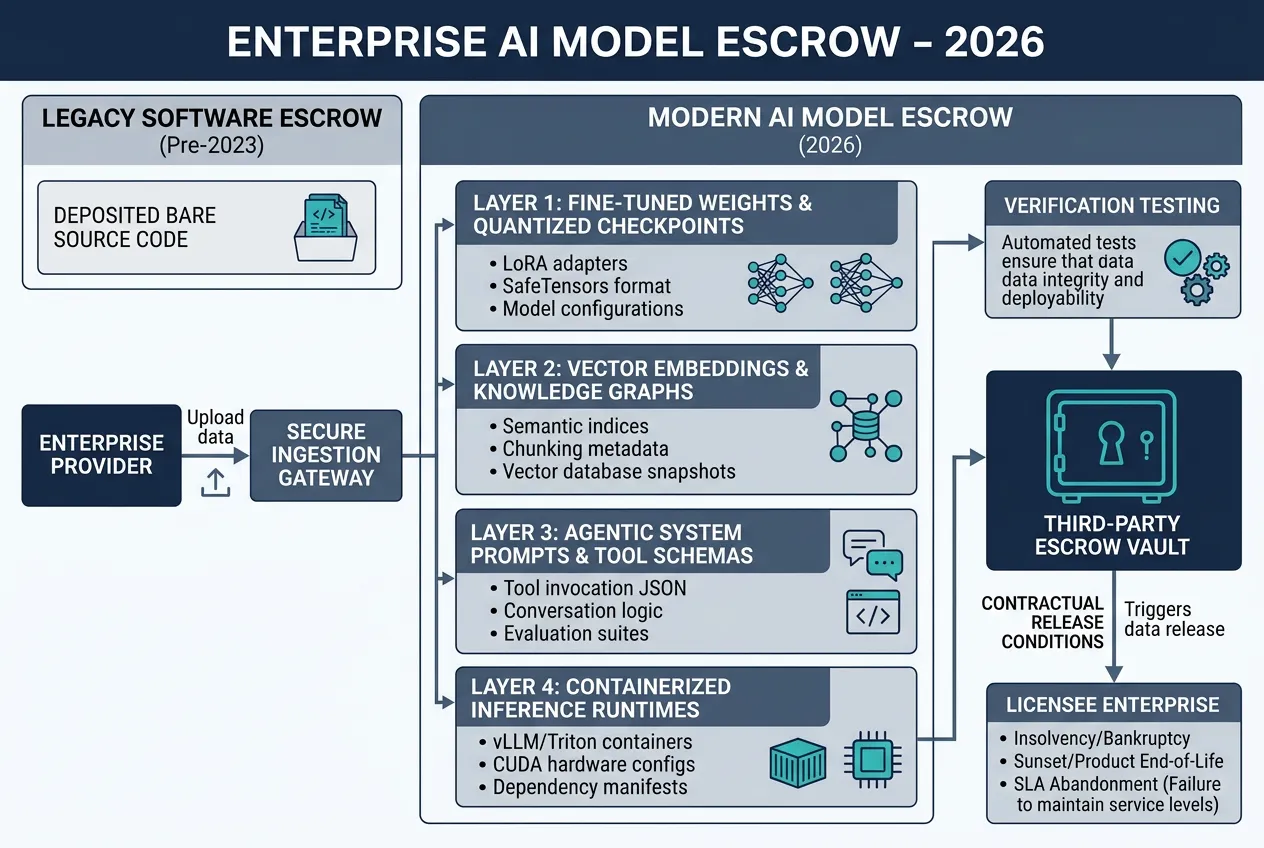
Why Is Legacy Source Code Escrow Obsolete for Enterprise AI?
Traditional software escrow contracts rested on a simple assumption: if a software vendor failed, an independent escrow agent released the source code repository, allowing internal engineers or third-party contractors to recompile the binaries and maintain the application.
In generative AI and agentic software, source code represents a small fraction of operational functionality. An AI software vendor’s application codebase is merely a thin client wrapper around complex model weights, specialized hardware drivers, and external API dependencies. If an enterprise receives only a Python repository containing orchestrator scripts without the underlying model parameters and inference configurations, the application cannot run.
Modern enterprise AI architecture creates three fundamental failure modes for traditional escrow:
- The Weight Dependency Problem: A model’s intelligence resides in billions of numerical parameters (weights and biases). Without the exact fine-tuned LoRA adapters or full model checkpoints, application code cannot reproduce downstream reasoning or task automation.
- The Infrastructure and Runtime Divide: Modern models require highly specific hardware runtimes, including exact versions of CUDA libraries, Triton inference engines, vLLM servers, and quantization kernels (such as AWQ, GPTQ, or FP8).
- The Semantic Context Gap: An agentic workflow depends directly on historical vector database embeddings, chunking algorithms, system prompts, and tool calling schemas. Releasing code without embedding models leaves the enterprise with amnesiac software.
Consequently, Fortune 500 procurement teams and corporate legal counsel are overhauling standard technology escrow riders to mandate comprehensive AI Model Escrow agreements.
What Must Be Deposited in an Enterprise AI Model Escrow Agreement?
A robust AI model escrow deposit moves far beyond Git repositories to capture the entire reproducible machine learning artifact suite. Enterprise procurement riders must require deposit across four distinct technological layers:
| Escrow Layer | Required Deposit Artifacts | Continuity Purpose |
|---|---|---|
| Layer 1: Model Weights & Checkpoints | Serialized SafeTensors files, LoRA adapter weights, base model version hashes, vocabulary tokenizers, and quantization configs | Enables immediate loading of proprietary reasoning layers onto independent compute |
| Layer 2: Inference Runtime & Orchestration | Docker/OCI container manifests, Helm charts, vLLM/Triton server configurations, CUDA driver specifications, and model server startup scripts | Guarantees deterministic container orchestration across private cloud or on-premise clusters |
| Layer 3: Knowledge Base & Vector Schemas | Vector embeddings, similarity index configurations (HNSW/IVF), document chunking pipelines, embedding model checkpoints, and knowledge graph taxonomies | Restores enterprise institutional memory and domain-specific context retrieval |
| Layer 4: Agentic Tooling & System Prompts | Versioned system prompts, few-shot demonstration libraries, JSON Schema function calling definitions, API gateway mocks, and synthetic benchmark suites | Re-establishes deterministic tool execution, agent permission gates, and task verification |
What Triggers the Contractual Release of Escrowed AI Assets?
In traditional software licensing, escrow release conditions typically required formal Chapter 7 bankruptcy liquidation or complete corporate dissolution. In production AI deployments, waiting for formal liquidation is unacceptable when an enterprise workflow depends on hourly inference uptime.
Enterprise procurement riders in 2026 incorporate expanded, time-sensitive release triggers:
- Insolvency or Assignment for Creditors: Filing of voluntary or involuntary bankruptcy, assignment for the benefit of creditors, or appointment of a receiver.
- Service Level Agreement (SLA) Abandonment: Failure to meet production uptime commitments (such as falling below baseline contract availability thresholds) for consecutive measurement windows, coupled with failure to cure within ten business days.
- Unannounced Deprecation or Feature Sunsetting: Vendor discontinuation of a core model checkpoint, API endpoint, or agentic capability without providing an enterprise-certified drop-in replacement.
- Distressed Acquisition or Change of Control: Acquisition of the vendor by a direct commercial competitor or restructuring that impairs zero data retention (ZDR) or enterprise IP covenants.
- Unremedied Security Default: Material failure of vendor security isolation leading to enterprise data compromise, where the vendor refuses or fails to deploy mandatory patches.
How Does Escrow Verification Testing Guarantee Real-World Recoverability?
The most dangerous pitfall in technology escrow is the "blind deposit"—where a vendor uploads an encrypted archive that sits untouched until a crisis occurs, only for the enterprise to discover corrupt files, missing weights, or incomplete dependencies.
Leading technology escrow providers (including EscrowTech, Escrow4all, PRAXIS, and Codekeeper) have established specialized AI verification tiers that must be written directly into procurement contracts:
[Vendor Continuous Deposit]
        │ (Automated CI/CD Sync on Model Version Releases)
        ▼
[Neutral Escrow Repository]
        │
        ├─► Tier 1: Checksum & File Inventory Audit (SafeTensors SHA-256 validation)
        ├─► Tier 2: Static Container & Architecture Review (OCI manifest verification)
        └─► Tier 3: Full Clean-Room Rebuild & Benchmark Suite Execution
                │ (Independent spin-up on isolated cloud GPU cluster)
                ▼
[Gold Master Release Certificate]
Under Tier 3 Active Verification, the escrow agent provisions an isolated cloud environment (e.g., an independent Azure or AWS GPU cluster), pulls the deposited container manifests, mounts the weights, ingests a standardized test vector database, and runs automated inference benchmarks. The deposit is certified only if the recovered model produces outputs matching baseline latency and accuracy thresholds.
What Are the Intellectual Property and Licensing Rules for Escrowed Weights?
Releasing an AI model deposit does not automatically grant the enterprise unconstrained ownership of the vendor's intellectual property. A well-negotiated escrow rider balances the vendor’s trade secret protections against the enterprise’s operational continuity:
- Limited Fallback License: The escrow agreement must include a pre-executed, irrevocable, non-exclusive, royalty-free license that activates automatically upon verified release. This license authorizes the enterprise (or its designated managed service provider) to host, compile, tune, and operate the model strictly for internal business continuity.
- Third-Party Foundation Model Pass-Throughs: Where a vendor builds proprietary adapters on top of commercial foundation models (e.g., Meta Llama, Mistral, or Microsoft Phi), the escrow rider must document all underlying open-weight licenses, confirming that downstream enterprise self-hosting does not violate commercial threshold limits.
- No Commercial Resale Rights: Vendors retain underlying copyright and patent rights in the model architecture. The enterprise agrees not to license, distribute, or commercially exploit the model externally, ensuring the vendor's enterprise value remains protected.
How Does Model Escrow Fit Into Enterprise AI Governance?
Model escrow is not an isolated legal checklist item—it is an operational pillar of enterprise risk management alongside Enterprise AI Exit Readiness: Business Continuity in 2026 and Enterprise AI Vendor Indemnification: IP Risk in 2026. When combined with rigorous Enterprise AI Vendor Change Control: Approval Is a Baseline, Not a Lifetime Pass, model escrow provides Chief Information Officers and General Counsel with the structural leverage needed to scale mission-critical generative AI without existential vendor lock-in.
What is the difference between source code escrow and AI model escrow?
Source code escrow protects human-readable application code and build scripts. AI model escrow protects the entire operational intelligence stack, including serialized neural network weights (SafeTensors, LoRA adapters), containerized inference runtimes (vLLM, Triton), vector database embeddings, system prompts, and automated benchmark verification suites.
Can an enterprise escrow a closed proprietary model like OpenAI or Anthropic?
Direct fine-tuned weights of closed commercial models hosted behind proprietary cloud APIs (such as GPT-4o or Claude 3.5 Sonnet) cannot typically be deposited into physical weight escrow due to vendor proprietary trade secrets. In those scenarios, escrow riders focus on prompt templates, tool schemas, synthetic training datasets, vector embeddings, and automated migration playbooks targeting certified open-weight models.
How often should an AI model escrow deposit be updated?
Deposits should follow vendor production release cadences. Procurement agreements should require automated deposits upon any major or minor model release, or at minimum every calendar quarter, backed by automated cryptographic checksum verification.
Who pays for AI model escrow verification testing?
Typically, the vendor covers standard deposit storage fees as part of enterprise contract terms, while the enterprise licensee funds annual or semi-annual Level 3 clean-room rebuild verification testing on dedicated GPU clusters.