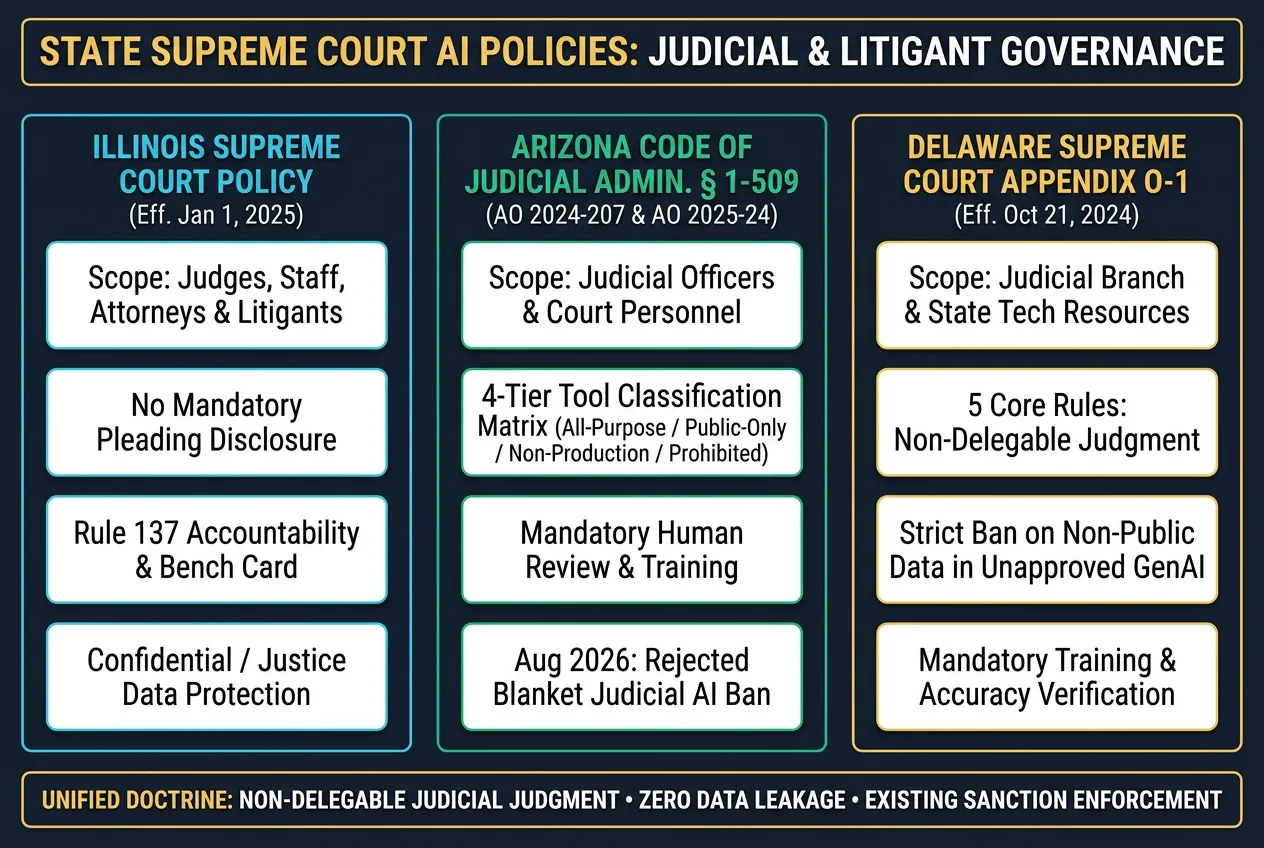
State supreme court AI policies in Illinois, Arizona, and Delaware establish that artificial intelligence is an authorized court and litigation instrument rather than a banned technology, provided human judgment remains non-delegable and confidential data stays protected. Across the Illinois Supreme Court's 2025 Policy and Bench Card, the Arizona Supreme Court's August 2026 rejection of a proposed judicial AI ban alongside Code of Judicial Administration § 1-509, and the Delaware Supreme Court's Appendix O-1 Interim Policy, high courts regulate AI through existing sanction rules, four-tier tool security matrices, and strict non-public data boundaries.
Why Are State Supreme Court AI Policies Moving Away from Blanket Bans and Mandatory Pleading Disclosures?
During the initial wave of courtroom generative AI incidents in 2023 and 2024, dozens of individual trial judges issued ad hoc standing orders requiring attorneys to file separate certificates disclosing whether generative AI drafted any portion of a brief or banning non-human drafting tools outright. As state supreme courts completed multi-year task force reviews across 2024, 2025, and 2026, statewide judicial governance shifted decisively toward technology-neutral accountability and institutional data classification.
Rather than treating generative AI as an inherently suspect instrument in every filing, the supreme courts of Illinois, Arizona, and Delaware recognized two operational realities:
- Ubiquity in Modern Legal and Court Software: Generative and assistive AI models are now embedded directly inside commercial legal research platforms, word processors, case-management systems, and translation tools. Requiring a blanket pleading disclosure whenever "AI" is used creates ambiguity over whether routine spell-checking, cite-checking, or search summarization triggers a filing certification.
- Sufficiency of Existing Ethical and Sanction Regimes: Whether an erroneous citation or fabricated quotation originates from an unverified language model, a careless paralegal draft, or an outdated secondary treatise, the signing attorney or self-represented litigant already bears full personal responsibility under state equivalents of Federal Rule of Civil Procedure 11 (such as Illinois Supreme Court Rule 137).
This evolution complements the statewide court-rule verification frameworks analyzed in Statewide AI Court Rules: Verification and Signature Doctrines in 2026 and the judicial governance mandates examined in California Court Rules for Artificial Intelligence: Judicial and Staff Governance in 2026.
| Jurisdiction & Authority | Effective / Action Date | Regulated Scope | Pleading Disclosure Mandate | Core Institutional Safeguard |
|---|---|---|---|---|
| Illinois Supreme Court Policy on AI & Judicial Reference Sheet | Effective Jan 1, 2025 (Announced Dec 18, 2024) | Judges, clerks, research attorneys, court staff, attorneys, and self-represented litigants | Expressly states disclosure of AI use should not be required in a pleading | Enforces Rule 137 signature sanctions, citation verification, and confidential justice-data protection |
| Arizona Supreme Court ACJA § 1-509 (AO 2024-207 & AO 2025-24) & Rule 135 Ruling | AO 2024-207 (Oct 30, 2024); AO 2025-24 (Jan 29, 2025); Petition denied Aug 27, 2026 | Judicial officers, court personnel, and court-administered systems | No statewide pleading disclosure rule; rejected proposed Rule 135 judicial AI moratorium | Four-tier AI tool approval matrix and mandatory anonymization for non-production testing |
| Delaware Supreme Court Interim Policy on GenAI (Appendix O-1) | Effective Oct 21, 2024 (Adopted Oct 22, 2024) | Judicial officers, employees, law clerks, interns, externs, and volunteers on State Tech Resources | Governs internal judicial branch operations rather than external litigant pleadings | Five mandatory rules barring delegated decision-making and prohibiting non-public data in unapproved GenAI |
How Does the Illinois Supreme Court Policy on Artificial Intelligence Regulate Litigants and Judges?
Announced on December 18, 2024, and effective January 1, 2025, the Illinois Supreme Court Policy on Artificial Intelligence is one of the most comprehensive single-document statewide declarations governing both sides of the bench. Rather than separating practitioner rules from judicial branch rules, the Illinois Supreme Court established a unified standard covering litigants, attorneys, judges, judicial clerks, research attorneys, and staff providing similar support.
1. Explicit Authorization Without Pleading Disclosure
The Illinois policy states directly that the use of artificial intelligence by litigants, attorneys, judges, and court staff "may be expected, should not be discouraged, and is authorized provided it complies with legal and ethical standards." Crucially for civil and criminal litigators, the policy declares: "Disclosure of AI use should not be required in a pleading."
By removing routine AI-use disclosures from the pleading stage, the Illinois Supreme Court focused trial courts on the veracity of the work product rather than the tooling used to draft it. Attorneys, judges, and self-represented litigants remain fully accountable for their final work product and must thoroughly review AI-generated content before submitting it in any court proceeding.
2. The Illinois Judicial Reference Sheet (Bench Card) and Rule 137 Enforcement
Alongside its policy statement, the Illinois Supreme Court issued an official Judicial Reference Sheet (Bench Card) guiding trial judges on how to manage AI issues in daily docket administration:
- Illinois Supreme Court Rule 137 Sanctions: The Bench Card reminds trial judges that existing Rule 137 (Illinois's counterpart to Federal Rule of Civil Procedure 11) provides complete authority to sanction filings that are not well grounded in fact or warranted by existing law—including briefs containing AI-hallucinated case citations or fabricated quotations.
- Evidentiary Scrutiny for Deepfakes and Authenticity: The Bench Card flags the emerging challenge of AI-generated audio, video, and photographic evidence, advising judges to apply rigorous authentication scrutiny before admitting contested digital exhibits—a state-court counterpart to the federal rulemaking examined in AI Judicial Evidence Rules: Deepfakes and Courtroom Admissibility in 2026 and Federal Rule of Evidence 707: Admitting AI Output Without an Expert Witness in 2026.
- Zero Tolerance for Compromising Confidential Justice Data: The policy prohibits entering confidential communications, personally identifiable information (PII), protected health information (PHI), justice and public-safety data, security information, or any material that could erode public trust into unvetted AI systems.
- Non-Delegable Judicial Authority: While judges and research attorneys may use AI tools for research and administrative drafting, the policy underscores that the Code of Judicial Conduct applies in full and judges remain ultimately responsible for every ruling and opinion.
Why Did the Arizona Supreme Court Reject a Blanket Judicial AI Ban in August 2026?
Arizona has constructed one of the nation's most detailed administrative frameworks for court-branch artificial intelligence, anchored by the Arizona Steering Committee on Artificial Intelligence and the Courts (established by Administrative Order 2024-33 on January 24, 2024) and Arizona Code of Judicial Administration (ACJA) § 1-509.
The August 27, 2026 Decision Denying Proposed Rule 135
In 2026, a formal rules petition (Proposed Rule 135 of the Rules of the Supreme Court of Arizona) asked the Arizona Supreme Court to impose a sweeping moratorium through December 31, 2029, barring Arizona judges from using generative artificial intelligence in "core judicial work." Following its August 25, 2026 Rules Agenda conference, the Arizona Supreme Court announced on August 27, 2026, that it denied the proposed ban.
In rejecting the moratorium, the Court articulated a two-part institutional holding:
- Human Judicial Judgment Is Strictly Non-Delegable: The Court reaffirmed that artificial intelligence can never make legal rulings, weigh credibility, or replace human judicial decision-making.
- Controlled Judicial Testing Advances Access to Justice: Rather than freezing court technology until 2029, the Court chose to continue supervised testing of AI tools—such as plain-language translation summaries of court orders for self-represented litigants, docket triage, and backlog reduction—under the oversight of the AI Steering Committee, directing the Committee to submit a comprehensive progress report by March 1, 2027.
How Does Arizona's Four-Tier AI Classification Matrix (ACJA § 1-509) Work?
First adopted via Administrative Order 2024-207 on October 30, 2024, and significantly expanded by Administrative Order 2025-24 on January 29, 2025, ACJA § 1-509 (Use of Artificial Intelligence Technology and Large Language Models) governs all judicial officers and court personnel using court-administered systems. Administrative Order 2025-24 requires the Administrative Director to maintain an official registry classifying every evaluated AI product into four mandatory operational tiers:
- Category 1 — Approved for All Purposes: Enterprise-vetted AI systems meeting strict judicial branch security, contractual zero-retention, and audit standards, cleared for official judicial branch workflows subject to mandatory human review.
- Category 2 — Approved for Public Content Only: AI tools that court personnel may use exclusively with publicly available records, published legal authorities, and non-confidential text, where no sealed, expunged, or non-public case information is input.
- Category 3 — Approved for Non-Production Use Only: Defined by Administrative Order 2025-24 as using an AI tool "solely for the purpose of testing and evaluation." Non-production tools may only be used for approved investigation, prototyping, or pilot projects, must have adequate security controls verified beforehand, and strictly prohibit the input of unredacted or unanonymized live court data.
- Category 4 — Prohibited: AI tools banned across all court networks and state devices due to unacceptable data harvesting, model-training retention, or security vulnerabilities.
How Does the Delaware Supreme Court's Appendix O-1 Govern Judicial Officers and Court Personnel?
In the nation's premier forum for corporate and commercial litigation, the Delaware Supreme Court adopted its Interim Policy on the Use of GenAI by Judicial Officers and Court Personnel on October 22, 2024 (effective October 21, 2024), codifying it as Appendix O-1 to the Delaware Judicial Branch Operating Procedures.
Applying to all judicial officers, court employees, law clerks, interns, externs, and volunteers acting in an official capacity or utilizing State Technology Resources, Appendix O-1 establishes that approved generative AI tools may assist court personnel in their work, but sets five binding rules:
- Personal Responsibility for Accuracy: Any Authorized User who utilizes generative AI remains personally responsible for ensuring the accuracy of all resulting work product, including verifying every legal citation and factual assertion against primary sources.
- Mandatory Training and Tool Competence: Authorized Users must understand the capabilities and limitations of generative AI—including hallucination risks and training-data cutoffs—and complete required training on approved tools before use.
- Prohibition on Delegating Judicial Decision-Making: Under no circumstances may judicial or administrative decision-making be delegated to a generative AI system. Reasoning, weighing equities, and adjudicating disputes belong exclusively to the human judicial officer.
- Compliance with Law and Judicial Ethics: All use of generative AI must comply with applicable federal and state laws, the Delaware Judges' Code of Judicial Conduct, and Judicial Branch security policies.
- Strict Isolation of Non-Public Information and State Technology Resources: Authorized Users may not input non-public information into any non-approved generative AI platform, and non-approved generative AI tools may not be accessed or used on State Technology Resources.
In chambers where high-stakes merger, fiduciary duty, and bankruptcy disputes routinely involve confidential merger valuations, sealed discovery, and market-moving commercial secrets, Delaware's fifth rule aligns judicial chambers with the same data-isolation standards demanded of corporate counsel in AI Legal Privilege and Work Product: Landmark Court Rulings of 2026 and Judicial AI Guidance: Evidence Reading and Hidden Prompts.
What Operational Steps Should Litigators and Legal Teams Take Under These State Supreme Court Policies?
For law firms and enterprise legal departments practicing across state and federal courts in 2026, the convergence of the Illinois, Arizona, and Delaware policies points to four immediate compliance practices:
- Distinguish Statewide Policies from Local Chamber Standing Orders: Even in states like Illinois where statewide policy states that AI disclosure should not be required in a pleading, litigators must still check individual trial-court administrative orders or federal district judge standing orders, as discussed in Federal Court AI Standing Orders: Disclosure Rules in 2026.
- Treat Primary-Source Verification as a Non-Delegable Pre-Filing Gate: Because Illinois Rule 137 and every state's Rule 11 counterpart punish unverified AI output regardless of whether a disclosure certificate was required, every case citation, statutory quote, and record cite must be checked against retrieved primary sources before filing—matching the discipline detailed in Rule 11 and Ethical Verification Requirements: Court Sanctions in 2026.
- Enforce Data-Classification Tiers Across Chambers and Client Workspaces: Never paste sealed filings, non-public discovery, client PII/PHI, or draft judicial submissions into consumer or Category 2 ("Public Content Only") AI tools. Restrict confidential matter drafting to zero-data-retention (ZDR) environments.
- Audit Exhibits for AI Alteration Before Offering Them at Trial: As the Illinois Bench Card and federal Rule 707/901(c) proposals warn, using generative AI to "enhance" or alter exhibits without disclosure and methodological validation invites exclusion and sanctions.
See how Prest0's zero-retention legal workspaces and source-verified drafting workflows support litigation teams on our Pricing & Platform Overview.
Does the Illinois Supreme Court require attorneys to disclose generative AI use in court pleadings?
No. The Illinois Supreme Court Policy on Artificial Intelligence (effective January 1, 2025) explicitly states that the use of AI by litigants and attorneys is authorized when consistent with legal and ethical standards, and that "Disclosure of AI use should not be required in a pleading." However, attorneys and self-represented litigants remain fully subject to Illinois Supreme Court Rule 137 sanctions for any unverified, inaccurate, or fabricated citations in their filings.
Did the Arizona Supreme Court ban judges from using artificial intelligence in 2026?
No. On August 27, 2026, following its August 25 rules conference, the Arizona Supreme Court denied Proposed Rule 135, which sought a moratorium through December 31, 2029, on judicial use of generative AI. Instead, the Court reaffirmed that AI can never replace human judicial decision-making while continuing controlled testing and governance under Arizona Code of Judicial Administration (ACJA) § 1-509 and the Arizona Steering Committee on Artificial Intelligence and the Courts.
What are the four AI tool categories under Arizona's ACJA § 1-509?
Under ACJA § 1-509, as amended by Arizona Supreme Court Administrative Order 2025-24 (effective January 29, 2025), the Administrative Director classifies AI tools into four categories: (1) Approved for all purposes, (2) Approved for public content only, (3) Approved for non-production use only (testing and evaluation, where unredacted or unanonymized live court data is strictly prohibited), and (4) Prohibited.
Can Delaware judicial clerks or court staff enter sealed or non-public case facts into commercial generative AI tools?
Only if the tool is formally approved for such use by the Delaware Judicial Branch. Under Rule 5 of the Delaware Supreme Court's Interim Policy on the Use of GenAI by Judicial Officers and Court Personnel (Appendix O-1, effective October 21, 2024), Authorized Users are strictly prohibited from entering non-public information into non-approved generative AI tools and may not use non-approved tools on State Technology Resources.