Statewide AI court rules have unified across state judicial systems in 2026, replacing fragmented judge standing orders with binding appellate and supreme court mandates. In jurisdictions like New York, Florida, and Connecticut, court procedural rules require personal verification of all legal citations and factual assertions generated by artificial intelligence, establish direct attorney certification under signature rules, and enforce non-delegable supervisory duties under ABA Model Rules 1.1, 3.3, and 5.3.
Why Are State Courts Transitioning From Standing Orders to Statewide Rules?
Throughout 2023 and 2024, judicial responses to generative AI were defined by idiosyncratic local standing orders. Individual trial judges issued ad hoc directives requiring varying disclosures, affidavits, and tool registrations. This patchwork created significant compliance friction for multi-jurisdictional litigators and led to inconsistent sanctions across neighboring courtrooms.
By late 2025 and 2026, state judicial councils, court administrators, and supreme court committees recognized that piecemeal standing orders were insufficient for systematic court administration. The transition to codified statewide court rules provides three structural advantages:
- Standardized Pleading Baselines: Establishing uniform definitions of generative artificial intelligence and clear human verification standards across all trial and appellate departments.
- Signature Rule Harmonization: Tying AI verification directly to established signature doctrines (analogous to Federal Rule of Civil Procedure 11) rather than creating conflicting bespoke certification forms.
- Supervisory Accountabilities: Making managing partners and lead counsel explicitly responsible for AI tools utilized by associates, paralegals, outside contractors, and expert witnesses pursuant to ABA Model Rules 5.1 and 5.3.
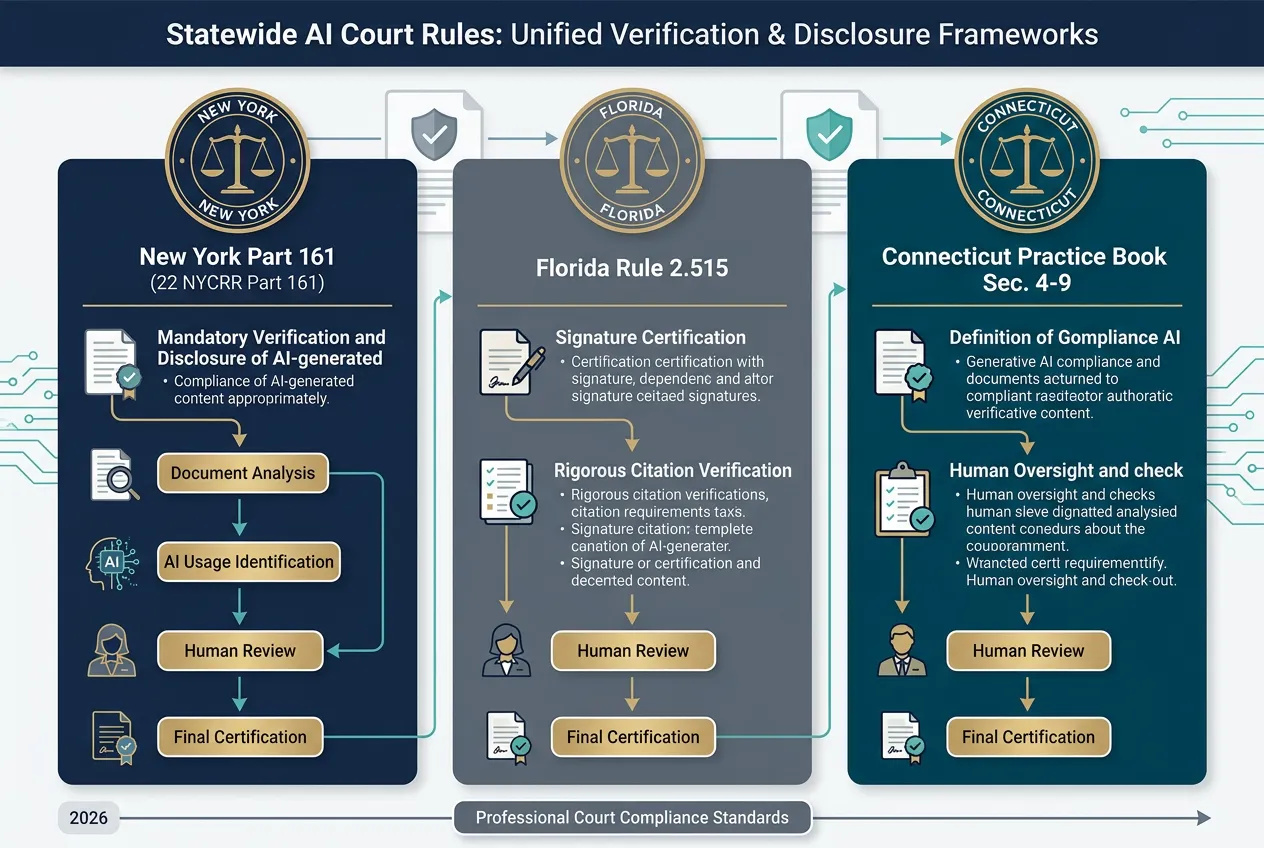
What Does New York's 22 NYCRR Part 161 Require of Litigators?
The New York State Unified Court System enacted 22 NYCRR Part 161 to govern the use of artificial intelligence in matters pending before the state supreme court, county courts, and commercial divisions. Rather than prohibiting algorithmic drafting tools, Part 161 focuses on transparency, substantive verification, and judicial discretion.
Under Part 161:
- Mandatory Human Verification: Every attorney signing or submitting a pleading, motion, brief, or affirmation must certify that every cited authority (including case law, statutory provisions, administrative rulings, and docket citations) has been personally verified against official reporters or certified commercial legal research databases.
- Disclosure Requirements: If an artificial intelligence application was utilized to draft or generate substantive legal arguments, factual summaries, or evidentiary syntheses, counsel must provide the court with disclosure upon request or when mandated by specific division rules.
- Sanctions and Disciplinary Referrals: Inaccurate citations or fabricated quotes cannot be excused by claiming vendor error or algorithmic hallucination. Under Part 161, submitting unverified AI outputs constitutes a sanctionable failure of reasonable inquiry under 22 NYCRR Part 130-1.1 and triggers mandatory notification to the appropriate Attorney Grievance Committee.
For a deeper dive into federal verification standards and Rule 11 precedents, see our analysis on Rule 11 and ethical verification requirements in 2026.
How Does Florida Rule of General Practice and Judicial Administration 2.515 Enforce AI Governance?
In Florida, the Florida Supreme Court and the Judicial Administration Rules Committee integrated AI compliance directly into Florida Rule of General Practice and Judicial Administration 2.515 (Signature and Certificates of Attorneys and Parties).
Rather than enacting an entirely separate AI code, Florida leveraged the attorney's signature as a comprehensive warranty:
- Signature as Certificate of Verification: Under Rule 2.515, an attorney’s physical or electronic signature on any court document certifies that the signer has conducted an independent, reasonable inquiry into the validity of all legal propositions and citations.
- Elimination of the "Vendor Defense": Florida courts have made clear that reliance on third-party legal research platforms, generative chatbots, or automated drafting agents does not alter the non-delegable duty of candor to the tribunal under Rule 4-3.3 of the Rules Regulating The Florida Bar.
- Pro Se Application: Crucially, Florida’s procedural framework applies the signature certification obligation to self-represented litigants, providing judges with administrative tools to strike non-compliant pro se submissions containing synthetic case law.
What Are the Operational Requirements of Connecticut Practice Book Sec. 4-9?
The Connecticut Judicial Branch adopted Section 4-9 of the Connecticut Practice Book ("Generative Artificial Intelligence Compliance"), establishing one of the nation's most explicit and detailed statutory frameworks.
Connecticut Practice Book Sec. 4-9 specifically addresses both definition and operational compliance:
| Requirement Category | Statutory Specification under Sec. 4-9 |
|---|---|
| Statutory Definition | Defines generative AI as any machine-learning model or application creating original content (text, images, video, audio, software code) in response to a prompt. |
| Enumerated Technologies | Explicitly cites leading platforms including ChatGPT, Co-Counsel, Google Bard, Neeva, Harvey, Ironclad, Bing, DeepSeek, and Grok. |
| Recognized Risks | Codifies judicial recognition of inaccurate factual/legal data, faulty citations, and fabricated quotations. |
| Mandatory Verification | Mandates human review and independent verification of all legal sources prior to filing. |
| Supervisory Oversight | Applies the standard of ABA Model Rule 5.3 to all nonlawyer and automated assistance. |
As detailed in our analysis of Connecticut court rules for artificial intelligence, Sec. 4-9 pairs mandatory human review with automated detection standards, setting a benchmark for state court rules nationwide.
How Do State AI Rules Compare to Judicial and Staff Administration Standards?
While New York, Florida, and Connecticut focus on practitioner filings, judicial governance bodies are simultaneously regulating internal court operations. For instance, the Judicial Council of California adopted California Rules of Court Rule 10.430 and Standard of Judicial Administration 10.80, which regulate how judicial officers and court staff utilize generative tools.
Standard 10.80 mandates that judges and staff:
- Verify the accuracy of all AI-generated content used in bench memorandums, tentative rulings, and orders.
- Correct erroneous or hallucinated outputs before entering judicial records.
- Take reasonable steps to remove biased or harmful material.
- Consider public disclosure whenever AI systems assist in creating public-facing court content.
This parallel structure demonstrates that statewide AI court rules are establishing a reciprocal standard: litigators and judicial officers alike are bound by identical obligations of verification, candor, and accountability. See our coverage of California court rules for judicial and staff AI governance.
What Practical Protocols Must Litigation Teams Implement Immediately?
To ensure total compliance across state courts, litigation departments must adopt four standardized operating procedures:
- 1. Primary-Source Citational Verification: Never rely on an AI agent's citation summary. Every case reporter volume, page number, court identifier, and quoted sentence must be checked against an authoritative primary source before submission.
- 2. Standardized Verification Logs: Maintain internal audit records documenting who verified the primary citations, what database was used, and the date the verification occurred.
- 3. Upstream Vendor Change Control: Review enterprise agreements with legal tech vendors to guarantee zero data retention (ZDR) and verify model update policies. See our guide on enterprise AI vendor change control.
- 4. Supervisory Sign-Off: Require lead counsel to confirm in writing that all junior associates and paralegals completed primary-source verification prior to affixing an electronic signature.
Do statewide court rules require attorneys to disclose every use of AI?
Most statewide rules, such as New York 22 NYCRR Part 161 and Florida Rule 2.515, do not require blanket disclosure for routine spell-checking, grammar refinement, or Boolean research queries. However, disclosure is typically required when generative models produce substantive legal arguments, evidentiary summaries, or when specifically directed by the presiding judge.
Can an attorney avoid court sanctions by blaming an AI software vendor?
No. Courts across New York, Florida, California, and Connecticut have consistently held that an attorney's duty to verify legal authority is non-delegable. Blaming an algorithm or vendor for fabricated case citations or hallucinated quotes constitutes an admission of failure to conduct a reasonable inquiry under signature rules.
How do statewide court rules affect nonlawyer staff and litigation assistants?
Statewide rules apply the supervisory framework of ABA Model Rule 5.3 to automated tools and staff alike. Supervising attorneys are strictly liable for work product submitted under their signature, regardless of whether the initial draft was prepared by a paralegal, an associate, or an automated agent.
Are pro se litigants exempt from statewide AI verification requirements?
No. Rules such as Florida Rule 2.515 explicitly bind self-represented litigants to the signature certification standard, ensuring that pro se submissions containing fabricated AI citations are subject to being stricken and dismissed.