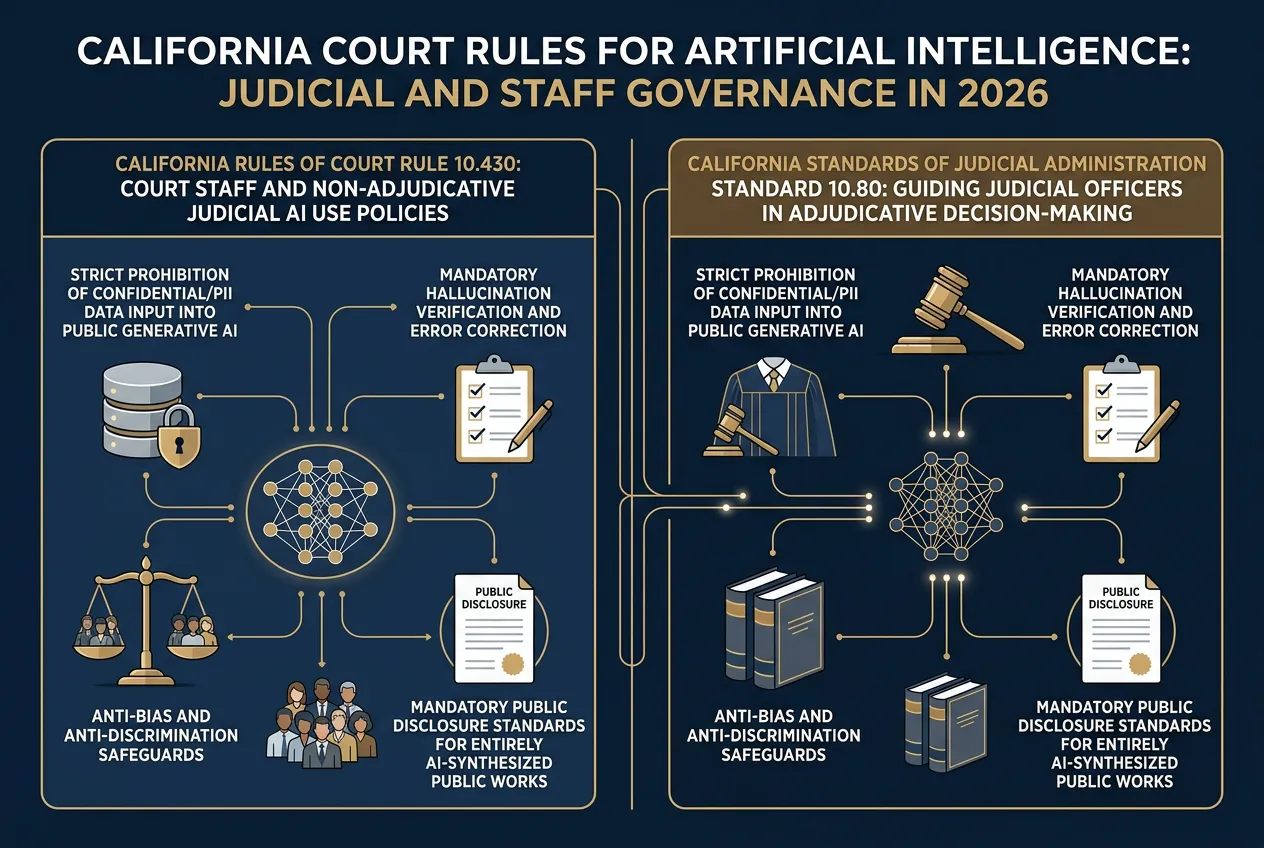
California court rules for artificial intelligence establish a dual governance architecture that divides judicial operations into court staff administration under California Rules of Court Rule 10.430 and adjudicative decision-making under California Standards of Judicial Administration Standard 10.80. Effective September 1, 2025, every California superior court, Court of Appeal, and the Supreme Court must either adopt a formal generative AI policy or entirely ban staff AI use. This framework mandates strict confidentiality perimeters barring nonpublic case records from public models, imposes affirmative verification duties to detect hallucinations, prohibits algorithmic discrimination, and requires visible disclosure whenever public-facing court materials are generated by AI systems.
How Does California Divide Court AI Governance Between Staff and Judges?
California chose not to issue a single uniform AI mandate across its court system. Instead, the Judicial Council established a jurisdictional separation between operational court administration and independent adjudicative decision-making.
| Governance Tier | Governing Authority | Scope of Application | Core Enforcement Mechanism |
|---|---|---|---|
| Court Staff & Non-Adjudicative Tasks | California Rules of Court, Rule 10.430 | All court employees, contractors, volunteers, and judicial officers acting outside their adjudicative role | Mandatory local policy adoption by December 15, 2025, or complete prohibition of generative AI |
| Adjudicative Decision-Making | California Standards of Judicial Administration, Standard 10.80 | Superior court judges, appellate justices, Supreme Court justices, temporary judges, and subordinate judicial officers | Ethical standards and judicial administration guidelines under the California Code of Judicial Ethics |
Under Rule 10.430(a)(2) and Standard 10.80(a)(2), "generative artificial intelligence" is defined broadly as:
"a computer-based system that uses machine learning or similar techniques to produce new content—such as text, images, audio, video, code, or data visualizations—in response to user inputs. Generative AI systems create content that is not pre-programmed or explicitly retrieved but synthesized based on underlying models trained on large datasets and may include integration with other sources, such as real-time access to proprietary databases."
This broad definition ensures that whether court staff utilize hosted commercial models, coding assistants, or enterprise Retrieval-Augmented Generation (RAG) platforms integrated with case management systems, the governance requirements apply equally.
What Are the Mandatory Requirements for Court Generative AI Policies Under Rule 10.430?
Under Rule 10.430(b), every trial and appellate court that does not prohibit generative AI was required to adopt a compliant use policy by December 15, 2025. Courts may adopt the Judicial Council's Model Policy verbatim or institute more restrictive local rules.
Every compliant court policy must enforce six non-negotiable standards:
- Strict Data Confidentiality and PII Firewall: Rule 10.430(d)(1) strictly prohibits entering confidential, personal identifying, or nonpublic information into any "public generative AI system." The rule defines public systems as those permitting third parties to access uploaded court data or using prompt data to train foundation models. Prohibited data categories explicitly include driver's license numbers, Social Security numbers, dates of birth, NCIC numbers, residential addresses, medical and psychiatric records, and sealed case records.
- Prohibition of Algorithmic Discrimination: Rule 10.430(d)(2) prohibits using generative AI in any manner that unlawfully discriminates against or disparately impacts individuals or communities across all protected classifications under California and federal law, including race, ancestry, disability, medical condition, socioeconomic status, and gender expression.
- Affirmative Accuracy Verification and Hallucination Correction: Under Rule 10.430(d)(3), court personnel who create or rely on generative AI material must take affirmative, reasonable steps to verify accuracy and correct erroneous or hallucinated citations, facts, or legal principles before any material is utilized.
- Content De-Biasing: Rule 10.430(d)(4) mandates proactive screening to remove biased, offensive, or harmful material generated by model synthesis.
- Mandatory Public Disclosure: Under Rule 10.430(d)(5), if the final version of any written, visual, or audio work provided to the public consists entirely of generative AI outputs, the court must include a prominent and understandable label, watermark, or statement identifying the AI system used and describing its role.
- Ethical and Professional Compliance: Rule 10.430(d)(6) reinforces that AI utilization must strictly comply with judicial branch ethics codes, court employee guidelines, and statutory duties.
How Does Standard 10.80 Regulate Judicial Officers in the Adjudicative Role?
While Rule 10.430 governs administrative administration, California Standards of Judicial Administration Standard 10.80 establishes ethical guardrails for judges and justices when performing adjudicative functions—such as reviewing motions, analyzing evidence, synthesizing bench briefs, or drafting tentative rulings.
Standard 10.80 establishes that judicial officers:
- Must Guard Adjudicative Confidentiality: Judges should never input nonpublic case records, in-camera submissions, or party PII into public AI systems where data retention or model training compromises court privilege.
- Retain Non-Delegable Duty of Verification: Standard 10.80(b)(3) explicitly states that judges must verify accuracy and correct hallucinations in all materials used in court rulings—including drafts prepared on their behalf by judicial research attorneys, externs, or staff.
- Prevent Algorithmic Bias in Sentencing and Findings: Standard 10.80(b)(2) bars reliance on models that manifest disparate impacts across protected classes, guarding against algorithmic bias in discretionary judicial determinations.
- Exercise Discretion on Public Disclosure: Unlike the mandatory disclosure imposed on staff-generated public notices, Standard 10.80(b)(5) directs judicial officers to "consider whether to disclose the use of generative AI if it is used to create content provided to the public," balancing judicial independence with transparency.
What Does California’s Framework Mean for Practicing Litigators and Law Firms?
California’s judicial AI rules mirror the broader transformation occurring across state and federal courts. As courts hold their own internal staff to rigorous verification and confidentiality standards, litigators face symmetrical judicial scrutiny:
- Heightened Scrutiny for AI-Assisted Filings: When judges are bound by Standard 10.80 to police hallucinations in their own chambers, judicial tolerance for fabricated citations in attorney briefs is nonexistent. Practitioners must maintain strict primary-source verification protocols before signing pleadings.
- Protective Orders Must Address AI Training: Because Rule 10.430(a)(4) defines public generative AI systems by whether user data is retained or used for model training, discovery agreements and protective orders must explicitly govern whether disclosed document productions can be ingested into third-party commercial AI tools.
- Bench-Side AI Capabilities: Litigators must anticipate that court research attorneys and judges may use enterprise, zero-retention AI tools to benchmark brief arguments, cross-examine record citations, and synthesize trial transcripts.
To review related developments in court rules, judicial sanctions, and ethical verification, explore our analyses of AI Court Standing Orders and Judicial Rules, Rule 11 Verification Standards, and AI Evidentiary Admissibility Standards.
When did California Rules of Court Rule 10.430 and Standard 10.80 take effect?
Both California Rules of Court Rule 10.430 and California Standards of Judicial Administration Standard 10.80 were adopted by the Judicial Council of California effective September 1, 2025. Rule 10.430 established a statewide deadline of December 15, 2025, for all superior and appellate courts to enact local generative AI policies.
Does Rule 10.430 require California courts to allow generative AI?
No. Subdivision (d) and the Advisory Committee Comment make clear that Rule 10.430 does not require any court to permit AI. Individual trial and appellate courts retain full authority to prohibit generative AI entirely or restrict its use to specific authorized tools and defined clerical tasks.
What constitutes a "public generative AI system" under California court rules?
Under Rule 10.430(a)(4) and Standard 10.80(a)(4), a public generative AI system is any platform that allows third parties outside the court to access uploaded data or uses input data to train underlying models. Secure, court-managed internal platforms and public-facing court informational chatbots are excluded from this classification.