Proposed Federal Rule of Evidence 707 prevents litigants from bypassing Daubert reliability standards when offering artificial intelligence output at trial without a testifying expert witness. Under the revised working draft reviewed by the Judicial Conference Advisory Committee on Evidence Rules at its October 15, 2026 meeting, any AI-generated evidence that would fall under Rule 702 if presented by a human witness must satisfy Rule 702’s four reliability criteria, ordinarily requiring an expert foundation unless exceptional circumstances permit independent validation proof.
Why Did the Advisory Committee Revise Proposed Federal Rule of Evidence 707 in 2026?
At its Spring 2025 meeting, the Judicial Conference Advisory Committee on Evidence Rules released an initial version of proposed Rule 707 for public comment to address machine-learning outputs offered into evidence without an accompanying expert. During the comment window closing in February 2026, the Committee received 59 written comments by the deadline (and more than 70 written submissions overall alongside testimony at two public hearings). Within the 59 comments tallied in the May 7, 2026 Committee minutes, 3 expressed unqualified support, 27 supported the rule subject to revisions, and 27 opposed it.
Commenters identified three primary structural flaws in the original 2025 text:
- Overbreadth of "Machine-Generated Evidence": Practitioners and the Department of Justice warned that regulating all "machine-generated" output could sweep in routine electronic records such as faxes, emails, and mirror-image cellphone extractions.
- Vagueness of the "Simple Scientific Instruments" Exception: The original carve-out for simple instruments lacked clear boundaries for modern software-assisted devices.
- Ambiguity Over Expert Foundation Requirements: Defense counsel and evidence scholars warned that tethering AI output to Rule 702 without specifying how a proponent must prove reliability could inadvertently invite parties to submit complex AI analyses without an expert witness.
At its May 7, 2026 meeting in Washington, D.C., the Advisory Committee voted to withdraw the initial public-comment draft and advance "Version Two" of a revised working draft for focused examination at its October 15, 2026 meeting in Boston. This regulatory trajectory parallels the broader tightening of courtroom verification duties examined in AI Judicial Evidence Rules: Deepfakes and Courtroom Admissibility in 2026 and Statewide AI Court Rules: Verification and Signature Doctrines in 2026.
| Provision | Initial 2025 Public-Comment Draft | Revised October 2026 Working Draft (Version Two) |
|---|---|---|
| Regulated Subject Matter | "Machine-generated evidence" | "Evidence [that] is a product of artificial intelligence" (Rule 707(a)) |
| Routine Technology Carve-Out | Exception for "simple scientific instruments" | Deleted; replaced by narrow AI definition (Rule 707(e)) and Rule 201 judicial notice carve-out (Rule 707(d)) |
| Foundation Pathway | Cross-referenced Rule 702(a)–(d) without specifying whether an expert is required | Ordinarily requires an expert foundation, with an "exceptional circumstances" path for other objective proof (Rule 707(b)) |
| Pre-Trial Disclosure | Discussed only in the Advisory Committee Note | Mandatory reasonable pre-trial notice to all parties in the rule text (Rule 707(c)) |
How Does the "Lay Witness with an AI Advisor" Evidentiary Gap Arise at Trial?
In his September 15, 2026 memorandum to the Advisory Committee (Tab III of the October 15, 2026 Agenda Book), Reporter Professor Daniel J. Capra highlights the exact doctrinal gap that proposed Federal Rule of Evidence 707 is built to close. When a testifying expert relies on an AI tool, Federal Rules of Evidence 702 and 703 already empower the trial judge to screen the methodology for reliability. As illustrated in Washington v. Puloka (2024), where a defense expert used a Topaz Labs AI video-editing tool to clarify grainy bystander video of an altercation, the trial court applied Rule 702 to exclude the AI-enhanced video because the experts could not rule out that the software "clarified" the footage by inserting fictionalized pixels.
The evidentiary gap emerges when a party offers AI output directly as an exhibit or through a lay witness who operated the software but knows nothing about its underlying statistical validity:
- Rule 702 (Expert Testimony): Applies only to a witness testifying as an expert. If an insurance claims adjuster runs vehicle event-data recorder logs through an AI accident-reconstruction program and offers the resulting sequence-of-events model, or a radiology technician describes an AI diagnostic readout without medical physics expertise, Rule 702 does not directly govern the lay witness.
- Rule 701(c) (Lay Opinions): Prohibits lay witnesses from offering opinions based on scientific, technical, or specialized knowledge, but does not clearly bar a lay witness from relaying a factual readout or translation generated by an autonomous device (such as real-time AI translation glasses).
- Rule 801 (Hearsay): Screens out-of-court statements for reliability, but defines a "statement" as a person's oral assertion, written assertion, or nonverbal conduct. Because an AI model is not a human declarant, its outputs are not hearsay—and even if hearsay rules were expanded, they would not capture an AI query run live in the courtroom.
- Rules 901(b)(9) and 902(13) (Authentication): Authentication requires only a threshold showing sufficient to support a finding that an item is what the proponent claims it is. As the draft Rule 707 Committee Note explains, self-authentication of certified electronic records under Rule 902(13) or system accuracy under Rule 901(b)(9) does not satisfy the higher Rule 104(a) preponderance-of-the-evidence standard required for expert reliability.
Recent 2026 appellate and trial decisions underscore how frequently courts now confront AI-altered or software-analyzed evidence:
- Linkugel v. City of Los Angeles, 2026 WL 1430790 (Cal. App. 2d Dist. 2026): The plaintiff offered photographs of a golf-course sinkhole that had been modified using generative AI. Rejecting the characterization of the edits as mere "enhancement," the court excluded the doctored images because the plaintiff made no showing—through an expert or otherwise—that the generative AI modification was reliable.
- United States v. Andrews, 172 F.4th 969 (7th Cir. 2026): In a firearm-possession prosecution, the Seventh Circuit upheld the admission of expert fingerprint testimony where the examiner used Photoshop to adjust the angle of a photograph showing a latent print on a gun, relying on the examiner's general experience. As the Reporter's memorandum observes, modern image-editing suites integrate generative AI functions alongside traditional geometric adjustments, raising a sharp threshold question: when an operator knows nothing about how the underlying software transforms pixels, general user experience cannot substitute for software-level reliability verification.
- Extraction vs. Analytical Inference in Digital Forensics: During the May 7, 2026 Advisory Committee meeting, Federal Public Defender Nicole Owens and Professor Andrea Roth emphasized the distinction between using a forensic tool like Cellebrite to create a mirror-image extraction of a phone (which requires no AI expert foundation) versus feeding extracted records into an AI analytical module that infers social hierarchies or identifies "key contacts." Under proposed Rule 707, the latter constitutes an expert-equivalent analytical conclusion that cannot be admitted through a lay investigator without Rule 702 scrutiny.
How Does the Two-Track Foundation in Rule 707(a)–(b) Work?
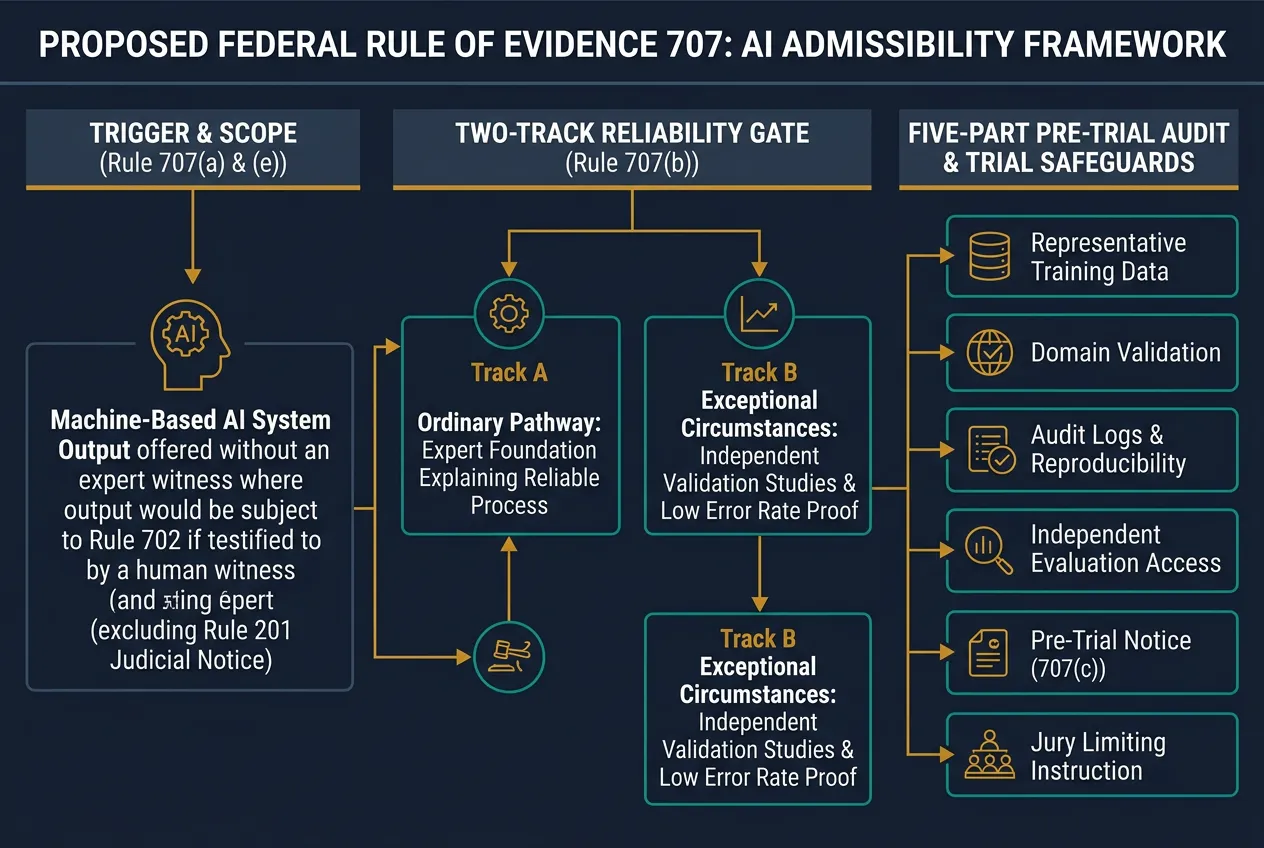
To prevent parties from evading Daubert by dropping the human expert and offering the machine output alone, revised Rule 707(a) incorporates the four substantive reliability pillars of Rule 702 directly into the rule text. When evidence is a product of artificial intelligence, is offered without an expert witness, and would be subject to Rule 702 if testified to by a witness, the proponent must establish by a preponderance of the evidence that the output:
- Will help the trier of fact (Rule 707(a)(1));
- Is based on sufficient facts or data (Rule 707(a)(2));
- Is the product of reliable principles and methods (Rule 707(a)(3)); and
- Reflects a reliable application of the principles and methods to the facts of the case (Rule 707(a)(4)).
Track 1: The Ordinary Requirement of an Expert Foundation
Under Rule 707(b), the proponent "ordinarily... must provide an expert to explain how the system of artificial intelligence reliably produced the evidence." As the draft Committee Note clarifies, the rule is not designed to encourage parties to substitute AI printouts for live experts; rather, meeting the four reliability requirements will ordinarily be impossible without an expert who understands how the model was trained and validated. Notably, as Professor Roth observed during the May 2026 Committee deliberations, the requirement to "provide an expert" to establish admissibility under Rule 104(a) allows a party to present an expert's foundational showing at a pre-trial Daubert/707 gatekeeping hearing (including by declaration or affidavit where permitted), even if the proponent seeks to introduce the validated AI output at trial without calling that expert before the jury.
Track 2: The "Exceptional Circumstances" Substitute Proof Pathway
In response to public comments arguing that rigid insistence on live expert testimony in every case could become obsolete as standardized validation protocols mature, Rule 707(b) adds a narrow safety valve: "But in exceptional circumstances, the court may consider other proof to find that the output satisfies the requirements of (a)(2)-(4)." According to the draft Committee Note, such substitute guarantees of reliability could include convincing, independent validation tests and objective peer-reviewed studies demonstrating a known, low rate of error under conditions matching the case at hand.
What Are the Five Pre-Trial Audit Factors in the Draft Rule 707 Committee Note?
For legal teams, forensic examiners, and enterprise technologists building or challenging AI systems that may generate courtroom evidence, the most operational section of the September 15, 2026 Reporter's Memorandum is the five-part judicial inquiry outlined in the draft Committee Note (lines 61–76). Trial judges conducting a Rule 707 gatekeeping review are directed to examine:
- Input Sufficiency & Training Data Representativeness: Whether the inputs and underlying training data are sufficiently representative to produce an accurate output for the specific population or physical environment involved in the case.
- Contextual Validation: Whether the AI system has been validated in operational circumstances sufficiently similar to the forensic or factual scenario at issue, guarding against "function creep" (using a model for an unvalidated purpose).
- System Logging, Deletion Policies, and Audit Reproducibility: What records the system retains, what telemetry or intermediate states are deleted, and whether the output can be independently reproduced or audited. (This directly echoes the runtime logging and judicial evidence guidance discussed in Judicial AI Guidance: Evidence Reading and Hidden Prompts and Rule 11 and Ethical Verification Requirements: Court Sanctions in 2026.)
- Independent Evaluation & Research Access: Whether the model or software has been evaluated by entities independent of the commercial developer, and whether opposing parties and independent researchers have meaningful access (for example, through research licenses or testing sandboxes).
- Adversarial Disclosure Parity: Whether the opposing party has received sufficient disclosure regarding how and why the process works, equivalent to the methodology disclosures required under Federal Rule of Civil Procedure 26(a)(2) or Criminal Rule 16 when a human expert testifies.
How Does Rule 707 Treat "Black-Box" and Self-Programming AI?
The draft Committee Note directly addresses the "black-box problem"—situations where an AI model has developed or adapted through self-programming or deep neural weights such that no human can explain the exact internal path to a specific output. The Note establishes a clear default rule and a narrow empirical exception:
- Default Exclusion for Unexplained Processes: If nobody can explain how the AI system reached its result, the court should in most cases find that the proponent has failed to establish by a preponderance of the evidence that the methodology is reliable—analogous to the Rule 702 principle that an experience-based expert cannot rely on ipse dixit without explaining how experience leads to the conclusion.
- Overcoming Inexplicability via Empirical Validation: Just as courts admit the conclusions of trained scent-detection animals without knowing the neurobiology of canine olfaction because rigorous testing proves a low error rate, a proponent may overcome algorithmic opacity by presenting an expert who explains how the model was trained and establishes through objective validation studies that the process reliably yields a low rate of error in the specific task.
How Do Rule 707(c)–(e) Handle Pre-Trial Notice, Judicial Notice, and the Definition of AI?
To prevent trial by ambush and prevent routine software tools from clogging federal dockets, the revised working draft pairs its reliability gate with three structural boundaries:
- Mandatory Pre-Trial Notice (
Rule 707(c)): Admissibility is conditioned on the proponent giving "all parties reasonable notice of the intent to offer the evidence — so that the party has a fair opportunity to meet it." Modeled on the flexible notice provisions of Rules 404(b) and 807, this ensures that complex battles over training data, source code versus validation testing, and error rates are resolved at pre-trial in limine hearings rather than mid-trial. - Judicial Notice Carve-Out (
Rule 707(d)): The rule explicitly does not apply to facts that may be judicially noticed under Rule 201 (such as standard map distances), nor does it apply when an AI output is offered for a non-truth purpose independent of its reliability (for example, proving that a driver relied on an erroneous navigation prompt to assess comparative negligence). - Statutory Definition of Artificial Intelligence (
Rule 707(e)): Adapted from the National Artificial Intelligence Initiative Act of 2020 (Pub. L. 116-283) and aligned with New York's 2026 court rule definition (22 NYCRR § 161.2), draft Rule 707(e) defines "artificial intelligence" as "a machine-based system that can, for a given set of human-defined objectives, [provide analysis] or make predictions, recommendations or decisions influencing real or virtual environments." At the October 15, 2026 symposium, panelists debated two bracketed refinements flagged by the Reporter: removing the qualifier "human-defined" (follow-on alignment with updated OECD and NIST definitions so autonomous or self-directed agentic systems cannot evade the rule) and adding "[provide analysis]" alongside predictions, recommendations, and decisions to ensure analytical and generative outputs are squarely covered.
Explore how Prest0's verifiable audit trails and zero-retention legal workspaces support litigation teams on our Pricing & Platform Overview.
Is Federal Rule of Evidence 707 currently in force in federal courts?
No. As of October 2026, Proposed Federal Rule of Evidence 707 is an active rulemaking proposal before the Judicial Conference Advisory Committee on Evidence Rules. Following the initial public comment period that closed in February 2026, the Committee withdrew the original draft in May 2026 and convened an expert panel on October 15, 2026, to refine "Version Two" of the revised working draft alongside proposed Rule 901(c) on deepfakes.
When does Proposed Rule 707 apply to AI-generated evidence?
Proposed Rule 707 applies when two conditions are met: (1) the proffered evidence is a product of artificial intelligence offered without an accompanying expert witness (either directly as an exhibit or through a lay witness), and (2) the output would be subject to Rule 702 expert testimony standards if a human witness were testifying to the same conclusion.
Does self-authentication under Rule 902(13) or Rule 901(b)(9) satisfy Rule 707?
No. The draft Rule 707 Committee Note explicitly clarifies that authenticating computer output under Rule 901(b)(9) or via a custodian's certification under Rule 902(13) only satisfies the threshold for authenticity, not the higher Rule 104(a) preponderance-of-the-evidence standard required to prove methodological reliability under Rule 702 or Rule 707.
Can a party ever admit AI-generated analytical evidence without calling an expert witness under revised Rule 707?
Under revised Rule 707(b), the proponent must ordinarily provide an expert to explain how the AI system reliably produced the evidence. Only in "exceptional circumstances" may a trial court rely on substitute proof—such as rigorous, independent validation studies establishing a low error rate in matching conditions—to find that the output satisfies Rule 707(a)(2)–(4) without an expert foundation.