Judicial AI guidance from the England and Wales judiciary draws a practical boundary: AI may assist with judicial work, but judges must still read the underlying documents and remain personally responsible for material produced in their names. The guidance also warns about hidden instructions in documents. Together, those points make trustworthy AI use a question of evidence handling and human accountability—not merely whether a generated summary sounds convincing.
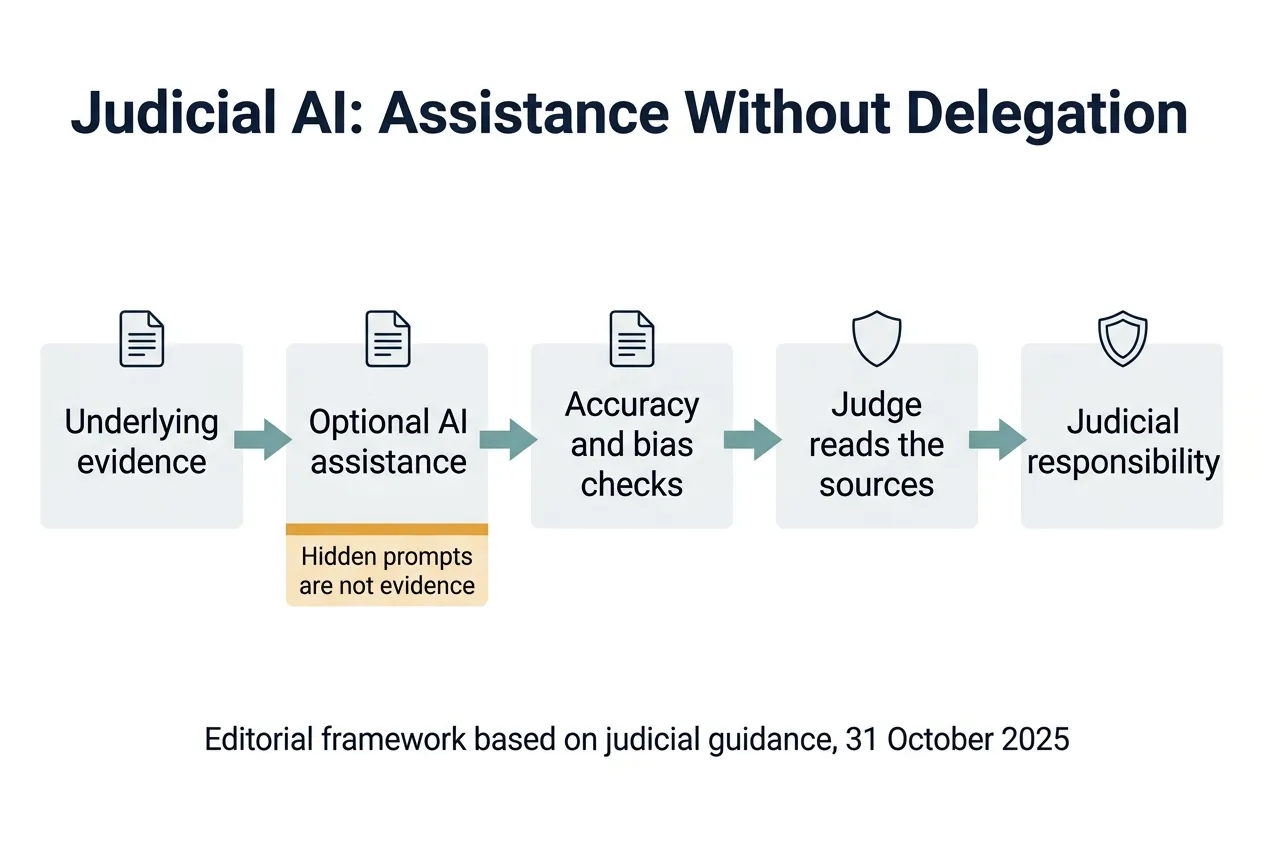
This is an editorial framework, not an official court diagram.
Which guidance does this article examine?
This article examines the complete official Artificial Intelligence (AI): Guidance for Judicial Office Holders, dated 31 October 2025, retrieved from the Judiciary's website and checked on 28 October 2026. The document says it updates and replaces the guidance issued in April 2025. Its stated audience includes judicial office holders under the Lady Chief Justice and Senior President of Tribunals, together with their clerks, judicial assistants, legal advisers or officers and other support staff.
The analysis below concerns that guidance. It is not a claim to summarize every subsequent judicial AI policy, a new court judgment or a litigant-facing procedural rule. Particular cases still require checking the applicable court rules, directions and orders.
The distinction matters. Guidance about how judicial personnel use AI should not be repackaged as a universal filing obligation for lawyers—or as a declaration that every court has adopted the same disclosure policy.
Why does reading the underlying evidence remain essential?
Section 3(V), under Take Responsibility, states:
"Judges must always read the underlying documents. AI tools may assist, but they cannot replace direct judicial engagement with evidence."
The same section says judicial office holders are personally responsible for material produced in their names. AI can therefore be a secondary aid without becoming the person who evaluates the record.
Editorial analysis: A summary is a representation of evidence, not the evidence itself. It may leave out a qualification, merge opposing accounts, lose a date or turn a disputed assertion into an apparently settled fact. A fluent answer can conceal those changes because the reader receives the model's compressed narrative rather than the document's original structure.
The practical question is not simply whether a summary is mostly accurate. It is whether the responsible reader can identify what it omitted, distinguish assertions from findings, and reconnect each consequential statement to the source. Direct reading is the safeguard that the guidance expressly retains.
What does the guidance say about hidden document prompts?
Section 2 defines white text as text made invisible to human readers—for example, white lettering against a white background—but still detectable by computers. Section 3(VI) warns about hidden prompts or concealed text inserted into documents so that a computer can detect them while a human reader cannot.
The guidance connects that possibility to judicial office holders' personal responsibility for anything produced in their names. It separately warns that AI tools can be used to produce fake text, images and video.
Editorial analysis: Hidden instructions create a different risk from an ordinary factual error. An AI assistant may encounter document content that attempts to redirect how it summarizes or interprets the record. That content should not acquire authority merely because the system can read it.
This article does not provide concealment techniques. The defensive principle is straightforward: a document submitted for analysis is source material, not an instruction channel entitled to override the task. Suspicious hidden content also should not be silently removed from an evidentiary original. Preservation, provenance and any necessary authenticity inquiry remain separate from how an AI system processes a working copy.
What must be checked before an AI output is relied upon?
Section 3(III), Ensure accountability and accuracy, says the accuracy of information provided by AI must be checked before it is used or relied upon. Its examples of hallucination include fictitious cases, citations or quotations; references to nonexistent legislation or texts; incorrect or misleading legal information; and factual errors.
Section 3(IV) addresses bias and the need to correct it. Section 4 identifies summarization, presentation preparation and administrative work as potentially useful applications, while warning against using public AI chatbots for new legal research that cannot be independently verified. It recommends checking final legal material against maintained authoritative sources.
Editorial recommendations: A useful review separates distinct questions:
- Source accuracy: Does the cited document or authority exist, and does it support the statement?
- Record fidelity: Does the summary preserve uncertainty, competing accounts and material qualifications?
- Instruction integrity: Has embedded document content tried to influence the assistant's behavior rather than supply evidence?
- Human responsibility: Has the responsible person read the relevant original material and approved what will be used?
Those are implementation suggestions derived from the guidance, not a newly prescribed judicial checklist.
How does confidentiality change the choice of tool?
Section 3(II) instructs judicial personnel not to enter information into a public AI chatbot unless it is already in the public domain. It warns against entering private or confidential information and says public AI tools should be treated as capable of making entered information public. The guidance also describes reporting routes for unintentional disclosure and personal-data incidents.
These are the guidance's precautionary instructions. They should not be read as a technical finding that every commercial service has identical retention, training or disclosure settings. Tool-specific arrangements need their own assessment; an attractive product description does not itself establish permission to upload court material.
Section 3(V) also addresses work devices, security and appropriate oversight of staff using AI. The central point is that efficiency does not cancel confidentiality or supervisory responsibility.
Does responsible AI use automatically require disclosure?
The guidance does not announce an across-the-board obligation to disclose every use of AI. Section 3(V) says judges are not generally obliged to describe research or preparatory work involved in producing a judgment, and describes generative AI as a potentially useful secondary tool when the guidance is followed.
For legal representatives, section 3(VI) says responsible use does not necessarily require referring to AI, but expressly makes that position context-dependent. It also addresses inquiries where an unrepresented litigant may have used a chatbot, including asking what accuracy checks were undertaken and reminding the litigant of responsibility for material put before the court.
That is not a safe basis for ignoring a particular court's directions, an order or another applicable obligation. Nor are stylistic indicators proof that a document was AI-generated or that its contents are false. Verification should focus on the material itself.
What is the broader governance lesson?
Editorial conclusion: The strongest AI workflow does not end when text is generated. It ends when the responsible person has checked the sources, engaged with the underlying evidence and decided what can properly be used.
Hidden prompts make this boundary visible, but the principle also applies when no attack is present. Confidentiality, factual accuracy, bias review and personal responsibility are complementary safeguards. A tool can improve access to information while still requiring independent human engagement with that information.
For related coverage, see California's judicial and staff AI governance framework and AI evidence, deepfakes and courtroom admissibility. Those articles concern different legal instruments and should not be treated as interchangeable rules.
Is this guidance a blanket ban on judicial AI assistance?
No. It identifies potentially useful tasks, including summarization and administrative work, while preserving accuracy checks, confidentiality and direct judicial engagement with evidence. This article examines the guidance dated 31 October 2025, not every later policy or local direction.
Can an AI summary replace the judge's reading of the underlying documents?
No. Section 3(V) expressly says judges must always read the underlying documents and that AI cannot replace direct judicial engagement with evidence.
What is the difference between a hallucination and a hidden prompt?
A hallucination is incorrect or misleading generated material. A hidden prompt is concealed document content that a computer can detect and that may attempt to influence its behavior. They are distinct risks; either can undermine a trustworthy summary.
Does the guidance impose universal AI disclosure on every court filing?
No. Its discussion of legal representatives' disclosure is context-dependent. Applicable rules, case directions and orders must be checked separately.
Primary sources and scope
- Complete official judicial AI guidance, dated 31 October 2025: sections 1 and 2; sections 3(II), 3(III), 3(IV), 3(V) and 3(VI); section 4.
- Official October 2025 publication page.
The complete official PDF was retrieved and reviewed on 28 October 2026. Source descriptions above are separated from editorial analysis and implementation recommendations. This information is for general informational purposes only and does not constitute legal advice.