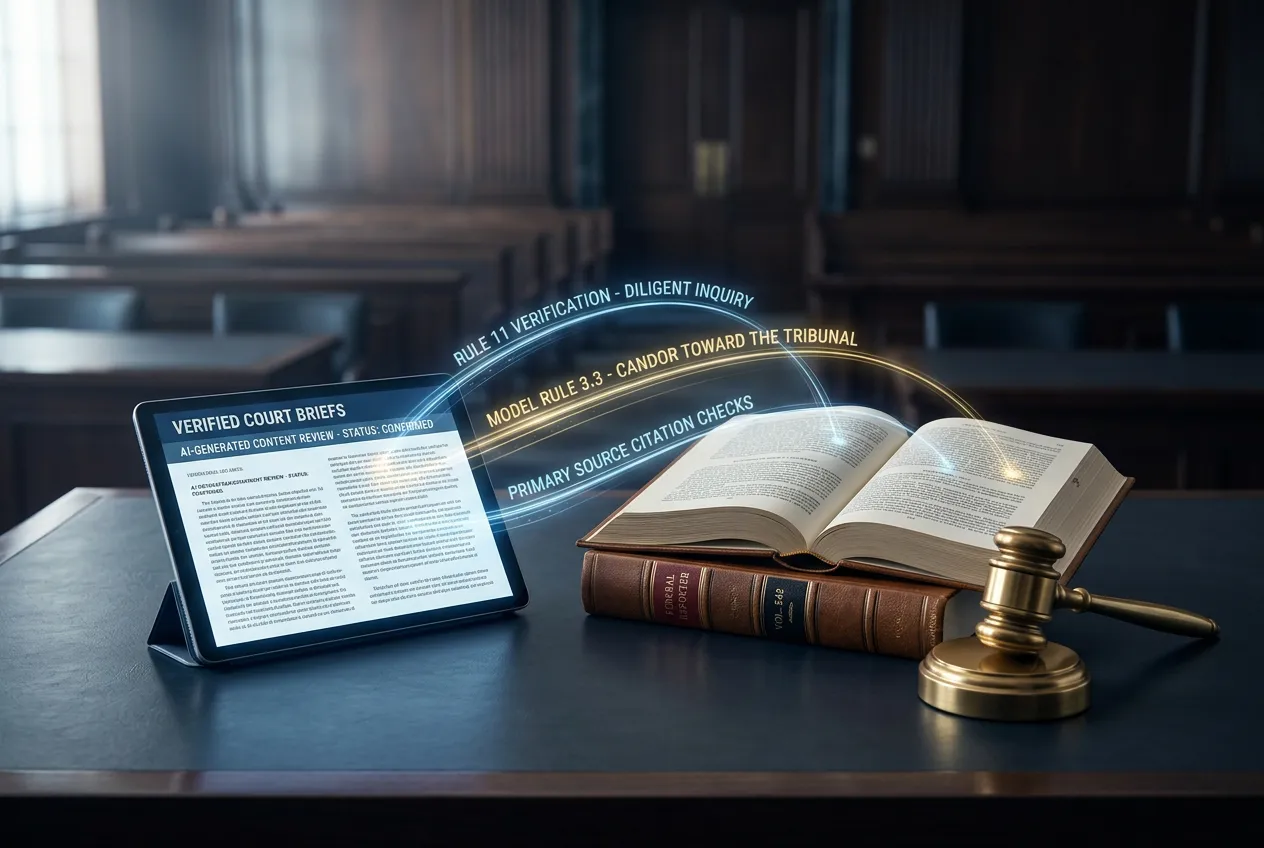
Under Federal Rule of Civil Procedure 11 and emerging 2026 judicial precedents, Rule 11 and ethical verification requirements mandate that counsel independently verify every citation, quotation, and legal proposition before filing, making attorneys personally liable for AI-generated hallucinations. Courts have established that delegating legal research to autonomous language models does not dilute the signing lawyer's non-delegable duty of candor and pre-filing inquiry under the law.
How Are Federal Courts Applying Rule 11 to Generative AI in 2026?
Federal Rule of Civil Procedure 11(b) certifies that every pleading, motion, or paper submitted to the court is formed after an "inquiry reasonable under the circumstances." In 2026, federal judges have solidified the principle that delegating legal drafting or case lookup to an automated model does not dilute that duty:
- The Fifth Circuit Affirmance (2026): In a published 2026 ruling, the U.S. Court of Appeals for the Fifth Circuit affirmed monetary sanctions and assessed $2,500 against counsel whose filings incorporated fabricated citations and substantive misrepresentations of precedent.
- District of Connecticut Sanctions & Grievance Referral (2026): Imposing a $3,500 sanction under Rule 11, the court referred the offending attorney to the local Grievance Committee, underscoring that submitting AI-hallucinated case law violates basic standards of professional competence.
- Eastern District of New York (April 30, 2026): Imposed Rule 11 sanctions for filings with hallucinated case quotes, emphasizing that the duty of primary-source verification existed long before large language models and applies with equal force today.
Courts are making plain that blaming the model, the software vendor, or an automated workflow is legally impermissible. Under Rule 11, the signing lawyer certifies the accuracy of every citation, quotation, and legal proposition.
What Does ABA Formal Opinion 512 Require for Legal AI Workflows?
Issued on July 29, 2024, by the American Bar Association Standing Committee on Ethics and Professional Responsibility, ABA Formal Opinion 512 remains the defining baseline for ethical generative AI deployment in American law practice. The opinion maps traditional professional obligations directly onto modern automated systems:
- Competence (Model Rule 1.1): Lawyers must understand the capabilities, material limitations, and hallucination risks of the specific AI technologies they employ, verifying all outputs against primary sources.
- Candor Toward the Tribunal (Model Rule 3.3): Filing a brief with fabricated citations or distorted judicial holdings constitutes a failure of candor, exposing counsel to disciplinary actions and court sanctions.
- Confidentiality (Model Rule 1.6): Inputting non-public client facts, privileged trial strategy, or protected personal data into commercial models without enforceable data-retention protections or informed client consent breaches confidentiality duties.
- Managerial and Supervisory Responsibilities (Model Rules 5.1 & 5.3): Law firm partners and managing attorneys must institute reasonable administrative policies, audit checks, and technical controls to supervise associates, paralegals, and third-party vendors utilizing AI.
How Are State Court Rules Codifying Mandatory AI Verification?
Beyond individual federal judicial standing orders, state judiciaries are formalizing explicit verification requirements directly into their rules of procedure.
A leading example is Indiana, where amended Indiana Trial Rule 11 (effective August 1, 2026) directly addresses court documents prepared with the assistance of artificial intelligence. Under the amended rule, attorneys must certify that cited authorities are authentic and verified against official reporters or court databases.
Across federal jurisdictions, numerous district judges have instituted standing orders requiring:
- Explicit disclosure of generative AI assistance;
- Mandatory human review and verification certifications; or
- Physical printouts or docket hyperlinks to cited unreported decisions.
Key Verification Safeguards for Modern Law Firms
To protect clients and prevent Rule 11 exposure, leading litigation departments have replaced ad-hoc AI usage with strict operational guardrails:
| Workflow Stage | Vulnerability | Mandatory Operational Control |
|---|---|---|
| Legal Research | Hallucinated citations and synthetic quotes | Automated primary-source retrieval tied to official reporters |
| Drafting | Overstated holdings and misapplied precedents | Inline cite-checking verifying every quoted sentence verbatim |
| Filing Review | Associate delegation without verification | Pre-filing sign-off certifying docket verification before signature |
| Data Ingestion | Model training on client privileged facts | Zero data retention agreements and isolated workspace boundaries |
For teams building modern legal infrastructure, this balance is essential. Autonomous agents provide immense productivity gains across discovery, synthesis, and drafting—provided they operate within verified, closed-loop retrieval architectures that respect judicial scrutiny.
To explore how robust verification architectures are built in production, see our technical breakdown on Closed-Loop Agent Reliability & Verification and our analysis of Agentic Memory Security & Privilege Isolation.
Does Rule 11 prohibit attorneys from using generative AI for brief drafting?
No. Federal Rule of Civil Procedure 11 does not prohibit the use of AI tools. However, Rule 11 requires a reasonable prefiling inquiry into the factual and legal grounds of every submission. The signing attorney remains strictly liable for the accuracy of all citations, facts, and legal arguments.
What should a law firm do if it discovers an AI hallucination in a filed brief?
Under Model Rule 3.3 and court rules, counsel has an affirmative duty of candor to immediately correct the record. Filing a prompt, candid notice of errata or corrected pleading mitigates disciplinary liability and judicial sanctions.
Are judicial standing orders requiring AI disclosure standard across all federal courts?
No uniform federal rule exists yet, though formal amendments to Rule 11 have been proposed in 2026. Currently, AI disclosure and verification mandates vary by judge and district through local rules and standing orders. Practitioners must check each presiding judge's specific practice requirements.
This article is provided for general educational and informational purposes only and does not constitute formal legal advice. Attorneys should consult their jurisdiction's specific ethics opinions, local court rules, and individual judicial standing orders.