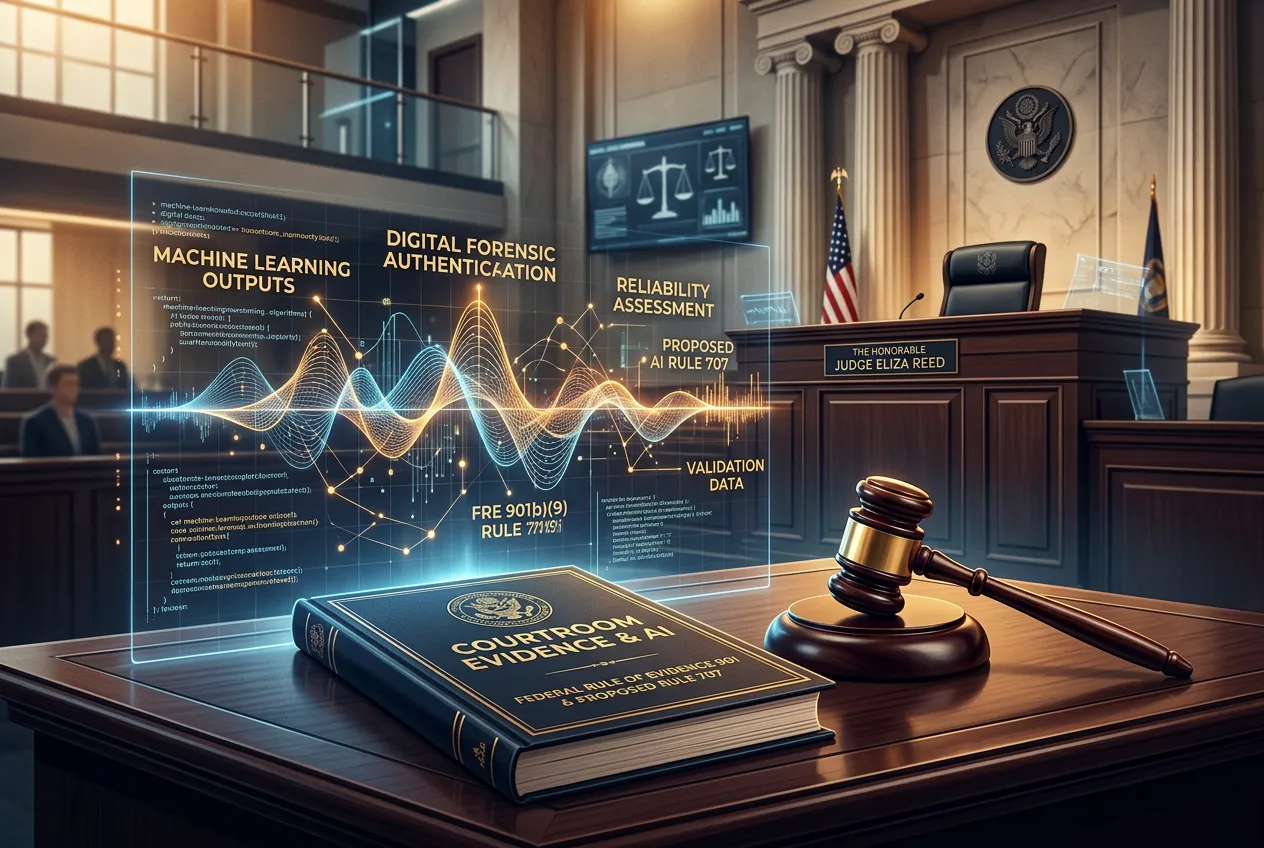
Federal courts are confronting a fundamental transformation in courtroom proof as artificial intelligence systems generate critical business records, forensic outputs, and potential audiovisual fabrications. In response to these evidentiary challenges, the Judicial Conference Advisory Committee on Evidence Rules has developed concrete procedural frameworks—most notably draft Federal Rule of Evidence 901(c) for synthetic deepfakes and Proposed Rule 707 for unaccompanied machine-learning outputs. Understanding these emerging doctrines is essential for litigators, corporate counsel, and judicial practitioners navigating AI judicial evidence rules and trial advocacy in 2026.
How Does Proposed Rule 901(c) Restructure Deepfake Authentication?
Traditional authentication under Federal Rule of Evidence 901(a) requires only that a proponent offer evidence "sufficient to support a finding that the item is what the proponent claims it is." Governed by the prima facie standard of Rule 104(b), this threshold has historically been low: a single witness testifying that a recording looks or sounds accurate often suffices to present the exhibit to the jury.
Generative artificial intelligence has broken the foundational assumptions underlying that permissive threshold. When photorealistic video or cloned voice audio can be generated in seconds, leaving juries to assess authenticity without forensic gatekeeping creates severe risks of evidentiary prejudice.
To address this vulnerability, the Advisory Committee on Evidence Rules has developed a two-tier burden-shifting standard under draft Federal Rule of Evidence 901(c):
- The Opponent's Threshold Burden: A party challenging digital evidence as an AI deepfake cannot make a bare allegation. The opponent must first provide evidence sufficient to support a finding that the challenged item was fabricated in whole or in part by generative artificial intelligence.
- The Proponent's Heightened Preponderance Burden: Once the opponent meets that threshold showing, the burden shifts back to the proponent, who must demonstrate by a preponderance of the evidence under Rule 104(a) that the item is authentic before the jury may see or hear it.
This shift replaces the conventional jury-decides standard of Rule 104(b) with rigorous judicial gatekeeping under Rule 104(a). Rather than allowing suspect digital recordings into evidence accompanied merely by cross-examination, trial judges must affirmatively resolve authenticity challenges on a preponderance standard before admission.
What Happened to Proposed Rule 707 on Machine-Generated Evidence?
While Rule 901(c) addresses synthetic media and audiovisual fabrications, Proposed Federal Rule of Evidence 707 was designed to regulate substantive machine-learning outputs offered without an accompanying human expert witness.
Under traditional practice, computerized calculations and algorithmic outputs were frequently admitted as routine business records under Rule 803(6) or self-authenticating machine records under Rule 902(13) and 902(14). However, modern foundation models, predictive algorithms, and probabilistic machine-learning models do not operate as deterministic digital filing cabinets. They generate synthetic predictions, statistical inferences, and automated summaries that mimic human expert analysis.
At its Spring 2025 meeting, the Advisory Committee approved Proposed Rule 707 for public comment. The proposed rule sought to impose reliability standards analogous to Rule 702 (Daubert) on machine outputs introduced without a sponsoring expert witness.
The proposal prompted extensive national scrutiny, generating testimony across two public hearings and more than 70 formal written comments from bar associations, civil rights groups, and corporate litigants. Litigants raised significant concerns that a rigid, technology-specific evidentiary rule would prematurely stifle routine digital workflows or quickly become obsolete as model architectures evolve.
Recognizing these complexities, the Advisory Committee voted to withdraw Proposed Rule 707 as initially published and submit a modified rule proposal for ongoing committee and expert study. The Committee convened an expert panel at its October 2026 meeting in Boston to re-examine the boundary between standard electronic records and autonomous artificial intelligence evidence.
What Are the Operational Takeaways for Litigators in Federal Court?
Although formal codification through the Rules Enabling Act takes multiple years, federal district judges are already applying existing evidentiary rules with heightened scrutiny to AI-generated submissions:
- Anticipate Early Notice Requirements: Draft Rule 901(c) incorporates a pre-trial notice requirement so that deepfake challenges are not ambushed during trial. Litigators must establish digital chain-of-custody, cryptographic hashes, and provenance logging at the discovery stage to withstand bad-faith fabrication claims.
- Guard Against the "Liar's Dividend": Courts remain acutely aware of bad-faith litigants claiming authentic evidence is a "deepfake" to evade liability. By requiring the challenger to present threshold evidence of fabrication before shifting the burden, the emerging rule prevents frivolous objections while protecting the record.
- Pair Mission-Critical AI Outputs with Sponsoring Witnesses: While Proposed Rule 707 remains under committee study, introducing proprietary algorithmic outputs or machine-learning summaries under routine business-records exceptions carries high exclusion risk under Rule 403 and Rule 702. Proponents should prepare qualified technical or custodian witnesses capable of explaining the model's training data, error rates, and verification controls.
For ongoing analysis of federal judicial rules, court orders, and AI privilege decisions, consult our related analyses on AI Court Standing Orders: Judicial Certification and Discovery Rules in 2026, Rule 11 and Ethical Verification Requirements, and AI Legal Privilege and Work Product: Landmark Court Rulings of 2026.
How does draft Rule 901(c) define generative artificial intelligence?
Draft Rule 901(c) adopts definitions tracking federal executive and statutory standards, capturing synthetic audiovisual content generated or altered by machine-learning algorithms that emulate human characteristics or real-world events.
Can a party exclude evidence simply by alleging it is an AI deepfake?
No. The opponent must present evidence sufficient to support a finding of fabrication before the burden shifts to the proponent to prove authenticity by a preponderance of the evidence.