Under Federal Rule of Evidence 1008, courts face a decisive evidentiary division between judge and jury when litigants introduce artificial intelligence outputs, machine-generated digital logs, and algorithmic secondary evidence. When an opposing party raises an issue of whether an asserted AI record ever existed, whether a proffered electronic printout is the authentic original, or whether secondary algorithmic evidence accurately reflects the underlying data, Rule 1008 explicitly allocates these factual determinations to the jury under Rule 104(b), rather than the judge under Rule 104(a).
This procedural framework creates substantial strategic challenges for trial counsel navigating modern generative AI and enterprise automation. While the presiding judge retains preliminary gatekeeping authority to evaluate legal conditions of admissibility—such as whether an original AI context window or raw API response log was lost or destroyed under Rule 1004—the ultimate factual accuracy and existence of the contested digital record remains within the province of the jury.
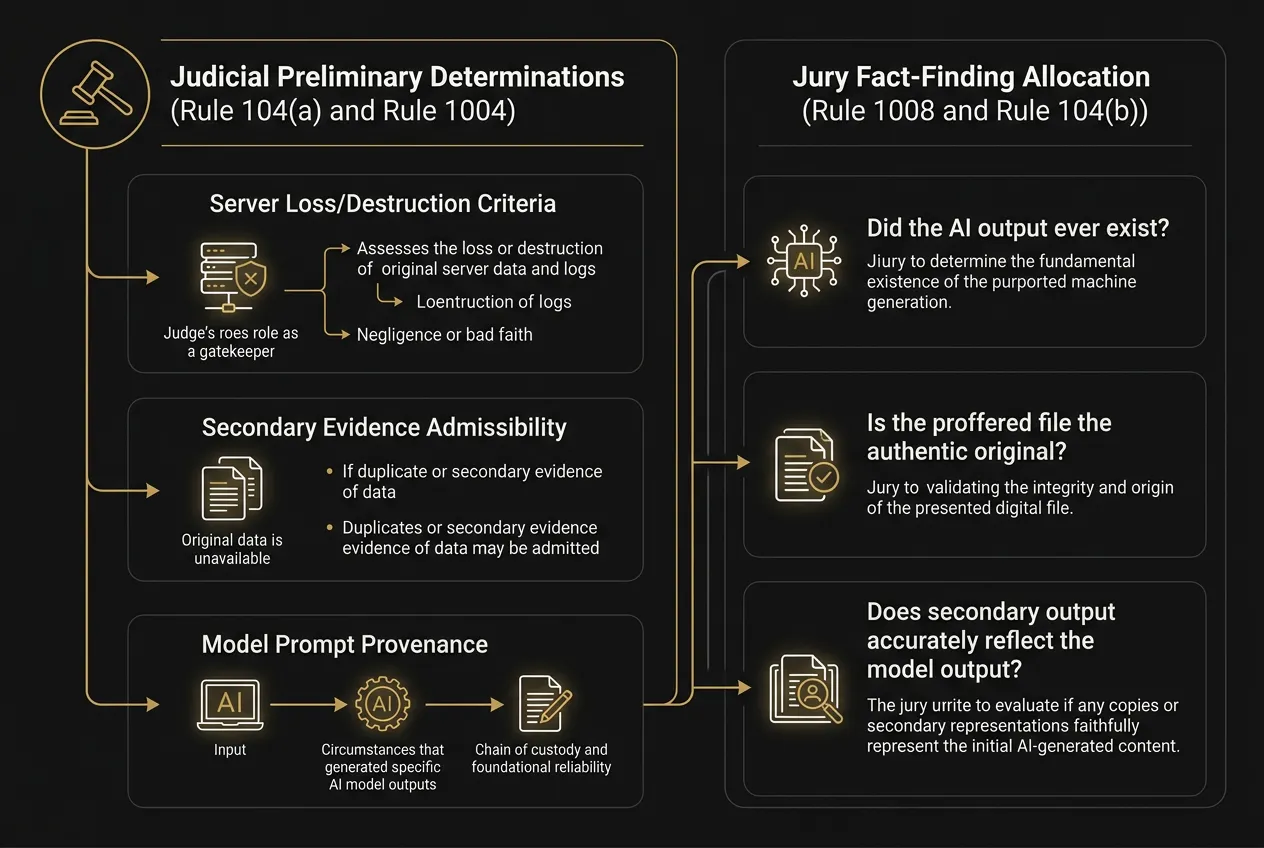
How Does Federal Rule of Evidence 1008 Divide Judicial Gatekeeping and Jury Fact-Finding?
Article X of the Federal Rules of Evidence governs the admissibility of writings, recordings, and photographs, codifying the historic Best Evidence Rule. In digital and automated contexts, Rule 1001(d) establishes that an original of electronically stored information (ESI) encompasses any printout or output readable by sight if it accurately reflects the data. However, when parties challenge the factual foundation of digital items, Rule 1008 establishes a tripartite division of responsibility between the bench and the jury box:
- Judicial Gatekeeping (Rule 104(a)): The trial judge determines preliminary questions of admissibility under Rule 104(a). This includes evaluating whether the proponent has satisfied statutory predicates for admitting secondary evidence under Rule 1004 (e.g., whether all originals are lost or destroyed without bad faith by the proponent) or Rule 1005 (official public records).
- Jury Fact-Finding Allocation (Rule 1008): In a jury trial, if an adverse party raises a genuine factual dispute regarding:
- Whether the asserted writing, recording, or photograph ever existed;
- Whether another writing, recording, or photograph produced at the trial is the original; or
- Whether other evidence of content accurately reflects the content, the rule mandates that the judge permit the issue to be submitted to the jury under Rule 104(b).
+-------------------------------------------------------------------------+
|                ARTICLE X DIGITAL ADMISSIBILITY GATEWAY                  |
+-------------------------------------------------------------------------+
                                     |
           +-------------------------+-------------------------+
           |                                                   |
           v                                                   v
 [JUDGE: Rule 104(a)]                                [JURY: Rule 1008 / 104(b)]
 - Loss/Destruction (Rule 1004)                      - Did the AI record ever exist?
 - Bad faith destruction inquiry                     - Is proffered printout the original?
 - Hearsay & privilege screening                     - Does secondary summary accurately
 - Daubert / Rule 702 reliability                      reflect original model output?
This structural bifurcation prevents trial judges from preempting the jury's historic role as arbiter of disputed historic facts under the guise of an evidentiary admissibility ruling.
What Happens When an Opponent Claims AI Evidence Never Existed?
In high-stakes enterprise and commercial litigation, parties increasingly confront machine-generated logs, autonomous agent transcripts, and synthesized algorithmic summaries. Because generative AI models are non-deterministic and can produce ephemeral runtime tokens without persistent disk serialization, opponents frequently argue that an alleged AI communication, automated recommendation, or synthesized report was fabricated or never materialized.
Under Rule 1008(a), the question of whether the asserted record ever existed is strictly a jury issue. If the proponent introduces sufficient foundational testimony—such as an engineering witness explaining API logs, W3C trace identifiers, or database write receipts—the court must admit the secondary evidence conditionally under Rule 104(b). The opposing party is entitled to present cross-examination and counter-evidence demonstrating:
- The absence of model inference telemetry or cryptographic session tokens;
- Potential hallucination or synthetic fabrication; and
- Discrepancies between local client exports and server-side model audit logs.
The jury then resolves whether the AI interaction actually occurred or represents a manufactured artifact.
How Does Rule 1008 Intersect with Rule 1006 AI Summaries and Demonstratives?
As courts evaluate voluminous corporate data parsed through automated extraction agents, litigants frequently invoke Federal Rule of Evidence 1006 to introduce algorithmic summaries. However, when an adversary disputes the accuracy of an automated synthesis, Rule 1008 directly controls.
If an expert or litigation team uses a language model to distill 50,000 corporate emails into a timeline exhibit, the opposing party may challenge whether the model omitted qualifying disclaimers or hallucinated conversational nuances. If reasonable minds could differ regarding whether the summary accurately reflects the voluminous originals, Rule 1008 requires the jury to make that evaluation, guided by Federal Rule of Evidence 104 preliminary questions standards.
What Practical Steps Should Litigators Take to Protect AI Evidence Under Rule 1008?
To ensure machine-generated evidence survives Rule 104(a) judicial scrutiny and persuades a lay jury under Rule 1008, trial attorneys and corporate counsel must establish verifiable forensic chains:
- Immutable Ingestion Logging: Implement Write-Once-Read-Many (WORM) storage or hardware-secured audit vaults that record raw API request-response pairs, model temperature settings, and cryptographic SHA-256 hashes at generation time.
- W3C Distributed Trace Telemetry: Standardize tracing across agent workflows to prove the temporal continuity and exact execution graph of automated tasks, defeating claims that records were post-hoc fabrications.
- Secondary Evidence Justification: Document enterprise data retention policies and ephemeral cache cycles so that if raw inference tokens are flushed, the loss is substantiated as routine, good-faith maintenance under Rule 1004(a) rather than spoliation.
- Jury-Facing Verification Witnesses: Prepare corporate data custodians or technical architects who can explain complex algorithmic pipelines in clear, human terms, demonstrating to the jury why secondary reproductions are faithful mirrors of the model's true output.
Does the judge or the jury determine whether an AI printout is an authentic original?
Under Federal Rule of Evidence 1008(b), if there is a disputed issue of fact as to whether a proffered document or printout is the authentic original, the question is submitted to the jury under Rule 104(b), provided the proponent has introduced sufficient prima facie evidence to support a finding of authenticity under Rule 901.
Can a party introduce secondary evidence if the raw AI context window was closed?
Yes. If the original electronic context or API response was lost or cleared as part of normal, good-faith operational lifecycle management without bad faith, Rule 1004 permits the proponent to introduce secondary evidence (such as system logs or exported summaries). However, whether that secondary evidence accurately reflects the original remains a question for the jury under Rule 1008(c).
How does Rule 1008 relate to Proposed Federal Rules 707 and 901(c)?
While Proposed Rule 707 addresses the scientific reliability of machine-generated output and Proposed Rule 901(c) targets deepfake authentication thresholds, Rule 1008 governs the procedural allocation of fact-finding for Article X best-evidence disputes, ensuring that contested existence, identity, and accuracy questions remain with the jury.