Is an autonomous generative AI or machine learning output considered hearsay when offered in federal court? Under Federal Rule of Evidence 801, hearsay requires an out-of-court statement made by a human declarant; because an algorithm or artificial intelligence model is not a natural person, purely autonomous machine-generated evidence cannot constitute hearsay under controlling federal jurisprudence. Litigants attempting to exclude AI model outputs, automated telemetry, and algorithmic risk assessments on hearsay grounds routinely face categorical rejection, as federal judges reassign the entire evidentiary inquiry from Article VIII hearsay rules to Article IX authentication under Rule 901(b)(9) and reliability gatekeeping under Rule 702.
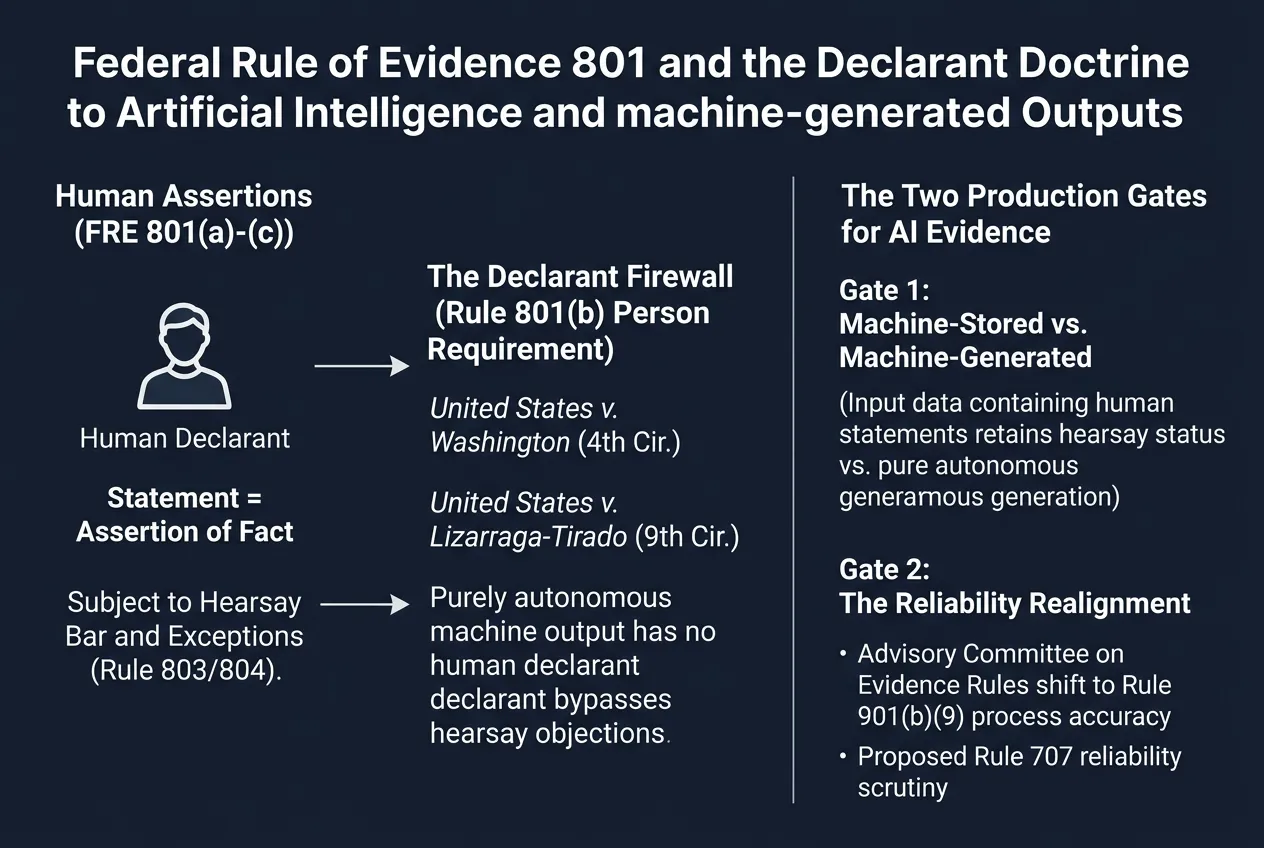
What Is the Federal Rule of Evidence 801 Declarant Doctrine?
Federal Rule of Evidence 801 establishes the foundational definition of hearsay across federal civil and criminal proceedings:
- Rule 801(a) (Statement): A "statement" is a person's oral assertion, written assertion, or nonverbal conduct, if the person intended it as an assertion.
- Rule 801(b) (Declarant): A "declarant" is the person who made the statement.
- Rule 801(c) (Hearsay): "Hearsay" means a statement that the declarant does not make while testifying at the current trial or hearing, offered in evidence to prove the truth of the matter asserted.
Under the literal text of the Federal Rules of Evidence, the entire architecture of hearsay presumes a human speaker. An out-of-court assertion cannot trigger Rule 802's exclusionary rule unless it originates from a "person." When software, instrumentation, or deep neural networks independently calculate, synthesize, or output factual assertions, there is no human declarant whose out-of-court perception, memory, sincerity, or narrative accuracy can be evaluated through constitutional or common-law cross-examination.
For decades, federal courts applying this statutory framework have maintained a strict line of demarcation: machines do not make hearsay statements because machines cannot be cross-examined under oath.
How Have Federal Circuit Courts Defined Machine-Generated Statements?
The judicial consensus governing automated machine output was established long before the emergence of large language models, anchored in two seminal federal appellate precedents:
1. The Fourth Circuit Doctrine: United States v. Washington
In United States v. Washington, 498 F.3d 225 (4th Cir. 2007), the Fourth Circuit addressed whether diagnostic chromatograph and spectrometer printouts detecting blood alcohol and phencyclidine (PCP) levels constituted testimonial hearsay under the Confrontation Clause and Rule 801. The defendant argued that admitting the machine printouts without requiring the live testimony of every operating laboratory technician violated the hearsay bar.
The Fourth Circuit squarely rejected this argument, holding that:
"[T]he 'statements' in question are the statements of machines, not people... The raw data generated by the machine was not the hearsay assertion of any person... It would be foolish to treat the machine's output as an assertion by a declarant because machines cannot be cross-examined."
The court established that when a mechanical, chemical, or electronic device takes an empirical input and independently computes an output, the resultant text or data represents the machine’s own mechanical translation, not an adopted human assertion.
2. The Ninth Circuit Clarification: United States v. Lizarraga-Tirado
In United States v. Lizarraga-Tirado, 789 F.3d 1107 (9th Cir. 2015), the Ninth Circuit confronted modern digital mapping evidence. Border Patrol agents entered GPS coordinates into Google Earth, which automatically rendered a digital satellite image with a yellow tack marking the arrest location south of the United States-Mexico border. The defense objected that the digital marker constituted inadmissible hearsay.
Writing for the panel, the Ninth Circuit held that automated software markers are not hearsay:
"A statement is an oral or written assertion, or nonverbal conduct that the person intended as an assertion. A declarant is a person who made the statement... Because the tack was generated entirely by software without human intervention, it was not made by a 'person' and therefore was not hearsay."
The court drew a crucial doctrinal distinction that remains the governing standard for enterprise AI evidence in 2026: machine-stored assertions vs. machine-generated assertions.
| Evidentiary Dimension | Machine-Stored Evidence | Machine-Generated Evidence |
|---|---|---|
| Primary Definition | Human assertions digitized, hosted, transmitted, or retrieved by hardware | Independent programmatic calculations, synthetic generations, or telemetry |
| Exemplars | Emails, word-processing files, Slack messages, PDF contracts, CRM notes | LLM reasoning summaries, neural vector clusters, autonomous log analytics |
| Declarant Identity | The human author who typed or dictated the underlying message | No natural person; generated through automated computational logic |
| FRE 801 Status | Hearsay (must qualify under an exception, e.g., Rule 803(6) business records) | Not Hearsay (categorically exempt from Rule 801(c) hearsay exclusions) |
| Admissibility Barrier | Article VIII Hearsay Exceptions & Rule 803/804/807 residual analysis | Article IX Authentication (Rule 901(b)(9)) & Article VII Reliability (Rule 702) |
[Inbound Digital Artifact]
         │
         ├── Does it contain an out-of-court human statement?
         │         ├── YES ──► Machine-Stored Evidence ──► Subject to FRE 801 Hearsay Bar
         │         │                                        (Requires FRE 803/804 Exception)
         │         │
         │         └── NO  ──► Purely Machine-Generated ──► Bypasses FRE 801 Hearsay Rules
         │                     (Autonomous AI/Telemetry)   (Proceeds to Rule 901(b)(9) & Rule 702)
Why Does AI Challenge the Traditional Declarant Boundary?
While the legal test appears straightforward, modern generative AI and agentic systems introduce profound complications that traditional diagnostic machines never posed:
- Natural Language Sophistication: Unlike a gas chromatograph printing raw millivolt spikes or a thermometer displaying numerical digits, generative AI produces fluent, persuasive, grammatical narrative prose that mirrors human thought and intent. Litigants intuitively read an AI executive summary as a "statement" asserting facts.
- Hybrid Human-Model Workflows: In enterprise retrieval-augmented generation (RAG) and document summarization, human-authored discovery materials, witness emails, or medical reports are embedded and summarized. When an AI agent synthesizes five depositions into a factual memorandum, does the output embody machine-generated data or an unverified concatenation of human hearsay?
- Probabilistic Hallucination vs. Deterministic Instruments: In Washington, the machine operated deterministically based on physical gas chromatography. An LLM operates non-deterministically based on probabilistic next-token predictions, sampling temperatures, and training weights. The output can assert fabricated facts with absolute semantic certainty.
Despite these nuances, federal courts in 2026 continue to adhere strictly to the plain language of Rule 801(b): without a statutory amendment, an algorithm cannot be declared a human being. Consequently, objecting to an AI agent's autonomous output as "hearsay" is an immediate strategic dead end.
How Does the Real Evidentiary Battle Shift to Rules 901(b)(9) and 702?
When an opposing party attempts to introduce autonomous AI evaluations, fraud scores, document classifications, or algorithmic projections, experienced trial counsel do not raise hearsay objections. Instead, the challenge attacks two distinct procedural gates:
Gate 1: Rule 901(b)(9) Process and System Authentication
Under Federal Rule of Evidence 901(b)(9), evidence describing a process or system must be authenticated by showing that:
"[T]he process or system produces an accurate result."
Because AI output is not hearsay, its admissibility depends entirely on proving that the underlying hardware, model weights, training pipeline, and prompt context operate accurately and reliably. Proponents cannot merely present an affidavit stating that an AI tool generated a report; they must establish:
- Input Integrity: Proof that data fed into the model was uncorrupted and verified.
- Model Version Pinning: Documenting the specific foundation model, checkpoint, and temperature parameter used during inference.
- Systemic Accuracy: Empirical validation demonstrating that the model’s error, hallucination, and variance rates meet industry standards for the task.
Gate 2: Rule 702 and Proposed Rule 707 Reliability Gating
If an AI system performs analytical work that would traditionally require an expert witness—such as complex financial accident reconstruction, structural engineering simulation, or multi-factor medical causation modeling—the output cannot enter evidence as a self-proving exhibit.
Under the 2023 amendments to Rule 702, the proponent must demonstrate to the court by a preponderance of the evidence under Rule 104(a) that:
- The expert's scientific, technical, or specialized knowledge will help the trier of fact;
- The testimony is based on sufficient facts or data;
- The testimony is the product of reliable principles and methods; and
- The expert's opinion reflects a reliable application of the principles and methods to the facts of the case.
The Judicial Conference Advisory Committee on Evidence Rules has actively evaluated Proposed Federal Rule of Evidence 707 throughout its 2025 and 2026 sessions (including its October 15, 2026 meeting agenda). Proposed Rule 707 directly targets the "AI loophole" created by the Rule 801 declarant doctrine: if machine-generated evidence is offered without a sponsoring human expert, and that output would otherwise constitute expert testimony under Rule 702, the proponent must establish that the machine's underlying methodology, validation datasets, and operating parameters satisfy Rule 702(a)–(d) reliability standards.
[Litigant Offers AI-Generated Analysis]
                  │
                  ├── Hearsay Objection (FRE 801/802)?
                  │         └── OVERRULED (Machine is not a Rule 801(b) declarant)
                  │
                  ├── Authentication Objection (FRE 901(b)(9))?
                  │         └── SUSTAINED unless proponent proves system "produces an accurate result"
                  │
                  └── Expert Reliability Objection (FRE 702 / Proposed Rule 707)?
                            └── SUSTAINED unless scientific validity, data sufficiency,
                                and methodological rigor meet Rule 104(a) preponderance standard
What Pre-Trial Protocol Should Corporate and Litigation Counsel Adopt?
To preserve trial records and prevent unauthenticated or hallucinated AI evidence from prejudicing proceedings, litigation teams must implement a four-part evidentiary protocol:
- Isolate Embedded Human Hearsay: Review all AI outputs for layered hearsay. If an AI agent ingests customer survey text and outputs a summary stating "35% of consumers reported brake failures," parse whether the proponent is offering the statement to prove the truth of what those consumers wrote. While the AI's calculation is machine-generated, the underlying survey responses remain out-of-court human hearsay under Rule 801.
- Issue Targeted Rule 901(b)(9) Interrogatories: Demand discovery regarding the AI system’s architecture, training data sources, model weights, prompt templates, fine-tuning methodologies, and golden-dataset benchmark evaluations. Without proof that the system produces accurate results, the exhibit fails baseline authentication.
- Depose Sponsoring Human Witnesses on Sincerity and Tool Agency: Interrogate whether the witness personally verified the output or blindly accepted the model's synthesis. Under Federal Rules of Civil Procedure 26 and 30, explore whether the sponsoring witness understands the mathematical mechanics of the software or is functioning as a mere mouthpiece for an unverified algorithm.
- Move in Limine Under Rule 403 and Rule 702: Even where an AI output survives authentication, assert Federal Rule of Evidence 403. An algorithm cloaked in pseudoscientific authority presents substantial danger of unfair prejudice, confusing the issues, and misleading the jury, particularly where the model's inner weights function as a black box incapable of meaningful forensic scrutiny.
Can an AI model ever be deemed a declarant under the Federal Rules of Evidence?
No. Under Federal Rule of Evidence 801(b), a declarant is strictly defined as a "person." Federal circuit courts across the nation have uniformly held that software, computer programs, and mechanical devices are not persons and therefore cannot be declarants for hearsay purposes.
What is the difference between machine-stored and machine-generated evidence?
Machine-stored evidence consists of human assertions created by people and preserved on electronic media (such as emails, digital contracts, and text messages); these remain subject to the hearsay rule. Machine-generated evidence consists of data, records, or text independently generated by software algorithms without human factual input; these bypass hearsay objections and are evaluated under authentication rules.
What rule governs the reliability of artificial intelligence evidence?
While Rule 801 governs hearsay, the reliability of AI evidence is governed primarily by Rule 901(b)(9) (process or system producing an accurate result) and Rule 702 (testimony by expert witnesses). Additionally, the Advisory Committee on Evidence Rules has been deliberating Proposed Rule 707 to require Rule 702 reliability standards for autonomous machine output offered without an expert.
For deeper analysis on federal evidentiary rules and autonomous technologies, explore our companion analysis on Federal Rule of Evidence 902(13): AI Evidence Self-Authentication in 2026, our examination of Federal Rule of Evidence 104: Preliminary Questions and Relevance Standards in 2026, and our review of Federal Rule of Evidence 901(c): Deepfakes Authentication in 2026.