How can organizations scale generative AI training and domain fine-tuning without triggering catastrophic model collapse or copyright contamination? In 2026, enterprise synthetic data governance has emerged as a mission-critical infrastructure mandate: because recursive training on ungrounded model outputs causes generative architectures to lose low-probability data distributions and degenerate rapidly (Nature, July 2024), production enterprise deployments require immutable human-curated anchor datasets, differential privacy verification, cryptographic provenance manifests, and permanently segregated golden holdout suites to ensure verifiable reliability, regulatory compliance, and sustained model performance across multi-generational lifecycles.
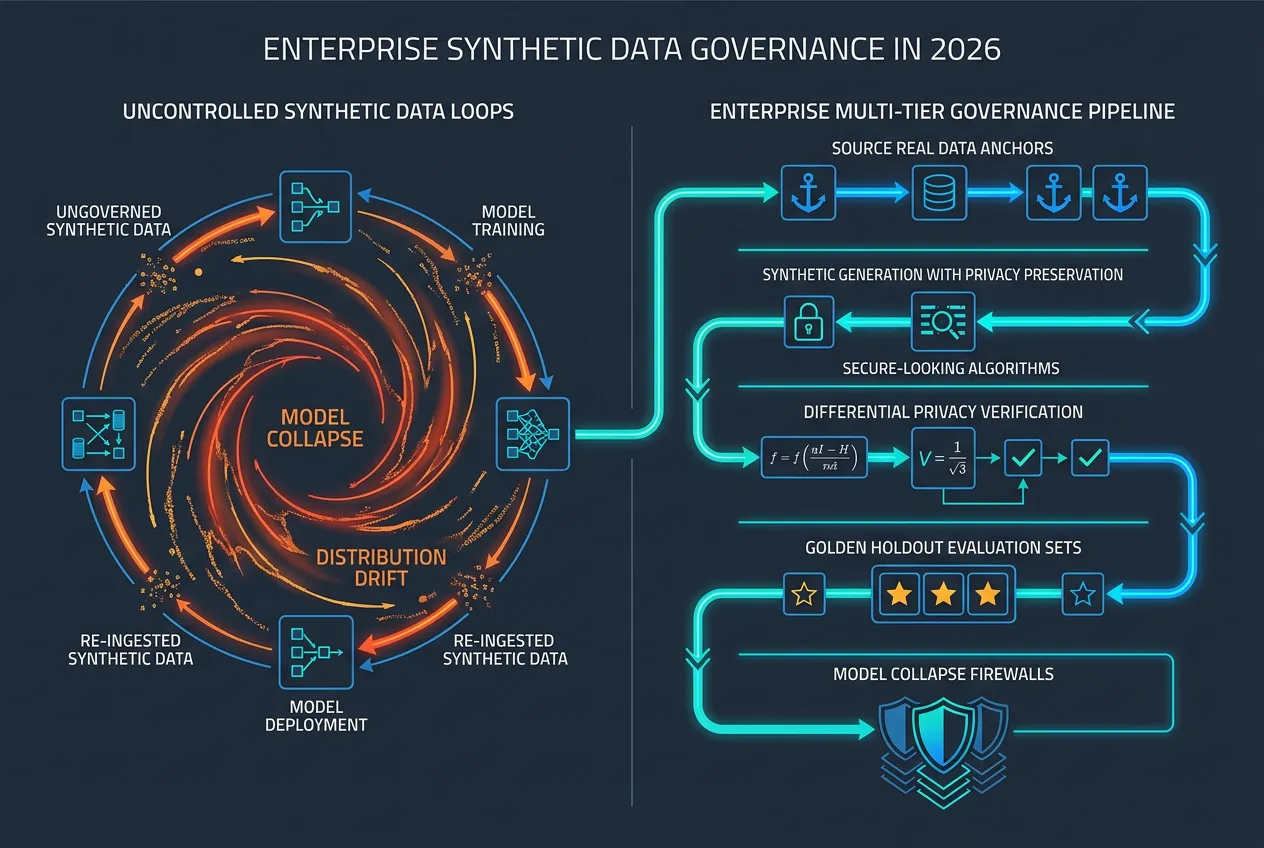
As enterprises race to train specialized foundation models and fine-tune domain-specific autonomous agents, the enterprise data pipeline has encountered a hard mathematical reality: high-quality human-generated data is rapidly depleting, and unmanaged synthetic data pipelines poison the very models they are intended to teach. What began as a cost-effective shortcut for data augmentation has metastasized into an enterprise operational risk, creating silent distribution drift, mode collapse, and acute regulatory exposure.
What is model collapse and why does recursive synthetic training fail?
Model collapse refers to the degenerative process whereby machine learning models trained on recursively generated synthetic content progressively lose information about the true underlying data distribution. First comprehensively documented in foundational research published in Nature (July 2024), model collapse occurs across two distinct degradation phases:
- Early Model Collapse: The model begins losing representation of the tails of the probability distribution. Rare but vital edge cases—such as atypical clinical symptoms in medical diagnostics, complex transactional edge conditions in financial fraud, or minority statutory exceptions in legal reasoning—are statistically smoothed out and erased.
- Late Model Collapse: The model's representations converge toward a severely truncated, homogenous mode. Variance collapses entirely, output distributions degenerate into repetitive gibberish or uniform hallucinations, and the model permanently loses the capability to generalize to novel inputs.
The underlying mechanics stem from continuous statistical sampling errors. When an AI model generates synthetic tokens, it samples from an approximation of the true distribution. When subsequent generations train on those samples, sampling errors compound exponentially with each recursive generation ($n+1, n+2, \dots$). Without an immutable external anchor of real-world data, the feedback loop acts as an algorithmic echo chamber, destroying informational entropy.
How do enterprise synthetic data pipelines create legal and copyright exposure?
Beyond mathematical degradation, uncontrolled synthetic data generation introduces severe legal liabilities under emerging global regulatory standards and intellectual property litigation:
- Copyright Contamination & Memorization Ingestion: Unconstrained generative models frequently regurgitate verbatim excerpts or distinctive proprietary structures from copyrighted pre-training corpora. Fine-tuning an internal model on synthetic data that carries verbatim training data fragments creates a "clean-room breach," infecting internal enterprise weights with third-party intellectual property infringement risks.
- EU AI Act GPAI Transparency (August 2026): General application rules under the EU AI Act (Regulation (EU) 2024/1689) took full effect in August 2026, establishing mandatory technical documentation and transparency standards for General Purpose AI (GPAI) deployers. Deployers must maintain verifiable summaries of data used for training and fine-tuning, including explicit technical identification of synthetic data pipelines and verification that synthetic sets do not reproduce systemic societal biases or illegal content.
- NIST AI 600-1 and NIST AI 100-4 Assurance: The National Institute of Standards and Technology's Generative AI Profile (NIST.AI.600-1) and Synthetic Data Guidance (NIST.AI.100-4) require organizations to evaluate data validity, maintain tamper-evident data lineage, and enforce privacy-preserving statistical bounds (such as differential privacy ($\epsilon, \delta$)-guarantees) to prevent re-identification of sensitive personal data embedded within synthetic training sets.
| Governance Dimension | Uncontrolled Synthetic Data Generation | Governed Enterprise Architecture (2026) | Technical & Legal Impact |
|---|---|---|---|
| Statistical Distribution | Unbounded recursive sampling loops | Version-pinned human data anchors | Prevents tail-end erasure and late-stage mode collapse |
| Validation Architecture | Self-referential synthetic evaluations | Immutable, held-out golden real datasets | Unmasks silent performance drift and generation rot |
| Provenance Tracking | Opaque prompt logs and CSV exports | W3C PROV-O & cryptographic C2PA manifests | Auditable compliance for EU AI Act Article 53 & ISO/IEC 42001 |
| Privacy Safeguards | Naive string matching / regex masking | Mathematical $(\epsilon, \delta)$-Differential Privacy | Eliminates membership inference and re-identification |
| IP & Copyright | High risk of latent training regurgitation | Filtered clean-room synthetic pipelines | Protects model weights against third-party copyright claims |
What architectural controls prevent model collapse in production?
To harness the genuine benefits of synthetic data—such as creating balanced datasets for rare classes, generating stress-test edge cases, and simulating adversarial agent environments—enterprises must implement a closed-loop governance architecture built around four structural controls:
1. The Immutable Human Data Anchor
An enterprise model must never be trained exclusively on synthetic content. Governance teams must enforce an algorithmic ratio—typically ensuring that at least 20% to 40% of the training distribution consists of certified, human-curated real-world data. This real-world anchor serves as a permanent statistical ballast, preventing the probability mass from collapsing toward a single degenerate mode.
2. The Permanently Held-Out Golden Real Evaluation Set
The single most dangerous failure mode in synthetic data engineering is evaluating an AI model using synthetic test benchmarks. When both training and evaluation sets are synthetic, evaluation scores artificially inflate even as real-world competence plummets.
Enterprises must maintain a permanently isolated "golden evaluation set" comprised entirely of verified, human-validated real enterprise data. This golden holdout suite must remain physically and cryptographically air-gapped from all training pipelines, accessible only through automated read-only canary evaluation gates as detailed in our analysis of Production AI Agent Evaluation and Canary Pipelines.
3. Cryptographic Data Provenance and Lineage
Every synthetic data batch generated within the enterprise must carry an immutable provenance record adhering to W3C PROV-O or C2PA manifest specifications. The provenance ledger must record:
- The precise foundation model architecture and temperature used for generation;
- The parent prompt templates, system instructions, and RAG context documents;
- The cryptographic hash of the input seed dataset; and
- The downstream pipeline stages where the synthetic data was consumed.
This audit trail ensures enterprise compliance with forensic discovery and corporate governance mandates, aligning with hardware-backed Enterprise AI Audit Readiness and Evidence Vaults.
4. Differential Privacy and Memorization Scrubbers
Before synthetic data is accepted into a staging fine-tuning bucket, it must pass through automated privacy and regurgitation firewalls. Deploying Rényi Differential Privacy bounds guarantees that no individual record from the seed data can be reconstructed through membership inference attacks. Concurrently, n-gram overlap scrubbers and semantic similarity threshold filters purge any synthetic candidate that mirrors seed documents too closely, preserving the clean-room integrity of the resulting model weights.
How should enterprises structure a synthetic data acceptance charter?
Establishing enterprise synthetic data governance requires cross-functional collaboration between engineering leads, legal counsel, and data security officers. Organizations should codify these operational rules into their Enterprise AI Governance Charter:
- Establish a Synthetic Data Review Board (SDRB): Mandate formal sign-off before any synthetic dataset exceeding 100,000 samples is ingested into fine-tuning or pre-training pipelines.
- Ban Purely Synthetic Feedback Loops in Autonomous Agents: Prohibit autonomous multi-agent systems from storing agent-generated dialog directly into persistent memory stores without human-in-the-loop review or strict semantic compaction firewalls, as outlined in our study of Agent Context Compaction Safety Rules.
- Execute Contractual Synthetic Guarantees with Vendors: When procuring external fine-tuned models or datasets, require vendors to warrant that training corpora are free from uncurated recursive synthetic data and provide verifiable holdout performance audits.
What is model collapse in generative artificial intelligence?
Model collapse is the progressive informational decay that occurs when AI models are trained recursively on data generated by earlier AI models. As demonstrated in foundational research published in Nature (July 2024), recursive training causes models to forget rare tail distributions (early collapse) and eventually converge into an unusable, unvarying mode of repetitive outputs (late collapse).
Can synthetic data safely be used for enterprise model training?
Yes, provided it is deployed under strict governance controls. Synthetic data should augment rather than replace human-curated data. Safe architectures maintain an immutable core of real-world human data, enforce statistical diversity constraints, and evaluate models against permanently held-out real datasets.
How does the EU AI Act regulate synthetic training data?
Under the EU AI Act (Regulation (EU) 2024/1689), which took general effect for General Purpose AI in August 2026, deployers must provide transparent technical documentation regarding training data provenance, identify synthetic data utilization, and demonstrate adequate safeguards against bias amplification and copyright infringement.
Why must evaluation datasets never contain synthetic data?
Evaluating an AI model against synthetic data creates a fatal blind spot: because the evaluation benchmark shares the same synthetic biases and distribution truncations as the training data, benchmark performance metrics can appear flawless even while the model has suffered catastrophic real-world capability loss. Golden evaluation benchmarks must always be composed of validated real-world data.
Explore related enterprise governance and data architecture analyses on Prest0: