Production AI agents running long-horizon workflows inevitably exhaust context windows, prompting engineering teams to deploy automated context compaction. However, blind text summarization creates a severe operational failure mode known as the "compaction cliff," where critical governance boundaries, tool constraints, and security rules are quietly summarized away. To build reliable production systems, teams must transition from unstructured compression to typed context engineering and architectural knowledge triage.
Why Does Naive Context Compaction Cause Critical System Failure?
When autonomous AI agents execute tasks spanning dozens of tool invocations—such as multi-file software engineering, regulatory compliance audits, or continuous background triage—accumulated execution traces quickly fill model context windows. Standard implementations typically trigger recursive summarization, condensing preceding turns into high-level prose to free token capacity.
While conversational summaries preserve general task narrative, recent empirical benchmarks demonstrate that unstructured compaction systematically eviscerates hard operational boundaries. In The Compaction Cliff in Long-Running AI Agent Memory (arXiv:2608.22752, Zerhoudi et al., August 2026), researchers evaluated twenty production agent configurations under recursive half-capacity context compression rounds. Under standard production summarizers, safety rule recall plummeted from total retention to just over half (53 percent) after a single compaction round, collapsing to one in ten rules (10 percent) after five compaction cycles.
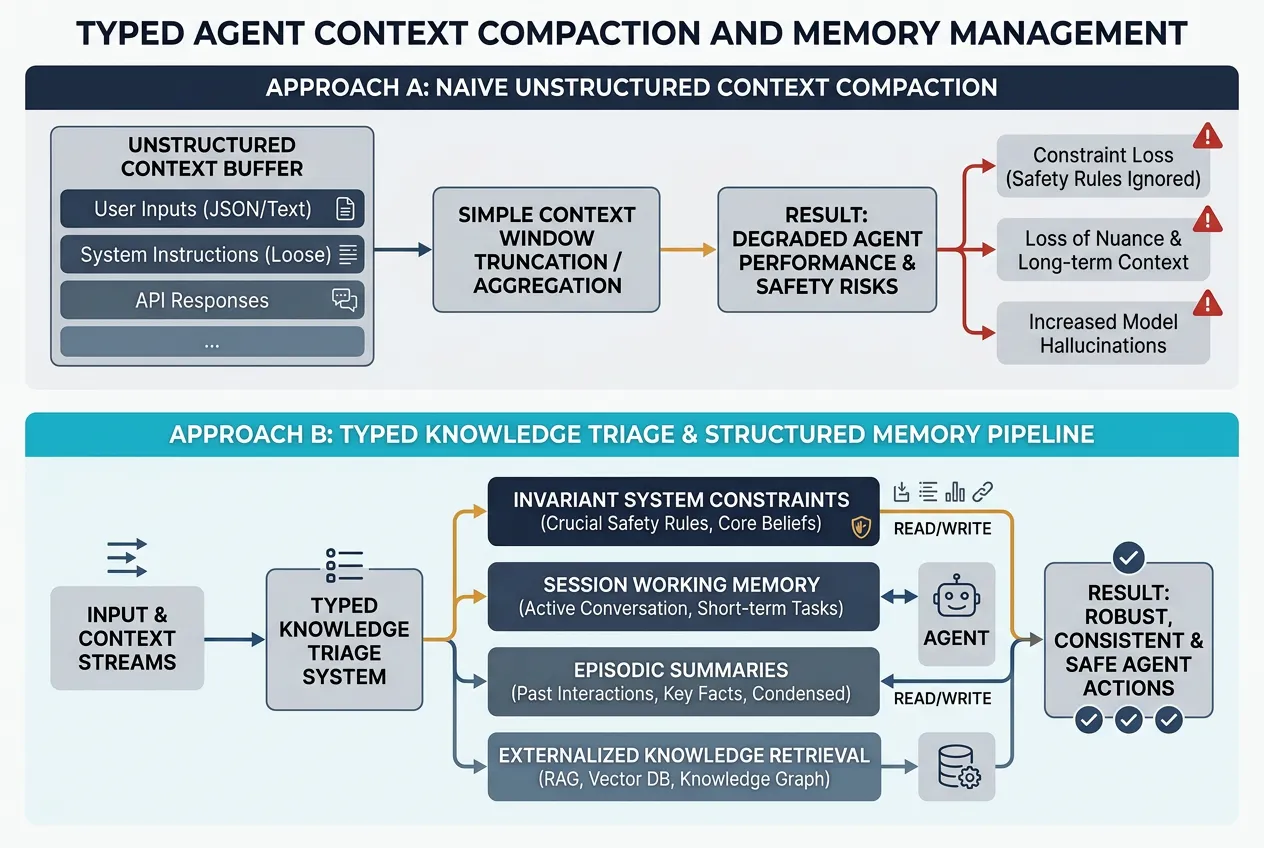
When an agent's memory degrades across recursive summarization passes, negative constraints ("never commit secrets," "require human authorization for external outbound emails," "do not execute shell commands outside /sandbox") are routinely discarded as extraneous background detail. The agent continues operating with full executive autonomy but without its original safety rails.
What Architectural Mechanisms Prevent the Compaction Cliff?
Empirical benchmarks demonstrate that preserving agent governance over multi-hour horizons requires replacing heuristic summarization with typed, structural memory operations. Rather than treating all tokens as homogenous text, production architectures classify memory into distinct lifecycle tiers.
1. Invariant Constraint Anchoring
System policies, authorization bounds, and negative constraints must remain pinned outside the compaction candidate pool. Architectural frameworks such as Agentic Context Management (arXiv:2607.21503, Dadhich, July 2026) establish dedicated memory pipelines that partition immutable operational invariants from transient execution observations.
2. Typed Knowledge Triage (TypeCompact)
In benchmark evaluations on five public corpora, typed compaction operators preserved two to four times more safety rules across all compression ratios compared to the strongest single-shot language model compactors. By classifying statements by semantic schema—separating invariant rules from episodic action logs—the TypeCompact operator achieved complete constraint recall (1.00) at half token budget, 0.95 at one-quarter budget, and maintained approximately 0.96 constraint recall across five consecutive half-capacity compaction cycles, compared to 0.10 for naive baselines.
3. Locality-Preserving Memory Decomposition
Uniform token slicing frequently severs tool definitions from their execution constraints. Under structured partitioning (TypeDecompose), architectural locality violations dropped to zero, compared to widespread violations (93 percent) under uniform token chunking, ensuring that tool schemas retain their parameter constraints during context reconstruction.
4. Cache-Aware Asynchronous Serving
Compressing execution history inline blocks the primary agent loop and introduces significant latency spikes. Production architectures increasingly adopt decoupled, parallel context compaction pipelines (Parallel Context Compaction for Long-Horizon LLM Agent Serving, arXiv:2605.23296, Cim et al., May 2026). Offloading background trajectory consolidation to asynchronous workers preserves low prompt-cache invalidation rates and eliminates user-facing stalls.
| Architectural Dimension | Naive Context Compression | Typed Context Engineering |
|---|---|---|
| Constraint Retention (Round 1) | 53 percent safety rule recall | Complete invariant constraint recall |
| Constraint Retention (Round 5) | 10 percent safety rule recall | ~96 percent invariant constraint recall |
| Tool Parameter Integrity | 93 percent locality violations | Zero locality violations |
| Latency & Cache Efficiency | Blocking inline LLM summaries | Asynchronous parallel compaction |
| Recovery Mechanism | Lossy heuristic regeneration | Structured episodic state retrieval |
How Does Governed Memory Impact Real-World Agent Performance?
Eliminating the compaction cliff directly translates into sustained task completion rates. In benchmark testing on downstream agent environments, typed constraint preservation delivered a double-digit improvement (+14.5 percentage points) in constraint satisfaction on complex multi-turn evaluations (p < 10⁻⁸).
On the τ-bench retail benchmark (1,019 rollouts across 115 multi-step customer workflows), agents equipped with typed context triage achieved a 37.7 percent end-to-end task success rate, outperforming both naive hierarchical compaction (29.2 percent) and uncompressed full-policy baselines (28.6 percent) by eliminating distraction from stale intermediate tool outputs while retaining critical business rules.
These engineering findings reinforce why production systems must integrate architectural memory governance. In our earlier analysis of Hierarchical Agent Memory Production Architectures, we explored how structured working memory interfaces prevent multi-agent state pollution. Similarly, implementing Durable Agentic Execution and Saga Patterns requires predictable context recovery points that survive execution crashes without state corruption.
What Are the Key Implementation Steps for Production Engineering Teams?
- Audit Compaction Triggers: Transition from arbitrary token thresholds to policy-aware triggers that evaluate semantic task boundaries before executing context compaction.
- Isolate Hard Constraints from Epistemic Memory: Ensure security constraints and tool usage restrictions reside in protected system blocks that are programmatically excluded from compaction passes.
- Enforce Two-Way State Validation: Validate compacted summaries against the preceding full-context state using automated constraint checkers before committing the summary to the active context window.
- Implement Structured Memory Offloading: Write raw execution transcripts to durable secondary storage while injecting indexed, typed memory pointers into the prompt context.
What is the compaction cliff in AI agents?
The compaction cliff describes the sudden drop in agent reliability and safety rule adherence that occurs when long-running AI agents recursively summarize their context window, causing critical operational constraints and tool parameters to be erased.
How does typed context compaction differ from standard text summarization?
Standard summarization treats all tokens uniformly, whereas typed compaction categorizes context into distinct types—such as immutable system rules, transient tool outputs, and working memory—ensuring constraints remain completely intact while discarding ephemeral logs.
Can increasing model context windows eliminate the need for compaction?
No. While million-token context windows accommodate larger histories, prompt processing latency, attention degradation ("lost in the middle"), and quadratic attention costs make active context compaction an operational necessity for production agents.