How do engineering teams safely evaluate and deploy autonomous AI agents when non-deterministic trajectories make traditional CI/CD unit tests obsolete? Production AI agent evaluation requires a continuous, five-stage pipeline spanning offline synthetic suites, pass^k reliability metrics, passive shadow execution, automated canary rollouts with circuit breakers, and production trace telemetry. Teams shipping enterprise agent workflows cannot rely on benchmark scores alone; they must verify state transitions, deterministic tool call contracts, and drift resistance across thousands of multi-turn user interactions before shifting live customer traffic.
Why Do Traditional Unit Tests and Public Benchmarks Fail for AI Agents?
In deterministic software, a unit test asserts that function $f(x) = y$. In classical language model applications like summarization, evaluation measures semantic overlap against reference strings. But in agentic architectures—where autonomous models plan sequences of tool calls, read intermediate environment states, recover from execution errors, and coordinate across multi-turn user dialogues—point-in-time output assertions collapse.
Public benchmarks like SWE-bench and human-eval provide broad directional signals for frontier models, but they measure isolated capabilities under synthetic constraints. When frontier agents operate inside production enterprise environments, failure modes do not stem primarily from lack of reasoning horsepower; they emerge from subtle trajectory drift, tool misuse under API rate pressure, schema hallucinations, and cascading coordination failures across subagents.
As established by Yao et al. in τ-bench: A Benchmark for Tool-Agent-User Interaction in Real-World Domains (arXiv:2406.12045), conventional benchmarks often score single-attempt completion (pass@1 or pass@k), which rewards an agent for succeeding at least once in $k$ attempts. In production, enterprise users do not tolerate an agent that succeeds once every four tries. Production viability demands pass^k reliability—the statistical probability that an autonomous agent executes a multi-turn task correctly across all $k$ independent runs. On complex multi-turn retail domains in τ-bench, standard function-calling models achieved pass^8 reliability below 25%, despite exhibiting single-attempt pass@1 success rates near 50%. Relying on isolated sample successes masks catastrophic failure rates in enterprise deployment.
Building on our foundation in Agentic Harness Engineering: Controlled Evolution, Not Blind Optimization, testing autonomous systems requires treating the evaluation harness as a mission-critical production component rather than an afterthought.
What Are the Five Stages of a Production Agent Evaluation Pipeline?
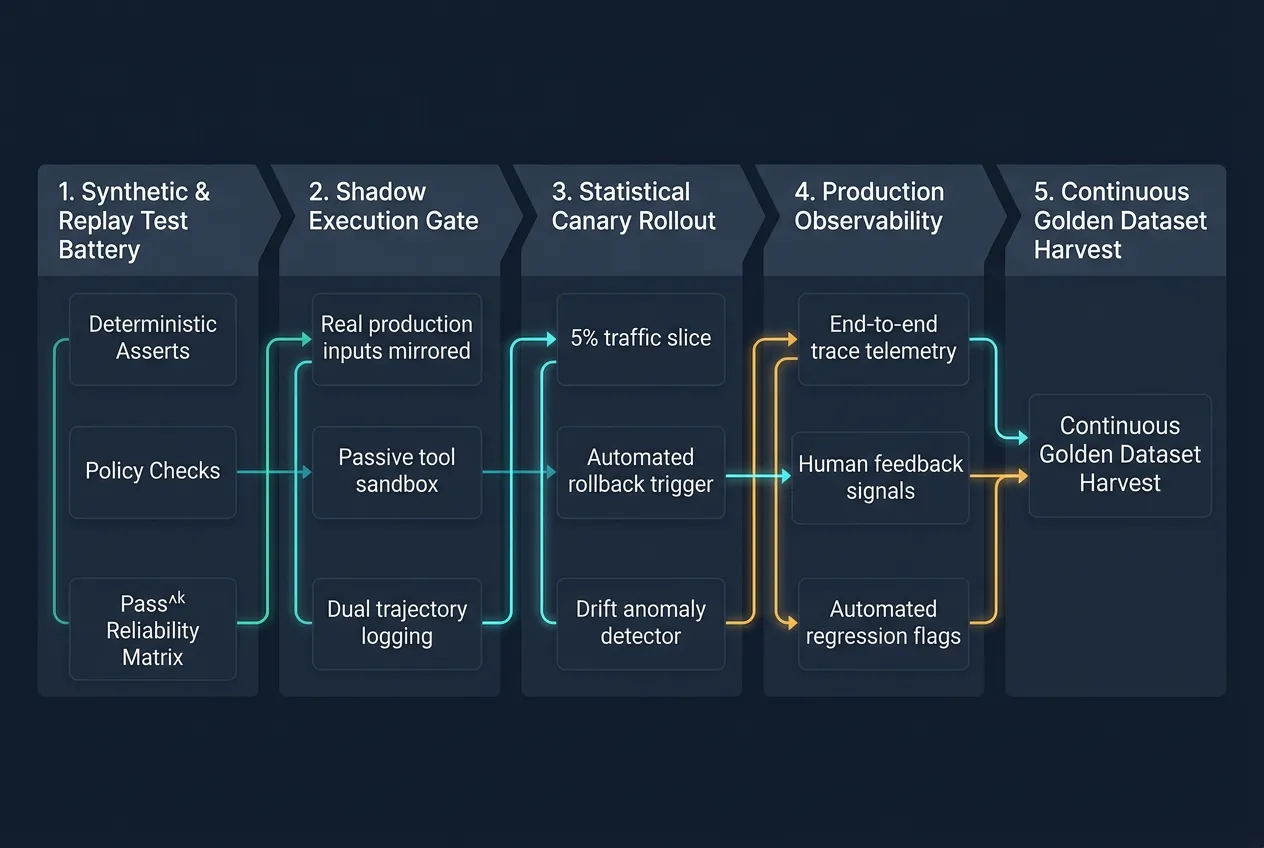
High-velocity engineering teams deploying autonomous agents operate a closed-loop, five-stage evaluation and release pipeline designed to catch regressions before they impact live production data:
1. Deterministic Replay and Synthetic Invariant Testing
Before any model weight, system prompt, or tool definition changes, the agent must pass an offline battery of deterministic test cases:
- Tool Schema Contract Verification: As explored in Agent Tool Contracts: Valid JSON Is Not Verified Work, the harness asserts that the agent constructs syntactically valid parameters, adheres to strict typing, and handles error responses gracefully.
- Deterministic Environmental Asserts: Rather than judging natural language prose, the evaluation harness inspects the final state of a sandboxed database or mock API service to verify that required database rows were written, modified, or deleted exactly as intended.
- Adversarial and Edge Replay: Regression test suites replay historical production failures, prompt injection attempts, adversarial user inputs, and unexpected tool latency spikes.
2. Multi-Trial Reliability and Trajectory Drift Scoring (pass^k)
Single-run evaluations are statistically meaningless in non-deterministic systems. The evaluation harness executes each golden scenario across $k$ independent trials (typically $k=5$ to $k=10$) with temperature variance:
- Reliability Metric (
pass^k): Measures the consistency of task completion across consecutive trials without human intervention. - Trajectory Divergence Analysis: Logs the sequence of tool invocations, planning steps, and backtracking operations. If an agent solves a task in 3 steps on Run 1 but requires 14 exploratory steps on Run 2, the harness flags latency and cost instability even if both runs reach the goal state.
3. Passive Shadow Execution Gate
Passing an offline test battery does not guarantee safety against live production user behavior. In shadow mode:
- The candidate agent receives mirrors of live production requests alongside the incumbent production agent.
- Tool Sandboxing & Mutation Muting: The candidate agent's read queries execute against real or read-replica systems, while all mutation actions (database writes, outward emails, payments, external API updates) are diverted into an inert sandbox or logged as intended side effects without actual execution.
- Comparative Trajectory Diffing: An automated evaluator compares the incumbent agent's actions and the candidate agent's intended actions, identifying discrepancies in tool parameter selection, policy compliance, and token consumption.
4. Statistical Canary Rollouts with Automated Circuit Breakers
Once shadow evaluation confirms trajectory parity, the candidate agent enters a canary deployment:
- Controlled Traffic Slices: The canary routes a small, statistically bounded fraction of real traffic (e.g., 2% to 5%) to the new agent configuration.
- Real-Time Guardrail Telemetry: Observability pipelines track real-time operational indicators, including tool execution error rates, user correction frequencies, context window compaction spikes, and task abort signals.
- Automated Circuit Breakers: If the canary crosses pre-set error thresholds—such as a 1.5% increase in tool parameter errors or a drop in goal-state completion—the deployment orchestrator immediately rolls back traffic to the incumbent baseline without engineer intervention.
5. Continuous Production Telemetry and Golden Dataset Harvesting
Production is not the finish line; it is the primary source of evaluation data:
- Trace Telemetry & OpenTelemetry Spans: Every agent reasoning step, LLM completion, retrieval call, and tool execution is recorded with structured distributed traces.
- Automated Failure Harvesting: Conversations requiring human takeovers, explicit user corrections, or abandoned sessions are automatically sanitized, scrubbed of PII, and ingested into the regression test suite as new test cases for future model iterations.
How Do Engineering Teams Balance Deterministic Checks and LLM-as-a-Judge?
A recurring architectural mistake is relying exclusively on LLM-as-a-Judge evaluators for every metric. LLMs evaluating other LLMs introduce correlated errors, non-deterministic scoring drift, and high inference costs. Resilient evaluation architectures partition evaluation responsibilities across three distinct verification layers:
| Evaluation Layer | Verification Mechanism | Key Target Metrics | Execution Stage |
|---|---|---|---|
| Layer 1: Deterministic Environment | Code assertions, schema validators, mock database diffs | Tool parameter typing, exact database mutations, HTTP status codes, execution latency | Pre-merge CI/CD & Shadow Gate |
| Layer 2: Trajectory & Policy Rules | State machine checkers, policy transition trees, regex validators | Forbidden tool sequencing, unauthorized resource access, step budget limits | Shadow Gate & Canary Rollout |
| Layer 3: Model-Assisted Judgments | Bounded, few-shot calibrated LLM evaluators with rubrics | Groundedness against retrieved context, clarity of user explanation, conversational tone | Offline Golden Sample & Nightly Batches |
By enforcing Layer 1 and Layer 2 deterministic gates first, teams eliminate 85% of functional regressions before incurring the compute cost of model-based evaluation.
Frequently Asked Questions
Why is pass^k more useful than pass@k for enterprise AI agents?
pass@k measures whether an agent achieves success at least once out of $k$ attempts, which is valuable in coding assistance where a developer can pick the best suggestion among multiple completions. In contrast, autonomous production agents must act reliably on behalf of users without multiple guesses. pass^k calculates the probability that an agent succeeds across all $k$ consecutive trials, directly measuring operational consistency and resilience against stochastic execution drift.
How does shadow execution handle destructive external actions?
In shadow mode, autonomous agents operate in an execution sandbox where state-mutating actions (such as sending emails, initiating payments, or updating database records) are intercepted by a mock adapter. The adapter validates that the parameters and payloads are syntactically and logically correct, logs the intended mutation, and returns realistic synthetic responses, allowing the candidate agent to complete its workflow without altering production systems.
What are the primary triggers for automated canary rollback?
Automated rollback triggers typically monitor operational and behavioral anomalies: an increase in tool invocation failures, higher rates of multi-turn user backtracking or clarification requests, excessive context compaction operations, cost or latency anomalies per task, and any violation of hard security boundaries (such as attempts to access unauthorized data scopes).
How often should an agent evaluation test suite be updated?
An evaluation test suite should be updated continuously through automated feedback loops. Whenever a production trace exhibits an unhandled failure, edge case, or user correction, that session should be scrubbed of sensitive information and promoted to the regression test battery. High-performing engineering teams treat every production anomaly as a high-priority bug report that requires an associated automated regression test.
Related Insights & Engineering Architecture
To explore related architectural patterns and operational standards in production agentic systems, review our technical analyses: