When litigators paste client communications, case chronologies, or legal theories into commercial artificial intelligence models, does that interaction destroy attorney-client privilege or waive work-product protection under federal law? In 2026, federal courts have established a decisive doctrinal split: consumer and click-wrap commercial AI tools that permit vendor data retention, employee auditing, or model training forfeit attorney-client privilege as a disclosure to an unprivileged third party (United States v. Heppner), whereas work-product doctrine remains intact only where counsel utilizes enterprise-grade architectures with zero data retention, strict non-training covenants, and verified non-disclosure firewalls (Morgan v. V2X; Warner v. Gilbarco).
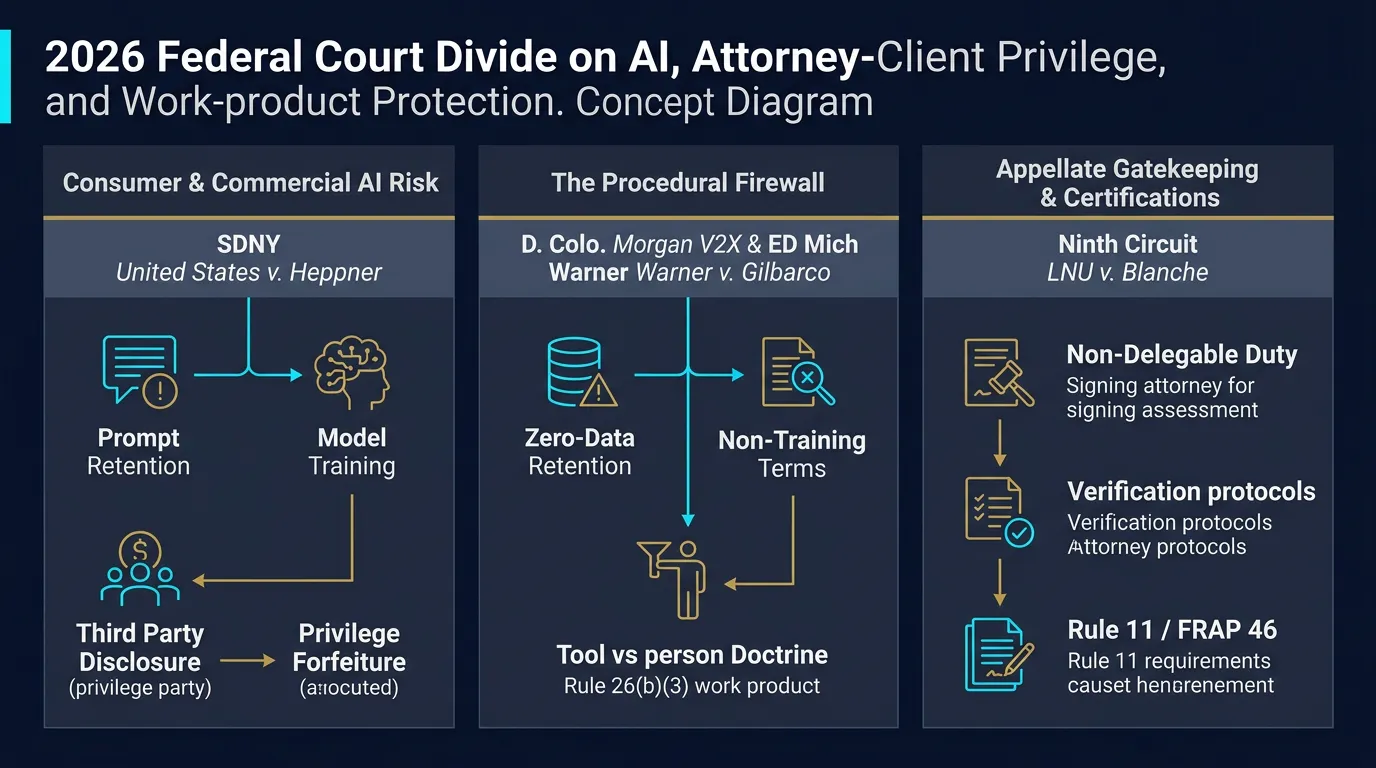
Federal jurisprudence across 2026 has demolished the comforting myth that generative AI queries enjoy the legal status of an associate attorney's research scratchpad. Across both trial and appellate dockets, judges are drawing sharp lines between the nature of attorney-client communications and the procedural mechanics of work product, imposing aggressive evidentiary and disciplinary consequences on attorneys who fail to distinguish consumer convenience from privileged enterprise infrastructure.
How does commercial generative AI waive the attorney-client privilege?
The attorney-client privilege protects confidential communications between privileged persons made for the primary purpose of obtaining or providing legal assistance. In United States v. Heppner, No. 25-cr-503 (S.D.N.Y. Feb. 17, 2026), the Southern District of New York evaluated whether 31 strategic case-planning documents and analytical prompts generated through commercial large language models were shielded from criminal discovery.
The court rejected the privilege assertion under a two-pronged analysis:
- Non-Human Entities Cannot Be Legal Advisors: An artificial intelligence platform is a computational software tool, not an attorney, legal clerk, or credentialed member of a defense team. Communications directed to an algorithm do not constitute requests for legal advice from a licensed professional.
- Click-Wrap Terms of Service Defeat Confidentiality: The defendant utilized commercial web tiers whose terms of service granted the vendor rights to log query data, retain transcripts for abuse monitoring, and use conversational data for model fine-tuning. The court held that disclosing facts to a commercial third party with contractual inspection rights vitiates the expectation of confidentiality necessary to sustain the privilege.
The lesson from Heppner is categorical: you cannot maintain confidentiality while consenting to third-party data harvesting. Transmitting unredacted client facts to any commercial LLM endpoint that reserves inspection or training rights functions as a voluntary waiver of attorney-client privilege under federal common law.
Why does work-product protection survive under enterprise zero-retention architectures?
While attorney-client privilege requires strict confidentiality between attorney and client, the work-product doctrine codified in Federal Rule of Civil Procedure 26(b)(3) serves a different purpose: protecting an attorney's mental impressions, case strategies, and trial preparation from opposing counsel. Consequently, work-product waiver requires showing that materials were disclosed to an adversary or transmitted under conditions that substantially increased the opportunity for an adversary to obtain them.
Federal courts in 2026 have recognized this critical doctrinal distinction:
- Warner v. Gilbarco, Inc. (E.D. Mich. Feb. 10, 2026): The Eastern District of Michigan held that litigation strategy outlines and legal theories generated with generative AI assistance remained shielded as opinion work product. The court reasoned that AI systems are "technological tools, not legal adversaries." Because the litigant took reasonable steps to maintain security and the software provider was not aligned with or accessible by the adverse party, the interaction did not constitute a waiver under Rule 26(b)(3).
- Morgan v. V2X, Inc., No. 25-cv-01991 (D. Colo. Mar. 30, 2026): In a landmark discovery ruling, the District of Colorado protected AI-assisted litigation files from production but established an enforceable judicial framework for confidential uploads. The court held that uploading litigation materials to an AI vendor is permissible only under protective orders requiring:
- Contractual guarantees prohibiting vendor model training on user inputs;
- Zero data retention (ZDR) or strict ephemeral processing limits;
- Express technical restrictions preventing third-party or human reviewer access; and
- Mandatory disclosure of the specific AI platform and infrastructure tier utilized.
The synthesis of Warner and Morgan creates an affirmative safe harbor: opinion work product generated through AI systems remains protected if—and only if—the enterprise deploys dedicated enterprise contracts and technical firewalls that legally and architecturally prevent adversary access.
| Judicial Doctrine | Governing Federal Rule | Standard for AI Interaction | Landmark 2026 Authority | Risk Profile |
|---|---|---|---|---|
| Attorney-Client Privilege | Common Law / FRE 501 | Absolute confidentiality required; third-party logging destroys privilege | United States v. Heppner (S.D.N.Y. 2026) | Severe waiver risk on standard consumer/web LLM tiers |
| Work-Product Protection | FRCP Rule 26(b)(3) | Protected unless disclosed to an adversary or adversary conduit | Warner v. Gilbarco (E.D. Mich. 2026) | Preserved if platform security and non-training terms apply |
| Confidential ESI Protective Orders | FRCP Rule 26(c) | Mandatory Zero Data Retention (ZDR) and platform disclosure | Morgan v. V2X, Inc. (D. Colo. 2026) | Non-compliant tools subject to mandatory sanctions and production |
| Appellate Certification & Candor | FRAP 46(c) / Rule 11 | Non-delegable personal duty to verify every citation and quotation | LNU v. Blanche (9th Cir. 2026); Fletcher (5th Cir. 2026) | $2,500+ monetary sanctions, mandatory suspensions, bar referrals |
What is the appellate standard for attorney verification and signing duties?
Federal appellate courts have made it clear that while generative AI may be used for drafting, the ethical and procedural duties of legal practice attach irrevocably at the moment an attorney signs and files a brief.
In LNU v. Blanche, No. 24-4790 (9th Cir. June 3, 2026), the United States Court of Appeals for the Ninth Circuit issued a precedential sanctions order against counsel who submitted appellate briefs containing fabricated citations and hallucinated quotations. The Ninth Circuit imposed a $2,500 monetary penalty, a six-month suspension, and two years of mandatory AI-use disclosure requirements.
Crucially, the Ninth Circuit articulated three governing principles for the federal bar:
"Ethical and procedural duties attach at the point of signing and filing, not at the research stage. A lawyer's signature certifies personal review and verification of every citation, holding, and quotation, regardless of whether AI or junior staff drafted the submission. We do not sanction counsel for using artificial intelligence; we sanction counsel for failing to exercise the non-delegable duty of personal verification and for concealing AI involvement when challenged."
This standard reinforces the Fifth Circuit's ruling in Fletcher v. Experian Information Solutions, Inc., No. 25-20086 (5th Cir. Feb. 18, 2026), where the court sanctioned an attorney $2,500 under Federal Rule of Appellate Procedure 46(c) for submitting AI-generated hallucinated authority. The Fifth Circuit explicitly rejected the notion that courts require novel AI-specific rules, holding that long-standing standards of procedural candor and Rule 11 due diligence are fully equipped to govern algorithmic misconduct.
How should law firms and legal departments structure an AI privilege protocol?
To insulate litigation workflows against catastrophic waiver and judicial sanctions, law firms and corporate legal departments must operationalize four procedural safeguards:
- Mandatory Enterprise Zero-Retention Contracts: Never permit staff or outside counsel to input client facts into consumer-grade or standard commercial web interfaces. Litigators must execute enterprise agreements featuring verified Zero Data Retention (ZDR), explicit bans on foundation model training, and technical exemptions from human safety auditing queues.
- Segregation of Core Attorney-Client Communications: Maintain a strict procedural barrier preventing direct, verbatim client emails or disclosures from being processed through external LLM APIs unless client consent is documented and enterprise encryption is enforced.
- Formal Verification and Citation Audit Trails: Prior to court submission, mandate a secondary manual check verifying every legal citation against official reporters or authoritative legal databases, mirroring the evidentiary standards of Proposed Federal Rule of Evidence 707 and Federal Rule of Evidence 902(13).
- Litigation Protective Order Compliance: Align eDiscovery and litigation workflows with emerging model protective orders like Morgan v. V2X, ensuring that cross-border transfer restrictions and platform identification disclosures are satisfied before processing confidential ESI.
Does submitting client facts to commercial AI waive attorney-client privilege?
Yes, if the AI service provider's terms of service permit the storage, human review, or model training use of user inputs. Under United States v. Heppner (S.D.N.Y. 2026), providing confidential information to a commercial third party with contractual access rights eliminates the reasonable expectation of confidentiality required to sustain attorney-client privilege.
Can AI-generated research memos and legal strategies qualify as work product?
Yes. Under Warner v. Gilbarco (E.D. Mich. 2026) and Morgan v. V2X (D. Colo. 2026), work-product protection under Federal Rule of Civil Procedure 26(b)(3) is preserved because AI systems are technological tools rather than adverse parties, provided that the litigator utilizes enterprise-tier tools with zero data retention and strict non-training covenants.
What are the court sanctions for filing AI hallucinations in federal court?
Federal courts sanction counsel under Federal Rule of Civil Procedure 11, Federal Rule of Appellate Procedure 46(c), and inherent judicial authority. Sanctions in 2026 routinely include monetary fines ($2,500+), attorney suspensions, mandatory continuing legal education, and formal disciplinary bar referrals (Fletcher, 5th Cir. 2026; LNU v. Blanche, 9th Cir. 2026).
Is there a requirement to disclose AI use in federal litigation?
Disclosure requirements depend on local rules and specific judicial standing orders. While some jurisdictions require affirmative certifications of AI use, federal appellate courts evaluate filings under traditional certification doctrines: signing an electronic filing certifies that the signing attorney has personally read, checked, and verified every cited authority.
Explore related judicial and evidentiary analyses on Prest0: