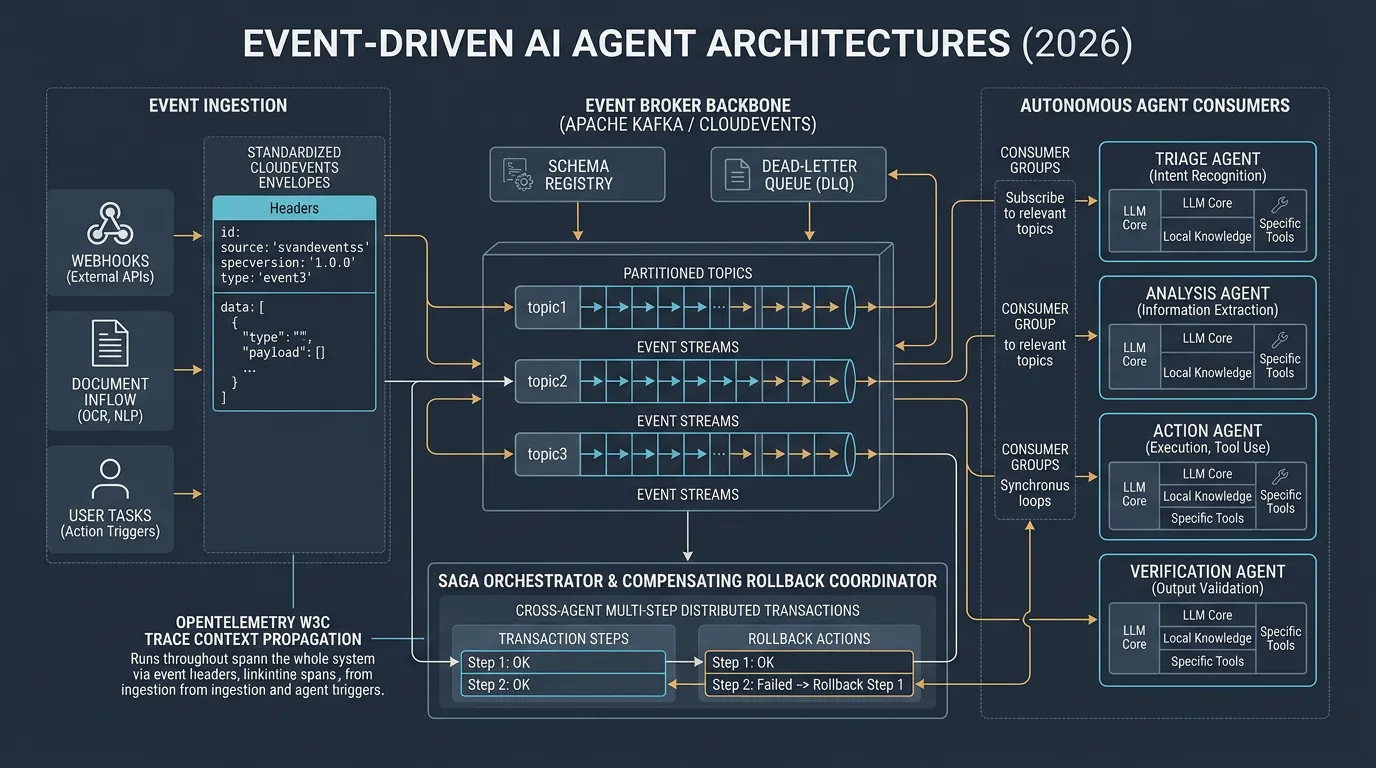
When engineering production AI agent systems, relying on synchronous HTTP request-response chains introduces severe cascading latency, network timeouts, and brittle failure modes. Event-driven agent architectures solve this bottleneck by decoupling agent invocation into asynchronous message streams, where autonomous agents consume domain events, execute multi-step reasoning loops, and emit verifiable state changes across an enterprise event broker like Apache Kafka.
By structuring inter-agent communication around standardized event envelopes, distributed AI systems achieve horizontal elasticity, zero idle compute costs, and robust fault isolation.
Why Do Synchronous Request-Response Chains Break Down in Agentic Systems?
In classical microservices, synchronous REST or gRPC calls function effectively because downstream services process deterministic inputs within predictable sub-second windows. In contrast, autonomous AI agent execution is fundamentally non-deterministic and highly variable in latency:
- Unbounded Inference Latency: An agent executing iterative multi-turn tool calling, dynamic retrieval, and code execution may run for 15 seconds to several minutes. Holding an open synchronous HTTP connection across multiple upstream orchestrators exhausts connection pools and triggers gateway 504 timeouts.
- Cascading Failure Amplification: When an upstream agent waits synchronously on three downstream specialist agents, a transient failure or rate limit in a single downstream model cascades backward, halting the entire workflow and burning token budgets without progress.
- Tight Temporal Coupling: Synchronous topologies force the producing service and consuming agent to be online and available simultaneously, eliminating the ability to buffer spiky ingestion workloads such as bulk litigation discovery or batch regulatory filings.
Transitioning to an event-driven model replaces synchronous blocking calls with durable event streaming, allowing agents to process work at their natural throughput while maintaining strict backpressure boundaries.
How Does Event Choreography Differ From Centralized Agent Orchestration?
Enterprise engineering teams frequently struggle with the architectural trade-off between centralized orchestration and decentralized choreography. In production agentic environments, modern systems implement a hybrid model tailored to execution topology:
| Architectural Dimension | Centralized Orchestration | Decentralized Choreography | Hybrid Event-Driven Architecture |
|---|---|---|---|
| Control Flow | Central workflow engine directs each step | Agents independently react to published events | Choreographed domain events with local saga orchestrators |
| Coupling | High temporal coupling to central director | Loose coupling via shared event bus | Decoupled services with explicit contract schemas |
| Failure Blast Radius | Orchestrator failure halts all workflows | Isolated to individual event subscriber groups | Faults isolated to topic partitions with DLQs |
| Scalability | Bottlenecked by orchestrator state management | Linearly scalable across topic consumer partitions | Horizontally elastic agent worker pools |
| Traceability | Built-in centralized execution graph | Requires distributed tracing across event headers | End-to-end W3C trace context injected in event envelopes |
In a pure choreography pattern, an ingestion service publishes a document.uploaded event. A Document Parsing Agent subscribes to the topic, extracts structured entities, and emits a document.parsed event. A Legal Analysis Agent consumes that event, spots relevant issues, and publishes an analysis.completed event. No single controller manages the entire sequence, eliminating single-point bottlenecks.
How Should Standardized Event Envelopes Be Structured With CloudEvents?
Inter-agent interoperability requires a uniform metadata envelope. Adopting the CNCF CloudEvents v1.0 specification standardizes event structure across disparate agent frameworks, runtime languages, and cloud providers.
Each event envelope carries core attributes alongside OpenTelemetry W3C distributed tracing context:
{
  "specversion": "1.0",
  "id": "evt-7f89d3a2-4b11-49e0-b631-018274aef819",
  "source": "https://agents.prest0.ai/parsers/legal-filing",
  "type": "ai.agent.document.entity-extracted.v1",
  "datacontenttype": "application/json",
  "time": "2026-11-09T14:30:00Z",
  "traceparent": "00-4bf92f3577b34da6a3ce929d0e0e4736-00f067aa0ba902b7-01",
  "tracestate": "ro=concurrency_checked",
  "data": {
    "matterId": "mat_98241",
    "documentHash": "sha256-e3b0c44298fc1c149afbf4c8996fb92427ae41e4649b934ca495991b7852b855",
    "extractedEntities": {
      "court": "U.S. District Court, Southern District of New York",
      "filingDate": "2026-11-06",
      "statuteOfLimitationsDeadline": "2027-05-06"
    },
    "modelMetadata": {
      "confidenceScore": 0.984,
      "tokenUsage": 1420
    }
  }
}
By standardizing on CloudEvents envelopes:
- Schema Validation: Event schemas are registered and enforced at the event broker boundary using Apache Avro or JSON Schema registries, preventing malformed payloads from poisoning agent context windows.
- Trace Propagation: Standardized W3C
traceparentheaders allow OpenTelemetry GenAI spans to track multi-agent execution paths as cohesive distributed traces across asynchronous message boundaries, aligning with production observability frameworks established in Distributed Agent Tracing: OpenTelemetry Architectures. - Idempotency Keys: The unique
idandsourcepair acts as a universal deduplication key, ensuring that retried message deliveries do not trigger duplicated tool executions or billing events.
How Do Event-Driven Agents Handle Idempotency and Deduplication?
Because distributed message brokers like Apache Kafka guarantee at-least-once delivery, an agent may receive the same event multiple times due to consumer rebalances, network partitions, or worker restarts. If an agent executes stateful external tools (such as charging a credit card, filing a pleading, or sending an email), duplicate execution can cause catastrophic production failures.
To achieve strict idempotency:
- Transactional Deduplication Stores: Before executing an inference turn or external tool call, the agent worker performs an atomic check-and-set operation in a high-speed distributed cache (such as Redis or DynamoDB) using the CloudEvents
id. If the key exists inIN_PROGRESSorCOMPLETEDstate, the duplicate event is acknowledged and discarded. - Idempotency Token Propagation: When calling third-party APIs or internal services, the agent derives an idempotency key directly from the event hash and passes it in API client request headers (e.g.,
Idempotency-Key: idemp_<hash>). - Deterministic State Replay: For complex multi-step reasoning workflows, agents leverage event sourcing. Rather than mutating global state in place, every intermediate tool outcome is recorded as an immutable event, enabling exact replay and recovery as detailed in our guide on Durable Agentic Execution and Saga Recovery.
How Are Distributed Transactions and Error Handling Managed Across Choreographed Agents?
In a decoupled choreography architecture, what happens when an agent encounters an unrecoverable failure midway through a multi-agent workflow? Because traditional two-phase commit (2PC) transactions introduce distributed locking bottlenecks—which directly violate the concurrency standards established in Multi-Agent Deadlock Prevention: Concurrency Control in 2026—event-driven architectures implement Compensating Sagas and Dead-Letter Queues (DLQ):
1. Compensating Sagas for Distributed Rollbacks
When an action agent fails to execute a downstream step (e.g., an automated court filing portal rejects an uploaded document format), the agent emits a filing.failed domain event. Upstream agents subscribing to failure events trigger compensating actions in reverse order:
- The Docketing Agent removes the provisional calendar entry.
- The Notification Agent alerts the supervising attorney with the specific portal error code.
- The Billing Agent cancels the provisional filing disbursement.
2. Dead-Letter Queues and Circuit Breakers
If an agent repeatedly encounters context-window exhaustion, invalid schema inputs, or upstream model outages, unprocessable events are routed to a dedicated Dead-Letter Queue (DLQ) after a configured retry threshold (typically 3 attempts with exponential backoff and jitter).
Inline circuit breakers isolate the failing agent consumer group, preventing backpressure build-up and preserving queue health across the broader cluster, mirroring the operational safeguards in AI Agent Circuit Breakers: Cascading Failure Isolation.
What is an event-driven AI agent architecture?
An event-driven AI agent architecture is a distributed software design where autonomous AI agents communicate asynchronously by publishing and subscribing to discrete domain events through a centralized event broker (such as Apache Kafka), rather than relying on blocking synchronous HTTP API calls.
Why is choreography preferred over orchestration in high-volume agent systems?
Choreography eliminates the central orchestrator as a single point of failure and scaling bottleneck. Specialist agents independently consume relevant event streams, scale horizontally across partitions, and react to system state changes without requiring a central coordinator to manage every execution turn.
How does CloudEvents improve agentic interoperability?
The CNCF CloudEvents standard defines a uniform metadata envelope (including id, source, specversion, and type), enabling cross-language, cross-framework message routing, automated schema enforcement, and distributed W3C OpenTelemetry tracing across diverse multi-agent fleets.
For enterprise teams deploying autonomous multi-agent systems, shifting from synchronous request chains to an asynchronous, event-driven architecture is the defining architectural milestone for achieving production scale, sub-second ingestion, and resilient fault isolation. Learn more about engineering enterprise agent infrastructure with Prest0n AI Solutions.