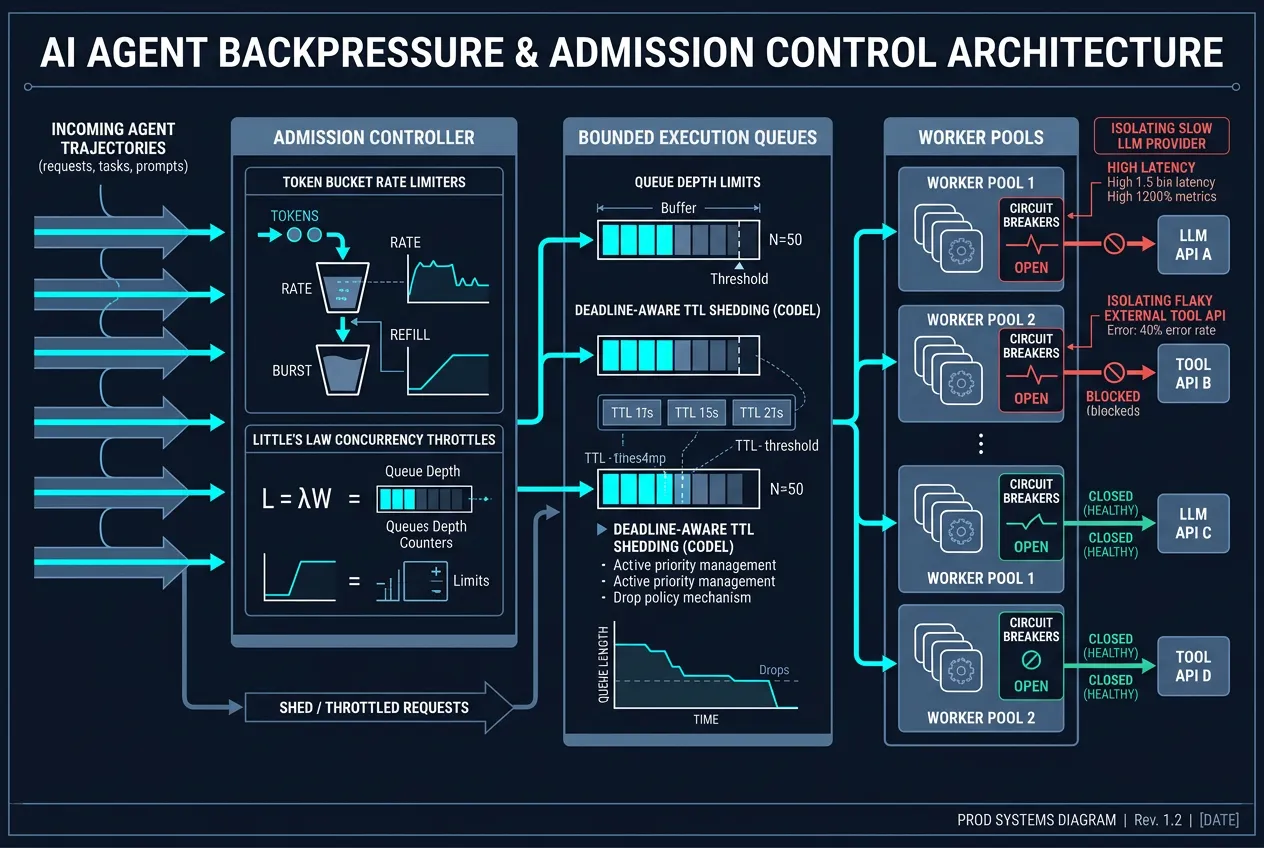
AI agent backpressure is the discipline of limiting accepted work when execution capacity or downstream dependencies cannot keep up. A production agent should admit only work it can reasonably finish, bound its queues, carry deadlines across tool calls, and limit retries. The objective is not maximum parallelism: it is preserving useful, timely work without turning a temporary slowdown into a wider failure.
Why do agent systems need admission control?
A single request can trigger retrieval, model calls, tool operations, and child tasks. When dependencies slow down, more work remains in flight. If the system keeps accepting new tasks and issuing retries, queued work competes with active work for the same scarce capacity.
The agent-specific recommendations in this article are engineering analysis applied to established distributed-systems guidance—not a claim that the cited sources benchmarked this exact agent architecture. Google's Handling Overload chapter describes rejecting excess work gracefully and using request criticality to protect more important traffic. The Amazon Builders Library explains why retries need limits, backoff, and jitter, and why a timeout does not prove a remote side effect failed to occur.
For agent builders, the implication is straightforward: the scheduler needs a policy for refusing or deferring work, not just a policy for starting it.
What should the admission controller decide?
Place admission checks before expensive work begins and before a task creates more downstream work. The controller should consider:
- Available execution capacity: whether the relevant worker and dependency pools can accept the task.
- Remaining deadline: whether queueing and execution leave a reasonable chance of timely completion.
- Workload class: whether the request is urgent interactive work, recoverable background work, or optional enrichment.
- Tenant allowance: whether one customer's fan-out would consume capacity reserved for others.
- Dependency condition: whether the required model or tool is healthy enough to attempt the operation.
Use distinct limits for distinct resources. A model-call concurrency limit is not a substitute for a tool-call limit, and a requests-per-minute limit does not directly bound long-running tasks already in flight. Choose limits from measured demand and completion behavior, then validate them under burst traffic and dependency slowdown.
Do not treat admission as a guarantee of completion. It is a decision made with imperfect estimates, so the system still needs cancellation, progress reporting, and recovery.
How should bounded queues handle overload?
A bounded queue makes the waiting-room capacity explicit. It does not, by itself, make the accepted work timely. Queue age and remaining deadlines matter alongside queue depth.
Apply the same principles to parent trajectories, child tasks, and dependency calls:
- Reject new work when the relevant capacity is exhausted rather than silently growing an unbounded queue.
- Expire work that no longer has a useful completion window.
- Preserve capacity for explicitly defined critical work.
- Return a clear deferred or rejected state, with recovery instructions appropriate to that workload.
For example, optional document enrichment can be deferred during an overload event while an already-authorized user action retains its reserved capacity. This is a recommended policy pattern, not a universal priority rule; a team must define which work actually deserves protection.
The cover diagram names token buckets, Little's Law, and CoDel as possible design vocabulary. They are not interchangeable controls or mandatory choices. Little's Law relates average work in the system to arrival rate and time in the system under its assumptions; it is not an admission-control algorithm. CoDel originates in queue-management work and should not be assumed suitable for agent-task deadlines without validation. The practical recommendation here does not depend on either: bound accepted work and reject work that cannot be usefully served.
Where do retries become dangerous?
A retry creates additional demand precisely when a dependency may already be struggling. Retrying at multiple layers can make the problem harder to control because each layer sees only its own attempt policy.
Amazon's guidance describes local token-bucket limits for retries, exponential backoff, and jitter. Applying that guidance to agents suggests a deliberate retry owner and a shared trajectory-level budget, with dependency-specific limits underneath it.
A retry policy should answer:
- Is this error plausibly temporary?
- Is there enough time left for another attempt?
- Is retry capacity available?
- Can this operation be repeated without duplicating an external effect?
- Is another layer already retrying the same work?
Keep admission tokens and retry tokens conceptually separate. Admission governs new work; retry capacity governs additional attempts on existing work. Backoff without an attempt budget can still produce too much demand, and a budget without jitter can synchronize callers.
What should happen after a tool-call timeout?
Treat the result as uncertain until the external system settles it. A timeout can occur after the remote system accepted or completed the operation.
For read-only work, another attempt may be safe within the deadline and retry budget. For an email, payment instruction, signature request, or record creation, first use the destination's supported idempotency or reconciliation mechanism. Reuse the operation identity where supported, inspect the destination's actual state, and avoid a fresh write until the earlier attempt is resolved.
This recommendation complements agent tool contracts and outcome verification. Overload protection prevents excess demand; outcome verification prevents an ambiguous attempt from becoming a duplicate external action. Neither replaces the person's required authorization.
How do worker isolation and circuit breakers fit?
Use separate execution pools for dependencies with different failure characteristics. A slow tool should not occupy every worker needed for unrelated work.
Circuit breakers are an optional isolation mechanism, not a substitute for deadlines or admission control. Define what opens the breaker, how recovery is tested, which traffic may probe the dependency, and what happens to waiting tasks. A fallback must also have its own capacity limit; otherwise the protection mechanism can move the overload to a second dependency.
At the trajectory level, stop scheduling children that cannot contribute a timely result. Cancellation must have explicit semantics: cancelling a local wait does not prove a remote operation was undone.
The admission controller, queue policy, worker isolation, and retry policy should agree on the same task identity and deadline. They should also preserve authorization boundaries rather than using overload as a reason to broaden permissions.
Which signals should operators watch?
Measure the outcomes that distinguish healthy shedding from failed service:
| Signal | What it reveals |
|---|---|
| Accepted, rejected, and deferred work | Whether admission policy is actually limiting demand |
| Queue age and expired work | Whether accepted tasks are becoming stale |
| In-flight calls by dependency | Which resource is constraining execution |
| Retry attempts and exhausted budgets | Whether recovery demand is amplifying overload |
| Completion latency and useful completions | Whether protected work is still being delivered |
| Tenant and workload-class breakdowns | Whether protection is fair and matches stated priorities |
| Unresolved external operations | Whether timeouts leave writes awaiting reconciliation |
Evaluate these signals together. A higher rejection rate may be appropriate during overload, but a low latency figure for the few surviving tasks does not prove that the service is meeting users' needs.
Connect these controls to distributed agent tracing, so an operator can follow a task from admission through queueing, attempts, and final verification. Trace collection itself should be bounded and should not disclose confidential task content unnecessarily.
What should a useful overload test prove?
Test bursts, slower model responses, failing tools, exhausted retry budgets, and cancellation while work is waiting. Include tasks with remote side effects whose responses are delayed.
The acceptance criteria should be behavioral rather than a fabricated throughput promise: queues remain bounded; optional work is refused or deferred visibly; critical capacity is preserved according to policy; retries stop at their budget or deadline; and uncertain writes are reconciled before repetition.
Compare the overloaded behavior with the normal workload baseline and report both completed work and rejected work. Do not infer reliability merely from a process staying alive.
What is the practical implementation takeaway?
Start with an explicit execution limit, bounded waiting room, propagated deadline, and safe retry policy. Add dependency isolation and more adaptive admission only where measurement shows they are needed.
The most important architectural change is a product decision: overload is a state the user can understand, not a reason to silently accumulate work. A trustworthy agent says what was accepted, what was deferred, and what actually completed.
Is backpressure the same as rate limiting?
No. Rate limiting controls arrivals over time. Backpressure also manages in-flight work, waiting queues, downstream capacity, and overload feedback. Both can be useful.
Should every failed tool call be retried?
No. Retry only when the error is plausibly temporary, capacity and time remain, and repeating the operation is safe. A timeout on a write requires reconciliation or supported idempotency.
Does an admission controller guarantee a deadline?
No. It uses estimates to avoid accepting obviously unserviceable work. Completion still depends on actual execution and dependency behavior.
Do circuit breakers replace bounded queues?
No. They address different problems. A breaker can stop calls to a failing dependency; bounded queues limit waiting work. A fallback dependency also needs its own limits.
Sources and scope
Primary-source guidance checked for this article on November 2, 2026:
- Google SRE Book — Handling Overload: load shedding, overload handling, and request criticality.
- Amazon Builders Library — Timeouts, retries, and backoff with jitter: retry limits, token buckets, backoff and jitter, and the uncertainty of side effects after a timeout.
Agent-specific policy choices and the illustrative architecture are the article's engineering analysis. No benchmark result or measured production improvement is claimed. This information is for general informational purposes only and does not constitute legal advice.