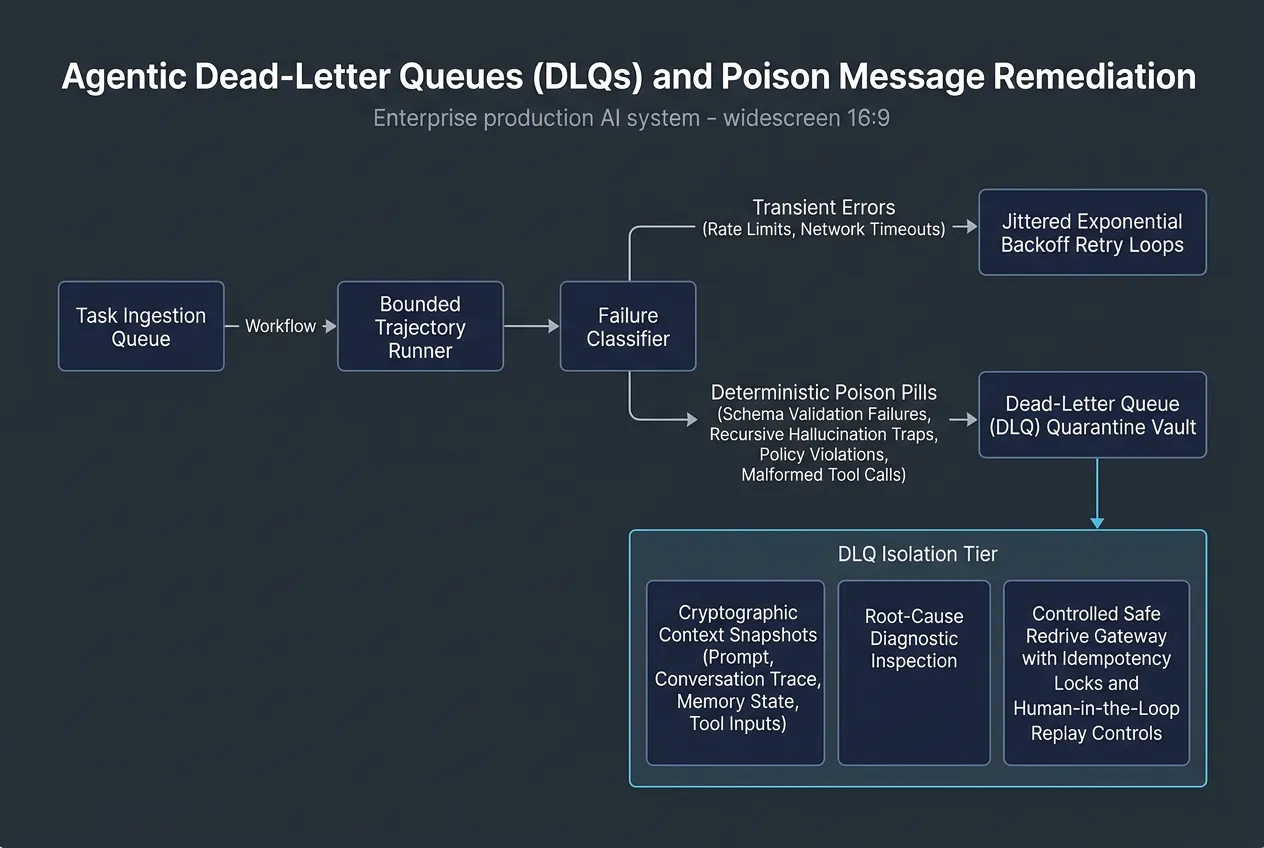
Agentic dead-letter queues in 2026 serve as the critical fault-isolation infrastructure that prevents unprocessable poison messages, malformed tool inputs, and deterministic model failures from triggering runaway inference retry storms in production autonomous AI swarms. By capturing immutable execution snapshots, context-window dumps, and cryptographic tool-call traces into isolated quarantine vaults, agentic dead-letter queues enable enterprise engineering teams to diagnose root causes and execute controlled, idempotent replays without risking data corruption or operational disruption.
Why Do Conventional Message Queues Fail in Autonomous Agent Systems?
In classical distributed microservices, message queues handle discrete, deterministic payloads such as payment events or inventory updates. When a downstream consumer fails, standard queue architectures—such as Amazon SQS, RabbitMQ, or Apache Kafka—rely on a basic retry policy: retry N times with exponential backoff, and if the message repeatedly fails, move it to a dead-letter queue (DLQ).
In production autonomous AI agent systems, this simplistic paradigm collapses due to the non-deterministic and stateful nature of large language models (LLMs) and multi-step tool-calling workflows:
- Poison Messages Amplify Runaway Cost: In an agentic system, a "poison message" is not merely malformed JSON. It is often an adversarial prompt, an out-of-distribution user query that induces an infinite reasoning loop, a tool output that exceeds context limits, or a schema validation error during tool calling. Blindly retrying an agent step that consumes 64,000 context tokens across multiple tool hops consumes substantial compute budgets and saturates provider rate limits within minutes.
- Context Window Loss Upon Retries: When a traditional queue retries a failed message, it re-queues the raw initial task. However, in an autonomous multi-step trajectory, the failure typically occurs at Step 6 or Step 12. Re-ingesting the initial message discards all preceding chain-of-thought tokens, tool outputs, and intermediate memory commits, forcing the agent to redundantly re-execute preceding steps and risking duplicate external mutations.
- Cascading Swarm Blockades: When an autonomous orchestrator dispatches sub-tasks across worker agents, a poison pill that crashes one worker can stall the entire dependency DAG (Directed Acyclic Graph). Without active agentic dead-letter queuing, the parent coordinator hangs waiting for an unreachable barrier synchronization, triggering widespread cascading timeouts across the entire platform.
To maintain production stability, modern agent runtimes must replace generic retry counters with an intelligent, context-aware Agentic Dead-Letter Queue (A-DLQ) architecture.
What Constitutes an Agentic Poison Message?
Enterprise agent deployments encounter four distinct classes of deterministic and semi-deterministic failures that must be quarantined immediately rather than subjected to blind retry loops:
| Poison Failure Mode | Root Cause Mechanism | Impact on Standard Queues | A-DLQ Quarantine Strategy |
|---|---|---|---|
| Context-Free Grammar (CFG) / Schema Rejection | LLM generates malformed JSON or invalid parameter types that violate strict tool call definitions. | Immediate consumer crash; infinite retry loops on identical prompt input. | Intercept schema validation failure; capture bad generation; quarantine with parser diagnostics. |
| Recursive Hallucination Loops | Semantic reasoning gets trapped cycling between identical tool calls with circular parameters. | Rapid token depletion; worker thread exhaustion; multi-dollar inference waste. | Semantic loop detector triggers circuit breaker; dumps full trajectory trace to DLQ. |
| Context Window Overflows | A tool returns an unexpectedly large payload (e.g., a 20MB unparsed PDF) exceeding model context limits. | Catastrophic model API 400 Bad Request rejection; unrecoverable by retries. | Flag payload size anomaly; isolate uncompacted state; route to DLQ with truncation warning. |
| Adversarial / Policy Refusal Trap | Unchecked user input triggers upstream model safety filters or prompt injection firewalls. | Hard provider 4xx rejection; deterministic failure across all retry attempts. | Quarantine prompt payload; flag security violation; notify administrative security logs. |
Distinguishing between transient faults (such as provider HTTP 429 rate limits, network connection resets, or temporary HTTP 503 gateway drops) and deterministic poison pills is the primary mandate of the agentic failure classifier. While transient faults require jittered exponential backoff retries, deterministic poison pills must be shunted to the A-DLQ immediately on the first failure.
How Does an Agentic Dead-Letter Queue Preserve Trajectory State?
Unlike traditional DLQs that store only the raw input message and an HTTP error code, an Agentic Dead-Letter Queue acts as a forensic black box for the agent's cognitive state. When a task is routed to the A-DLQ, the runtime captures an immutable, cryptographically signed state snapshot containing:
+-----------------------------------------------------------------------------------+
|                        AGENTIC DEAD-LETTER QUEUE SNAPSHOT                         |
+-----------------------------------------------------------------------------------+
|                                                                                   |
|  [Metadata Envelope]                                                              |
|   ├── Task ID & Trace ID (W3C traceparent compliant)                              |
|   ├── Agent Persona & Model Snapshot (e.g., claude-opus-5.5@20261118)             |
|   ├── Execution Step Counter (e.g., Step 7 of max 15)                             |
|   └── Failure Classifier Signature (e.g., ERR_SCHEMA_VALIDATION_MALFORMED_TOOL)   |
|                                                                                   |
|  [Cognitive Context Dump]                                                         |
|   ├── Full Conversational History (System, User, and Assistant message arrays)    |
|   ├── Ephemeral Tool Registry State & In-Memory Variables                         |
|   ├── Intermediate Reasoning Trajectory & Uncommitted Scratchpad Thoughts         |
|   └── Token Consumption & Cost Telemetry (Input/Output/Cache Read Counts)         |
|                                                                                   |
|  [Execution Boundary Record]                                                      |
|   ├── Completed Side-Effects (Database writes, external API mutations)           |
|   ├── Compensating Transaction Log (Saga rollback descriptors)                    |
|   └── Cryptographic Checkpoint Hash (SHA-256 state seal)                          |
|                                                                                   |
+-----------------------------------------------------------------------------------+
By persisting this comprehensive cognitive envelope into durable object storage, engineers prevent data loss, capture exact prompt reproduction artifacts, and insulate the primary message bus from toxic traffic.
How Is Safe Redrive and Replay Engineered?
Quarantining poison messages in a dead-letter queue is only half of the solution. The core operational challenge lies in remediating the failure and redriving the workflow without generating duplicate real-world side effects.
+-----------------------------------------------------------------------------------+
|              AGENTIC DLQ INSPECTION, REMEDIATION & REDRIVE GATEWAY                |
+-----------------------------------------------------------------------------------+
|                                                                                   |
|  [Active Agent Run] ──► [Deterministic Failure] ──► [Failure Classifier]           |
|                                                              │                    |
|                                                              ▼                    |
|                                                    [A-DLQ Quarantine Vault]       |
|                                                              │                    |
|                                    ┌─────────────────────────┴─────────────────┐  |
|                                    ▼                                           ▼  |
|                         [Automated LLM Healer]                     [Human SRE]    |
|                         (Repairs Tool Args / Clamps Context)       (Admin Portal) |
|                                    │                                           │  |
|                                    └─────────────────────────┬─────────────────┘  |
|                                                              │                    |
|                                                              ▼                    |
|                                                [Pre-Redrive Validation Gate]      |
|                                                              │                    |
|                                                              ▼                    |
|                                                [Idempotent Step Replay Engine]    |
|                                                (Bypasses Completed Side-Effects)  |
|                                                              │                    |
|                                                              ▼                    |
|                                                [Primary Agent Trajectory Resumed] |
|                                                                                   |
+-----------------------------------------------------------------------------------+
Production systems employ four architectural safeguards during redrive operations:
1. Step-Level Replay Gating via Idempotency Keys
If an agent successfully charged a customer credit card at Step 3 and posted an invoice at Step 4, but encountered a poison pill schema crash at Step 5, redriving the task must not re-execute Steps 1 through 4.
By pairing the DLQ redrive gateway with an idempotent transactional outbox, the runtime fast-forwards the agent's execution. Intermediate state variables and past tool outputs are replayed directly from the cryptographic state snapshot, allowing the agent to resume execution precisely at Step 5 with zero duplicate external side effects.
2. Context Compaction and Schema Mutation Gateways
When a poison message lands in the DLQ due to context overflow or invalid tool arguments, human operators or automated remediation bots can apply targeted mutations before releasing the message back into production:
- Context Compaction: Stripping redundant past conversational turns or applying extractive summarization to oversized tool outputs.
- Model Fallback Injection: Overriding the model router to assign a higher-reasoning frontier model or an alternate specialized provider specifically for the problematic step.
- Schema Patching: Manually editing corrupted JSON parameters into strictly valid data schemas before triggering execution.
3. Rate-Controlled Redrive Throttling
Releasing thousands of quarantined messages back into active production queues simultaneously can create artificial traffic spikes, crashing downstream internal microservices or triggering provider rate limits. A-DLQ systems enforce strict token-bucket redrive pacing (e.g., releasing no more than 5 redriven trajectories per second) to safeguard production stability.
4. Poison Pill Dead-Letter Discard and Audit Logging
If an investigation reveals that a quarantined task was a malicious prompt injection attempt or an unrecoverable corrupted payload, operators can issue an administrative discard command. The task is permanently expunged from the active queue, compensating transactions are dispatched to roll back partial uncommitted changes, and the full cryptographic snapshot is archived in a cold WORM (Write-Once-Read-Many) compliance vault for security audit review.
What Are the Operational Metrics for Agentic Queue Health?
Engineering teams managing production agent fleets track four primary Service Level Indicators (SLIs) to measure queue resilience:
- DLQ Ingestion Velocity: The rate of tasks moving to quarantine per 10,000 executed steps. A sudden spike indicates upstream model provider degradation, silent prompt drift, or a broken external API schema.
- Deterministic-to-Transient Failure Ratio: The proportion of failures classified as poison messages versus transient network drops, guiding retry configuration tuning.
- Mean Time to Diagnosis (MTTD): The duration required for automated heuristics or on-call SREs to isolate the root cause from a DLQ cognitive snapshot.
- Clean Redrive Realization Rate: The percentage of redriven tasks that successfully complete their remaining trajectory without generating duplicate mutations or re-entering quarantine.
By treating failure as a first-class architectural state, enterprise engineering teams transform brittle AI prototypes into resilient, self-healing production platforms capable of operating reliably across millions of autonomous transactions.
What is the difference between a traditional dead-letter queue and an agentic dead-letter queue?
A traditional dead-letter queue stores raw message payloads and basic network error codes after a fixed number of failed delivery attempts. An agentic dead-letter queue captures a comprehensive, multi-step cognitive snapshot—including conversational history, intermediate chain-of-thought tokens, ephemeral tool registry states, and completed side-effect logs—enabling root-cause analysis and surgical step-level replay.
Why shouldn't you automatically retry all failed agent tool calls?
Automatically retrying all failed tool calls creates severe financial and operational risks. Deterministic failures, such as schema validation errors or recursive hallucination loops, will repeatedly fail on identical inputs, burning tens of thousands of tokens and triggering provider rate limits. Only transient faults (e.g., network timeouts, HTTP 429 rate limits, and 5xx server errors) should be retried with exponential backoff and jitter.
How does an agentic DLQ prevent duplicate external side effects during replay?
An agentic DLQ pairs with an idempotent step replay engine and transactional outbox. When an agent fails at Step 5 after successfully executing database writes or API calls in Steps 1 through 4, the redrive engine replays previous tool outputs directly from the saved state snapshot, allowing the agent to resume at Step 5 without re-triggering earlier real-world mutations.
Related reading on prest0.ai/insights:
- Event-Driven Agent Architectures: Asynchronous Choreography in 2026
- Agent State Checkpointing: Durable Execution and Saga Rollback in 2026
- Agent Idempotency Architecture: Side Effects in 2026
- AI Agent Circuit Breakers: Cascading Failure Isolation in 2026
- AI Agent Backpressure: Admission Control in Production