In autonomous AI agent systems, agent state checkpointing provides durable execution and deterministic time-travel recovery, but restoring internal memory without coordinating external side effects causes severe production failures. When an autonomous agent encounters an unexpected network partition, model hallucination, or tool-level schema failure, naive state restoration merely rewinds conversation buffers while leaving mutating API calls, payment dispatches, database writes, and external communications committed in third-party systems. To prevent state divergence and phantom duplicate execution, modern enterprise agent runtimes combine synchronous super-step checkpointing with transactional outbox staging, idempotent request deduplication, and backward Saga compensation cascades.
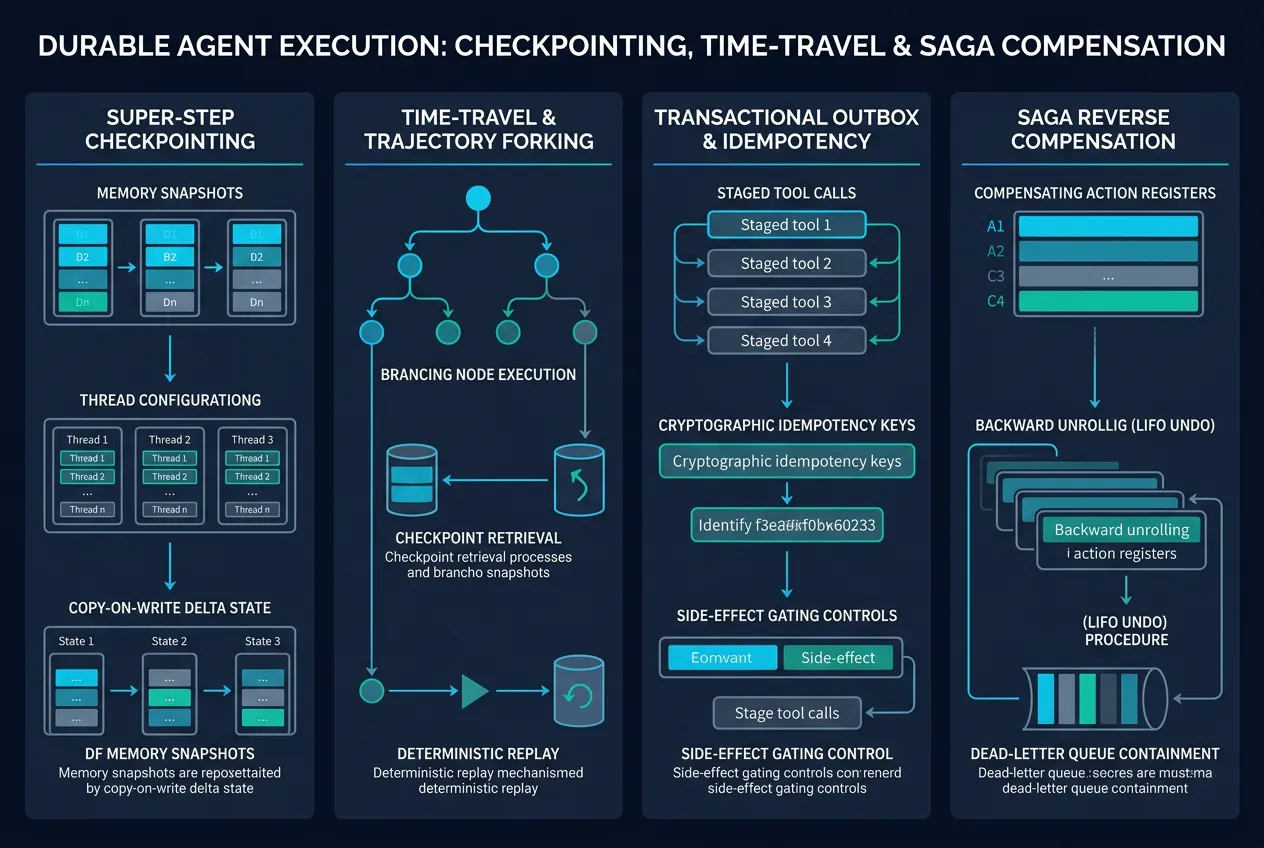
Why Is Restoring Agent Memory Insufficient for Production Rollback?
Restoring an autonomous agent's conversational memory or context window to a previous step only recovers internal runtime state—it does not roll back external reality. In single-turn prototypes, an error can be resolved simply by modifying the system prompt or truncating the message array. In distributed enterprise workflows, however, every autonomous agent step triggers real-world side effects: updating records in a CRM, provisioning cloud infrastructure, debiting payment balances, or dispatching webhooks to customer endpoints.
When an uncoordinated runtime encounters an exception at Step 5 and rolls back its internal message history to Step 3, the agent re-executes its reasoning trajectory under the assumption that Steps 4 and 5 never occurred. In reality:
- Duplicate Mutation: The agent re-invokes external tools without idempotency keys, re-issuing duplicate financial transactions, redundant ticket creations, or repeated customer emails.
- State Desynchronization: External data stores reflect mutations made during the aborted attempt, causing subsequent queries to return conflicting values that trigger severe agent hallucination or schema validation errors.
- Ghost Side Effects: Downstream microservices remain committed to workflows initiated by an agent execution that has been erased from the orchestrator's local memory ledger.
True fault tolerance requires treating autonomous agent trajectories not merely as conversational graphs, but as distributed, multi-party transactions.
How Does Super-Step Checkpointing Enable Deterministic Time Travel?
Modern graph-based agent runtimes enforce super-step execution boundaries. A super-step represents an atomic processing barrier: nodes (such as parallel subagents or reasoning chains) compute concurrently, emit state deltas, and synchronize at an immutable checkpoint before any subsequent step evaluates the next routing condition.
[Super-Step N] ──► Emit State Deltas ──► Synchronous Checkpointer ──► [Super-Step N+1]
                                                 │
                                                 ▼
                                     Copy-on-Write Delta Log
                                     (PostgreSQL / Redis WAL)
Durability Modes and Latency Bounds
Enterprise runtimes provide three distinct durability modes for state persistence:
| Durability Mode | Persistence Guarantees | Performance Overhead | Optimal Production Use Case |
|---|---|---|---|
| Sync Checkpointing | State delta durably flushed to persistent storage before next step | 10–18ms per super-step (overlapped with model scheduling) | Financial transactions, legal compliance workflows, and mutating API calls |
| Async Checkpointing | State delta queued to background I/O worker while execution proceeds | <2ms inline overhead; risk of step loss on hard worker crash | Read-heavy web retrieval, exploratory data analysis, and internal triage |
| Exit-Only Checkpointing | State saved strictly upon final task completion or uncaught exception | Zero intermediate I/O; no mid-trajectory recovery capability | Ephemeral diagnostic queries and single-turn automated classifications |
Recent benchmarks on agent execution runtimes indicate that copy-on-write filesystem snapshots and warm-template process forking achieve checkpoint persistence overheads of approximately 10.83ms per step—completely hidden under foundation model token generation latency—with mean state retrieval times under 2ms.
Trajectory Forking vs. In-Place Overwrite
When an engineer or automated supervisor intervenes to correct an agent's reasoning trajectory—often called "time travel"—the runtime must never overwrite historical state in place. Instead, the orchestrator retrieves the checkpoint at step_id: N, attaches a new branched thread_id or trajectory version vector, and spawns an alternate execution path. This guarantees an immutable audit trail for legal compliance and enterprise governance, ensuring that failed trajectories remain fully auditable while allowing active execution to branch toward resolution.
What Role Does the Transactional Outbox Play in Side-Effect Isolation?
To prevent premature mutations from escaping into third-party environments before a super-step is verified, enterprise architectures decouple tool decision-making from tool execution using the Transactional Outbox Pattern.
When an agent decides to invoke an external API:
- Staged Intent: The agent's tool call is not dispatched immediately over HTTP. Instead, an immutable record of the tool invocation is written directly into the local checkpoint payload within the same atomic database transaction.
- Pre-Execution Validation: Guardrails, policy engines, and human-in-the-loop approval gates evaluate the staged payload against organizational constraints and spending budgets.
- Outbox Dispatcher: Once the checkpoint transaction commits, an asynchronous worker reads the staged intent and dispatches the request to the external service.
- Cryptographic Idempotency: Every staged call carries an immutable
Idempotency-Keyderived fromhash(thread_id + step_id + tool_call_index + input_digest). If a worker crashes mid-call and replays the checkpoint, the downstream API recognizes the duplicate key and returns the cached response without re-executing the underlying mutation.
How Does Saga Reverse Compensation Clean Up Failed Agent Trajectories?
Because distributed cloud services and third-party SaaS applications do not support two-phase commit (2PC) or distributed ACID locking across organizational boundaries, agent runtimes must manage failure through the Saga Pattern.
A Saga models an agent trajectory as a sequence of forward actions paired with explicit backward compensating actions:
$S = {(A_1, C_1), (A_2, C_2), \dots, (A_n, C_n)}$
Where $A_k$ represents the forward mutating action, and $C_k$ represents its registered compensating operation (e.g., forward: create_user_account; compensating: deactivate_and_soft_delete_user).
Forward Trajectory:  [Action 1: Reserve] ──► [Action 2: Charge] ──► [Action 3: Provision (FAIL)]
                                                                                │
                                                                                ▼
Backward Saga Undo:  [Compensate 1: Unreserve] ◄── [Compensate 2: Refund] ◄─────┘
The Rules of Backward Compensation
- LIFO Execution Order: When an agent trajectory is aborted or rejected by a supervisor, the orchestrator halts forward execution and executes compensating actions in strict reverse order (Last-In, First-Out).
- Semantic Compensation: A compensating action does not restore exact historical bytes; it establishes semantic balance. A refunded credit card charge leaves a ledger trail rather than erasing the original transaction from existence.
- Guaranteed Eventual Completion: Compensating actions must be engineered to succeed unconditionally. If a compensating endpoint experiences a temporary outage, the Saga coordinator retries with exponential backoff and circuit-breaker isolation, ultimately escalating to a Dead-Letter Queue (DLQ) for human operator review.
- Forward Retry Gating: An agent is prohibited from resuming forward execution or branching to a new trajectory until the compensation cascade for the failed branch has successfully verified clean-up.
Architectural Checklist for Resilient Production Agents
Before moving an autonomous multi-step agent workflow from staging into production, platform teams must audit five core durability capabilities:
- [ ] Synchronous Super-Step Gating: Every mutating agent action is preceded by a verified checkpoint flush to persistent, multi-region storage.
- [ ] Deterministic Replay Isolation: Replaying a past checkpoint re-uses cached tool outputs for completed steps, invoking foundation models only for unexecuted branches.
- [ ] Universal Idempotency Enforcement: All tool integrations inject deterministic cryptographic idempotency keys across every outbound HTTP request.
- [ ] Two-Way Tool Contracts: Every tool definition exports both an execution endpoint and an explicit compensation endpoint with standardized parameter mappings.
- [ ] Dual-Principal Audit Trails: Checkpoint logs record both the runtime agent identifier and the delegating human user token under RFC 8693 token exchange standards.
By combining granular super-step checkpointing with transactional outbox staging and Saga compensation, enterprise engineering teams can build autonomous systems that recover gracefully from unexpected edge cases without stranding corrupted state across the corporate ecosystem.
How does checkpointing differ from standard database backups?
Database backups snapshot underlying data tables at scheduled intervals, whereas agent checkpointing captures the complete in-flight cognitive state of an execution graph—including message buffers, intermediate tool observations, routing decisions, and pending asynchronous tasks—at every single execution barrier.
Can an agent roll back an email or external communication?
No. External communications cannot be erased once sent. Instead, the Saga coordinator executes a semantic compensation by dispatching a follow-up retraction, error notice, or human supervisor notification explaining that the prior transmission has been superseded.
Does time-travel replay result in identical model outputs?
Foundation models are inherently stochastic even at low temperatures. While replaying from a checkpoint re-evaluates prompts from that exact historical state, the newly generated tokens may diverge. Enterprise systems manage this by caching prior deterministic outputs and using constrained grammar decoders for critical structural transitions.