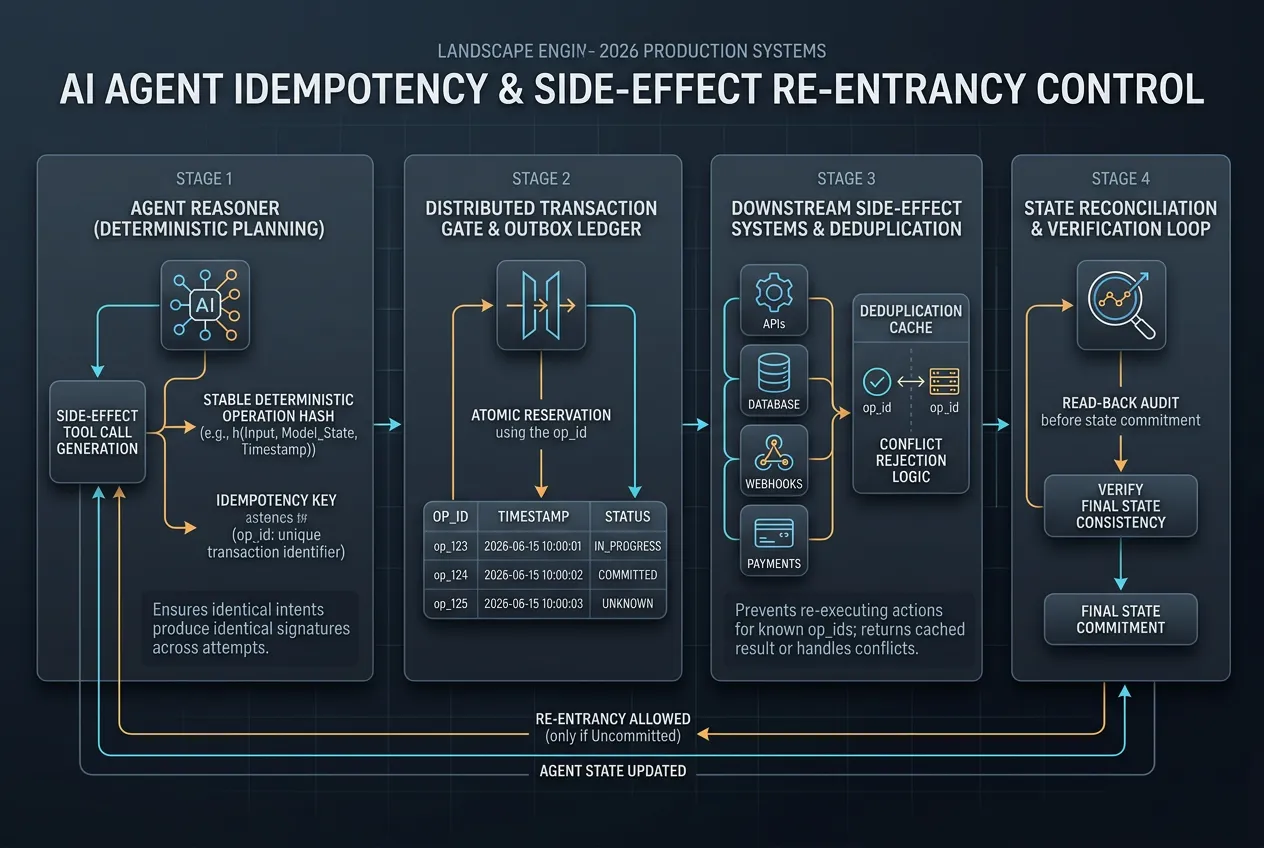
An agent idempotency architecture prevents duplicate external mutations when autonomous AI agents retry operations, experience network timeouts, or resume from interrupted execution flows. In 2026 production AI systems, raw LLM retry loops without deterministic transaction keys represent one of the primary drivers of corrupted state, double billing, duplicate external dispatches, and unrecoverable downstream side effects.
Why Do Production AI Agents Cause Duplicate Side Effects?
When software engineers transition from conversational chat interfaces to autonomous agentic workflows, traditional network assumptions immediately break down. In deterministic microservices, retry semantics are well-understood. In multi-turn LLM reasoning loops, however, model stochasticity compounds distributed network failures.
When an AI agent executes a tool call that triggers an external side effect—such as charging a credit card, sending an email, creating a database record, or modifying a cloud file—three distinct points of failure frequently occur:
- Downstream Execution Without Upstream Acknowledgement: The destination service successfully commits the write, but an intermediate gateway or network socket times out before returning an HTTP 200 response to the agent harness.
- Context Window Re-evaluation & Stuttering: The agent perceives the timeout as an execution failure, re-evaluates its reasoning trace, and generates a second tool call with slightly rephrased arguments to achieve the same underlying objective.
- Crash Recovery & Sagas Replay: As demonstrated in Durable Agentic Execution: Engineering Crash-Resilient AI Workflows with Replay and Saga Recovery, orchestrators that restore agent state from event journals risk blindly re-executing non-idempotent side effects during worker rehydration.
Empirical evaluation from distributed systems research indicates that unguarded agent tool execution environments experience duplicate side-effect rates during synthetic network fault injection benchmarks. By enforcing deterministic idempotency keys and server-side deduplication, those failure rates drop significantly.
How Should Idempotency Keys Be Generated for Autonomous Agents?
A fatal architectural flaw in early agentic systems was delegating idempotency key generation to the language model itself. Prompts asking an LLM to "invent a unique transaction ID" produce non-deterministic keys across re-evaluations, completely defeating server-side deduplication.
In a resilient agent idempotency architecture, the execution harness—not the model—is solely responsible for generating, persisting, and enforcing idempotency keys.
The Canonical Operation Hash
Production harnesses construct deterministic idempotency keys by computing a cryptographically secure hash across five immutable operational dimensions:
$\text{IdempotencyKey} = \text{HMAC-SHA256}\Big(K_{\text{tenant}}, \text{WorkflowID} \parallel \text{StepIndex} \parallel \text{TargetAction} \parallel \text{CanonicalArguments}\Big)$
Where:
- WorkflowID / RunID: The persistent identifier of the top-level agent execution session.
- StepIndex: The logical topological step in the plan or DAG, ensuring identical actions at different workflow phases maintain distinct identities.
- TargetAction: The exact tool slug being invoked (e.g.,
send_payment,create_record). - CanonicalArguments: Normalized JSON where object keys are sorted lexicographically, whitespace is stripped, and type coercions are standardized.
When the agent attempts to retry an operation following a transient timeout, the harness intercepts the tool dispatch, recognizes the identical operation hash, and attaches the existing key rather than minting a new one.
What Is the "Unknown Outcome" Dilemma in Agentic Execution?
The most dangerous state in distributed agent architecture is neither success nor failure; it is unknown status.
When an HTTP call to a partner API or internal database times out, the agent runtime cannot assume the mutation failed. If the harness immediately executes a compensating transaction or initiates an alternate tool path, it risks introducing catastrophic race conditions.
+-----------------------------------------------------------------------------+
|                      AGENT IDEMPOTENCY EXECUTION LIFECYCLE                  |
+-----------------------------------------------------------------------------+
|                                                                             |
|  [Agent Reasoner]                                                           |
|         │                                                                   |
|         ▼ (Dispatch Tool Call)                                              |
|  [Harness Deterministic Hash Engine] ───► Generates stable Op_ID            |
|         │                                                                   |
|         ▼ (Atomic Outbox Reservation)                                       |
|  [Durable Transaction Ledger] ──────────► State: IN_PROGRESS                |
|         │                                                                   |
|         ▼ (Execute Network Call)                                            |
|  [External Side-Effect Service]                                             |
|         │                                                                   |
|         ├───► (Success HTTP 200) ───────► Ledger: COMMITTED                 |
|         │                                                                   |
|         ├───► (Deterministic 4xx Error) ─► Ledger: REJECTED                 |
|         │                                                                   |
|         └───► (Timeout / Socket Drop) ──► Ledger: UNKNOWN                   |
|                                                  │                          |
|                                                  ▼                          |
|                                       [Reconciliation Probe]                |
|                                                  │                          |
|                                 ┌────────────────┴────────────────┐         |
|                                 ▼                                 ▼         |
|                       (Status Confirmed Live)           (Effect Not Found)  |
|                       Mark COMMITTED & Return           Safe Re-dispatch    |
|                                                                             |
+-----------------------------------------------------------------------------+
The Three Operational Rules for Unknown States
- Atomic Outbox Logging Before Dispatch: The agent harness must write an
IN_PROGRESSreservation to local persistent storage before opening the network socket to the downstream tool. - Reconciliation Over Blind Retries: If a timeout occurs, the agent's next tool execution must not be a repeat write. It must be an explicit status probe or read-back query using the idempotency key to determine whether the remote resource was created.
- Parameter Mismatch Rejection: If an agent replays an existing idempotency key with modified arguments (due to prompt drift or hallucinated parameter shifts), the downstream tool service must immediately abort with an explicit conflict error (HTTP 409 or
IDEMPOTENCY_ARGUMENT_MISMATCH), preventing accidental mutations.
As established in our analysis of Agent Tool Contracts: Valid JSON Is Not Verified Work, schema validation is merely step zero. True operational reliability requires verifying the physical state transition in the system of record.
How Does Re-Entrancy Threaten Multi-Agent Coordination?
In complex agent environments featuring subagent delegation, shared memory graphs, and parallel tool calling, systems face classic distributed re-entrancy challenges.
When multiple subagents operate concurrently against the same enterprise assets—such as a shared CRM contact, a legal case file, or a financial ledger—unserialized concurrent tool execution leads to lost updates and state corruption.
Defensive Re-Entrancy Controls
- Distributed Leases & Optimistic Concurrency: Shared entity records must carry version counters or cryptographic ETags. An agent mutating an object must provide the expected revision number; if a concurrent subagent updated the record in the interim, the write is refused, prompting an explicit merge or re-read.
- Isolated Write Sandboxes: As detailed in Agent Sandbox Isolation and Least Privilege Execution in 2026, write operations should be staged in isolated staging sandboxes and committed to production data stores only upon end-of-turn verification.
- Model Context Protocol (MCP) Constraints: While modern integration standards such as MCP provide schema annotations like
idempotentHint, production architects must treat client-side hints as non-binding documentation. Exactly-once semantics cannot be achieved at the transport layer alone; they require transactional coordination across both the harness and the target database.
Technical Comparison: Idempotency Patterns for Production Agents
The following matrix compares common engineering approaches for managing side-effect integrity in AI agent architectures:
| Architecture Pattern | Mechanism | Resilience to Timeout | Concurrency Protection | Operational Overhead |
|---|---|---|---|---|
| Naive LLM Retry | Prompt instructions asking model to retry on failure | Fails under network drops | None | Zero |
| Two-Phase Commit (2PC) | Distributed prepare/commit coordinator | High (Atomic across participants) | Strong | Very High (Incompatible with 3rd-party SaaS/Webhooks) |
| Harness-Bound Idempotency Keys | Deterministic HMAC argument hashing & server deduplication | High (Prevents duplicate mutations) | Moderate (Requires backend key cache) | Low |
| Transactional Outbox + Reconciliation | Atomic local reservation with read-back verification | Maximum (Eliminates zombie writes & drift) | High (Guarantees at-most-once committed effect) | Moderate |
Enterprise Recommendations for Agent Engineering Teams
Engineering teams deploying production AI agents in mission-critical environments should enforce four non-negotiable architectural guardrails:
- Mandate Idempotency Keys on All Mutating Endpoints: Never expose bare
POSTorPUTendpoints to an agent without requiring anIdempotency-Keyorop_idheader. - Implement Two-Way Replay Storage: Store both the input payload and the exact response body associated with each idempotency key for at least 24 to 72 hours. Replays with identical keys should instantly return the cached response without re-triggering business logic.
- Classify Tool Outcome Tri-States: Replace binary
success/failuretool return schemas with explicit tri-state responses:CONFIRMED,REJECTED, andUNKNOWN. Train agent system prompts and fine-tuned control layers to trigger state verification workflows wheneverUNKNOWNis encountered. - Audit Agent Trajectory Drift: Regularly evaluate multi-turn tool trajectories against benchmark suites to detect whether prompt updates introduce hidden parameter oscillation during retry loops, cross-referencing insights from Production AI Agent Evaluation: Canaries, Shadow Gates, and Continuous Regression Harnesses in 2026.
What is an agent idempotency architecture?
An agent idempotency architecture is a distributed software design pattern that ensures external side-effecting operations (such as payments, database updates, or emails) are executed at most once, even when an autonomous AI agent encounters network timeouts, re-evaluates its reasoning loop, or replays execution logs after a system crash.
Why can't the language model generate its own idempotency keys?
Language models are inherently non-deterministic. When an agent experiences a transient timeout and re-evaluates its reasoning trace, it frequently generates a new UUID or alters parameters, which bypasses downstream deduplication caches and triggers duplicate real-world transactions.
How does this differ from standard distributed systems idempotency?
Standard distributed systems idempotency handles network drops between static microservices. Agent idempotency must additionally defend against "semantic re-try drift"—where an LLM perceives an unacknowledged timeout as an intellectual problem, rewrites its prompt context, alters function arguments, and hallucinates alternative tools that circumvent conventional API deduplication.