Proposed Federal Rule of Evidence 707 establishes a comprehensive judicial reliability framework for machine-generated and artificial intelligence evidence offered in federal court without a sponsoring expert witness. By extending Rule 702's Daubert gatekeeping criteria directly to autonomous algorithmic outputs, the Advisory Committee on Evidence Rules bridges the critical gap between superficial process authentication under Rule 901(b)(9) and rigorous evidentiary reliability.
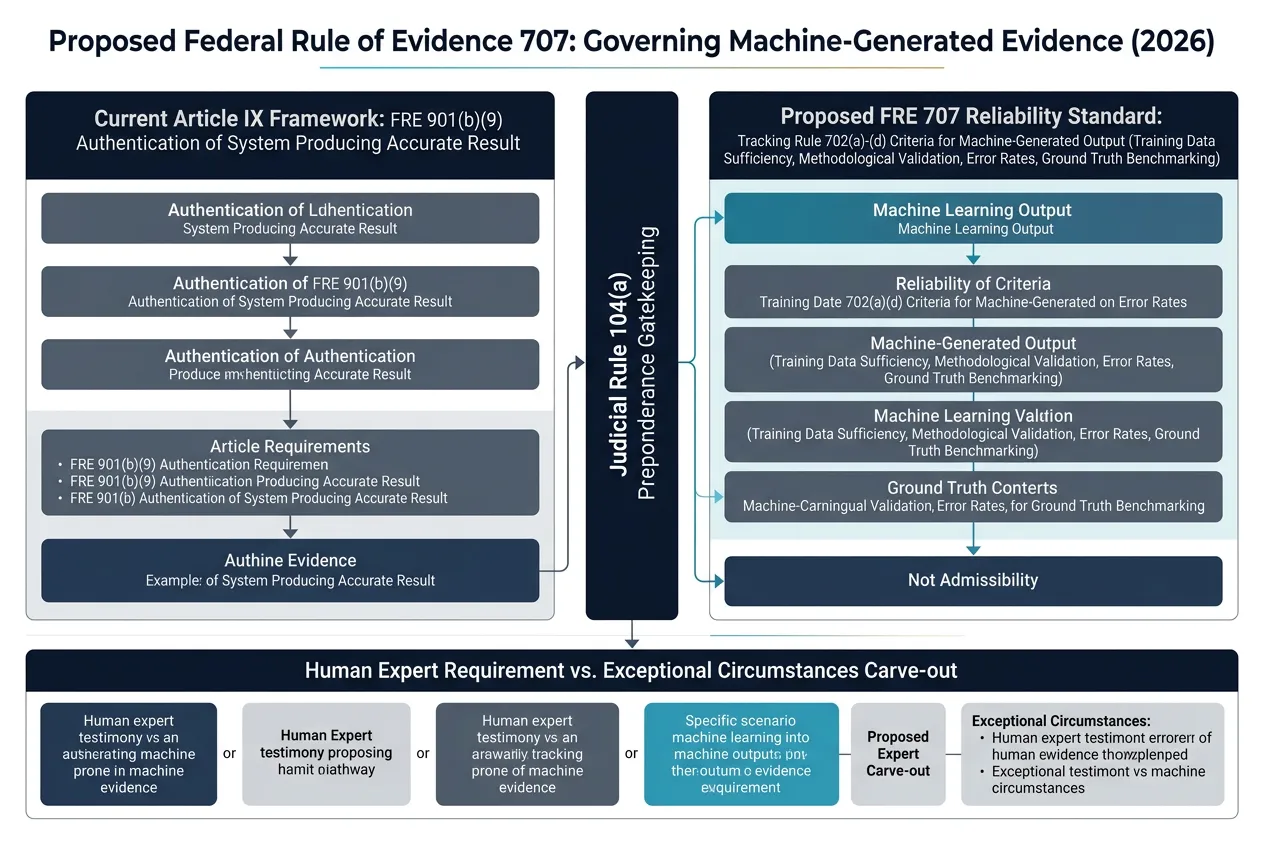
In modern federal litigation, artificial intelligence and autonomous software systems generate critical substantive evidence—ranging from automated eDiscovery categorization and algorithmic forensic reconstructions to autonomous agent execution logs and generative predictive models. However, federal courts confronting machine-generated output have struggled with a structural statutory dilemma: Federal Rule of Evidence 801(b) excludes machine outputs from hearsay scrutiny because computers are not natural persons, while Rule 901(b)(9) requires only prima facie authentication showing that a technical system produces an accurate result.
Without an evidence rule specifically addressing algorithmic outputs, litigants could introduce highly persuasive, probabilistic machine inferences by satisfying minimal authentication hurdles, entirely bypassing the rigorous reliability scrutiny required for human expert witnesses under Rule 702. To resolve this imbalance, the Advisory Committee on Evidence Rules drafted Proposed Federal Rule of Evidence 707.
Why Did the Advisory Committee Draft Proposed Federal Rule of Evidence 707?
The Advisory Committee on Evidence Rules initiated rulemaking on machine-generated evidence to address the increasing sophistication and opacity of complex algorithms, deep learning neural networks, and generative AI systems entering federal courtrooms. Under current federal evidence doctrine, evidence falls into two primary categories: factual exhibits authenticated under Article IX or expert opinion testimony evaluated under Article VII.
When automated technical systems produce substantive factual conclusions—such as facial recognition matches, proprietary fraud scores, predictive recidivism indicators, or autonomous agent decision logs—proponents frequently seek admission as ordinary business records under Rule 803(6) paired with Rule 901(b)(9) process authentication. This mechanism allows complex machine inferences to reach jurors without satisfying the judicial gatekeeping protections established in Daubert v. Merrell Dow Pharmaceuticals, Inc. and codified in Rule 702.
Proposed Rule 707 addresses this vulnerability by ensuring that machine-generated factual output offered for its truth is subjected to reliability scrutiny comparable to human expert testimony, preventing litigants from laundering unvalidated algorithmic claims through standard business record exceptions.
How Does Proposed Rule 707 Structure Evidentiary Reliability?
Proposed Federal Rule of Evidence 707 directly tracks the four substantive reliability prongs of Federal Rule of Evidence 702(a)–(d), adapting them to automated and algorithmic technical systems:
- Sufficient Facts and Training Data: The algorithmic system must be based on sufficient, representative, and verified training or input data. In machine learning contexts, this requires demonstrating that data pipelines are devoid of systemic bias, temporal contamination, and uncurated noise.
- Reliable Principles and Methods: The underlying computational architecture, statistical modeling, or machine learning methodology must represent an objective, scientifically valid principle capable of empirical testing and independent peer review.
- Consistently Accurate and Reliable Execution: The proponent must establish that the machine learning model or software system reliably and consistently produces accurate results within acceptable, measured error margins.
- Reliable Application to Case Facts: The software system must be reliably applied to the specific facts, parameters, and operational constraints of the matter at issue.
Importantly, Proposed Rule 707 expressly distinguishes complex, non-deterministic artificial intelligence models from simple, basic scientific instruments. Standard mechanical and electronic recording tools—such as digital thermometers, radar speed detectors, and standard photographic sensors—are excluded from heightened Rule 707 scrutiny, preserving established, streamlined authentication pathways for routine instrumentation.
What Is the Role of Sponsoring Expert Witnesses Under Proposed Rule 707?
A central pillar of Proposed Rule 707's procedural architecture is the presumption of human expert sponsorship. Under the Committee's refined framework, machine-generated evidence that asserts a material fact or substantive inference must ordinarily be introduced through a qualified human expert witness under Rule 702.
The sponsoring expert must be competent to testify regarding:
- The provenance and integrity of the model's training data.
- The mathematical or architectural validity of the algorithm.
- Model validation protocols, benchmark ground truth evaluations, and known error rates.
- The exact prompt constraints, hyperparameters, and contextual data fed into the system during the case-specific execution.
The rule incorporates a narrow "exceptional circumstances" exception. A federal court may admit machine-generated evidence without a sponsoring expert witness only where the proponent establishes by clear and convincing evidence that the automated process is universally recognized as reliable, transparent, and self-verifying, and where cross-examination of an expert witness would provide no meaningful adversarial value.
How Does Proposed Rule 707 Interact with Rule 104(a) Judicial Gatekeeping?
Consistent with the December 2023 clarifying amendments to Federal Rule of Evidence 702, Proposed Rule 707 enforces a strict judicial gatekeeping standard under Rule 104(a). Admissibility of machine-generated output is a preliminary legal question for the trial judge, not a weight-of-the-evidence question left to the jury.
Under Rule 104(a), the proponent bears the affirmative burden of proving each reliability element by a preponderance of the evidence. Jurors are not permitted to evaluate whether an unverified artificial intelligence system is technically reliable; if the proponent fails to persuade the court that the algorithmic method satisfies Rule 707's threshold criteria, the evidence must be excluded in its entirety.
This gatekeeping firewall prevents the risk of "automation bias," wherein juries afford outsized deference to complex computer-generated outputs simply because they appear objective and mathematically precise.
What Is the Current Rulemaking Status of Proposed Rule 707?
As of 2026, Proposed Federal Rule of Evidence 707 has not yet been formally adopted by the Supreme Court of the United States or enacted into law. Following its initial publication for public comment in 2025, the Advisory Committee on Evidence Rules received comprehensive commentary from leading legal and scientific organizations, including the Association for Computing Machinery (ACM), the Center for Democracy & Technology (CDT), and the American Association for Justice (AAJ).
While public commentators strongly supported the Committee's objective of preventing unreliable algorithmic evidence from entering federal trials, they raised significant practical questions regarding:
- Defining the precise statutory boundary between "artificial intelligence" and conventional deterministic software.
- The operational burdens of mandatory pre-trial disclosure and notice requirements.
- The interaction between Rule 707 and trade secret protections asserted by proprietary AI vendors over training datasets and weights.
At its May 2026 meeting, the Advisory Committee elected to defer immediate recommendation to the Standing Committee on Rules of Practice and Procedure, engaging in focused revisions and empirical research alongside the Federal Judicial Center. Despite this procedural pause, federal district courts and circuit panels are increasingly adopting Proposed Rule 707's analytical framework as persuasive authority when applying existing Rules 403, 702, and 901(b)(9) to evaluate AI evidence.
What Strategic Steps Should Federal Litigators Take Today?
While formal codification proceeds through the federal rulemaking cycle, litigators introducing or opposing algorithmic evidence in federal proceedings should align their pre-trial strategy with Proposed Rule 707's criteria:
- Conduct Early Machine Discovery: Demand disclosure of training data sources, model architectures, validation test suites, and hyperparameter logs during initial Rule 26 discovery conferences.
- Retain Qualified Technical Experts Early: Ensure that any party offering complex algorithmic output engages a qualified expert witness prepared to satisfy Rule 702 gatekeeping, rather than relying on business records custodians under Rule 803(6).
- Challenge Autonomous Output via Rule 104(a): When opposing machine-generated evidence, file targeted pre-trial motions in limine asserting that superficial Rule 901(b)(9) authentication cannot substitute for rigorous methodological reliability.
- Maintain Immutable Telemetry and Validation Records: For corporate and legal clients deploying generative AI in production environments, implement tamper-evident telemetry logs and ground-truth validation records to withstand aggressive pre-filing evidentiary challenges.
Related Insights and Federal Evidence Analyses
- Federal Rule of Evidence 801: AI Evidence and the Declarant Doctrine in 2026
- Federal Rule of Evidence 902(13): AI Evidence Self-Authentication in 2026
- Federal Rule of Evidence 104: Preliminary Questions and Relevance Standards in 2026
- Expert Witness AI Prompts: The FRCP 26 Federal Court Split in 2026
Frequently Asked Questions
What is Proposed Federal Rule of Evidence 707?
Proposed Federal Rule of Evidence 707 is an evidentiary rule drafted by the Judicial Conference Advisory Committee on Evidence Rules governing the admissibility of machine-generated and artificial intelligence evidence. It requires that algorithmic outputs offered without an expert witness satisfy the reliability criteria of Rule 702(a)–(d).
Does Proposed Rule 707 apply to ordinary scientific instruments?
No. Proposed Rule 707 explicitly excludes simple, basic scientific instruments—such as digital thermometers, radar devices, and conventional optical cameras—from its heightened reliability requirements, preserving routine Article IX authentication pathways.
Why doesn't Federal Rule of Evidence 801 exclude AI output as hearsay?
Under Federal Rule of Evidence 801(b), a "declarant" is strictly defined as a natural person. Because artificial intelligence models, automated software, and algorithmic pipelines are machines rather than human beings, their autonomous outputs cannot legally constitute hearsay statements under federal law.
What must an expert witness establish to admit AI evidence under Rule 707?
A sponsoring expert witness must demonstrate by a preponderance of the evidence that the model's training data was sufficient and representative, that the computational principles are scientifically valid, that the system consistently generates accurate results within measured error rates, and that the algorithm was reliably applied to the case facts.
Has Proposed Rule 707 been officially enacted in federal courts?
Not yet. As of late 2026, Proposed Rule 707 remains under active revision by the Advisory Committee on Evidence Rules. However, federal trial judges frequently consult its draft framework as persuasive authority when adjudicating AI evidentiary challenges under Rules 403, 702, and 901(b)(9).