Are an expert witness’s generative AI prompts protected work product under Rule 26, or are they discoverable facts, data, and methodology? Under emerging 2026 federal case law, there is an active judicial split: where an expert deploys generative AI as an analytical methodology to cull, filter, or process record evidence, courts treat those prompts and queries as discoverable under Federal Rule of Civil Procedure 26(a)(2)(B); conversely, where prompts reflect preliminary ideation, outlining, or drafting iterations, courts shield them under Rule 26(b)(4)(B) and Rule 26(b)(3).
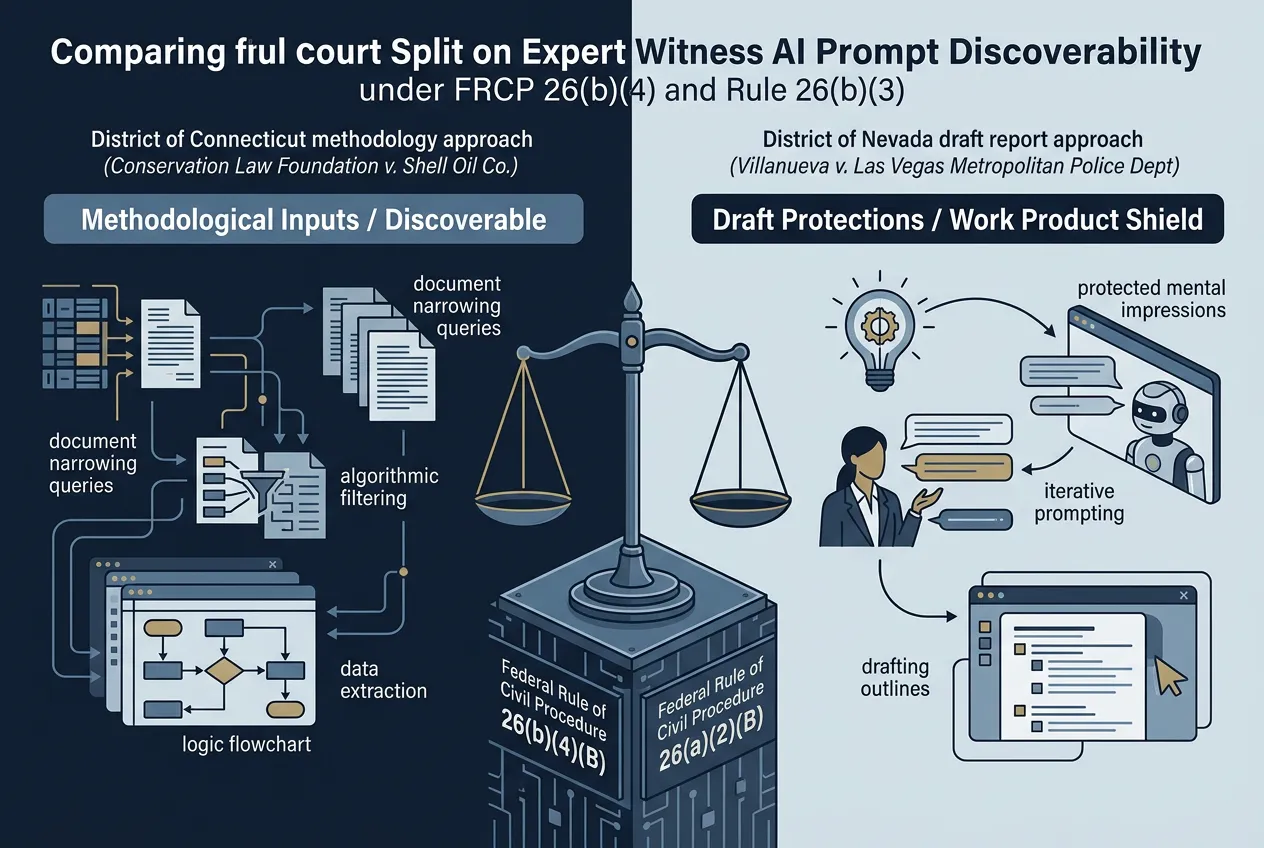
The explosive adoption of commercial and local large language models (LLMs) across technical, economic, and forensic consulting has transformed the mechanics of expert witness preparation. Rather than manually indexing thousands of pages, expert teams routinely employ LLMs to synthesize production sets, test damage models, generate exploratory case summaries, and draft expert reports. However, because modern litigation turns on rigorous adversarial testing of an expert’s foundational methodology under Federal Rule of Evidence 702 and Daubert v. Merrell Dow Pharmaceuticals, litigators face an urgent threshold question: where does protected draft work product end, and discoverable expert methodology begin?
How Does Federal Rule of Civil Procedure 26 Apply to AI Prompts?
To understand the emerging judicial rift, litigators must view generative AI workflows through the statutory text of Federal Rule of Civil Procedure 26:
- FRCP 26(a)(2)(B)(ii) — "Facts or Data Considered": Retained expert witnesses must disclose a written report containing "the facts or data considered by the witness in forming them." Advisory Committee notes establish that "considered" is interpreted expansively: anything viewed, reviewed, or taken into account by the expert—even if ultimately rejected—is subject to mandatory disclosure. When an expert uploads document productions or prompt queries into an AI workspace, opposing counsel argues that the resulting summaries or outputs constitute "facts or data considered."
- FRCP 26(a)(2)(B)(i) — "Complete Statement of All Opinions and Basis": An expert must provide a complete accounting of the basis and reasons for their conclusions. If an expert uses an LLM to cull 50,000 internal emails down to 200 key exhibits, the prompts that executed that culling represent the operative search and selection methodology.
- FRCP 26(b)(4)(B) — Work Product Shield for Draft Reports: Enacted in the landmark 2010 amendments, Rule 26(b)(4)(B) explicitly protects "drafts of any report or disclosure required under Rule 26(a)(2), regardless of the form in which the draft is recorded." Proponents of AI confidentiality argue that interactive prompt conversations with an LLM represent modern, digital drafts and scratchpads.
- FRCP 26(b)(4)(C) — Attorney-Expert Communications: Communications between trial counsel and an expert witness are protected, subject to three narrow exceptions: compensation, facts or data provided by counsel, and assumptions provided by counsel. When counsel assists an expert in refining an AI prompt sequence, does the prompt exchange trigger the Rule 26(b)(4)(C) work product shield?
Understanding how courts reconcile these competing provisions requires examining the two leading federal decisions of 2026.
What Did the District of Connecticut Hold in Conservation Law Foundation v. Shell Oil Co.?
The leading authority ordering the compelled production of expert AI prompts arose in the environmental litigation Conservation Law Foundation, Inc. v. Shell Oil Co., No. 3:21-cv-00933 (D. Conn. May 18, 2026) (ECF No. 970).
In Shell Oil, plaintiff's expert Dr. Naomi Oreskes and her research team utilized generative AI software to search, review, and narrow Shell’s voluminous document production. Opposing counsel moved to compel discovery of the specific prompts, search strings, system queries, and AI outputs generated during that document-culling process.
U.S. Magistrate Judge Thomas O. Farrish granted Shell’s motion in significant part:
- Prompts as Methodological Machinery: Magistrate Judge Farrish ruled that when an expert relies on generative AI to filter and extract relevant evidentiary documents, the prompts and queries are not merely incidental drafting notes; they constitute the expert’s core investigative methodology under Rule 26(a)(2)(B).
- The "Black Box" Cross-Examination Rationale: The court observed that opposing counsel cannot effectively cross-examine an expert or test methodological reliability under FRE 702 without knowing the exact parameters, semantic framing, and systemic exclusions embedded in the expert's AI instructions. If an expert instructs an LLM to "ignore non-substantive corporate policies" or focuses solely on specific keywords, that constraint dictates what facts the expert actually considered.
- Procedural Posture: The plaintiff filed a timely objection under FRCP 72(a), arguing that compelling prompt histories intrudes into core opinion work product. U.S. District Judge Vernon D. Oliver entered an order staying ECF No. 970 on June 3, 2026, pending review of the magistrate judge's order. While stayed pending final district court resolution, Magistrate Judge Farrish’s reasoning has established the foundational framework for treating AI prompts as discoverable methodology across federal litigation.
How Did the District of Nevada Distinguish AI Drafts in Villanueva v. LVMPD?
Four months after Shell Oil, the U.S. District Court for the District of Nevada established a contrary, protective doctrine in Villanueva v. Las Vegas Metropolitan Police Department, No. 2:24-cv-00125 (D. Nev. Sept. 29, 2026) (ECF No. 112).
In Villanueva, a section 1983 civil rights action, plaintiff’s police practices expert utilized a commercial LLM (ChatGPT) to organize witness testimony, summarize deposition transcripts, brainstorm lines of inquiry, and draft sections of his Rule 26 expert report. The defense sought full forensic production of the expert’s entire generative AI session history, including every iterative prompt, refinement prompt, and generated draft.
The District Court drew a decisive conceptual line between methodological factual inputs and protected drafting iterations:
- Outputs Supplying Factual Content Are Discoverable: To the extent the expert relied on AI-generated factual summaries as the factual basis for his opinions, those substantive summary outputs had to be disclosed as "facts or data considered" under Rule 26(a)(2)(B)(ii).
- Prompts and Iterative Brainstorming Are Protected: The court denied the motion to compel the expert's raw prompt logs, preliminary questions, and drafting prompts. The court held that conversational prompting with an AI assistant to refine text, structure an outline, or test rhetoric falls squarely within Rule 26(b)(4)(B)’s categorical protection for draft reports "regardless of the form in which the draft is recorded."
- Core Mental Impressions Protected Under Rule 26(b)(3): The Villanueva court emphasized that an expert’s stream-of-consciousness prompting reveals their inner thought processes, mental impressions, and preliminary doubts. Forcing an expert to surrender their prompt history would penalize modern drafting methods and eviscerate the core rationale of the 2010 Rule 26 amendments.
The 2026 Federal Framework: Discoverable Methodology vs. Protected Drafting
The emerging judicial consensus synthesizes Shell Oil and Villanueva into a practical functional-use continuum. Whether a court compels production of an expert’s AI prompts depends not on the software brand, but on the functional role the prompt played in the analysis:
| Functional AI Role | Practical Workflow Example | FRCP Classification | Judicial Discoverability Status |
|---|---|---|---|
| Evidence Culling & Filtering | Directing an LLM to filter 100,000 emails for responsive liability terms | Investigative Methodology (Rule 26(a)(2)(B)(i)) | High Risk / Discoverable: Essential to test reliability under FRE 702 (Shell Oil). |
| Data Extraction & Structuring | Prompting an AI tool to extract quantitative transaction figures into tables | Facts or Data Considered (Rule 26(a)(2)(B)(ii)) | Discoverable: Raw inputs and extracted data must be produced for independent audit. |
| Iterative Drafting & Rephrasing | Asking an AI to "make this paragraph more concise" or "improve readability" | Draft Report (Rule 26(b)(4)(B)) | Protected: Shields drafting iterations regardless of digital form (Villanueva). |
| Legal/Strategic Brainstorming | Prompting an AI model to identify potential counter-arguments or critique a thesis | Opinion Work Product (Rule 26(b)(3)) | Protected: Disclosing prompts reveals mental impressions and trial strategy. |
What Protocols Should Trial Teams Implement to Protect Expert AI Workflows?
Until the Advisory Committee on Civil Rules addresses generative AI prompts directly, litigation counsel must proactively govern how retained experts utilize AI tools. Retained experts should adopt a four-point compliance protocol:
1. Establish Strict Workspace Separation
Experts must never mix evidence-processing workflows with report-drafting workflows in the same AI session or tool context. When processing, searching, or indexing discovery productions, maintain an auditable log of queries, models, and prompts, anticipating that a court may compel disclosure as part of the expert’s methodology. Conversely, report drafting and editorial polish should occur in segregated workspaces that clearly reflect draft preparation under Rule 26(b)(4)(B).
2. Guard Against Third-Party Waiver and Zero Data Retention
As demonstrated in United States v. Heppner, No. 25-cr-00503 (S.D.N.Y. Feb. 17, 2026), using consumer-grade AI platforms where user data is retained for model training can waive work-product protections and confidentiality. Expert retainers must mandate enterprise-tier agreements with strict Zero Data Retention (ZDR) guarantees and explicit non-disclosure contractual protections.
3. Verify Every Factual Citation at the Primary Source
Under Model Rule 1.1, Model Rule 3.3, and emerging statewide disclosure rules like Connecticut Practice Book Sec. 4-9 and New York 22 NYCRR Part 161, an expert cannot rely on an LLM's unverified citations. If an expert adopts a hallucinated statistic or non-existent case summary generated by an AI tool, opposing counsel can independently compel the underlying prompt logs under Rule 37 to prove methodological unreliability.
4. Negotiate Generative AI Discovery Protocols at the Rule 26(f) Conference
Litigators should not leave AI prompt discoverability to chance. During early Rule 26(f) discovery conferences and in Rule 16 scheduling orders, parties should explicitly negotiate whether expert AI prompt histories are discoverable, agreeing on reciprocal carve-outs that treat AI drafting prompts as non-discoverable draft reports while preserving access to data-processing methodologies.
For broader analysis of court disclosure mandates and judicial evidentiary thresholds, explore our companion reviews on Statewide AI Court Rules and Federal Court AI Standing Orders.
Frequently Asked Questions
Are an expert’s ChatGPT or Claude prompts automatically discoverable in federal court?
No. Federal courts do not treat AI prompts as categorically discoverable or categorically privileged. Under the 2026 federal split, discoverability depends on functional use: prompts used to cull, filter, or process evidence are vulnerable to disclosure as expert methodology (Shell Oil), whereas prompts used to refine drafts, brainstorm, or edit text are protected under Rule 26(b)(4)(B) (Villanueva).
Does sharing attorney work product with an expert’s AI model waive privilege?
Yes, potentially. If an expert inputs privileged attorney work product into a public or consumer AI model whose terms of service permit vendor data training, employee review, or third-party disclosure, courts have held that confidentiality is destroyed (United States v. Heppner). Litigators must ensure experts use enterprise-grade AI environments with Zero Data Retention (ZDR) policies.
Can opposing counsel depose an expert witness about their prompt engineering?
Yes. Under FRCP 26(b)(4)(A), opposing counsel is entitled to depose any designated expert regarding the basis of their opinions. If the expert disclosed that AI was used to conduct literature searches or document reviews, counsel may examine what instructions, constraints, and criteria the expert fed into the model to assess potential bias or hallucination.