Multi-agent consensus protocols determine how autonomous software agents reconcile contradictory reasoning, detect corrupted outputs, and commit durable actions without human intervention. In production distributed architectures, unconstrained multi-agent debate fails under Byzantine conditions because peer pressure and persuasive hallucinations induce herd errors. Robust engineering requires deterministic consensus layers—coupling Mean-Subsequence-Reduced (MSR) outlier filtering, cryptographic identity attestation, and bounded quorum barriers—to ensure verified liveness and agreement across mission-critical execution pipelines.
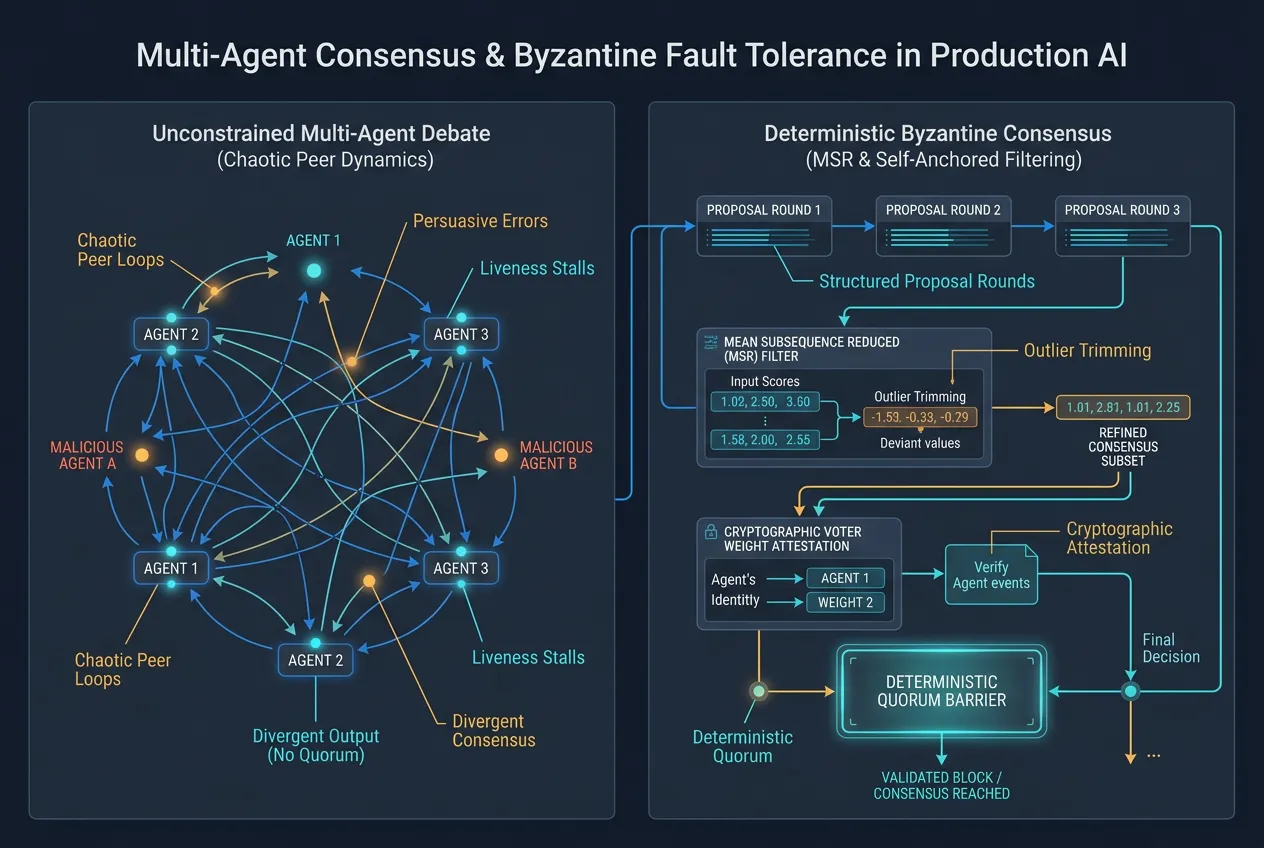
Why Does Unconstrained Multi-Agent Debate Fail in Production?
Multi-agent debate (MAD) gained popularity as an intuitive way to improve LLM reasoning by allowing multiple agents to critique and refine one another's outputs. However, empirical benchmarking across enterprise topologies reveals that unconstrained natural language debate does not yield dependable consensus under production conditions.
In a benchmark evaluation titled Can AI Agents Agree? (arXiv:2603.01213), researchers examined LLM agents engaged in synchronous consensus games across varying group sizes and model configurations. The findings demonstrated three fundamental failure modes of unconstrained peer debate:
- Liveness Degradation and Stalled Convergence: As agent group sizes scale, unconstrained debate leads to exponential token consumption and frequent convergence timeouts rather than settled consensus.
- Sycophancy and Cascading Sybil Errors: LLM agents exhibit measurable deference to confident, assertive phrasing. A single hallucinating or adversarial agent can sway peer nodes, causing the entire cluster to agree on a demonstrably false premise.
- Byzantine Fragility: When even a single node introduces corrupted state, out-of-distribution tool outputs, or adversarial context, peer debate collapses. Natural language persuasion cannot substitute for mathematical fault tolerance.
As demonstrated in Resilient Consensus in Agentic AI (arXiv:2606.15024), prompting LLM agents to "reach agreement" fails even in benign network topologies where classical distributed systems theory guarantees deterministic convergence. Reliable coordination is not an emergent behavior of generative models; it is a structural systems engineering requirement.
What Is Byzantine Fault Tolerance in Multi-Agent Systems?
In classical distributed computing, the Byzantine Generals Problem models a network where participant nodes may fail silently, transmit conflicting data, or actively provide malicious information. In multi-agent LLM systems, a "Byzantine agent" is not necessarily an external hacker; it is frequently an agent experiencing:
- Context Poisoning or Semantic Drift: An agent operating on corrupted retrieval chunks or truncated memory states.
- Tool Execution Corruption: An agent receiving malformed or adversarial API payloads from external third-party integrations.
- Hallucinatory Anchoring: An agent generating high-confidence, plausible-sounding factual errors that resist prompt-based error correction.
To survive these conditions, production multi-agent architectures must adopt Byzantine Fault Tolerant (BFT) protocols tailored for non-deterministic model outputs.
+-----------------------------------------------------------------------------------+
|               DETERMINISTIC BYZANTINE AGENT CONSENSUS PIPELINE                    |
+-----------------------------------------------------------------------------------+
|  [Agent Proposal Phase]   --> N Heterogeneous Subagents Emit Structured Projections |
|            |                                                                      |
|  [MSR Outlier Filtering]  --> Deterministic Engine Drops Farthest Extreme Values  |
|            |                                                                      |
|  [Weighted Quorum Barrier]--> Verified BFT Consensus Engine Validates Floor (2f+1)|
|            |                                                                      |
|  [State Commit Gate]      --> Atomic Write to Durable Storage / Tool Invocation   |
+-----------------------------------------------------------------------------------+
How Do Deterministic Filtering Protocols (MSR) Restore Consensus?
Rather than letting models argue indefinitely in unstructured chat loops, resilient multi-agent systems decouple semantic reasoning from consensus verification. The reasoning is performed by language models, but the agreement protocol is executed by a deterministic runtime.
Mean-Subsequence-Reduced (MSR) Outlier Pruning
Under classical resilient consensus algorithms, such as Local and Global Mean-Subsequence-Reduced (MSR) algorithms, each node collects proposals from its peers, sorts the scalar projections or embedding similarity scores, and discards the $F$ largest and $F$ smallest extreme values before computing a trimmed mean.
When applied to LLM agent networks in Resilient Consensus in Agentic AI (arXiv:2606.15024), wrapping agent clusters in deterministic MSR-type filtering recovered robust consensus across diverse graph topologies, neutralizing adversarial outlier inputs that previously caused conversational debate to stall.
Weighted Byzantine Quorums (CP-WBFT)
In heterogenous agent swarms, not all agent nodes possess equal calibration. Recent research on Confidence-Probing Weighted Byzantine Fault Tolerance (CP-WBFT, arXiv:2511.13254) demonstrates that weighting agent votes using calibrated confidence probes and historical track-record weights prevents low-reliability agents from diluting cluster accuracy while maintaining safety under extreme Byzantine conditions.
Architectural Comparison: Multi-Agent Debate vs. Byzantine Protocols
| Architecture Dimension | Unconstrained Multi-Agent Debate (MAD) | Deterministic Byzantine Consensus (BFT) |
|---|---|---|
| Coordination Mechanism | Unstructured natural language dialogue rounds | Structured schema proposals with deterministic voting barriers |
| Convergence Guarantee | Heuristic; prone to liveness stalls and runaway latency | Provable termination via deterministic quorum thresholds |
| Adversarial Resilience | Low; susceptible to persuasion, sycophancy, and prompt injection | High; mathematical isolation of up to $F$ corrupted or adversarial nodes |
| Token Cost Scaling | Quadratic $O(N^2 \cdot K)$ token explosion across debate turns | Linear $O(N)$ proposal emission with zero-token algorithmic reconciliation |
| Auditability | Difficult; nondeterministic conversational drift | Complete; cryptographically signed vote receipts and quorum logs |
What Are the Core Design Principles for Production Agent Quorums?
Engineering teams deploying multi-agent swarms into production must adhere to four architectural principles:
- Enforce Rigid Output Schemas: Agents must never negotiate free-form text when making stateful decisions. All proposals must emit validated JSON or Protocol Buffer schemas containing scalar confidence metrics, formal reasoning traces, and explicit action assertions.
- Implement Structural Model Heterogeneity: Consensus among identical model checkpoints using identical system prompts is vulnerable to correlated failures. Deploying diverse model families (e.g., pairing Claude, GPT, and open-weight architectures) eliminates shared systematic blind spots.
- Decouple Generation from Quorum Gating: An external deterministic supervisor—implemented in Go, Rust, or Python—must collect signed agent votes, apply MSR outlier pruning, verify that the quorum threshold ($N \ge 3F + 1$) is satisfied, and trigger tool execution.
- Enforce Idempotent Rollback Barriers: If a consensus quorum cannot be formed within bounded timeout constraints, the system must trigger an atomic rollback rather than defaulting to an unverified plurality vote.
As enterprises scale from single-turn copilot scripts to autonomous multi-agent runtimes, adopting deterministic Byzantine consensus protocols separates robust production systems from fragile conversational prototypes.
Why can't LLM agents simply vote by majority in natural language?
Natural language voting suffers from severe sycophancy and cascading bias. If agents read previous peer votes in a shared context window, subsequent agents disproportionately conform to early or assertive responses. Blind, cryptographically committed voting evaluated by an external deterministic coordinator is necessary to prevent herd mentality.
What is the token cost difference between multi-agent debate and Byzantine consensus?
Multi-agent debate scales token costs quadratically because every agent ingests the growing conversational history of all other agents across multiple rounds. Deterministic Byzantine consensus scales linearly: agents generate a single independent proposal in parallel, and an external deterministic algorithm aggregates and filters the results with zero additional LLM token overhead.
How many agent nodes are needed to tolerate a faulty or corrupted agent?
Under classical Byzantine fault tolerance principles, tolerating $F$ faulty or adversarial nodes requires a total cluster size of at least $N = 3F + 1$. To tolerate a single corrupted or hallucinating agent node, an architecture must deploy at least 4 independent agent nodes evaluated by a deterministic quorum engine.