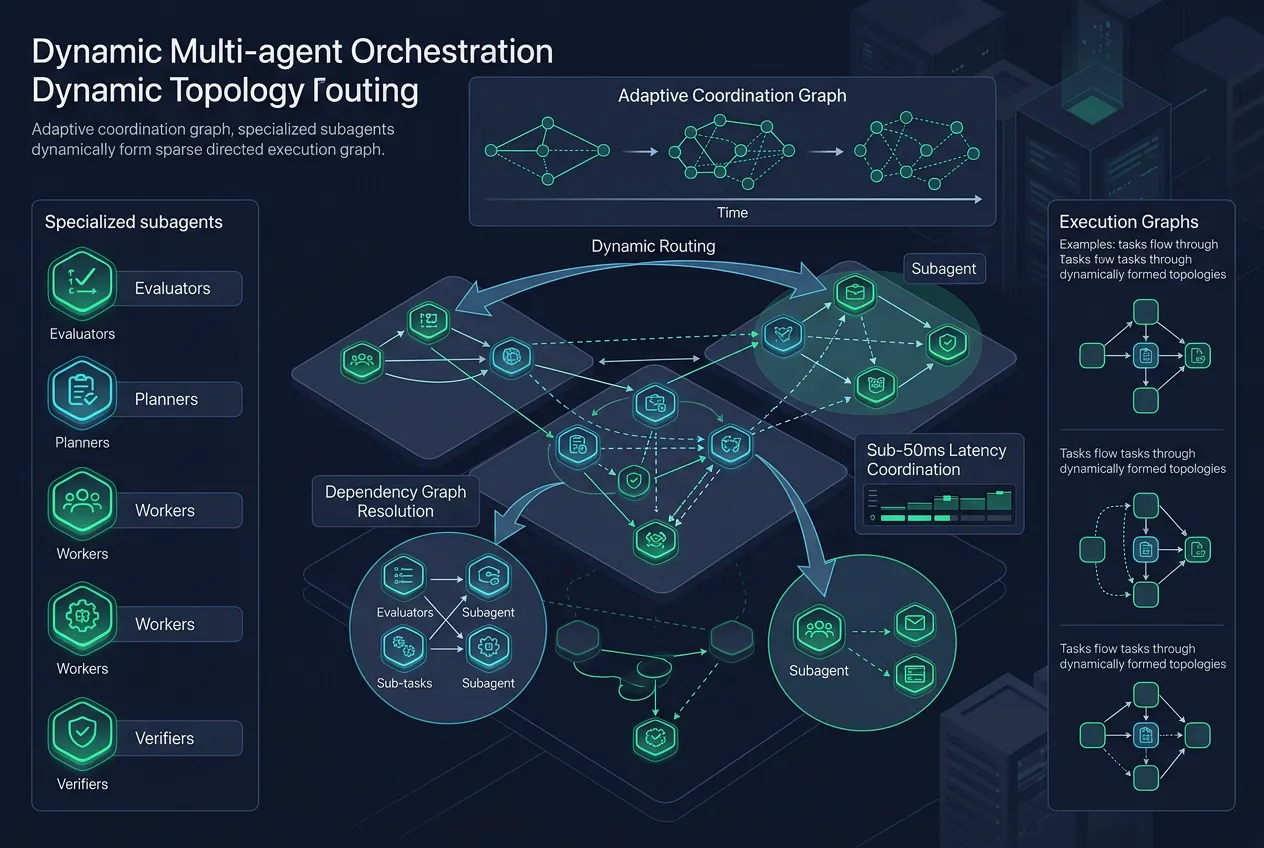
Dynamic subagent orchestration is the distributed engineering architecture that replaces static, hard-coded agent pipelines with runtime task-dependency graph routing, allowing complex AI systems to dynamically select parallel, sequential, or hierarchical subagent topologies based on real-time execution context. By assembling sparse directed communication graphs on the fly rather than passing context through fixed linear chains, modern agent platforms eliminate coordinating latency bottlenecks, prevent cascading multi-agent deadlocks, and achieve verifiable execution reliability across demanding enterprise workflows.
Why Do Static Multi-Agent Pipelines Fail Under Production Workloads?
Early multi-agent engineering patterns relied on rigid, hand-crafted workflows: a master orchestrator invoked Agent A, which passed its entire context to Agent B, which eventually queried Agent C. While functional for narrow three-step demonstrations, these static architectures degrade catastrophically as workflow complexity, tool diversity, and context length expand.
In production environments, static topologies introduce three fatal architectural bottlenecks:
- Compounding Latency Cascades: Forcing every subtask through a sequential chain means total response latency is strictly additive. If three specialized agents take 8 seconds each, the user waits 24 seconds—even when two of those subtasks could have executed concurrently across independent data sources.
- Context Window Contamination: In static pipelines, each agent tends to append its entire conversation history and raw tool outputs to the prompt before handing off to the next agent. Downstream agents are quickly overwhelmed by irrelevant tokens, increasing reasoning errors, hallucination rates, and inference costs.
- Rigid Failure Propagation: If an intermediate agent in a static sequence encounters an unexpected tool error, schema mismatch, or ambiguous document, the entire pipeline grinds to a halt. The static orchestrator lacks the runtime adaptability to spawn a targeted recovery subagent or reroute the dependency to an alternative domain specialist.
As models converge on core cognitive capabilities, empirical research shows that system-level coordination—not raw model size—increasingly dictates end-to-end performance. In AdaptOrch: Task-Adaptive Multi-Agent Orchestration in the Era of LLM Performance Convergence (arXiv:2602.16873, February 2026), researchers demonstrate that adaptive task-dependent topology routing produces measurable gains over static single-topology baselines across complex multi-step reasoning benchmarks while maintaining efficient routing complexity.
How Does Dynamic Topology Routing Solve the Multi-Agent Coordination Dilemma?
The core challenge in distributed agent coordination is determining who speaks to whom, and when. Full-mesh communication (where every agent broadcasts its state to all other agents) scales quadratically ($O(N^2)$), causing token explosion and attention saturation. Conversely, fixed pipelines ($O(N)$) are fragile and slow.
In DyTopo: Dynamic Topology Routing for Multi-Agent Reasoning via Semantic Matching (arXiv:2602.06039, February 2026), researchers propose a breakthrough approach: rebuilding a sparse directed communication graph at every execution turn using semantic "need/offer" matching. Rather than forcing a predetermined conversational structure, DyTopo allows each active subagent to declare what information it requires and what intermediate findings it can provide.
The operational advantages of dynamic semantic topology routing include:
- Empirical Accuracy Improvements: DyTopo achieved a documented average improvement across complex reasoning benchmarks over the strongest static multi-agent baseline by pruning redundant communication edges.
- Sparse Context Graphs: By restricting inter-agent message passing to verified dependency edges, each subagent receives only the targeted context it needs, preserving context window hygiene and eliminating cross-agent attention drift.
- Adaptive Microservice Handoffs: Subagents dynamically publish capabilities and subscribe to required intermediate artifacts without saturating the parent orchestrator's prompt.
| Orchestration Architecture | Topology Selection | Communication Complexity | Execution Profile | Key Vulnerability |
|---|---|---|---|---|
| Static Linear Chain | Fixed at design time | $O(N)$ sequential | Purely additive latency | Cascading failure on single tool error |
| Centralized Master-Worker | Static hub-and-spoke | $O(N)$ through orchestrator | Moderate concurrency | Orchestrator context congestion |
| Full-Mesh Multi-Agent | Static peer-to-peer | $O(N^2)$ broadcast | Extreme token overhead | Hallucination and context poisoning |
| Dynamic Topology Routing | Compiled at runtime per task | $O(E)$ sparse directed graph | Minimal coordination overhead | Requires calibrated meta-routing policies |
What Meta-Decision Policies Govern Production Agent Routing?
Deploying dynamic subagent orchestration at scale requires robust meta-routing policies that evaluate incoming requests under uncertainty. A routing mechanism that takes excessive time to select a subagent defeats the purpose of distributed concurrency.
In MetaRoute-Bench: Evaluating Meta-Decision Policies for Agentic Workflow Routing (arXiv:2608.00107, July 2026), researchers conducted an exhaustive evaluation of workflow routing policies across diverse multi-turn agentic traces. Their findings establish clear engineering boundaries for production systems:
- Compositional Routing Outperforms Monolithic Execution: Compositional routing policies—which decompose tasks into discrete sub-goals before dispatching to specialized domain agents—consistently surpass single-agent monolithic architectures on complex benchmarks.
- Minimal Coordination Penalty: Modern graph-routing formulations introduce negligible runtime overhead relative to foundational model inference times, proving that runtime graph compilation is viable for real-time systems.
- Hardware-Aware Latency Optimization: As corroborated by RouterWorld: Scaling Conversational AI with Latency-Aware LLM Routing (
arXiv:2610.26511, October 2026), which analyzed extensive corpora of single-turn and multi-turn trajectories, routing policies that incorporate real-time system state and server queue telemetry deliver the lowest tail latencies in production.
In a hardened enterprise architecture—working alongside durable saga execution, privilege-isolated memory, and closed-loop trajectory validation—dynamic topology compilation forms the backbone of scalable agentic engineering.
How Can Engineering Teams Implement Dynamic Subagent Topologies in Production?
Transitioning from toy multi-agent scripts to production-grade dynamic orchestration involves four fundamental architectural layers:
1. Task-Dependency Graph Deconstruction
When a complex objective arrives, the primary orchestrator performs an initial semantic decomposition pass. Rather than deciding which exact tools to call, the orchestrator identifies the causal relationships between subtasks:
- Independent branches: Tasks that can run in parallel without shared state (e.g., searching external case law while pulling internal matter records).
- Sequential gates: Tasks that require previous outputs as strictly typed inputs (e.g., verifying client identity before creating a trust ledger transfer).
- Conditional branches: Tasks spawned only if an earlier verification step returns an exception or incomplete data.
2. Runtime Subagent Spawning and Scoped Context Ingestion
Subagents should never inherit the global orchestrator's entire memory footprint. Instead, each subagent is spawned with:
- A tightly scoped system prompt and specialized tool whitelist.
- Only the specific artifacts, document pointers, or structured fields necessary for its assigned subtask.
- An explicit resource and execution budget (e.g., maximum step count and token ceiling).
3. Asynchronous Barrier Synchronization and State Joining
For parallel subagent branches, the runtime coordination layer implements asynchronous barrier synchronization. The parent orchestrator awaits incoming results, validates output schemas against deterministic assertions, and merges returned state into the central thread. If an individual subagent times out or errors, the orchestrator triggers an isolated retry or branches into an alternative recovery topology without terminating the broader execution.
4. Continuous Trace Logging and Trajectory Telemetry
Every routing decision, graph mutation, and inter-agent message must be emitted to structured observability pipelines. By tracking routing accuracy, agent hop counts, and latency percentiles across traces, engineering teams can continuously fine-tune their meta-routing policies and detect workflow bottlenecks before they impact end users.
What is dynamic subagent orchestration?
Dynamic subagent orchestration is an architectural design pattern for multi-agent AI systems where the execution graph (whether agents run in parallel, in sequence, or hierarchically) is compiled dynamically at runtime based on task dependencies, rather than following a static, pre-programmed workflow.
How does dynamic topology routing reduce multi-agent latency?
By identifying independent subtasks and executing them concurrently while pruning unnecessary communication hops between agents, dynamic topology routing eliminates linear waiting times. Empirical benchmarks such as DyTopo (arXiv:2602.06039) demonstrate that sparse directed communication graphs prune redundant execution edges without sacrificing reasoning accuracy.
What is the performance overhead of runtime routing decisions?
Task-adaptive routing algorithms formulate topology selection as efficient dependency resolution passes that execute with negligible latency relative to model inference times.
How does dynamic orchestration prevent context window contamination?
Instead of passing an ever-growing conversation history through every agent in a chain, dynamic orchestration passes only specialized task definitions and strictly necessary data artifacts to individual subagents. Each subagent runs in an isolated context window, preventing attention dilution and reducing reasoning failures.