Agentic checkpointing and state persistence allow production AI systems to survive transient worker crashes, pause deterministically for human-in-the-loop authorization, and support non-destructive time-travel replay. Rather than treating multi-step agent execution as a volatile in-memory loop, enterprise architectures serialize thread state snapshots across durable execution boundaries. By decoupling execution journals from volatile worker processes and isolating external side effects behind idempotent boundary activities, engineering teams eliminate runaway token loops, ensure zero-data-loss crash recovery, and enable audit-grade replay across complex enterprise workflows.
Why Does In-Memory Agent Execution Fail at Production Scale?
Traditional script-based LLM orchestration models execute multi-turn reasoning loops inside ephemeral worker memory. While this approach functions in single-turn prototypes, it introduces severe reliability hazards when applied to multi-step enterprise workflows:
- Transient Worker Eviction and Node Failures: In containerized cloud environments (such as Kubernetes pods or serverless execution runtimes), spot instances terminate, container memory limits trigger OOM restarts, and network partitions drop active connections. If an agent has consumed 45 tool turns and $12 in API tokens over eight minutes, an unhandled node termination forces the entire workflow to abort and re-execute from scratch, duplicating downstream side effects and multiplying compute costs.
- Unbounded Human-in-the-Loop Latency: Enterprise agents frequently execute sensitive actions—such as initiating bank transfers, provisioning infrastructure, or filing court pleadings—that require explicit managerial approval. Because human review cycles span hours or days, holding volatile worker threads and compute allocations open during review is both financially prohibitive and prone to timeout disconnections.
- Cascading State Corruption and Prompt Poisoning: When an agent encounters an unhandled tool exception or enters a hallucinatory loop, operators cannot easily inspect intermediate thread state or rewind the execution graph to a known-valid state without destroying production logs.
Solving these failure modes requires transitioning from ephemeral in-memory loops to durable state persistence governed by atomic checkpoints.
What Constitutes a Durable State Snapshot in Modern AI Agents?
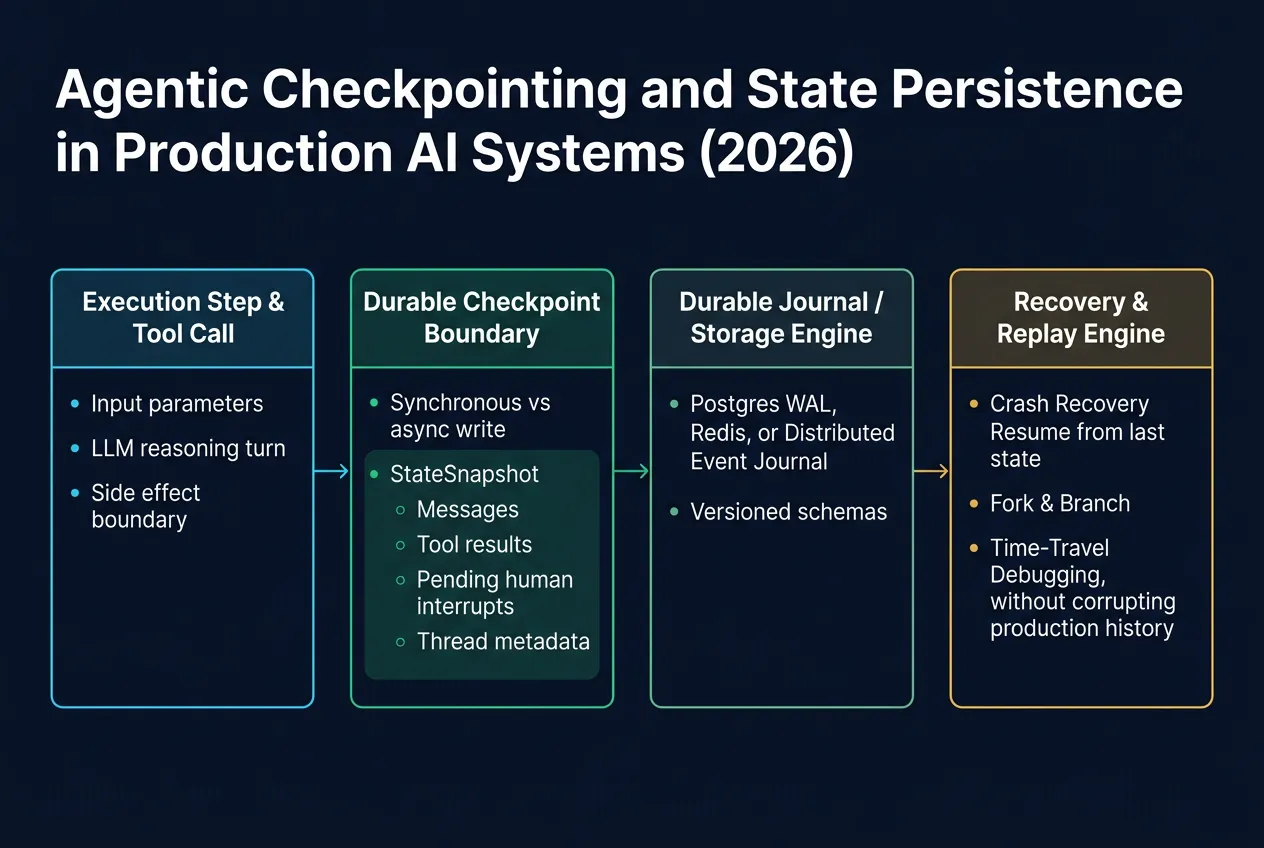
A production checkpoint is not merely an append-only text log of chat messages. It is an immutable, serialized snapshot of the execution graph captured at deterministic super-step boundaries. Under modern orchestration engines, a durable state snapshot encompasses four discrete data layers:
- Message Thread History: The complete chronological array of system prompts, user inputs, intermediate reasoning traces, and structured tool outputs generated up to the current turn.
- Workflow Scratchpad and Node State: Structured key-value variables, intermediate entity extractions, accumulated token counts, and step counters tracked across graph nodes.
- Pending Interrupts and Resumption Vectors: Deserialization metadata indicating whether the workflow is paused awaiting external signals, webhooks, or human authorization, along with the precise continuation node identifier.
- Execution Metadata and Parent Pointers: Thread identifiers, run IDs, deterministic version numbers, and cryptographic parent checkpoint hashes that form an immutable Directed Acyclic Graph (DAG) of the agent's historical trajectory.
By persisting these layers atomically into durable distributed storage—such as PostgreSQL with Write-Ahead Logging (WAL), Redis persistence, or durable event streams—the agent framework decouples execution state from the physical worker executing the code.
| Architecture Component | In-Memory Ephemeral Loop | Durable Checkpointing Engine |
|---|---|---|
| Fault Recovery | Complete restart from turn 1; duplicate billing and side effects | Resumes from exact last successful super-step in milliseconds |
| Human-in-the-Loop | Long-polling HTTP timeouts; thread starvation | Cold sleep; zero active compute while waiting for approval signal |
| Auditability | Ephemeral console output or unstructured text logs | Cryptographic, versioned DAG of all intermediate decisions |
| Debugging Method | Rerun from input and hope non-deterministic LLM reproduces bug | Time-travel branch off exact checkpoint without corrupting history |
How Do Durable Execution Engines and Graph Checkpointers Differ?
When architecting agent persistence, engineering teams navigate two primary design patterns: graph-state checkpointers (exemplified by LangGraph) and durable execution engines (exemplified by Temporal and Restate). Understanding the distinction between these paradigms determines system resilience:
1. Graph-State Checkpointing (Super-Step Snapshots)
Graph checkpointers save a serialized state snapshot at the completion of each discrete node or super-step. When a worker fails or pauses for human input, the checkpointer loads the latest saved state snapshot and resumes the graph. If an operator triggers time-travel debugging, the system loads an earlier checkpoint and forks a new thread branch. Crucially, in graph-state checkpointers, downstream nodes—including LLM inference calls and tool executions—will re-execute against the provider API unless an external caching layer is explicitly configured.
2. Durable Execution Engines (Deterministic Event Journaling)
Durable execution engines take persistence a layer deeper by maintaining an immutable, append-only event journal of every workflow step. Instead of snapshotting arbitrary memory blobs, durable execution tracks every activity input, completion status, and return value. Upon node failure or pod eviction, a replacement worker replays the workflow code deterministically: previously completed activities return their recorded journal outputs instantaneously without re-calling external APIs or consuming LLM tokens. The agent continues execution at the exact point of interruption.
For mission-critical production workflows that involve irreversible financial or operational side effects, pairing graph reasoning with durable execution guarantees that no external tool is executed twice.
What Are the Non-Negotiable Safety Rules for Time-Travel Replay?
Time-travel debugging allows developers and automated evaluation harnesses to inspect a past agent failure, rewind the execution graph to the turn immediately preceding the error, alter the prompt or tool configuration, and observe the resulting trajectory. However, replaying execution in production environments introduces substantial systemic risk if not strictly bounded:
Rule 1: Never Mutate Historical Checkpoints in Place
Production checkpoints must remain append-only and cryptographically immutable. When time-traveling, the orchestration engine must create a fork (a new child thread ID linked via parent pointers) rather than overwriting historical records. In-place mutation destroys regulatory audit trails and corrupts downstream observability metrics.
Rule 2: Enforce Idempotency Keys on All External Tool Boundaries
Replaying an agent's trajectory from step 5 when the agent originally completed step 8 risks duplicating external mutations (e.g., sending duplicate client emails, charging payment gateways, or writing duplicate records). Every external tool call must be wrapped in an idempotent boundary activity using a deterministic hash of (thread_id, step_index, tool_parameters) as its idempotency key.
Rule 3: Decouple Short-Term Checkpoints from Long-Term Memory
Short-term thread checkpoints represent transient execution state and should be governed by automated Time-to-Live (TTL) retention policies (e.g., 30 to 90 days) to comply with enterprise data minimization standards. Conversely, durable user facts, enterprise knowledge graphs, and cross-thread preferences must be stored in dedicated long-term memory stores with explicit access control and deletion endpoints.
Rule 4: Cryptographically Isolate Tenant Checkpoint Stores
Because serialized state snapshots contain raw user inputs, proprietary context, and intermediate tool responses, checkpoint datastores represent high-value data exfiltration targets. Organizations must enforce strict multi-tenant row-level security (RLS), encrypt state snapshots at rest with customer-managed keys (CMAK), and redact sensitive PII before serialization.
How does agentic checkpointing handle long-running human approvals?
When an agent triggers a human approval gate, the checkpointer serializes the entire thread state, marks the thread status as paused with an interrupt vector, and terminates the worker process. The workflow enters a zero-compute cold sleep state. When the human approver submits their authorization via API or dashboard, the orchestration engine deserializes the exact checkpoint and resumes execution from the continuation node without state loss.
Does time-travel replay re-run external tool calls automatically?
In standard graph checkpointers without activity caching, nodes downstream from the selected checkpoint will re-execute their logic, including calling APIs and LLMs. In durable execution engines (like Temporal or Restate) or graph checkpointers configured with idempotent activity boundaries, completed side effects return their recorded journal results, preventing duplicate external transactions.
What database backends are best suited for enterprise agent checkpointing?
For enterprise scale, PostgreSQL with Write-Ahead Logging and partitioned tables (or Azure Cosmos DB / DynamoDB for global key-value distribution) provides the optimal combination of ACID transactional consistency, low-latency snapshot reads, and robust multi-tenant row-level isolation.
Related reading: