Enterprise AI TRiSM runtime governance in 2026 establishes an active control plane that enforces cryptographic identity verification, dynamic least-privilege scope attenuation, and real-time policy guardrails directly at the consequence-producing boundary. Rather than relying on passive static documentation or post-hoc log audits, modern AI trust, risk, and security management architectures decouple probabilistic model reasoning from deterministic tool execution, ensuring all agentic actions adhere strictly to NIST AI 600-1 and ISO/IEC 42001 compliance standards.
Why Do Traditional Governance Frameworks Fail in Autonomous Agent Deployments?
Traditional enterprise IT governance models were engineered around static software binaries and predictable, deterministic request-response lifecycles. When enterprises deployed early generative AI systems, governance focused primarily on output filtering—inspecting prompts for sensitive data loss prevention (DLP) violations and screening natural language completions for toxicity or confabulation.
In 2026, autonomous agentic systems represent fundamentally different risk profiles:
- Execution Risk Over Output Risk: Multi-agent workflows do not merely generate prose; they actively invoke external API tools, query relational and vector datastores, update CRM and ERP records, execute software code, and trigger financial transactions.
- Non-Deterministic Multi-Hop Trajectories: An agent’s intermediate reasoning steps evolve dynamically across multi-turn trajectories, meaning runtime behavior cannot be verified by static code analysis or single-turn input scanning.
- Cascading Failure Modes: A single poisoned prompt or unhandled API failure at step two of an eight-step trajectory propagates downstream, potentially causing unauthorized write operations across disparate enterprise systems.
Treating autonomous agents as execution entities requires organizations to implement AI Trust, Risk, and Security Management (AI TRiSM) as a real-time runtime operating layer rather than an annual compliance checklist.
What Are the Four Core Pillars of Enterprise AI TRiSM Runtime Architecture?
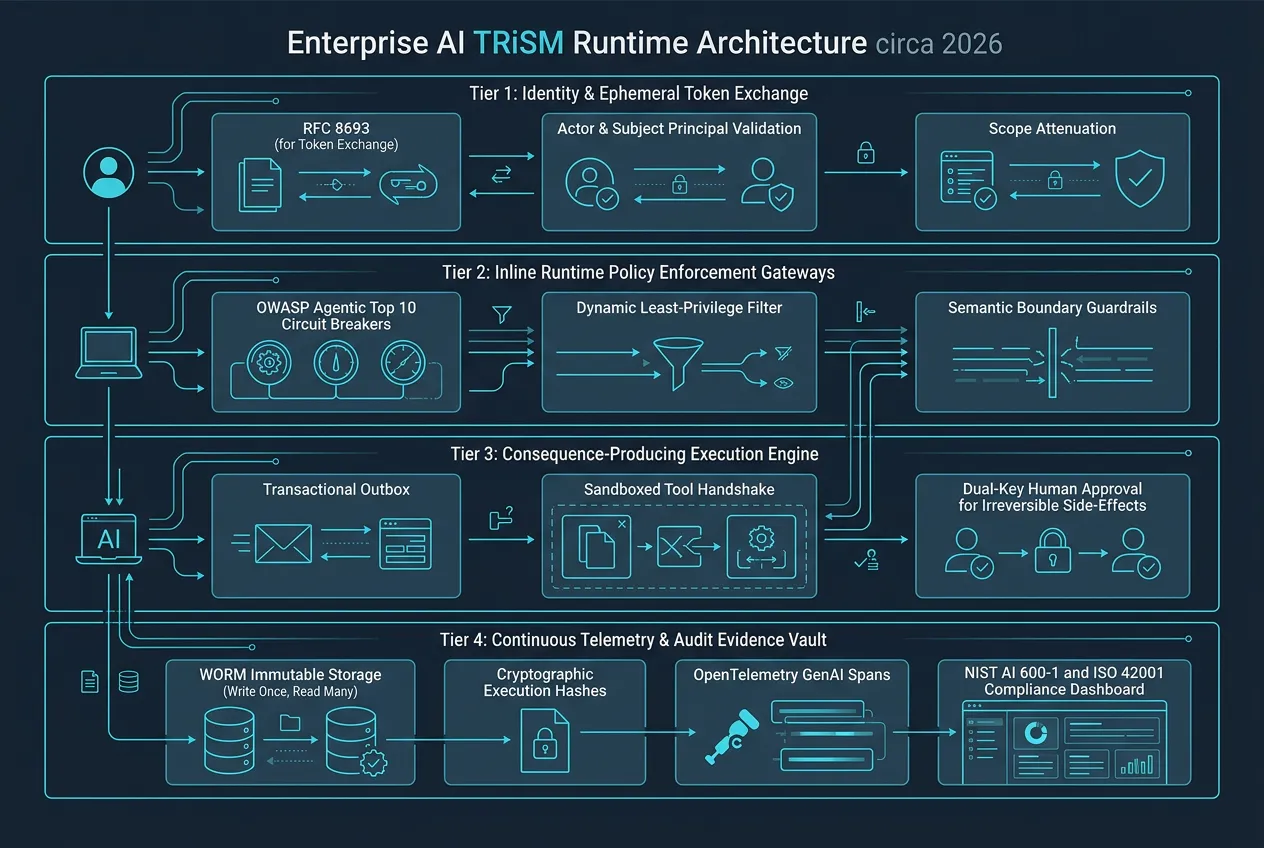
To bridge the gap between regulatory mandates and production operations, enterprise AI TRiSM runtime governance structures an inline enforcement plane across four defensive tiers:
| Architecture Tier | Operational Role | Governing Security & Compliance Standards |
|---|---|---|
| Tier 1: Non-Human Identity & Token Exchange | Enforces short-lived, cryptographically verified OAuth 2.0 Token Exchange (RFC 8693) with strict sub (end-user) and act (agent) claim validation. | NIST SP 800-207 Zero Trust, OWASP Agentic Top 10 ASI03 (Identity Abuse) |
| Tier 2: Inline Runtime Policy Enforcement | Evaluates outgoing tool parameters and incoming schemas against Context-Free Grammar (CFG) constraints and data boundary firewalls. | NIST AI 600-1 Section 3, OWASP Agentic Top 10 ASI02 (Tool Misuse) |
| Tier 3: Consequence-Producing Boundary Controls | Sandboxes irreversible state mutations using transactional outbox buffers, compensating sagas, and dual-key human approval gates. | ISO/IEC 42001:2023 Clause 8.2, NIST AI RMF 1.0 GOVERN & MANAGE |
| Tier 4: Continuous Telemetry & Evidence Vaults | Streams immutable OpenTelemetry GenAI spans into WORM (Write-Once-Read-Many) datastores with cryptographic SHA-256 state hashes. | AICPA SOC 2 Type II CC8.1, EU AI Act Article 72 Post-Market Monitoring |
How Does RFC 8693 Token Exchange Prevent Privilege Escalation?
Legacy agent deployments frequently suffered from service-account pooling, where all agents shared high-privilege API tokens, or pass-through user token delegation, where an agent inherited the human user’s full administrative credentials. Both patterns violate foundational least-privilege principles:
- Service Account Pooling: Obscures the initiating human actor, rendering forensic audits impossible and exposing the enterprise to catastrophic horizontal privilege escalation if an agent suffers prompt injection.
- Pass-Through Delegation: Grants the agent excessive blast radius, allowing it to modify data or access enterprise systems outside the explicit context of the assigned subtask.
Under RFC 8693 OAuth 2.0 Token Exchange, the agent runtime presents the user's active session token to an enterprise authorization server to obtain an ephemeral, tightly scoped delegation token. This token embeds composite claims: the subject (sub) identifies the authenticated end-user, while the actor (act) identifies the specific executing agent instance.
Furthermore, the authorization gateway computes dynamic scope attenuation via mathematical intersection:
$\text{Effective Permissions} = \text{User Entitlements} \cap \text{Agent Policy Baseline} \cap \text{Task Manifest Boundary}$
If a user possesses global database delete rights but initiates an expense-reporting agent whose manifest permits only read access to financial receipts, the effective token permits only receipt reads. Any attempt by the model to call deletion routines results in an immediate HTTP 403 authorization failure handled gracefully by the orchestrator.
How Do Inline Gateways Mitigate Prompt Injection and Context Poisoning?
At Tier 2, runtime policy enforcement acts as an active circuit breaker positioned between the cognitive model orchestrator and external enterprise systems. This gateway addresses the primary vulnerabilities highlighted in the OWASP Top 10 for Agentic Applications:
1. Indirect Prompt Injection Neutralization (ASI01)
When agents ingest external, untrusted content—such as parsed customer emails, PDF invoices, or web search results—adversaries can embed hidden adversarial instructions designed to hijack model control flow. Inline gateways enforce strict schema isolation by parsing all untrusted external payloads into quarantined structured objects before passing them to the primary reasoning engine.
2. Context-Free Grammar (CFG) Constrained Decoding (ASI02)
Rather than relying on post-generation regular expression validation, the runtime gateway enforces pushdown automaton CFG bitmasks directly at the model sampling layer. Tokens that violate the registered JSON Schema for a given tool cannot be sampled, eliminating syntax hallucinations, parameter injection, and malformed command execution.
3. Semantic DLP Egress Filtering (ASI06)
Before any tool execution payload departs the private enterprise network, inline DLP inspection validates that outbound arguments do not contain unredacted personally identifiable information (PII), proprietary source code, or internal cryptographic secrets.
How Do Enterprise Consequence-Producing Boundaries Operate?
A cornerstone of the 2026 NIST AI 600-1 Generative AI Profile and ISO/IEC 42001 AI Management System (AIMS) is the governance of actions that create irreversible physical or legal consequences. Enterprise AI TRiSM architecture classifies all tool invocations into three deterministic tiers:
- Read-Only / Idempotent Queries: Cached vector lookups, public search queries, and internal document retrievals proceed automatically without manual intervention.
- Reversible Mutations: Creating staging draft documents, queuing email drafts, or updating scratchpad database records utilize transactional outbox patterns. If the trajectory fails or triggers an anomaly detector, automated compensating sagas roll back intermediate states.
- Irreversible Real-World Actions: Wire transfers, production database schema alterations, customer-facing email dispatch, and legal document execution require dual-key human approval. The agent prepares the complete, deterministic payload and halts, generating an interactive authorization ticket. Execution proceeds only after an authenticated human supervisor signs off.
How Do Immutable Audit Vaults Satisfy ISO 42001 and SOC 2 CC8.1?
Regulatory bodies, insurance underwriters, and external auditors require provable reconstruction of algorithmic decision paths. Standard application logs fall short because non-deterministic model outputs and floating system prompts cannot be reproduced from simple timestamped text entries.
Enterprise AI TRiSM architectures implement dedicated Evidence Vaults operating under Write-Once-Read-Many (WORM) hardware storage rules:
- Cryptographic State Pinning: Every agent invocation generates an immutable execution record containing the SHA-256 hash of the exact system prompt, the version-pinned model digest, the temperature and top-p sampling parameters, the tool manifest definition, and the complete input-output token trajectory.
- OpenTelemetry GenAI Telemetry: Spans standardized under OpenTelemetry GenAI semantic conventions track parent-child relationships across nested subagent handoffs (
invoke_agentandexecute_tool), recording exact latency, token consumption, and cost attribution. - Continuous Drift and Fairness Verification: Golden benchmark datasets evaluate production trajectories asynchronously against frozen baseline performance distributions, alerting compliance officers immediately if model updates introduce silent semantic drift or statistical bias.
What is the difference between AI TRiSM and traditional cybersecurity?
Traditional cybersecurity protects the infrastructure hosting an application (firewalls, operating system patches, network segmentation). AI TRiSM specifically governs the non-deterministic cognitive risks inherent to artificial intelligence—including prompt injection, model extraction, hallucinated tool calls, autonomous privilege abuse, and unverified data provenance.
Does implementing runtime AI TRiSM add prohibitive latency to agent workflows?
No. High-performance enterprise TRiSM gateways leverage precomputed CFG token bitmasks, asynchronous CPU-GPU forward-pass overlapping, and local token validation, adding less than 15 milliseconds of overhead per tool invocation. This latency is negligible compared to standard foundation model generation times and eliminates costly multi-turn error recovery loops.
How does AI TRiSM support compliance with the EU AI Act?
For high-risk and general-purpose AI deployers, the EU AI Act mandates post-market monitoring (Article 72), logging of technical events (Article 12), and human oversight mechanisms (Article 14). AI TRiSM runtime gateways provide the technical enforcement layer required to satisfy these legal obligations through automated audit trails, human approval gates, and continuous anomaly detection.
Related Insights analysis: