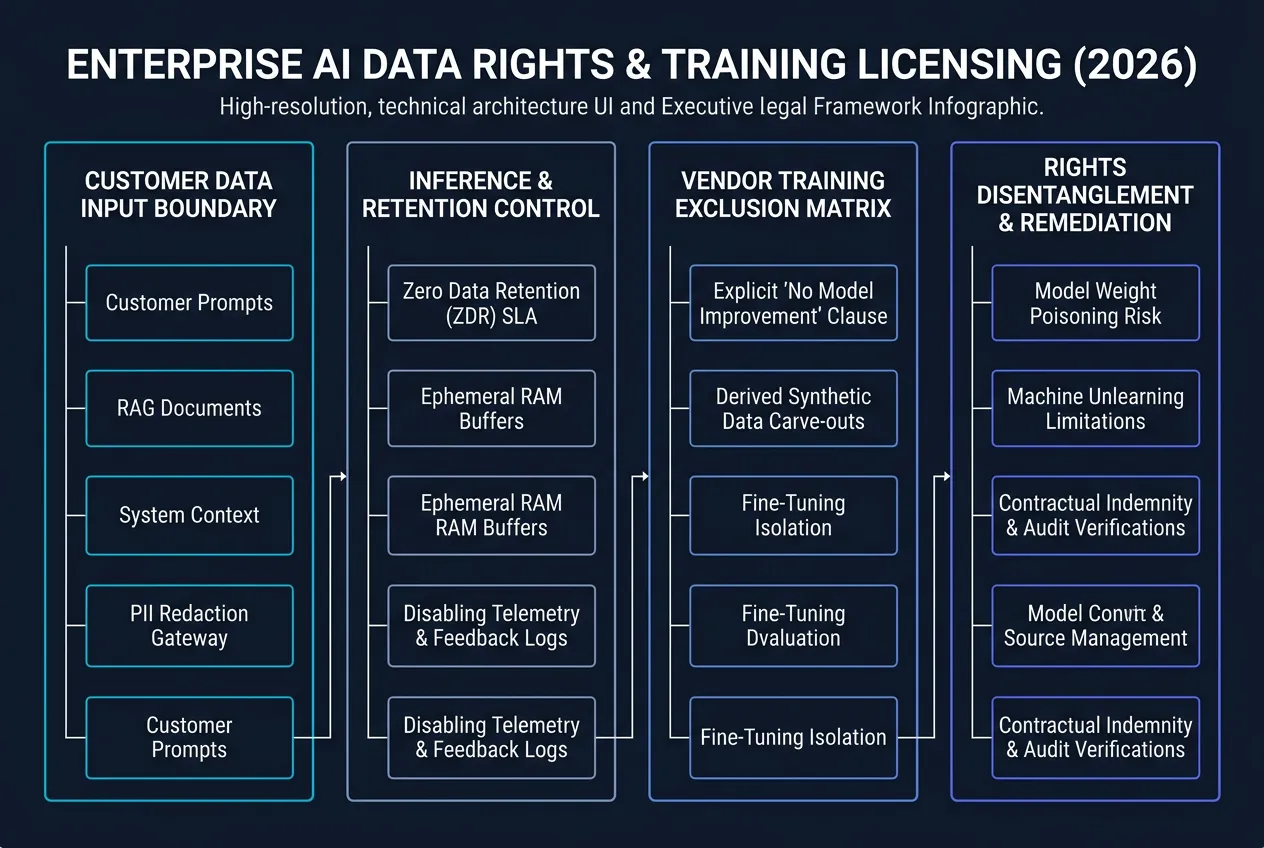
Enterprise AI data rights and training licensing agreements govern whether corporate prompts, proprietary retrieval-augmented generation (RAG) context, fine-tuning datasets, and generated outputs can be ingested by frontier model providers to train or improve foundation models. In 2026, enterprise legal and procurement teams are moving beyond standard click-through terms and blanket "no training" promises to mandate four enforceable contractual safeguards: audited Zero Data Retention (ZDR) infrastructure, explicit exclusions for derived synthetic telemetry, fine-tuning dataset ownership covenants, and model weight disentanglement indemnities.
Enterprise AI deployments inherently involve transmitting high-value corporate intellectual property, sensitive customer records, and confidential operational knowledge through third-party model inference gateways. While consumer terms of service routinely permit model developers to retain user prompts for system refinement, commercial enterprise master service agreements (MSAs) require strict data boundary isolation to preserve trade secrets, prevent regulatory violations, and maintain commercial advantage.
Why Is Traditional SaaS Data Protection Insufficient for Enterprise AI?
Traditional cloud software agreements rely on established boundaries: customer data is stored in dedicated database partitions, encrypted at rest and in transit, and processed strictly to deliver the hosted application. Under conventional software-as-a-service (SaaS) frameworks, customer data remains segregated and can be deleted upon contract termination.
Generative foundation models break this paradigm through parameter memorization. As detailed in the National Institute of Standards and Technology's Generative AI Profile (NIST AI 600-1, July 2024), foundation models ingest massive corpora during pre-training and continuous post-training alignment, creating substantial risks of data memorization and accidental data leakage:
"The use of personal data for GAI training raises risks to widely accepted privacy principles, including to transparency, individual participation (including consent), and purpose specification... Models may leak, generate, or correctly infer sensitive information about individuals... This problem has been referred to as data memorization, and may pose exacerbated privacy risks even for data present only in a small number of training samples." (NIST AI 600-1, Section 2.4).
Once enterprise data is absorbed into neural network weights during pre-training, instruction fine-tuning, or reinforcement learning from human feedback (RLHF), standard cryptographic deletion cannot extract it. Because exact "machine unlearning" remains mathematically intractable for complex non-linear transformer architectures, data ingestion into model weights represents an irreversible transfer of enterprise value.
What Are the Four Essential Enterprise AI Data Rights Contractual Safeguards?
Enterprise procurement standards in 2026 require four distinct, interlocking contractual protections in any foundation model or AI platform agreement:
+---------------------------------------------------------------------------------------------------+
|                        ENTERPRISE AI DATA RIGHTS: CONTRACTUAL INTEGRATION MATRIX                  |
+---------------------------------------------------------------------------------------------------+
| 1. ZERO DATA RETENTION (ZDR)       | Ephemeral inference buffers; 0-day disk logging; no telemetry|
| 2. DERIVED DATA CARVE-OUTS         | Prohibiting synthetic data generation & metadata distillation|
| 3. FINE-TUNING DISENTANGLEMENT     | Customer ownership of adapters, LoRAs, and embedding matrices |
| 4. RECOVERY & REMEDIATION RIGHTS   | Audit verification, breach notification, & model destruction |
+---------------------------------------------------------------------------------------------------+
1. Contractually Audited Zero Data Retention (ZDR)
Standard commercial API agreements frequently include temporary caching provisions—typically retaining customer prompts, embeddings, and completions for 30 days to facilitate automated abuse monitoring and rate limiting. In high-consequence enterprise environments (financial services, healthcare, defense, and legal), a 30-day disk-persisted cache introduces unacceptable discovery and subpoena exposure.
Enterprise agreements must mandate Zero Data Retention (ZDR) as an enforceable service-level agreement (SLA):
- Ephemeral RAM Execution: Prompts and generated tokens must be held exclusively in volatile memory during the active inference execution thread and purged immediately upon response delivery.
- Log Elimination: Provider application logs, debugging dumps, error traces, and infrastructure monitoring must redact, hash, or completely exclude prompt and completion payloads.
- Independent Attestation: Vendors must provide annual SOC 2 Type II or ISO/IEC 42001 third-party audit reports confirming that automated retention filters and ZDR configurations function as specified across all serving clusters.
2. Explicit Prohibitions on Derived Data, Telemetry, and Synthetic Training
One of the most pervasive loopholes in contemporary AI vendor contracts is the distinction between "Customer Content" and "Usage Data" or "Derived Telemetry." While a vendor may promise not to train models on raw customer prompts, boilerplate provisions often grant the vendor unrestricted rights to use de-identified metadata, system telemetry, error logs, and derived synthetic representations for "service improvement and model research."
Enterprise legal teams must close this gap by expanding data protection definitions:
- Synthetic Data Carve-In: The definition of protected Customer Data must expressly incorporate synthetic data, embedding vectors, system prompts, retrieval rankings, and agentic tool-invocation traces derived from enterprise workloads.
- Prohibition on Model Distillation: The agreement must explicitly bar the vendor from using customer inputs, outputs, or performance telemetry to train, fine-tune, calibrate, or distill any foundation model, reward model, or auxiliary classifier—whether proprietary to the vendor or shared with third parties.
3. Customer Ownership of Fine-Tuning Artifacts and Adapters
When an enterprise utilizes a vendor's infrastructure to train customized models, domain-specific Low-Rank Adaptation (LoRA) weights, or prefix embeddings, the ownership of those weights must be clearly defined.
A robust enterprise AI agreement establishes clear property boundaries:
- Artifact Title: The enterprise retains sole and exclusive ownership of all proprietary fine-tuning training datasets, validation pairs, custom adapter weights (e.g., LoRA, QLoRA), and specialized embedding spaces.
- Exportability & Host Portability: The vendor must contractually guarantee the ability to export trained adapter weights in open standard formats (such as SafeTensors or GGUF) without proprietary encapsulation upon contract termination.
- Tenant Isolation: Custom adapters and fine-tuned checkpoints must execute within dedicated, cryptographically isolated inference enclaves that prevent cross-tenant parameter leakage or shared memory caching.
4. Machine Unlearning Limitations, Weight Poisoning, and Contractual Remedies
When a vendor inadvertently or wrongfully trains a public or shared foundation model on enterprise data—whether through misconfigured telemetry pipelines or rogue batch jobs—traditional injunctive relief ("delete the data") is technically impossible.
To address this technical reality, enterprise agreements require specialized breach provisions:
- Mandatory Notification: The vendor must notify the enterprise within 48 hours of discovering any unauthorized ingestion of customer inputs into model training pipelines.
- Model Retraction and Destruction: If customer data cannot be verifiably purged via mathematical machine unlearning protocols, the vendor must be obligated to retire, retract, and destroy the affected model weights and checkpoints from production deployment.
- Uncapped Indemnification: Violations of data training restrictions must be categorized alongside intellectual property infringement and gross negligence as an exclusion from the contract's general limitation of liability cap.
Comparative Assessment: Commercial Standard Terms vs. Enterprise-Negotiated Safeguards
Enterprise procurement negotiations reveal marked contrasts between default self-service API terms and enterprise-grade MSAs:
| Governance Domain | Standard Self-Service Commercial Terms | Enterprise-Negotiated Master Agreement |
|---|---|---|
| Data Retention | 30-day disk logging for abuse monitoring and system debugging | Strict Zero Data Retention (ZDR) SLA; ephemeral volatile memory execution |
| Model Improvement | Opt-out available, but telemetry and aggregated data retained | Complete ban on training, fine-tuning, RLHF, and synthetic distillation |
| Derived Embeddings | Vendor claims rights to optimize vector search and caching | Enterprise retains exclusive title to embeddings and RAG taxonomies |
| Custom Adapters | Locked into vendor's proprietary runtime infrastructure | Full exportability in open formats (SafeTensors); tenant-isolated execution |
| Verification & Audits | Rely on vendor self-certification and public documentation | Annual SOC 2 Type II / ISO 42001 verification and dedicated audit rights |
| Liability Limits | Capped at 12 months of fees paid (or nominal service credits) | Uncapped liability or dedicated super-cap for unauthorized training ingestion |
Actionable Negotiation Checklist for Enterprise AI Counsel and Procurement
To ensure comprehensive data boundary protection, procurement teams should integrate the following five-point checklist into their contract negotiation workflows:
- Verify Default API Settings: Never rely on verbal sales representations. Audit vendor configuration dashboards to confirm whether ZDR is default or requires specific API header flags (e.g., passing organizational opt-out headers).
- Eliminate Feedback Loop Telemetry: Ensure that in-product user feedback features (such as thumbs-up/thumbs-down ratings or user edits) do not implicitly trigger customer content transmission into vendor RLHF data pools.
- Cross-Reference Vendor Subprocessors: Map all third-party hosting partners and inference infrastructure providers (e.g., hyperscaler cloud regions). Contractual training prohibitions must flow down to all underlying compute and model hosting subcontractors.
- Demand Zero-Retention Fallback Protections: In multi-region failover scenarios, ensure that backup inference clusters maintain identical ZDR and data boundary configurations.
- Align with Enterprise Governance Frameworks: Ensure third-party AI licensing aligns with internal AI governance charters and technical access governance, treating external foundation model APIs as untrusted computing tiers.
How does Zero Data Retention (ZDR) differ from standard data encryption?
Standard data encryption secures data stored on disk or traversing networks, but leaves that data persisted within vendor systems for 30 days or longer. Zero Data Retention mandates that customer data is never written to persistent disk storage at all—executing solely in ephemeral volatile memory (RAM) and vanishing immediately once inference tokens are returned.
Can a foundation model vendor delete customer data after training a model on it?
No. Once data is absorbed into a deep neural network's weights, it cannot be selectively excised like a record in a database. Current mathematical machine unlearning techniques are incomplete and cannot reliably guarantee complete removal without retraining or degrading model capabilities. This is why preventing training ingestion via enforceable pre-execution covenants is essential.
Are synthetic data and embeddings protected under standard non-disclosure agreements?
Frequently not. Standard NDAs define confidential information in terms of tangible customer documents and raw text inputs. Without specific language covering derived synthetic datasets, vector embeddings, and agentic tool-invocation traces, vendors may argue that derived data structures fall outside confidentiality protections.
Does the EU AI Act or NIST AI RMF address AI data rights?
Yes. NIST AI 600-1 (Generative AI Profile) expressly identifies data privacy leakage, parameter memorization, and untraceable component integration as primary risks. Similarly, the European Union's regulatory frameworks mandate transparency regarding training data sources and purpose limitation for personal data processing.