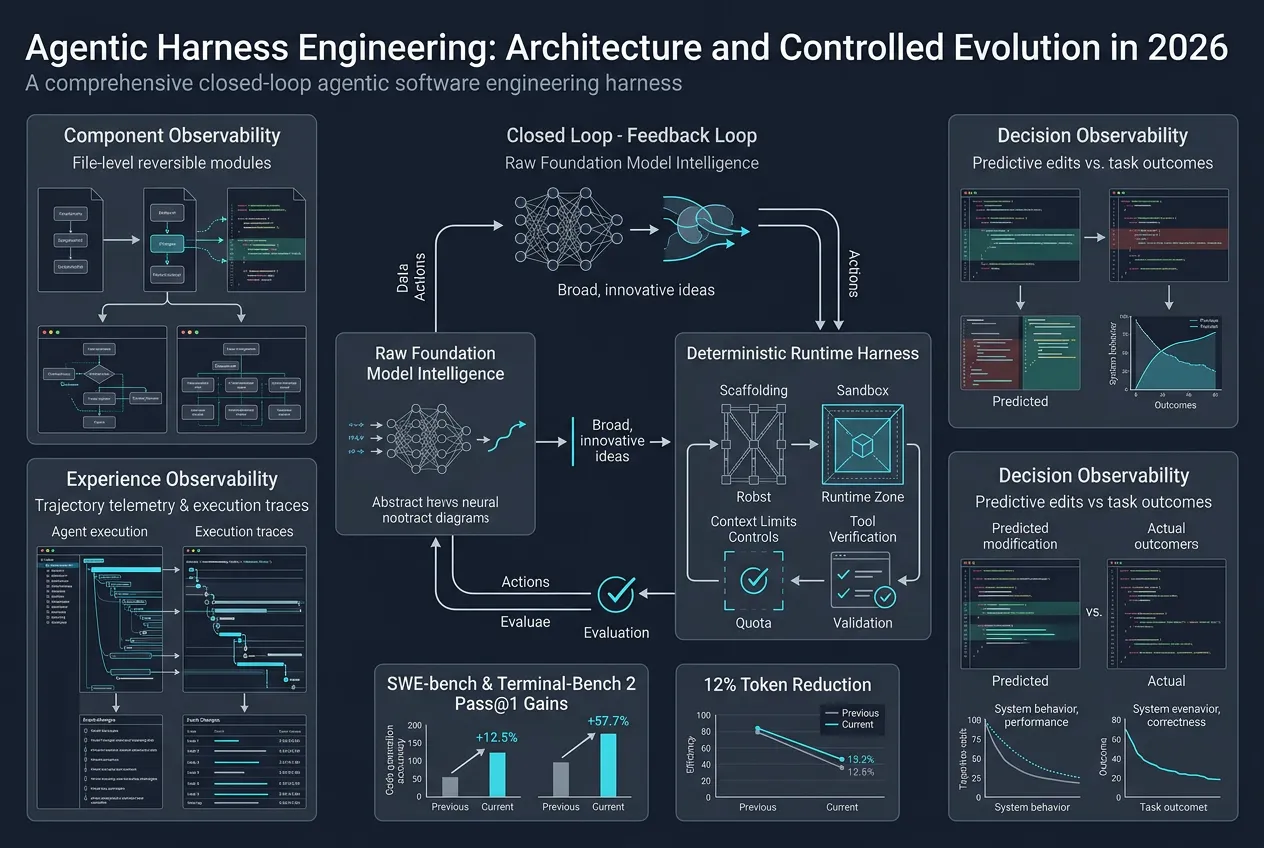
Agentic harness engineering means improving the runtime around an AI model through observable, versioned, reversible changes. That runtime determines how the agent receives context, calls tools, handles errors, and records outcomes. Recent research reports useful benchmark gains from harness evolution, but those results do not justify letting an optimizer rewrite production unchecked. The practical goal is controlled improvement: identify a failure, propose a bounded change, test it independently, and preserve the ability to roll back.
What does an agent harness actually control?
A model generates a proposed action. The harness determines what happens around that proposal: which instructions and task state are visible, what tools exist, which permissions apply, how outputs are interpreted, and what evidence counts as completion.
That distinction matters when an agent appears to reason correctly but still fails operationally. A misunderstood tool result, stale context, an unbounded retry, or missing outcome verification can defeat an otherwise sensible plan.
A useful engineering boundary separates:
- Context assembly: instructions, retrieved material, memory, and the current task state.
- Action control: argument validation, permissions, isolation, and limits on what a tool may change.
- Recovery: retries, uncertain outcomes, checkpoints, and escalation when the agent lacks a necessary fact.
- Evidence: records of what was attempted and what was actually observed afterward.
These are design categories, not a universal architecture or a claim that every deployment needs the same implementation.
What does the recent research support?
Lin and colleagues' preprint, Agentic Harness Engineering: Observability-Driven Automatic Evolution of Coding-Agent Harnesses, was submitted April 28, 2026, and revised May 18, 2026. Its abstract describes component, experience, and decision observability as the basis for evolving coding-agent harnesses.
The authors report Terminal-Bench 2 pass@1 increasing from 69.7% to 77.0%. The absolute change is 77.0 − 69.7 = 7.3 percentage points. This is an author-reported benchmark result for the studied setup—not a prediction that another company's agent will gain the same amount.
The abstract also reports lower token use on SWE-bench-verified relative to its seed harness. Token consumption is not the same as total deployment cost: evaluation, latency, infrastructure, review, and operational support also matter. The abstract alone does not establish production safety or expose every detail needed for independent replication.
A separate preprint, Toward Evidence-Based Agentic Software Engineering, submitted October 26, 2026, examines published agentic software-engineering experiments. Baltes and Treude report incomplete disclosure of harness versions, experiment dates, and execution traces, along with comparisons that did not isolate harness changes.
That finding supports a narrower conclusion than 'the harness causes most failures': without sufficiently controlled comparisons, it is difficult to attribute a result to the harness, the model, or their interaction.
How do the observability layers help?
| Research concept | Practical engineering interpretation |
|---|---|
| Component observability | Make the relevant runtime parts identifiable so a proposed change has a clear scope. |
| Experience observability | Preserve useful evidence from task trajectories rather than keeping only a final success label. |
| Decision observability | State what a change is intended to improve and compare its expected effect with the observed result. |
The middle column is our implementation interpretation, not a quotation or a claim that the paper mandates particular storage formats.
Consider an agent that repeatedly retries after receiving an ambiguous write result. An optimizer might improve its score by shortening the retry prompt. But the actual problem may be that the tool does not distinguish 'not written' from 'possibly written.' In that case, another write can duplicate the action.
The better hypothesis is explicit: improve the outcome contract and re-check the target before retrying. The evaluation must then test duplicate prevention as well as task completion. See Agent Tool Contracts: Valid JSON Is Not Verified Work.
Why is a higher final score not enough?
A task score summarizes an outcome; it does not necessarily identify the component responsible for that outcome. An agent may answer correctly despite a flawed memory update, or answer incorrectly despite retaining the right facts.
Beyond Downstream QA: Rethinking How We Evaluate Agent Memory, submitted October 15, 2026, makes this distinction through a diagnostic fact-evolution benchmark. Its abstract describes divergence between intrinsic memory evaluation and downstream question-answering evaluation on one representative memory system.
The scope is important. This is not evidence that all leading memory systems share the same failure rate. It is a reason to inspect component behavior rather than assuming an end-to-end answer measures everything underneath it.
The production implication is to use more than one lens: check the final outcome, the relevant intermediate state, and the action trace. For context-specific failures, see Agent Context Compaction Safety Rules.
What should a controlled harness change include?
The following is an engineering recommendation derived from the research, not a standardized compliance requirement.
A bounded hypothesis
Describe the observed failure and the smallest proposed intervention. 'Reduce repeated retries after uncertain writes' is testable; 'make the agent smarter' is not. Record which components may change and which are deliberately held constant.
A reproducible baseline
Keep the active harness version, relevant model configuration, evaluation inputs, and scoring rules. Where exact reproducibility is unavailable, disclose the uncertainty rather than implying a deterministic rerun.
Do not confound a harness edit with a simultaneous model swap and then attribute the whole improvement to one variable.
A separate evaluation set
Test the proposed change on tasks not used to select it. Include realistic edge cases: missing permissions, malicious retrieved text, stale task state, partial tool failures, and ambiguous write receipts.
For consequential actions, score safe failure as well as success. An agent that refuses to act without authorization can be behaving correctly even when it does not finish the task.
Protected security boundaries
An optimizer should not be able to remove approval requirements, widen tool permissions, weaken isolation, or redefine verification merely to improve a benchmark score. Keep those boundaries outside its editable search space.
Execution isolation is a distinct concern from answer quality. A runtime must constrain what an action can affect, while the evaluation checks whether that action was appropriate. Neither layer replaces the other.
A release and recovery plan
Use a limited rollout where appropriate, monitor the failure mode the change targeted, and retain the previous working version. Reverting software does not necessarily undo external actions already taken; an operational recovery plan must address those effects separately.
How much evidence should a trace retain?
Enough to determine what happened, but not an unrestricted copy of every confidential input.
A useful record identifies the harness version, relevant configuration, proposed action, permission decision, tool outcome, and verification evidence. Sensitive content should be minimized, redacted, or kept in access-controlled storage under the organization's retention rules.
'Log everything' is not a safe default. Prompt text, tool arguments, and retrieved documents can contain credentials, personal data, or privileged material. Observability and confidentiality must be designed together. See Agentic Memory Security and Privilege Isolation.
What should engineering leaders take away?
Treat the harness as part of the product, not incidental glue. Version it, make failures observable, and evaluate changes against both task performance and protected operational boundaries.
The research supports investigating controlled harness improvement. It does not establish that automatic changes always generalize, that a benchmark gain proves production reliability, or that optimizing the harness should replace model evaluation.
The strongest release decision combines an explicit hypothesis, a fair comparison, independent evaluation, and evidence from the environment where the agent will actually work.
Frequently asked questions
Is an agent harness the same as a model?
No. The model generates outputs; the harness manages the runtime in which those outputs become proposed tool actions, context updates, and verified outcomes.
Does the reported benchmark gain predict our production result?
No. It is a result from the authors' studied configuration. Your deployment needs its own baseline, evaluation set, security checks, and operational evidence.
Can an agent optimize its own harness?
It can propose or test bounded changes if the system supports that work. Permission boundaries, approval requirements, and release decisions should remain protected from the optimization loop.
Why evaluate intermediate state as well as the final answer?
A final answer may hide a faulty memory operation or an unsafe action. Component checks help identify what improved and what regressed.
Must observability retain every prompt and document?
No. Retain the evidence necessary for diagnosis with appropriate minimization, access controls, and retention limits. Complete visibility for every reader is not the goal.
Sources and scope
Primary arXiv abstract records were checked October 27, 2026. The source findings above are author-reported research, not an independent replication or a statement of production readiness. The recommended release controls are our engineering analysis.
- Lin and colleagues, Agentic Harness Engineering: Observability-Driven Automatic Evolution of Coding-Agent Harnesses, submitted April 28, 2026; revised May 18, 2026.
- Baltes and Treude, Toward Evidence-Based Agentic Software Engineering, submitted October 26, 2026.
- Toma and colleagues, Beyond Downstream QA: Rethinking How We Evaluate Agent Memory, submitted October 15, 2026.