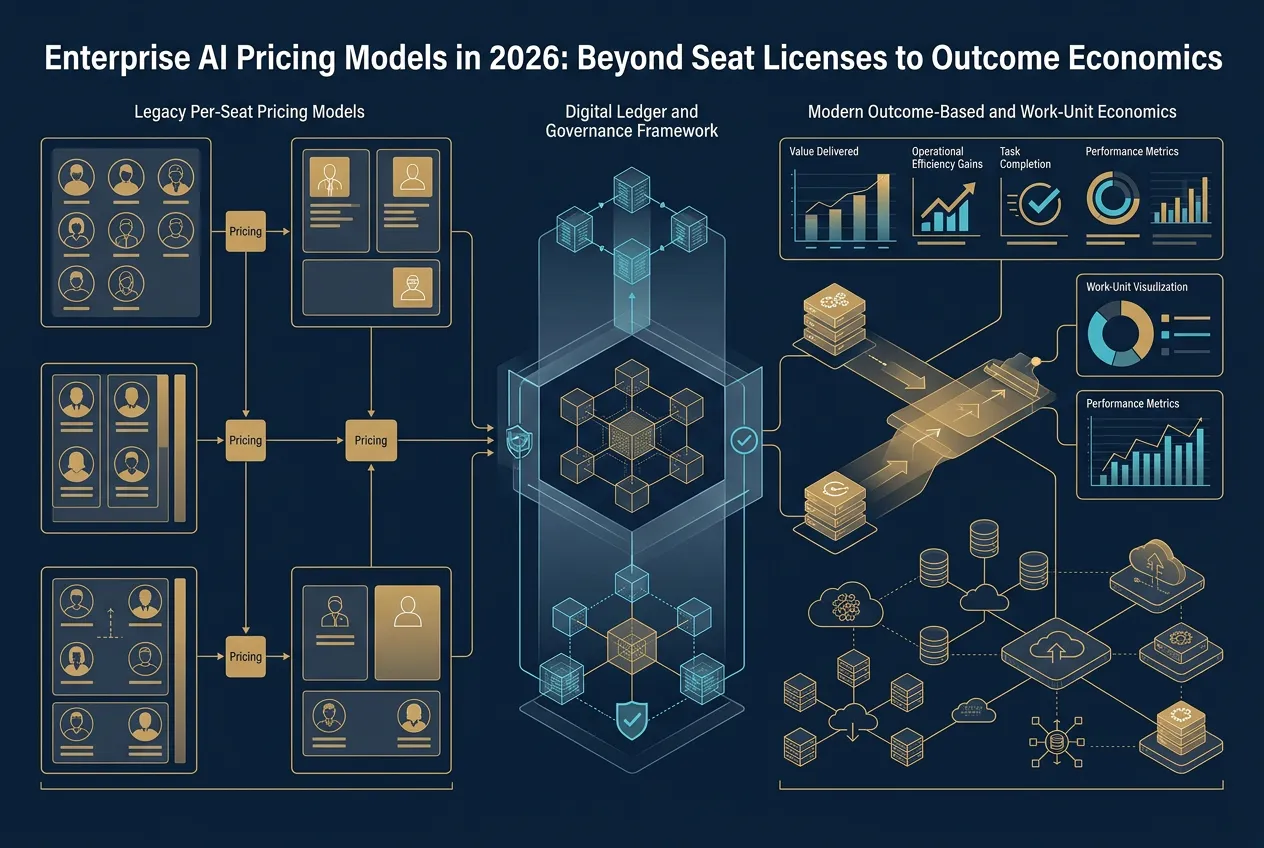
Enterprise AI pricing models are undergoing a structural realignment in 2026 as corporate procurement heads, General Counsels, and Chief Information Officers reject opaque raw token consumption and shelfware-inducing per-seat subscriptions in favor of outcome-based work-unit economics. Organizations shifting from exploratory copilots to multi-turn agentic workflows discover that sustainable enterprise adoption requires predictability, governance caps, and direct correlation between software spend and completed business deliverables.
Enterprise procurement and corporate legal operations have encountered a persistent structural tension between legacy enterprise SaaS contracts and the realities of agentic compute. For decades, enterprise software budgeting relied on predictable annual seat licenses—paying fixed recurring fees per employee regardless of whether an end user logged in daily or once a quarter. But as specialized legal, financial, and operational systems incorporate agentic architectures that autonomously plan, query databases, execute multi-step tools, and generate complex deliverables, raw seat models create misaligned vendor incentives while raw token billing exposes enterprise balance sheets to unbounded financial volatility.
In response, enterprise buyers in 2026 are renegotiating vendor commitments, implementing strict cost-governance guardrails, and establishing hybrid commercial frameworks that tie software spend directly to verifiable business outcomes.
Why Are Per-Seat SaaS Licenses Failing in the Agentic AI Era?
Per-seat pricing models fail in agentic environments because an AI system's core economic value is delivered through autonomous task execution rather than human interface occupancy. When an organization deploys autonomous agents capable of reviewing complex outside counsel invoices, drafting compliance disclosures, or executing end-to-end procurement reconciliations, measuring value by the number of human logins fundamentally mismeasures work completed.
Historically, legal tech and corporate productivity vendors priced enterprise generative AI platforms at approximately $1,200 to $3,000 per user per year on strict annual enterprise agreements. However, enterprise adoption data reveals two acute failure modes under this structure:
- The Shelfware Trap: Enterprise buyers purchase enterprise-wide seat tiers to satisfy volume minimums, only to find that deep utilization concentrates within a specialized power-user cohort. The remaining licenses generate negligible ROI while inflating the total cost of ownership.
- Disincentive for Automation: When vendors charge per human seat, automating entire operational steps creates a pricing paradox. If an enterprise uses autonomous workflows to handle repetitive intake or triage, the vendor's traditional commercial model penalizes the customer for reducing human touchpoints.
Consequently, enterprise procurement departments are actively dismantling blanket per-seat mandates in favor of commercial structures that scale with delivered operational leverage.
What Are the Hidden Risks of Unbounded Raw Token Billing?
While moving away from fixed seat licenses is necessary, replacing them with unmetered, passthrough raw token billing introduces severe operational and budgetary hazards for corporate finance teams. In an agentic system, token consumption is non-linear and inherently unpredictable.
Unlike single-turn conversational chatbots where an input prompt generates a proportional output response, production agentic architectures execute iterative reasoning loops. An autonomous agent tasked with analyzing a complex vendor contract may perform initial document parsing, issue contextual vector queries, execute external API tool calls, evaluate intermediate outputs against policy constraints, and self-correct through recursive reflection before producing a finalized memorandum.
A single complex business query can trigger dozens of model invocations, multiplying context window consumption by an order of magnitude. If an unexpected recursive retry loop or an inefficient subagent topology occurs, an enterprise on raw token billing absorbs sudden cost spikes without an advance guarantee of task completion.
To prevent these budgetary overruns, corporate IT and procurement committees are requiring software vendors to implement:
- Granular Spend Quotas: Hard administrative caps configured at the departmental, project, and matter levels.
- Circuit Breakers for Execution Loops: Automatic termination thresholds that interrupt recursive agentic retries when intermediate progress stalls.
- Zero Data Retention (ZDR) Commitments: Contractual isolation ensuring that high-volume enterprise token traffic is never retained or utilized for foundation model training.
How Are Enterprise Buyers Structuring Hybrid and Outcome-Based AI Pricing?
To balance cost predictability with fair compute allocation, the prevailing standard in 2026 enterprise software procurement has consolidated around hybrid commercial frameworks. Rather than choosing between rigid seats or volatile token streams, enterprise contracts increasingly combine three distinct tiers:
| Contract Component | Commercial Mechanism | Operational Function |
|---|---|---|
| Base Platform Fee | Predictable Annual / Monthly Base | Covers infrastructure hosting, tenant isolation, SOC 2 / ISO compliance, administrative consoles, and continuous security maintenance. |
| Metered Work Units (PWUs) | Standardized Task / Deliverable Credits | Measures discrete, successful agentic operations (e.g., analyzed brief, reviewed invoice, validated regulatory disclosure) rather than raw prompt tokens. |
| Volume Overage Safeguards | Pre-Negotiated Drawdown & Rollover | Provides committed credit pools with volume discounts, multi-period rollover allowances, and automated soft-warning alerts before hard stops. |
Under this outcome-oriented framework, enterprise buyers align vendor compensation directly with operational milestones. For corporate legal departments, this model closely mirrors modern billing guidelines that restrict outside counsel from charging standard hourly rates for mechanical drafting while encouraging alternative fee arrangements (AFAs) anchored to verified deliverables.
What Key Metrics Measure True Enterprise AI Total Cost of Ownership?
Evaluating enterprise AI investments requires corporate finance and operational leaders to look beyond the initial subscription sticker price. True Total Cost of Ownership (TCO) encompasses the complete operational ecosystem required to sustain reliable production deployments:
- Cost per Completed Business Deliverable: Measuring expenditure per successfully resolved matter, reviewed agreement, or finalized filing rather than cost per thousand tokens.
- Human Review and Exception Handling Time: The labor cost of qualified professional oversight required to validate automated drafts, correct hallucinations, and manage edge-case escalations.
- Integration and Pipeline Maintenance: Ongoing engineering overhead necessary to maintain schema synchronization across enterprise repositories, databases, and document management systems.
- Security, Auditability, and Compliance Overhead: The expense of continuous logging, regulatory disclosure tracking, and privilege boundary verification required under emerging corporate governance mandates.
Leading organizations that audit these metrics discover that a platform delivering higher per-task completion reliability—even at a premium unit price—significantly outperforms low-cost models that suffer from high exception rates and frequent manual rework.
How Can Organizations Prepare Their Procurement Strategies for Next-Generation AI?
Enterprise leadership can establish immediate fiscal and operational discipline across their AI procurement pipelines by enforcing four strategic procurement principles:
- Mandate Outcome-Linked Service Level Agreements (SLAs): Insist on contract terms that define performance by task completion accuracy and latency thresholds rather than raw platform uptime alone.
- Demand Transparent Work-Unit Logging: Require vendor dashboards to report granular audit logs detailing which agents, tools, and execution steps contributed to each unit of consumed spend.
- Align Internal Legal and Procurement Guidelines: Ensure that corporate outside counsel guidelines and vendor procurement policies maintain consistent standards regarding AI billing, automated invoice auditing, and zero data retention guarantees.
- Conduct Regular Workload Audits: Quarterly reviews comparing realized cycle-time reductions and labor savings against contractual software commitments to identify underutilized tools and reallocate budget to proven high-leverage workflows.
By retiring legacy seat models and insulating operational budgets from unbounded token volatility, enterprise organizations in 2026 establish the commercial foundation required to scale agentic automation with confidence, transparency, and provable economic return.
Related Insights on Enterprise Adoption and Governance
- Enterprise AI Permission Readiness: Discovery Is Not Access
- Enterprise Shadow AI Governance: Modernizing Corporate Procurement in 2026
- Enterprise AI Implementation: Overcoming the ROI Gap and Redesigning Pricing Models
- Outside Counsel Guidelines AI Billing in 2026
Why is raw token-based pricing problematic for enterprise procurement?
Raw token pricing exposes enterprise budgets to unpredictable financial volatility because multi-turn agentic workflows consume non-linear compute through tool execution, vector retrieval, and recursive reasoning loops. Without standardized work units and administrative spending limits, single complex queries can result in sudden, uncontrolled cost spikes.
What is the primary advantage of work-unit or outcome-based AI pricing?
Outcome-based work-unit pricing directly correlates enterprise software expenditure with verified operational deliverables—such as a completed document review, finalized audit reconciliation, or approved compliance draft—eliminating paying for inactive employee seats while ensuring vendors are incentivized to optimize task completion rather than raw compute volume.
How do modern Outside Counsel Guidelines impact enterprise AI pricing models?
Corporate legal departments are actively updating Outside Counsel Guidelines to restrict law firms from billing standard hourly rates for routine tasks automated by generative AI. This pressure accelerates the broader enterprise shift toward alternative fee arrangements, fixed deliverables, and transparent technological cost accounting.