Enterprise AI vendor change control means reassessing an approved AI workflow when its capabilities, access, or operating conditions materially change. A procurement decision should establish a baseline—not become a lifetime permission slip. The practical goal is to connect each consequential change to affected business boundaries, proportionate testing, and a named release decision, while allowing routine maintenance to proceed within an agreed scope.
Why is vendor approval not the end of an AI rollout?
An approval can describe a particular use case, audience, repository, and action scope. It does not logically establish that every future combination of those elements is acceptable. A new tool connection can expand the systems a workflow reaches. A changed permission can expand the audience or records it can access. A model update can justify retesting behaviors on which the organization relies, even when the interface looks unchanged.
These are implementation considerations, not findings that a particular vendor has changed its product or caused an incident. They expose a basic decision problem: the evidence supporting yesterday's approval may not answer today's question.
The distinction is especially useful for enterprises and law firms adopting assistants that can act, rather than only return text. A workflow approved to draft a response is not automatically approved to send it. A workflow approved for one repository is not automatically approved for a newly connected repository.
The question is not whether every update requires starting procurement again. It is whether the organization can explain which assumptions still hold—and who decides when an assumption no longer does.
What do the primary sources actually establish?
NIST's official AI RMF development page records the release of AI Risk Management Framework 1.0 on January 26, 2023, and describes its intended voluntary use. Its Playbook organizes suggested actions around Govern, Map, Measure, and Manage. Those resources provide a risk-management vocabulary; they do not certify a deployment or make the workflow proposed here mandatory.
OWASP's December 9, 2025 announcement of the Top 10 for Agentic Applications identifies Tool Misuse, Identity & Privilege Abuse, and Agentic Supply Chain Vulnerabilities among its risk categories. These categories help explain why procurement should examine an agent's tools, identity, and dependencies—not only the quality of its written answers.
The change-control approach below is the author's implementation analysis informed by those resources. Neither source is presented as prescribing this exact review process, a universal contract clause, or a guaranteed security outcome.
What belongs in the approved baseline?
Record the business decision in a form the workflow owner and the technical team can both understand. The baseline should identify what was approved, the evidence supporting that approval, and the limits of that evidence.
Useful elements include:
- Purpose and audience: the task, intended users, and accountable business owner.
- Information boundary: approved repositories, data types, and applicable access assignments.
- Action boundary: what the assistant may read, draft, change, or send, and what still needs a person's approval.
- Dependencies: relevant tools, integrations, service components, and known version information.
- Acceptance evidence: expected behavior, observed behavior, unresolved exceptions, and test limitations.
- Change ownership: who receives notices, assesses consequences, and releases an affected workflow.
A vendor name or purchased subscription alone is not an adequate description of the approved workflow. Nor should the record imply that every internal component has been independently inspected when that information was not available.
Where a vendor does not expose a version or dependency detail, record that limitation. Build the decision around observable behavior and the information actually available rather than inventing traceability.
Which changes should trigger a fresh review?
Materiality should follow consequence, not the vendor's marketing label. A release called minor may warrant attention if it changes access or external actions. A visible interface refresh may be low consequence if the approved boundary remains unchanged.
The following table proposes review triggers. It does not state that these changes always occur together or that every organization needs identical controls.
| Change | Decision to revisit | Example acceptance check |
|---|---|---|
| New repository or integration | Is the new information scope approved? | Allowed and disallowed retrieval scenarios |
| Wider permissions or a different identity | Does the intended audience still match access? | Role-specific access and revocation tests |
| New external action | May the workflow commit this action? | Approval gate and cancellation behavior |
| Model or workflow update | Do relied-on behaviors still hold? | Representative tasks and failure cases |
| Changed dependency | Is the prior assessment still applicable? | Dependency-specific scope and behavior checks |
| Changed monitoring or retention behavior | Is required evidence still available? | Inspection of the affected records and settings |
An enterprise can also define a maintenance lane: changes permitted without a new release decision because they remain within a documented envelope. The owner should define that envelope before relying on it, not after an inconvenient change arrives.
How can review stay proportionate rather than become a bottleneck?
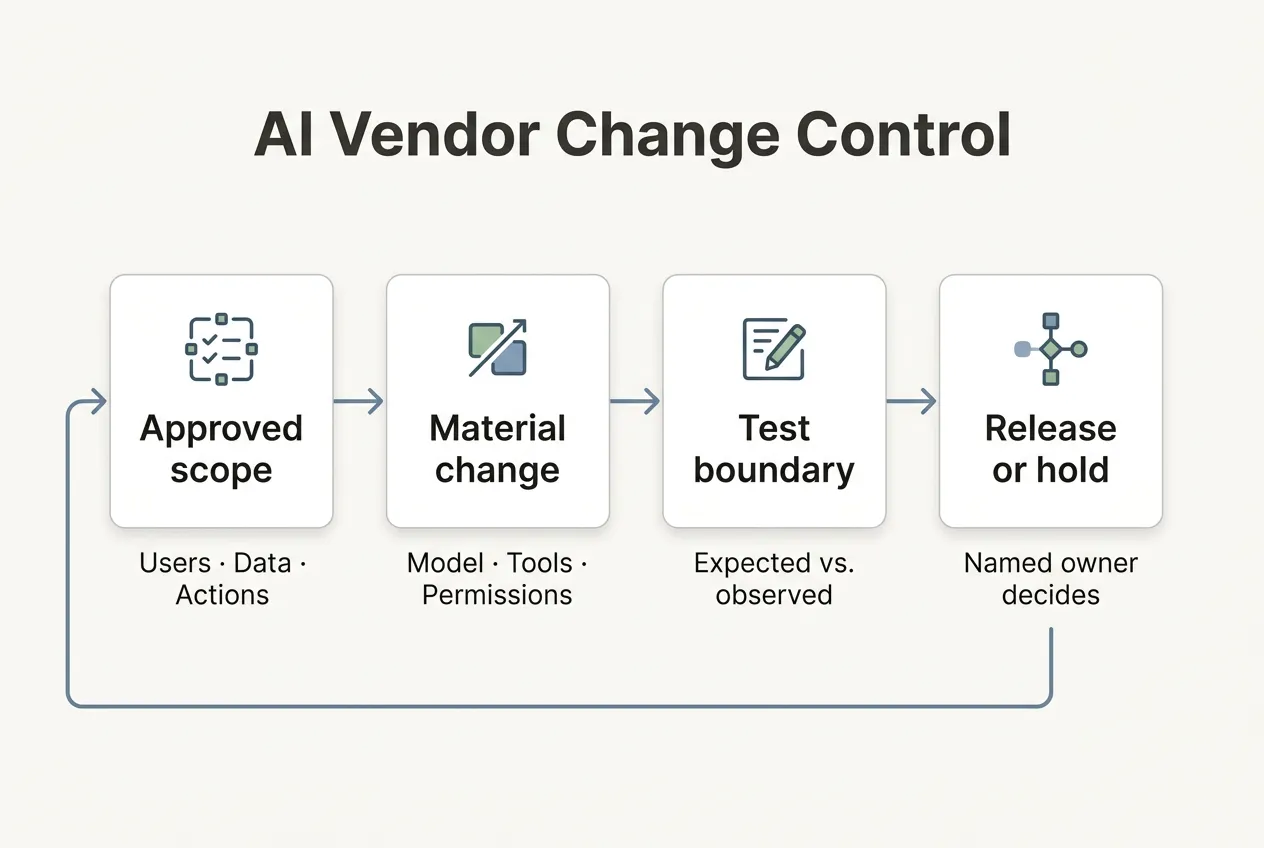
Conceptual implementation diagram: approved scope → material change → boundary testing → release or hold → refreshed baseline. This is not a product screen, audit certification, or measured security result.
Start with the affected boundary. A new sending capability calls for attention to recipients, authorization, and what happens before an action becomes irreversible. A repository addition calls for attention to information scope and access. A model update calls for attention to the behaviors on which the approved workflow depends.
Then distinguish targeted review from broader reassessment. When a change is contained and its effects are understood, the organization may be able to test that boundary without repeating unrelated work. When dependencies or consequences are unclear, a wider review may be warranted.
This is a proposed decision principle, not a promise that testing can reveal every effect. An absence of observed failure is narrower than proof that no failure is possible. Preserve test conditions and limits alongside results.
A useful release record states what changed, what was tested, what remained out of scope, who accepted any exceptions, and what conditions require another look. It should be possible for a later reviewer to reconstruct the decision without relying on someone's memory.
What should a hypothetical review look like?
Consider a hypothetical law firm that has approved an assistant to draft internal status summaries using a restricted set of records. A later integration introduces the ability to email a summary outside the firm.
The relevant change is not simply that a connector was added. The workflow can now commit an outward action. The review would revisit the approved recipients, the identity used to send, the release requirement, and whether the summary includes information beyond its intended audience.
Representative tests could use fictional records and controlled recipients to check that an unapproved send is held, a cancelled draft does not go out, and the record distinguishes drafting from delivery. The firm would still need to determine its own professional, confidentiality, and contractual obligations with qualified reviewers. This example does not resolve those obligations or authorize sending any client information.
If the sending boundary is not understood, hold that capability rather than describing the entire assistant as either safe or unsafe. Keep any unaffected activity within its previously approved scope only if that separation is actually available and confirmed.
What should buyers ask vendors before expansion?
Ask practical questions about what can be learned and controlled:
- How are consequential changes communicated, and to whom?
- Which model, tool, permission, and workflow details can the customer observe?
- Can new capabilities be kept off until the customer approves them?
- What testing options exist before an affected capability reaches production?
- Can the customer pause that capability, revoke its access, or return to a known configuration?
- What evidence is available after a changed workflow acts or fails?
These are evaluation questions, not assertions that every vendor offers each mechanism. Some services may not expose rollback or component-level controls. In that case, identify the constraint and decide whether narrower scope, additional review, or a different implementation is appropriate.
Any contractual commitments should be tailored by the organization's legal and procurement reviewers. This article does not supply ready-to-sign terms or determine what notice, audit, liability, or termination rights a buyer has.
Where does the competitive advantage come from?
The strategic opportunity is a repeatable expansion decision. Clear baselines and change ownership give teams a way to distinguish a bounded update from a new authorization request.
That can be more useful than an undifferentiated approved-vendor list. It connects adoption to the actual workflow: who can access what, which actions can occur, and what evidence supports the current decision.
This is a strategic recommendation, not a measured claim of faster procurement, lower incident rates, or improved return on investment. Its value should be assessed in the organization's own implementation rather than assumed from a framework name.
Frequently asked questions
Does every AI update require a complete procurement review?
Not necessarily. A proposed approach is to classify the consequences, test affected boundaries, and broaden review when dependencies or impacts are unclear. The organization defines and owns that decision.
Does NIST AI RMF certify a vendor or deployment?
No. NIST describes the framework as intended for voluntary use. Using its vocabulary is not certification that a system passed a particular assessment.
Is change control only about model versions?
No. Tools, repositories, identities, permissions, external actions, and workflow conditions can also change the assumptions supporting approval.
What if a vendor does not offer rollback?
Record the limitation. Assess available options such as holding the affected capability, narrowing scope, or performing additional review. Do not claim that a rollback path exists without checking it.
Is this a complete legal or security assessment?
No. It is general implementation analysis. A deployment needs review of its actual configuration, information, contracts, risks, and applicable obligations.
Related reading
Enterprise AI Permission Readiness: Discovery Is Not Access explains the difference between visibility and authorization. Enterprise Shadow AI Governance covers procurement ownership. For the distinction between a successful tool call and a verified business result, see Agent Tool Contracts: Valid JSON Is Not Verified Work.
Explore Prest0 for the platform's own information.
Sources and scope
Primary sources checked October 26, 2026:
- NIST, AI RMF Development: framework release date and intended voluntary use.
- NIST, AI RMF Playbook: Govern, Map, Measure, and Manage functions.
- OWASP, Top 10 for Agentic Applications announcement: publication date and named tool, identity, and supply-chain risk categories.
No customer environment was tested for this article. The baseline, material-change triggers, example, and review process are the author's recommendations—not claims that a source mandates the exact procedure or that any vendor passed it.
This information is for general informational purposes only and does not constitute legal advice.