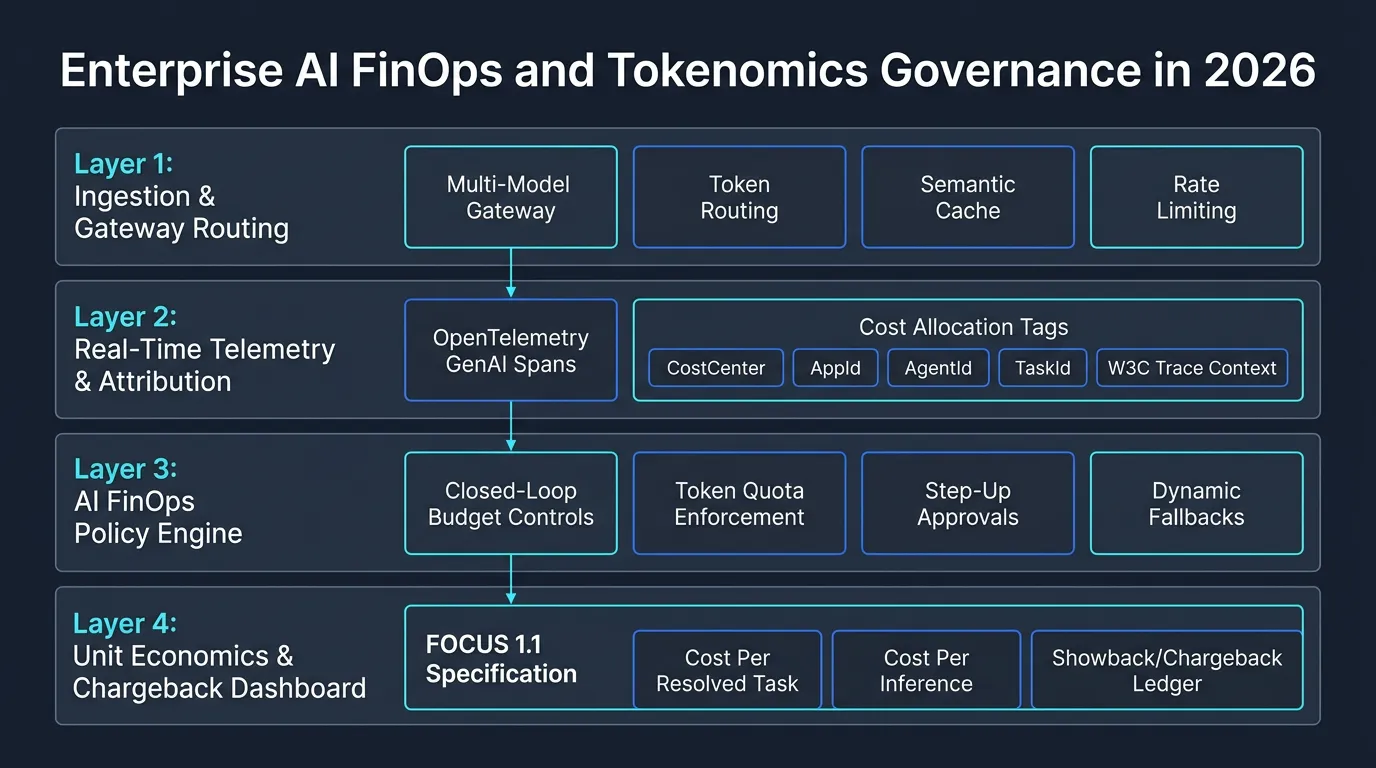
Enterprise AI FinOps and token economics establish the operational and financial governance framework required to measure, attribute, and control artificial intelligence inferencing spend across multi-model deployments in 2026. By moving beyond raw token consumption meters toward standardized FinOps Open Cost and Usage Specification (FOCUS 1.1) chargeback schemas, real-time OpenTelemetry GenAI span attribution, semantic cache tiering, and closed-loop budget circuit breakers, enterprises align autonomous agent execution costs directly with verified business outcomes.
Why do legacy cloud FinOps models fail in enterprise AI deployments?
Traditional cloud Financial Operations (FinOps) frameworks were engineered for predictable, deterministic infrastructure primitives: virtual machine instance hours, provisioned gigabytes of block storage, and predictable network egress thresholds. In contrast, enterprise generative AI and autonomous agentic systems introduce non-deterministic, dynamic inferencing workloads characterized by exponential consumption variance.
A single autonomous agent trajectory executing a complex research or reconciliation workflow may consume between 5,000 and 500,000 tokens across reasoning loops, dynamic tool invocations, recursive planning passes, and self-correction retries. In production environments, treating foundation model API consumption as an aggregated, unallocated IT infrastructure expense creates severe governance vulnerabilities:
- Unallocated Shared Pool Spend: Departmental teams route unmetered inferencing calls through monolithic corporate API keys, obscuring cost attribution and preventing business units from calculating accurate return on investment (ROI).
- Cascading Token Loops: Autonomous agents caught in reasoning loops or processing malformed tool outputs rapidly exhaust monthly departmental inferencing allowances within hours without triggering legacy cloud billing alerts that operate on 24-hour reporting delays.
- Context Window Expansion Inefficiencies: Prompt engineering anti-patterns that continuously dump unbounded conversational transcripts, zero-shot system instructions, and massive vector retrieval chunks into every reasoning step dramatically inflate input token costs without measurable gains in task accuracy.
- Vendor Price Asymmetries: Blended API pricing across proprietary frontier reasoning models, high-throughput mid-tier models, and self-hosted open-weights instances creates severe cost variances ranging from $0.15 to $75.00 per million tokens.
To maintain sustainable unit economics, enterprise finance and engineering organizations are standardizing on AI FinOps—a specialized discipline combining granular cryptographic attribution, runtime gateway controls, and standardized cost allocation ledgers.
How does FOCUS 1.1 standardize AI token cost attribution and chargeback?
The FinOps Foundation's FinOps Open Cost and Usage Specification (FOCUS) establishes a vendor-neutral, standardized billing data specification designed to normalize cloud and AI cost data across heterogeneous providers. Under FOCUS 1.1, enterprise AI consumption is normalized into structured billing records that map raw API usage directly into organizational accounting hierarchies.
| FOCUS 1.1 Column Attribute | Description & Schema Mapping | Enterprise AI Governance Impact |
|---|---|---|
ChargePeriodStart / End | ISO 8601 UTC microsecond timestamp | Enables precise correlation with application telemetry spans |
ProviderName | Foundation model provider or hosting cloud | Normalizes hybrid multi-cloud and proprietary API vendors |
ServiceName | Standardized AI inferencing or embedding tier | Distinguishes text generation, multimodal processing, and embeddings |
SubAccountName | Consuming business unit or client cost center | Drives automated departmental chargeback and general ledger journal entries |
UsageQuantity & Unit | Exact count of PromptTokens and CompletionTokens | Separates input token processing costs from output generation premiums |
BilledCost | Net contractual currency amount after tier discounts | Delivers auditable GAAP financial reporting for capitalized AI workloads |
Tags['AgentId'] | Unique cryptographic autonomous agent identifier | Attributes inferencing cost directly to individual automated workflows |
Tags['TaskId'] | Operational transaction or matter reference ID | Calculates exact unit economics per completed business transaction |
By binding FOCUS 1.1 metadata tags at the API gateway layer, enterprise FinOps teams eliminate reconciliation disputes between engineering and accounting, enabling automated internal invoice generation and client-billable disbursement recovery.
How do enterprise AI gateways enforce real-time FinOps and unit economics?
Governing enterprise AI tokenomics requires deploying an intelligent, policy-driven API gateway situated between consuming applications and underlying foundation model endpoints. Rather than relying on post-billing monthly reviews, the gateway enforces real-time cost, routing, and quota policies at the network boundary.
Incoming Request (App / Agent)
       │
       ▼
┌────────────────────────────────────────────────────────┐
│               Enterprise AI FinOps Gateway             │
├────────────────────────────────────────────────────────┤
│ 1. Metadata Injection: CostCenter, AppId, AgentId      │
│ 2. Semantic Cache Check (Exact Hash & Vector ANN)     │
│ 3. Policy Engine: Rate Limits, Daily Budget Balances   │
│ 4. Adaptive Model Routing (SLO / Cost Optimization)   │
└────────────────────────────────────────────────────────┘
       │                                  │
[Cache Hit: $0.00]             [Cache Miss: Execute]
       │                                  ▼
       │                    ┌────────────────────────────┐
       │                    │ Foundation Model Endpoint  │
       │                    │ (OpenTelemetry Telemetry)  │
       │                    └────────────────────────────┘
       │                                  │
       ▼                                  ▼
┌────────────────────────────────────────────────────────┐
│      Telemetry Collector & FOCUS 1.1 Allocation        │
└────────────────────────────────────────────────────────┘
An enterprise AI FinOps gateway executes four critical governance functions:
1. Mandatory Context and Cost Tagging
The gateway rejects any inference request lacking standardized HTTP metadata headers, including X-Cost-Center, X-Application-ID, X-Agent-ID, and X-Task-Reference. These headers are injected into OpenTelemetry GenAI distributed tracing spans (gen_ai.usage.prompt_tokens and gen_ai.usage.completion_tokens), ensuring every token consumed across distributed microservices is cryptographically linked to a responsible cost center.
2. Multi-Tier Semantic Caching
To prevent redundant expenditure on identical or semantically equivalent queries, the gateway evaluates requests against a two-tier caching infrastructure:
- Tier 1 (Exact SHA-256 Hash Matching): Bypasses model invocation for identical prompt and system configurations, delivering sub-millisecond responses at $0.00 marginal cost.
- Tier 2 (Vector Approximate Nearest Neighbor Gating): Evaluates semantic similarity against pre-computed prompt embeddings using strict cosine thresholds (typically $\ge 0.94$), reducing redundant retrieval-augmented generation (RAG) inferencing costs by 28% to 45% across repetitive customer-support and document-intake workflows.
3. Closed-Loop Budget Circuit Breakers
The gateway continuously synchronizes against in-memory key-value stores tracking real-time departmental spend against allocated monthly budgets. If an autonomous agent trajectory experiences an anomalous token surge or approaches 90% of its daily threshold, the policy engine executes automated mitigation actions:
- Enforces hard throttling or graceful degradation to smaller, cost-efficient model tiers.
- Requires cryptographic step-up approval tokens from authorized human supervisors before releasing high-cost reasoning model passes.
- Terminates runaway recursive loops via automated execution timeouts.
4. Adaptive Dynamic Model Routing
Not all enterprise tasks require maximum-parameter frontier reasoning models. Gateways implement dynamic routing classifiers that evaluate task complexity, input token length, and latency service level agreements (SLOs). Basic classification, entity extraction, and syntactic reformatting are routed to compact, high-efficiency models, while complex multi-step reasoning and statutory analysis are selectively escalated to frontier reasoning models. In production legal and financial enterprises, adaptive routing lowers overall token expenditure by 35% to 60% while maintaining equivalent output quality.
What metrics define production AI tokenomics?
Measuring enterprise AI value requires shifting executive reporting from gross infrastructure cost to unit economics. Forward-looking chief financial officers (CFOs) and chief artificial intelligence officers (CAIOs) track five standardized unit metrics:
- Cost Per Resolved Task (CPRT): Total blended inferencing, embedding, and tool execution cost required to resolve a customer support ticket, reconcile a vendor invoice, or analyze a contract to completion.
- Cost Per Successful Trajectory (CPST): Total token expenditure across both successful completions and aborted retries, divided by verified successful task outcomes, isolating the financial penalty of model hallucinations and trajectory failures.
- Token Efficiency Ratio (TER): The proportion of completion tokens that directly contribute to the final deliverable versus intermediate internal reasoning scratchpads and discarded tool call retries.
- Cache Hit Cost Avoidance (CHCA): Cumulative gross dollars saved through exact and semantic caching layers relative to baseline direct-to-endpoint inferencing rates.
- Gross Margin Impact (GMI): For software-as-a-service (SaaS) and digital service providers embedding generative AI features, the direct percentage reduction in gross software margin attributable to customer-facing inference costs.
What is the difference between AI FinOps and token economics?
AI FinOps is the operational discipline of tracking, budgeting, allocating, and optimizing artificial intelligence expenditure across enterprise systems. Token economics (or tokenomics) is the broader microeconomic framework that connects token consumption, prompt engineering architecture, model latency, and caching strategies directly to unit profitability and business value creation.
How does FOCUS 1.1 treat AI model costs compared to standard cloud computing?
Standard cloud computing under FOCUS tracks compute capacity primarily through machine hours and provisioned resources. FOCUS 1.1 treats AI inferencing as a dedicated consumption category, tracking distinct prompt and completion token counts, API invocation volumes, model identifiers, and custom organizational tags (AgentId, TaskId) to support granular chargeback and unit-cost accounting.
Can semantic caching compromise data privacy or access controls?
Yes, if improperly architected. In enterprise environments, semantic caches must enforce tenant isolation, role-based access control (RBAC) boundaries, and zero data retention compliance. Cache keys must incorporate the caller's organizational domain, permission context, and security classification to prevent unauthorized cross-tenant data leakage from cached prompt responses.
For related operational and legal frameworks, explore our analyses on Enterprise AI M&A Technical Due Diligence, Enterprise AI Model Deprecation Covenants and Version Pinning, Enterprise AI Service Level Agreements and Drift Gating, and Distributed Agent Tracing with OpenTelemetry.